avatarTiago Forte

Free AI web copilot to create summaries, insights and extended knowledge, download it at here

1040

Abstract

nd of information from any source</li><li><b>flexible</b>, able to work with any project or activity you take on, now and in the future</li><li><b>simple</b>, not requiring any time-consuming maintenance, cataloguing, tagging, or reorganizing beyond a bare minimum</li><li><b>actionable</b>, integrating seamlessly with task management and project management methods</li><li><b>cross-platform</b>, able to be used with any application, now existing or yet to be developed</li><li><b>outcome-oriented</b>, structuring information in a way that supports the delivery of valuable work</li><li><b>modular</b>, allowing different levels of detail to be hidden or revealed, depending on the needs of the current task</li><li><b>opportunistic</b>, in the good sense, taking advantage of work already being performed, instead of requiring dedicated overhead time</li></ul><p id="3bf2">I believe I’ve developed a system for organizing digital information that meets all these requirements. After several years of introducing it to a wide variety of

Options

people, I’m confident that it works. In this post I will attempt to show you how.</p><p id="2312">P.A.R.A. stands for <b>Projects — Areas — Resources — Archives</b>, the four top-level categories that encompass every type of information you might encounter in your work and life.</p><p id="92a6"><a href="https://praxis.fortelabs.co/the-p-a-r-a-method-a-universal-system-for-organizing-digital-information-75a9da8bfb37/"><b><i>This article has moved</i></b></a> <b><i>to the new Praxis blog.</i></b> <a href="https://praxis.fortelabs.co/membership/"><b><i>Sign up here</i></b></a> <b><i>for a free 30-day trial, or subscribe to the <a href="https://www.fortelabs.co/newsletter">newsletter</a> to receive notifications of free articles. You can also follow us on <a href="https://twitter.com/fortelabs">Twitter</a>, <a href="https://www.facebook.com/fortelabs/">Facebook</a>, <a href="https://www.linkedin.com/in/tiagoforte/">LinkedIn</a>, or <a href="https://www.youtube.com/user/simulacrumsquared">YouTube</a>.</i></b></p></article></body>

The P.A.R.A. Method: A Universal System for Organizing Digital Information

By Tiago Forte

PART 1| PART 2 | PART 3 | PART 4 | PART 5

Imagine for a moment the perfect organizational system. One that supported and enhanced the work you do, telling you exactly where to put a piece of information, and exactly where to find it when you needed it.

This system would have to be:

  • universal, encompassing any conceivable kind of information from any source
  • flexible, able to work with any project or activity you take on, now and in the future
  • simple, not requiring any time-consuming maintenance, cataloguing, tagging, or reorganizing beyond a bare minimum
  • actionable, integrating seamlessly with task management and project management methods
  • cross-platform, able to be used with any application, now existing or yet to be developed
  • outcome-oriented, structuring information in a way that supports the delivery of valuable work
  • modular, allowing different levels of detail to be hidden or revealed, depending on the needs of the current task
  • opportunistic, in the good sense, taking advantage of work already being performed, instead of requiring dedicated overhead time

I believe I’ve developed a system for organizing digital information that meets all these requirements. After several years of introducing it to a wide variety of people, I’m confident that it works. In this post I will attempt to show you how.

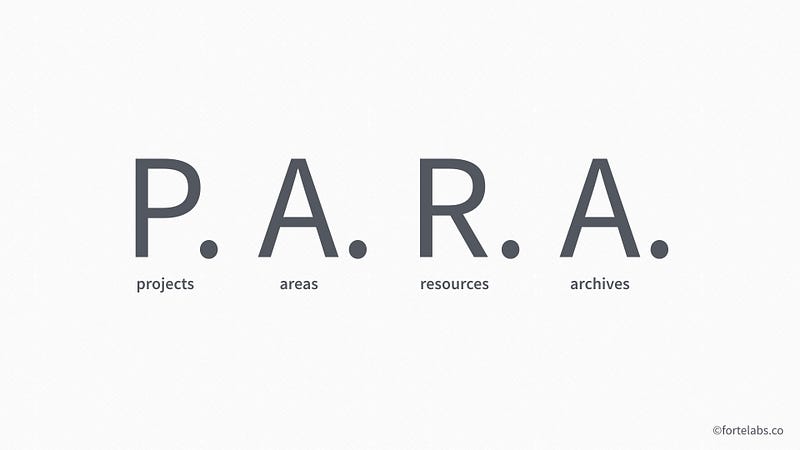
P.A.R.A. stands for Projects — Areas — Resources — Archives, the four top-level categories that encompass every type of information you might encounter in your work and life.

This article has moved to the new Praxis blog. Sign up here for a free 30-day trial, or subscribe to the newsletter to receive notifications of free articles. You can also follow us on Twitter, Facebook, LinkedIn, or YouTube.

Productivity
Project Management
Agile
Knowledge Management
Workflow
Recommended from ReadMedium