‘The Outsiders’ and the Arrogance of Academics
Why it’s dangerous to dismiss popular novels
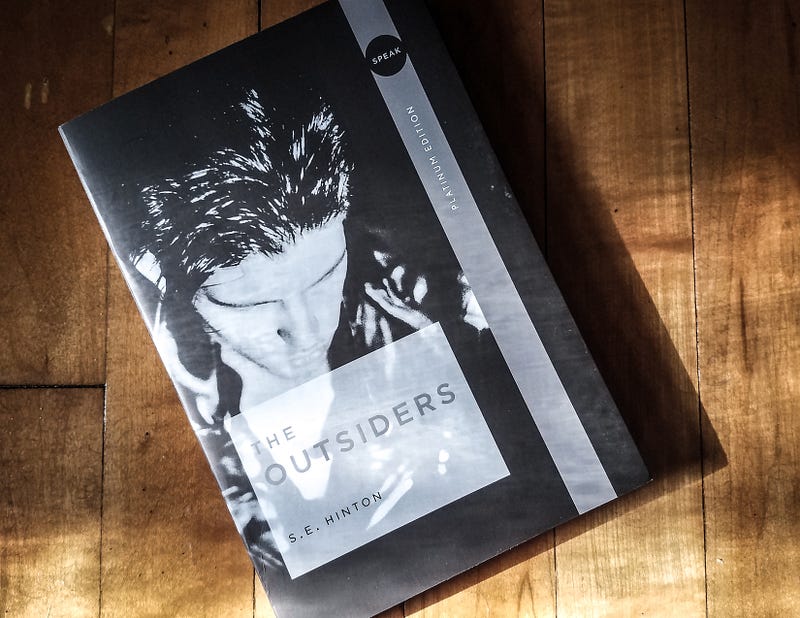
I am the father of two girls aged ten and seven, and one of my greatest joys in my life is reading to them. I try to pick books that appeal to their interests, and I’ve recognized that they have shown a growing curiosity in things like relationships, romance, and high-school life.
I was never a fan of The Outsiders growing up. In fact, I was furious when my eighth grade reading class was assigned the book. At the time, I was only interested in fantasy novels and I did not appreciate an infringement upon my mental space. Looking back, I think I felt I already had to experience enough class struggle and unfair social dynamics in my day to day life. I needed escapism, not more reality.
But things change.
As an adult, one of my main topics of interest is how the literary community can be so blatantly hypocritical and stunningly elitist. After revisiting The Outsiders, I can see why it has had such an impact on readers of all ages, and I think the book deserves a higher regard than it currently enjoys. The Outsiders is a flawed novel, but it has flashes of greatness that cannot be ignored.
Critical dismissal
As a writer, there are two types of rejection letters that you receive. Some editors are polite:
“Thanks for the submission, but this piece doesn’t work for us.”
Some are discourteous:
“You’re a terrible writer and you should never submit anything anywhere ever again.”
The inclination to be needlessly cruel is prevalent in the writing community, and it shapes our whole literary concept. The result is that even sincere critics seem to think they have to adopt a petulant tone with unnecessary disparagement even in a critical essay. Take this comment for example:
Hinton wrote The Outsiders when she was 16, which is a double-edged sword. On one hand, it doesn’t just approximate the perspective of an adolescent — it’s actually written by someone who would understand that point of view exceedingly well. At the same time, it’s rough and shoddy in its technical aspects. It’s a first book that reads like an extended diary entry. The narrative conceit is that Ponyboy writes his harrowing story down for a school assignment, so the stream-of-consciousness passages and timeline cross-cutting make sense, but it’s still a noticeably juvenile work, for better and worse. — Kevin McFarland, The A.V. Club
There is something inherently wrong approaching The Outsiders from this perspective. First of all, there is nothing wrong with a book being “juvenile,” and even though the author says “for better and worse,” I believe the word is used here with a negative connotation.
The thoughts and feelings of adolescents are just as worthwhile as the thoughts and feelings of people who are different than us because of gender, race, or culture. A novel that accurately represents the mindset of a group of people we don’t fully understand should be treated with respect.
Perhaps the components this critic called “rough and shoddy” are essential to making The Outsiders a legitimate work for young adult readers. If that’s the case, then those elements need to be celebrated, not maligned.
There is also a double standard. Many of the elements that appear in The Outsiders are also present in works that enjoy a higher stature. When a novel becomes “anointed” by the literary community the “rough and shoddy” aspects don’t go away, the critics simply stop harping on them.
The opening lines
It had been years since I’d read The Outsiders when I considered it for my daughters. Out of curiosity, I jumped onto Amazon and decided to take a look at the opening paragraph:
When I stepped out into the bright sunlight from the darkness of the movie house, I had only two things on my mind: Paul Newman and a ride home. I was wishing I looked like Paul Newman — he looks tough and I don’t — but I guess my own looks aren’t so bad. — S.E. Hinton
I came away feeling impressed. I couldn’t recall that I’d read anything to my kids in the first person, and I thought they’d find it impactful. Also, I thought it interesting that Hinton had elected to select Newman as the actor to reference on the first page.
The Outsiders was published in 1967, and Hinton managed to identify arguably the most iconic actor of her time. With the benefit of hindsight, it’s easy to make the assumption that this was an easy choice. But consider the actor you would pick if you were to write similar lines in 2020. It’s really not so easy to casually toss out a name that you could expect to command even greater stature fifty years after publication.
Mentioning Newman is also a terrific device for setting the time frame of the book. I instantly felt this was a story I wanted to explore. For those who are compelled to debate the value of an opening line, this is a case study of one that led directly to a purchase on my part.
‘The Catcher in the Rye’
As I started to read The Outsiders, I began to get the impression that I was reading a sort of “rough papers” version of The Catcher in the Rye. I’ve long had a great respect for Catcher. For many people, I think Catcher represents the first book that goes beyond storytelling and enters the realm of literature.
That being said, there is certainly a greater level of elitism in Catcher and a greater level of authenticity in The Outsiders. The two novels are very much mirror images of one another. Catcher features a sixteen-year-old protagonist and was published in 1951 when J.D. Salinger was thirty-two years old. The Outsiders was published in 1967 and features a fourteen-year-old protagonist written by a sixteen-year-old.
Clear influence
Hinton most certainly was aware of Salinger. The structure of The Outsiders is similar to Catcher in many ways, particularly in the narrative voice and the character dynamics. I don’t mean that as a criticism, because The Outsiders aspires to more than just a rehash of the social commentary inherent to its predecessor.
The representation of class structure present in The Outsiders is almost wholly absent in Catcher. Caulfield is an entitled rich kid secure in the knowledge that he can prance from prep school to prep school no matter how many times he gets expelled. Ponyboy Curtis, on the other hand, is fundamentally aware that he has no recourse if he makes a mess of his life.
Both Caulfield and Curtis exhibit the same kind of desperation, but their experiences are miles apart.
Grounds for further study
It’s interesting that Salinger strives to replicate the authentic speech of a sixteen-year-old, while Hinton strives to replicate the literary qualities of Salinger.
Because Hinton was 16 when she wrote The Outsiders, her book represents a more authentic take on the adolescent voice than Catcher.
Hinton doesn’t have the technical polish of Salinger, but some of Salinger’s polish has the effect of eroding the authenticity. There is a very interesting give and take between these two books and the choices made by the authors throughout the two separate narratives.
Hinton’s career and stature
I do not envy the pressure Hinton must have felt after the tremendous success of The Outsiders. Her next book, That Was Then, This is Now, came almost four years later, and suffered from the almost impossible expectations that had built up in the intervening time.
I’ve found very little academic work dedicated to tracing Hinton’s development as a writer in her subsequent novels. It’s almost as if the literary community looks at Hinton and says, “She’s not the prodigy writer, I’m the prodigy writer.” Then they cross their arms, hunch their shoulders, and wait for their latest rejection slip.
But let’s get something straight. The Outsiders is a remarkable achievement for an author of any age. The fact that it was produced by a sixteen year old makes it somewhat miraculous. In many ways, it is a love letter to The Catcher in the Rye, but in its innocence it reveals how Catcher might not be fully worthy of the adoration it receives.
What can we learn from ‘The Outsiders?’
I fully admit that part of me feels an inclination to dismiss The Outsiders, but at the same time I wonder if that’s a true reaction or a result of the entitlement that got programmed in during the course of my education.
Too often it seems to me that academics try to impose their will on what is perceived to be great literature. I understand the argument that we need to pay attention to the opinion of experts. At the same time, there is so much arrogance within academia that there should also be a mechanism for a reality check.
It is dangerous to dismiss our own perceptions and never challenge the opinions of academics. What would stop them from anointing their own writing as emblematic even though they only sold three copies of their work and those were to close friends and relatives? Any true process of evaluation has to assign some degree of value both to public and critical reception.
Popular novels have value
It is absurd to dismiss a novel that has stood the test of time and achieved a massive following. In fact, doing so risks transforming the literature of our society into just another form of propaganda.
“You cannot fool all the people all the time.” — Abraham Lincoln
I’m not saying that The Outsiders is my favorite book. In fact, I’m unlikely to ever read it again. However, the novel has an indisputable power in how it establishes a lasting impression. Hinton captured some fragment of truth in The Outsiders. I can’t fully articulate what, but that failing is mine and not hers.
The importance of castoff literature
The Outsiders is a highly appropriate work to use as a case study of how our academic community can be too rigid in setting its parameters for what constitutes literary achievement. It’s appropriate that, like the characters in the novel, the book itself is often pushed aside, ignored, and mistreated.
If you had to choose between the catalog of films that were awarded best picture, and the ones that were not, you’d find a much better selection among those that did not take the top honor. There are more of them, for one thing, and oftentimes true influence cannot be judged until years or decades after the initial release.
Politics and changing social norms often transform our perception of art. As individuals who are dedicated to the discovery and celebration of literature, we cannot be too quick to dismiss popular novels and the power they have to move the public. Our work as writers is to capture the imaginations of readers. We can’t afford to be dismissive of the novels that do just that.


