avatarRebecca Sealfon

Free AI web copilot to create summaries, insights and extended knowledge, download it at here

2945

Abstract

caption>Republican Dwight Eisenhower with Democrat Lyndon Johnson. Johnson served as Senate Majority Leader while Eisenhower was President. He later became President himself and was known for signing civil rights laws. Image from <a href="https://static1.businessinsider.com/image/5a8203eed03072f9008b4661-1200/lyndon-johnson-visited-former-president-dwight-d-eisenhower-in-june-1968-at-walter-reed-army-hospital-in-washington-where-eisenhower-was-recuperating-from-a-heart-attack.jpg">https://static1.businessinsider.com/image/5a8203eed03072f9008b4661-1200/lyndon-johnson-visited-former-president-dwight-d-eisenhower-in-june-1968-at-walter-reed-army-hospital-in-washington-where-eisenhower-was-recuperating-from-a-heart-attack.jpg</a></figcaption></figure><p id="56ce">Midcentury America was also a historical anomaly, in the extent to which Americans consumed the same media. Television only had a few channels and needed to cater to the least common denominator. Print newspapers and magazines were read by many people in the same locale, and some had a wide national subscription. Print books were better for catering to more niche interests. However, they generally needed a sizable market to be sold in bookstores or offered in the library. Today, the Internet allows each person to receive their own information feed. It is easy to receive a steady stream of ever-more-extreme posts, incendiary tweets, and unverified fringe “news.” Despite being able to travel easily and communicate much better, Americans often seem to be fighting each other instead of working to take care of each other.</p><p id="f113">Which type of country will we wake up to, once the dust of the election settles? Will we wake up to a country that is focused on finding common ground, as America was in the mid-twentieth century? Or will we wake up to a country at loggerheads, as America was during the Civil War? In order to stop the polarization and incitement, the first step is to recognize it as a problem. Divided over what are appropriate mores for our speech, we have yet to develop a language of multi-partisanism.</p><p id="814a">In this respect, we can learn from another iconic conflict that has begun to divide America — Israel-Palestine. In the U.S., the challenge is actually greater in certain respects than it is in Israel-Palestine. In Israel-Palestine, the lines of conflict are largely ethnoreligious. This means there are significant obstacles to connecting ideologically similar people, the moderates, and convincing them they are actually on the same side. In addition, the conventional description of Israel-Palestine as a high-priority international conflict to resolve means greater awareness of the problem. A language of peace has been developed. In the U.S., the high levels of polarization are quite new, too new for us to have developed a standard language describing their toxicity.</p><figure id="1ae3"><img src="https://cdn-imag

Options

es-1.readmedium.com/v2/resize:fit:800/0*A9XMFuDfRA9uMOIL"><figcaption>Photo by <a href="https://unsplash.com/@priscilladupreez?utm_source=medium&amp;utm_medium=referral">Priscilla Du Preez</a> on <a href="https://unsplash.com?utm_source=medium&amp;utm_medium=referral">Unsplash</a></figcaption></figure><p id="d664">As the Internet was part of the problem, though, it can be part of the solution. A vocabulary of inclusion, coming with a strongly positive branding, can encourage the growth of truly multi-partisan forums. Rather than being driven to incitement, the same people can be driven to de-incitement. An example of a de-inciting part of the Internet is the Spaces feature of Quora.com. The Quora community is relatively small, cosmopolitan, and ideologically diverse. On Quora, <a href="https://readmedium.com/how-i-came-to-start-a-successful-israel-palestine-peace-space-46902c759a68?source=friends_link&amp;sk=8f05d93a84422440ac91315a87dbc246">a group with multiple perspectives on Israel-Palestine <i>can </i>be brought together</a>, and most really do care about the well-being of all the people on the land. By now, the main space about Israel-Palestine has over 80 contributors, 5,500 followers, and nearly a million views.</p><p id="c679">Based on the energy behind Quora’s Israel-Palestine spaces, <a href="https://www.quora.com/profile/Lior-Zamir-2">Lior Zamir</a> came up with the idea of starting a space promoting multiple perspectives in U.S. politics. It is called Depolarizing America and is found <a href="https://www.quora.com/q/depolarizingamerica">here</a>. As of now, it has over 20 contributors and 30,000 views. It is a forum for everyone — black and white, poor and rich, conservative and liberal, young and old — to discuss how to depolarize America. A post or other discussion about what vocabulary to use could help set the tone. For example, the language of political correctness associated with the U.S. Left is often a sincere attempt at inclusion but leaves white, rural, less-educated Americans behind. Can we do better?</p><p id="bccb">The goal, as well, must not be to end the discussion but to begin it. All discussions are based on some type of common starting premise. And our concern for the well-being of America is a great place to start.</p><div id="f5b2" class="link-block"> <a href="https://readmedium.com/how-to-write-and-contribute-to-spaces-on-quora-de2f5af5fae8"> <div> <div> <h2>How to Write and Contribute to Spaces on Quora</h2> <div><h3>A new marketing channel on everyone’s favorite Q&A platform</h3></div> <div><p>medium.com</p></div> </div> <div> <div style="background-image: url(https://miro.readmedium.com/v2/resize:fit:320/1*PTVqPuLxiBWU5Sg3bXuyCA.png)"></div> </div> </div> </a> </div></article></body>

The Other U.S. Political Party are People Too

Photo by Maria Oswalt on Unsplash

In the time of the most contentious election in many people’s memories, we now need a reminder that the members of the other U.S. political party are people, too. Whether we are Democrats, Republicans, or independents, we are all Americans. And even if we might disagree about how the country should be run, most of us truly wish the country well.

The United States is huge. In its land area, it is about the size of Europe or China. In its population, it is the third-largest country in the world. But there has been a very strong American identity and American pride for a long time. Still, partisanship nearly tore the country in two after the election of 1860, when Abraham Lincoln won the presidency. Lincoln’s political platform opposed the expansion of slavery into new states. Although by antislavery standards he was a moderate, his position was still too radical for South Carolina, Virginia, and nine other Southern states, which seceded upon his election to the presidency and attempted to form the Confederate States of America. This caused the war that is still America’s bloodiest, the American Civil War. Many families were torn apart by being on both sides of this conflict, and even today, the wounds have not completely healed.

Photo by Garry T on Unsplash

In contrast, the historical period many Americans remember was a long era of bipartisanship, the exception rather than the rule in America’s history. In the middle and late 20th centuries, Congresspeople of both parties would generally vote to confirm Cabinet and Supreme Court appointments, regardless of party. Voters splitting their tickets, supporting Democrats in some races and Republicans in others, was common. Pulitzer Prize-winning journalist Hedrick Smith, in his book The Power Game, even complained it was contributing to gridlock in Washington, as the split government was getting less done. Even earlier, Republican President Eisenhower would regularly meet with Democratic leaders of the House and Senate to discuss how bills could be written to be acceptable to both parties.
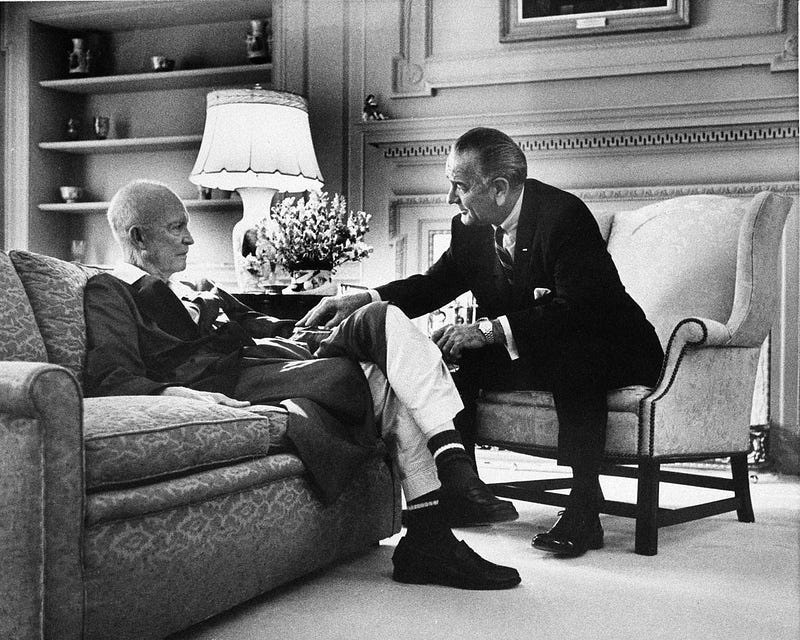
Republican Dwight Eisenhower with Democrat Lyndon Johnson. Johnson served as Senate Majority Leader while Eisenhower was President. He later became President himself and was known for signing civil rights laws. Image from https://static1.businessinsider.com/image/5a8203eed03072f9008b4661-1200/lyndon-johnson-visited-former-president-dwight-d-eisenhower-in-june-1968-at-walter-reed-army-hospital-in-washington-where-eisenhower-was-recuperating-from-a-heart-attack.jpg

Midcentury America was also a historical anomaly, in the extent to which Americans consumed the same media. Television only had a few channels and needed to cater to the least common denominator. Print newspapers and magazines were read by many people in the same locale, and some had a wide national subscription. Print books were better for catering to more niche interests. However, they generally needed a sizable market to be sold in bookstores or offered in the library. Today, the Internet allows each person to receive their own information feed. It is easy to receive a steady stream of ever-more-extreme posts, incendiary tweets, and unverified fringe “news.” Despite being able to travel easily and communicate much better, Americans often seem to be fighting each other instead of working to take care of each other.

Which type of country will we wake up to, once the dust of the election settles? Will we wake up to a country that is focused on finding common ground, as America was in the mid-twentieth century? Or will we wake up to a country at loggerheads, as America was during the Civil War? In order to stop the polarization and incitement, the first step is to recognize it as a problem. Divided over what are appropriate mores for our speech, we have yet to develop a language of multi-partisanism.

In this respect, we can learn from another iconic conflict that has begun to divide America — Israel-Palestine. In the U.S., the challenge is actually greater in certain respects than it is in Israel-Palestine. In Israel-Palestine, the lines of conflict are largely ethnoreligious. This means there are significant obstacles to connecting ideologically similar people, the moderates, and convincing them they are actually on the same side. In addition, the conventional description of Israel-Palestine as a high-priority international conflict to resolve means greater awareness of the problem. A language of peace has been developed. In the U.S., the high levels of polarization are quite new, too new for us to have developed a standard language describing their toxicity.

Photo by Priscilla Du Preez on Unsplash

As the Internet was part of the problem, though, it can be part of the solution. A vocabulary of inclusion, coming with a strongly positive branding, can encourage the growth of truly multi-partisan forums. Rather than being driven to incitement, the same people can be driven to de-incitement. An example of a de-inciting part of the Internet is the Spaces feature of Quora.com. The Quora community is relatively small, cosmopolitan, and ideologically diverse. On Quora, a group with multiple perspectives on Israel-Palestine can be brought together, and most really do care about the well-being of all the people on the land. By now, the main space about Israel-Palestine has over 80 contributors, 5,500 followers, and nearly a million views.

Based on the energy behind Quora’s Israel-Palestine spaces, Lior Zamir came up with the idea of starting a space promoting multiple perspectives in U.S. politics. It is called Depolarizing America and is found here. As of now, it has over 20 contributors and 30,000 views. It is a forum for everyone — black and white, poor and rich, conservative and liberal, young and old — to discuss how to depolarize America. A post or other discussion about what vocabulary to use could help set the tone. For example, the language of political correctness associated with the U.S. Left is often a sincere attempt at inclusion but leaves white, rural, less-educated Americans behind. Can we do better?

The goal, as well, must not be to end the discussion but to begin it. All discussions are based on some type of common starting premise. And our concern for the well-being of America is a great place to start.

United States
Politics
Liberalism
Conservatism
Election 2020
Recommended from ReadMedium