
The Origins of Scribe
Do you know why I chose this name for the publication?
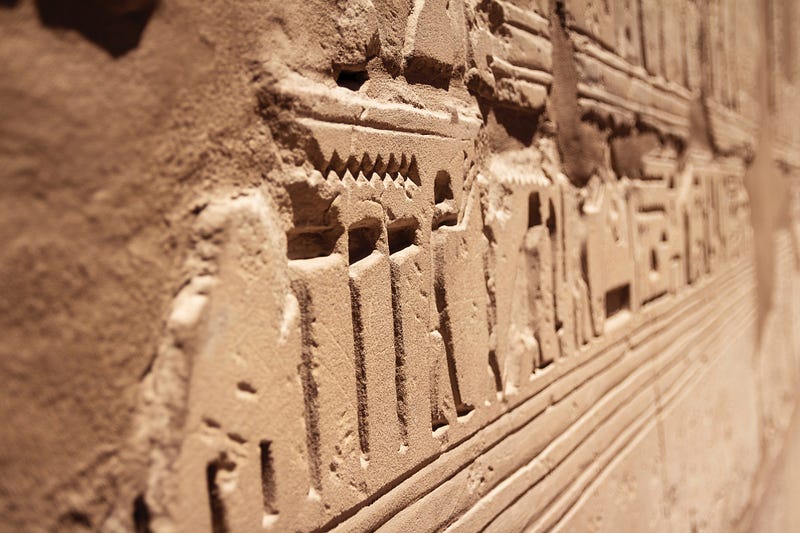
Today, I’m going to tell you something in confidence. I admit that I have never said how and why I chose to call the publication what it is: Scribe. Maybe you don’t care, or maybe you already know the answer, since the name is quite explicit. But I would like to share with you in a few words the origins of the publication, and why the name I chose is not a coincidence. It will be very short and crisp, don’t worry.
When I created the publication, I wanted its name to be representative of the editorial line I had imagined for it. In my mind, the name had to be intimately linked to writing and writers.
It was important to me that the reader understood that he is in a place where the light is put on words and emotions. In addition, I wanted the name to be short, easily recognizable, and understandable in both French and English.
Being interested in Ancient Egypt and the time of the Pharaohs, I did some research and soon came across the meaning of Scribe, which in the historical sense refers to a person who practices writing. I couldn’t find anything better!
For the record, here are a few words from Wikipedia that tell us who the Scribes were in Ancient Egypt:
The scribe (from the Latin scriba, de scribere, to write) in ancient Egypt was a literate civil servant, educated in the art of writing and arithmetic. Ubiquitous as an administrator, accountant, litterator or public writer, he runs Pharaoh’s state within its bureaucracy, army or temples. The royal scribe dominates the central administration. Superior scribes are part of the pharaoh’s court, they do not pay taxes and have no military obligations.
The scribe masters the different forms of written characters: hieroglyphic, symbol-based, hieratic, cursive and logographic writing, demotic, logo-syllabic type and ancestor of Coptic (hieroglyphic, demotic and ancient Greek are the three languages of the famous Rosetta Stone).
Master of the written word and knowledge, the scribe has its symbolic attributes. Depicted simply wearing a loincloth, with a calamus (a pointed reed) in one hand and a papyrus or ostracon (a pottery shard) in the other, the scribe exercises a respected profession, which the famous text “of the teaching of Chety” enshrines as the noblest and most honorable activity in Egyptian society.
The hieroglyph used to signify the scribe, to write and writings, etc., is Gardiner sign Y3, from the category of ‘writings, & music’. The hieroglyph contains the scribe’s ink-mixing palette, a vertical case to hold writing-reeds, and a leather pouch to hold the black and red ink blocks.
After the pharaoh, the scribes are the most represented characters in statuary or painting. Masterpieces of Egyptian art found in the Caire Museum, the Louvre Museum, and the Neues Museum (Berlin) have been bequeathed to us, showing the historical and symbolic importance of scribes in Pharaonic Egypt.
Now you know why the publication is so named. Personally, I love this reference. In the end, in addition to writing in Scribe, we are all scribes! I don’t know if we will make history as much as our colleagues in Ancient Egypt, but in any case, I am proud of this publication and of all of you writers.
So I end this story with this: when you publish a story in Scribe, consider yourself almost as important as a pharaoh.


