
The Origins of Santa Claus
The Turkish St. Nicholas

I love the various American incarnations of Santa Claus that I remember from childhood — from the old man in the original, black and white version of Miracle on 34th Street to the jolly old elf featured in ’Twas the Night Before Christmas to the humorous version featured in The Santa Clause as well as various cartoon versions.
There are also versions celebrated around the world, from St. Nicholas to Pere Noel in France, Papa Noel in Spain, Sinterklaas in Holland, and Babbo Natale in Italy. The Germans of course make this complex. Nikolaustag (St. Nicholas) is celebrated on December 6th. Weihnachtsmann is Santa Claus while das Christkind is the Christ child, who is preferred in some areas. Traditionally, Germans open presents on Christmas Eve.
What many don’t realize — all of these versions are based on an actual historical figure — a Turkish bishop who was canonized as St. Nicholas.
He wasn’t a jolly, sleigh-riding elf who lived at the North Pole. Instead, he was an actual saint.
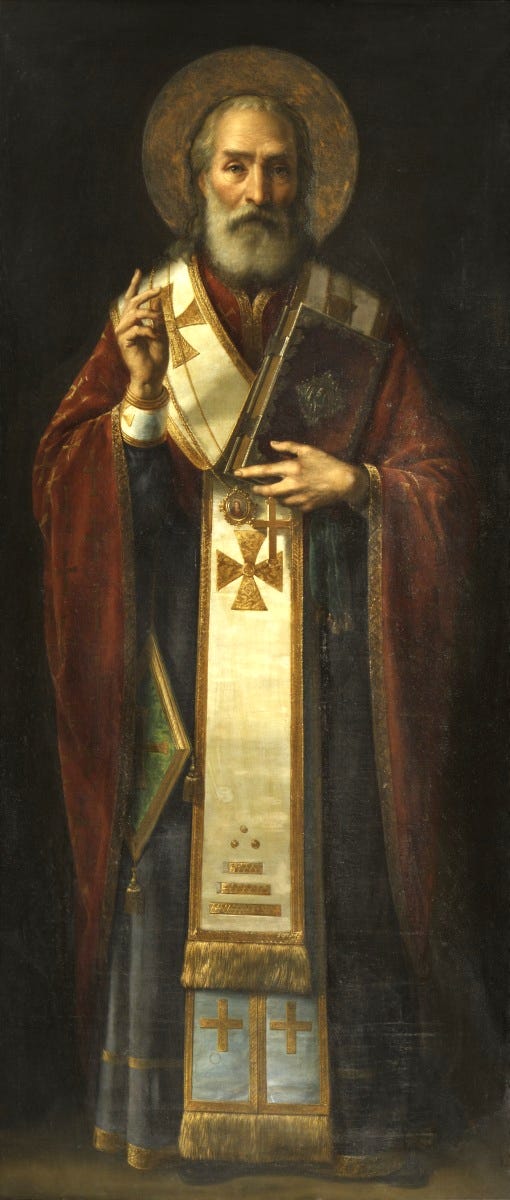
Deceber 6th is his feast day, still celebrated not only in Germany but by Orthodox Christians and Byzantine Catholics throughout the world. St. Nicholas was the bishop of Myra during the persecution of Emperor Diocletian.
This occured in AD 303 and was the last such episode of the Roman Empire. Churches were destroyed and Christians who refused to sacrifice to Roman gods were tortured and killed.
St. Nicholas refused to give up his faith, yet surived this persecution despite being repeatedly imprisoned.
While his parents were rich as well as being pious, after he was orphaned, Nicholas dedicated his fortune to helping the poor.
One story tells how he saved three girls from prostitution by throwing bags of gold through the window. On the third night he did this, the father caught St. Nicholas in the act. The bag of gold was said to land in a stocking hanging over the fire to dry. This story was an inspiration for the tradition of putting gifts into stockings both on the Feast of St. Nicholas where it is celebrated and on Christmas.
Another story tells of how he raised murdered children from the dead.
His life was filled of such tales of kindness but it also told of his righteous anger for Christ. Apparently he once slapped the heretic Arius in his Lord’s defense.
What are the lessons we can learn from the life of St. Nicholas?
There is his faith, courage, and endurance in the face of persecution due to his faith. This is also a reminder that doing the right thing is not always easy and requires sacrifice.
There is the example that St. Nicholas set in terms of charity. He cared particularly for the poor, the sick, and for children. While Jesus emphasized the importance of prayer and fasting, He showed through His own actions that faith and love must be followed by action.
This is not simply through acts of charity but also those in defense of righteousness and the faith, such as when Jesus drove the money changers from the temple.
In many ways, St. Nicholas is the perfect saint for the seaon of Advent that precedes Christmas. He believed strongly in the Christ as the incarnation of God as man. He suffered and sacrificed for his faith while also giving generously to those in need.
As we seek to follow his example, we will seek to defend truth, renew faith, and bring joy.
I am fighting stage IV cancer. If you would like to help with medical bills, I would really appreciate it. Or if you enjoy my writing and would like to buy me a cup of coffee, that’s great too. Maybe someday I can return the favor.