The Origins Of Dune
Before you watch part 2 of Dune, learn about the inspirations and origins of Frank Herbert’s classic SciFi novel

In 1953, a journalist by the name of Frank Herbert traveled to Florence, Oregon to write an article about the coastal dunes that had become a big tourist destination and a site of a long-standing environmental struggle.
The Oregon Dunes span over 30,000 acres and still attract over a million and a half tourists to this day. But long before Herbert was a journalist and before environmental issues were everywhere in the news, the coastal communities in the 1920s were struggling with the impact and movement of these dunes.
High coastal winds shifted the dunes constantly, swallowing roads, railroad tracks, homes, and more. To combat this constantly shifting landscape, the US Department of Agriculture planted European Beach Grass in hopes of stabilizing the dunes.
Although the grass worked in some areas there simply wasn’t enough to cover the huge footprints of the dunes — the type you’d expect to see in African deserts.
In the areas where the grass was working, a new problem arose: the grass itself was an invasive species and soon the area was overgrown and the landscape shifted.
Over a few decades, parts of the dunes that were once used for sledding and recreation were covered in forest. The grass had not only stabilized some areas, but had allowed other plant life to grow.
This struggle between man and nature — the effort to form something as wild as a landscape into a stable environment to build on — would be the foundation for Herbert’s debut novel, Dune.
“These waves can be every bit as devastating as a tidal wave in property damage.” - Frank Herbert
A Life In Journalism and Research
Although Dune would become Herbert’s first novel, writing had been a profession for all of his adult life. He had worked at The Seattle Star and Tacoma Times before both papers went out of business in the late 1940s.
A former colleague at Tacoma Times urged him to move to California and work for the Santa Rosa Press-Democrat in 1949 — a move that would prove instrumental in forming the philosophy behind Dune. Here, he met Ralph and Irene Slattery — two psychologists that Herbert often cited as important influences in his writing.
“Those wonderful people really opened a university for me… Ralph had doctorates in philosophy and psychology. Irene had been a student of Jung in Zurich. And both of them were analysts… They really educated me in that field.” - Frank Herbert
Exposing Herbert to different philosophical ideologies such as Marxism, Buddhism, Islam, and more sparked some of the broader ideas of the Dune Universe.
His journalistic background would play a heavy role in writing the series, harnessing his obsessive research skills and need to experience things firsthand would help shape the worlds that so many fans have come to know.
When asked to become a wine writer for The Examiner he found someone to train him in wine-making and imbibing. To better understand politics, he worked in DC as a speechwriter for Republican senator Guy Cordon. Photographer, oyster diver, television cameraman, and more. Herbert held many secondary jobs to verse himself in various subjects.
Over the course of his career, he learned to engross himself in a subject, research it to an obsessive degree, and craft articles and stories that were as much personal essays as stories.
The dunes on the Oregon Coast sparked his interest, but it would take him years to research desert climates and what it takes to survive.
“I did a year at the Library of Congress. I did about six years on the whole book (Dune). I leaned on Muslim and Arab history very heavily. I did an extensive study of Arab history. I also used the Library of the British Museum. I’ve lived in the desert. I was doing other things during those six years. Don’t get the idea that was all I did. But I did the research over a six-year period.” - Frank Herbert
Islamic and MENA Inspiration
By 1953, Herbert’s wife had given up her own creative career for a job in marketing and became the primary breadwinner of the family, allowing him to step back from full-time work.
During his trip to Florence to write the article about the coastal dunes, Herbert researched the ecology of deserts. He visited the Siuslaw Public Library, where (according to public records) he checked out multiple titles on Islam, MENA (Middle Eastern and North African) customs, and more.
“I finally saw that I had something enormously interesting going for me about the ecology of deserts… for a science fiction writer anyway it was an easy step from that to think ‘What if I had an entire planet that was a desert?’ And during my studies of deserts of course and previous studies of religions, we all know that many religions began in a desert atmosphere so I decided to put the two together” - Frank Herbert from a 1968 interview
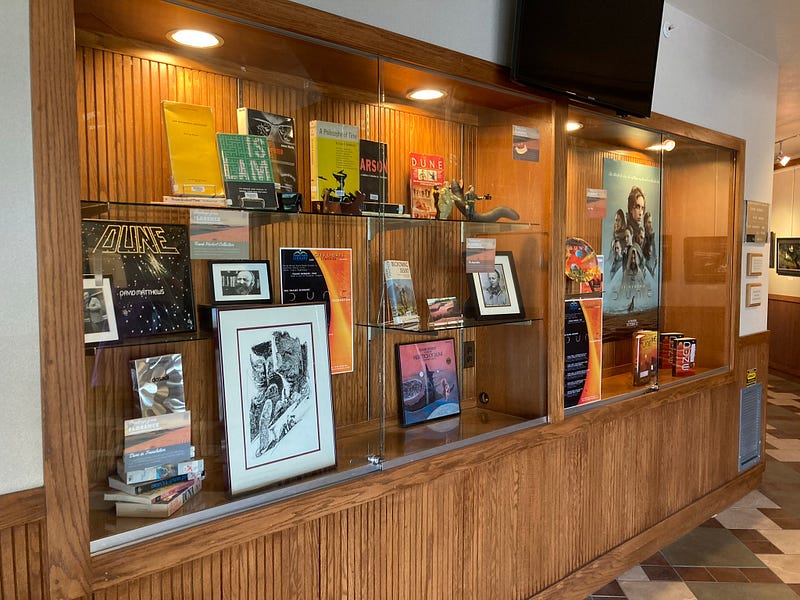
Herbert, however, never spent significant time in the Middle East. Many of his inspirations, names, places, and more came from library research and current literature. Many point out similarities with Lawrence of Arabia but it is the 1960s novel Sabres of Paradise that is cited by fans as the bigger inspiration.
These references to Muslim religions and Arabic names have drawn criticism of appropriation in the past. In her 2016 article “Epic World-Building: Names and Cultures in Dune” Kara Kennedy discusses some of the problematic aspects of the reference material used for Dune and depictions of The Fremen (the tribal people indigenous to the planet Arrakis).
“One problematic aspect of Herbert’s creation of the Fremen culture by using Arabic and Arabic-based names is the potential for the Fremen to be viewed as a monolithic, backwards society trapped by archaic religious and cultural beliefs… The Fremen thus appear as a quasi-Arabic and Middle Eastern people bent on jihad to avenge their historical oppression, unable or unwilling to think rationally and modernize their way of living” - Kara Kennedy
Other scholars, however, applaud Herbert’s depiction of Muslim themes, such as Harris Durrani, a history professor at Princeton.
“Say what you will about Herbert’s politics and orientalism, but it’s clear that he put in the work. To strip out and downplay the Islamic and MENA references in Dune would be to deprive it of its very essence. I doubt many readers pick up on the thoroughly Muslim themes unless they are Muslim or are intimately familiar with Muslim histories, practices, and concepts” - Harris Durrani
Applying These Inspirations
So, how does all this researh come together to craft a science fiction novel that is still talked about 60 years after its publication?
The Planet Arrakis is allegorical to the Middle Eastern nations of Earth that control much of the oil production. It is the only known planet that produces spice — a substance that can elongate life, make faster-than-light space travel possible, and more.

It is the byproduct of Sand Worms — enormous creatures that thrive in the inhospitable, desert planet. Despite Arrakis’s lack of other natural resources, it becomes the most important planet in the universe, and the indigenous Fremen suffer as a result.
Much like many of the real world desert nations that inspired it, Arrakis is the victim of colonialism, where a relatively peaceful people are exploited for natural resources that are out of their control.
Despite the seemingly unlivable conditions, the Fremen have called Arrakis home for millennia, which is made possible through fanatical conservation practices. Herbert, even before becoming a Science Fiction author, was enthralled with the idea of self-sustaining homes and conservation.
In a 1977 interview with Peter Sean MacKenzie, Herbert spoke of his custom home and work put in place to conserve as much energy and natural resources as they could.
“We just put a double-use house over the pool. The whole pool concept here is for multiple use. Where you see carpentry, they’re solar collectors. There’ll be solar collectors on both sides. I intend to use the pool water — 30,000 gallons — as heat storage to heat the greenhouse at night. We’ll overheat the pool during the day — we generally swim in the mornings — we can draw 20 degrees from 30,000 gallons at night to heat the greenhouse” - Frank Herbert
The Fremen and imperial inhabitants leverage similar conservative practices. Not a drop of water is wasted and many spend most of their days in reclaimers — suits designed to reclaim and reuse every drop of moisture.
Drawing on research from real-world examples of people surviving extreme conditions (such as the San of the Kalahari desert), Herbert crafts a world that is not only fascinating to read, but scarily realistic.
The Use Of Hallucinogens
On his plot of land, Herbert was able to grow and cultivate hallucinogenic mushrooms. The use of psilocybin had a great influence on the story.
Spice has hallucinogenic attributes, which are attributed to the ability of extending someone’s life. In fact, faster-than-light travel isn’t possible unless the people are tripping on spice and many of the prescient abilities held by the more mystical figures in the series come about through the use of psilocybin.
The premise in the novel is that the use of psilocybin unlocked the abilities of the Bene Gesserit — a sisterhood of social, religious, and political leaders who have conditioned their minds to posess prescience.
Science Fiction At the Time
Science Fiction was a growing genre at the time. Asimov’s Foundation series was gaining popularity and shortly after the publication of Dune, the first episode of Star Trek would air. Herbert’s work was coincidentally well timed but is often cited as pivotal in starting the Science Fiction revolution.
His work differed greatly from Asimov and other popular authors of the time, however. One of the staples of Dune is the complete lack of technology. A backdrop in the novel’s lore is the “Butlerian Jihad”, an event where all robots and computers were destroyed.
The technology we see in Dune is functional and advanced but never automated. There are no super-intelligent androids, autopilots, artificial intelligence, etc. Many series (including Foundation) deal with the concept of technology becoming too powerful and intelligent. Herbert had the same fear but saw a future where humans take action before the breaking point.
“We’re going to have a lot of violence and upset. It’s no simple, one thing. One of the things that’s involved is the information explosion. Computers are going to have more influence on the society that involves this world for the next 35 years, very likely, than fire did. Computers are going to make an enormous difference.” - Frank Herbert
Even in the 1960s, he saw how much computers would change the world. Rather than asking “How will it destroy us?” his work asks “How will humans take back control?” We’re given a universe with space travel, but less powerful computers than we have today.
Science fiction, he believed, was a great vehicle for helping humanity prevent tragedy in the future. By putting an idea into the public consciousness, humanity could be prepared for the situation.
“Neither Brave New World nor 1984 will prevent our becoming a planet under Big Brother’s thumb, but they make it a bit less likely. We’ve been sensitized to the possibility.” - Frank Herbert
This lack of technology has inspired countless science fiction works. Star Wars is a great example, where although it has self-aware droids, the architecture, clunky ships, and reliance on mystical powers all draw influence from Dune.
The Chosen One
Star Wars, like many others, also dealt with the concept of a “chosen one.” Luke Skywalker is held up as a pillar that who will not only serve as moral example, but as someone lifing up the entire galaxy.
As a researcher, Herbert hated the idea of a “chosen one.” As he wrote in his 1985 short story collection Eye, the idea of a “chosen savior” was popular in fiction but detrimental in practice.
“Dune was aimed at this whole idea of the infallible leader because my view of history says that mistakes made by a leader (or made in a leader’s name) are amplified by the numbers who follow without question.” - Frank Herbert
If you have read all of Dune, you know that Paul’s elevation to a “chosen one” does not lift the disenfranchised, but ultimately leads to more destruction. History has shown us that one person cannot save everyone.
“The bottom line of the Dune trilogy is: beware of heroes. Much better rely on your own judgment, and your own mistakes.” - Frank Herbert
Conclusion
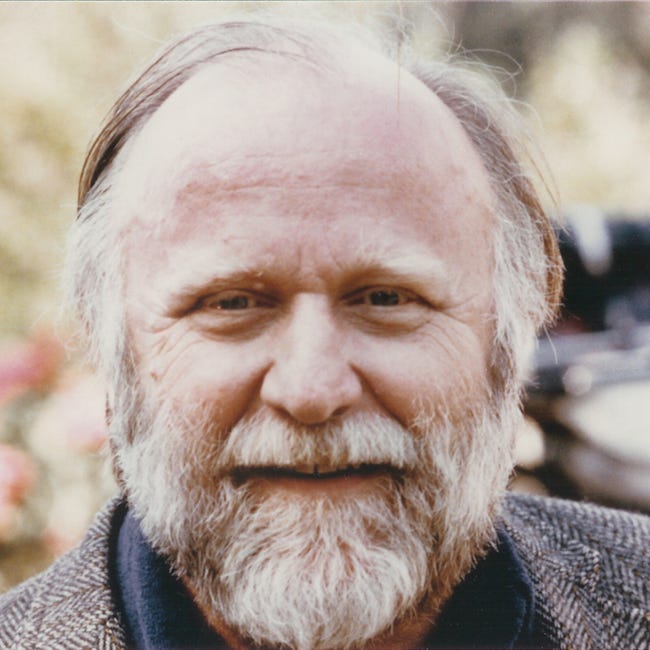
A lot of time and research went into this book — much more than I could fit into a blog post. What is impressive is Dune wasn’t published until Herbert was 51 years old, proving that it’s never too late to start writing and that inspiration can come from anywhere.
Even some sand dunes and beach grass off the coast of an Oregon town.


