
The Only To-Do List You’ll Ever Need to Have Your Life in Order
Focus on what’s important and make sure that you don’t forget the rest — in just two minutes per day.
For years, I have despised to-do lists for a number of reasons. First, I felt like I was capable of getting my shit together without them. Second, I thought they were too complicated, struggled with different layouts, and felt like they didn’t bring any value to my life. Third, I often either felt completely overwhelmed by the sheer amount of things or fell into the trap of checking off box after box without accomplishing much.
If you can relate to at least one of these issues — and I’m sure you can! — you’ll like what’s about to come.
Because at one point in my life, I decided to put some effort into it and come up with a systematic to-do list that would boost my productivity, stop me from forgetting things, and force me to focus on what really matters.
But, most important: I wanted a tool that added value to my life by making it simpler, not more complicated.
What any good to-do list needs
To-do lists come in all kinds of forms. Concise or detailed. Physical or digital. Multiple colors or a simple black and white. Ultimately, most of these choices come down to personal preference.
However, a to-do list has a purpose. It has to fulfill certain criteria in order to be useful and add value to your life. Over time and through testing different lists and strategies, I have identified four key requirements that any good to-do list should be able to fulfill.
Listing current and future to-dos
I have found that a key feature of any good to-do list is that it carries over to the next day and lists your current as well as future to-dos.
This has two obvious advantages. First, you make sure that nothing goes by the board. If you can’t check off all your tasks on a certain day, they’re still there on the next one. Second, you have your current and future to-dos in one place, which provides you with an overview that goes beyond the next 24 hours.
To accomplish this, I use the same list template every day, without erasing it — I simply add or delete items.
Priority ranking
Not all tasks are created equal. When I write an article, I can spend an hour looking for the right cover picture. However, I can also use the same hour to write another article or edit the existing one. Putting my time into writing and editing provides me with a lot more value than looking for the perfect photo, although I can spend the same amount of time on both.
The Pareto-Principle states that 20% of the things you do are responsible for 80% of your accomplishments. You’d be straight nuts if you decided to waste your time on something insignificant before you tackle the things that really move the needle.
Apart from how much you get out of them, tasks also differ in their urgency and importance. Watering the plants and calling your boss might both be urgent — your plants are dried up and your boss eagerly awaits an update on your project.
However, they are not equally important — a dead houseplant won’t ruin your day like losing your job will. Depending on payoff, urgency, and importance, you have to make some tasks a priority before others.
And if your list doesn’t have a simple way to set your priorities, you’re lost.
Temporary storage space aka brain dump
Today’s connected world with high-speed internet and multiple communication channels is both a blessing and a curse. It’s cool because whenever you have a question or want to get something sorted out, it’s just an e-mail or phone call away. The sucky part is that whenever someone else has a question or wants to get something sorted out, you’re just an e-mail or phone call away.
It doesn’t even have to be someone else that disturbs your focus. Sometimes you come up with more todos or an idea that you want to follow up later on. A lot of things can happen during the day.
When you are immersed in a task, you don’t want to break your focus more than necessary. That’s why your list should have something that I call a temporary storage space — a section where you can write down anything that pops into your mind, without having to categorize or think about it further. This allows you to do a brain dump whenever you want.
Routine checklist
Even if you don’t get up at 5 am and plan your miracle mornings Hal Elrod style or follow an advanced 15-step evening routine, chances are that you have certain things that you do on the daily. May it be exercise, learning a language, calling your grandma or reading.
To keep up, you could put all of them on your to-do list. But since these are things you are doing daily, there is a simpler way of holding yourself accountable.
A good to-do list has a space for your daily routines, so you can check yourself at the end of the day without much hassle.
How to set up your to-do list
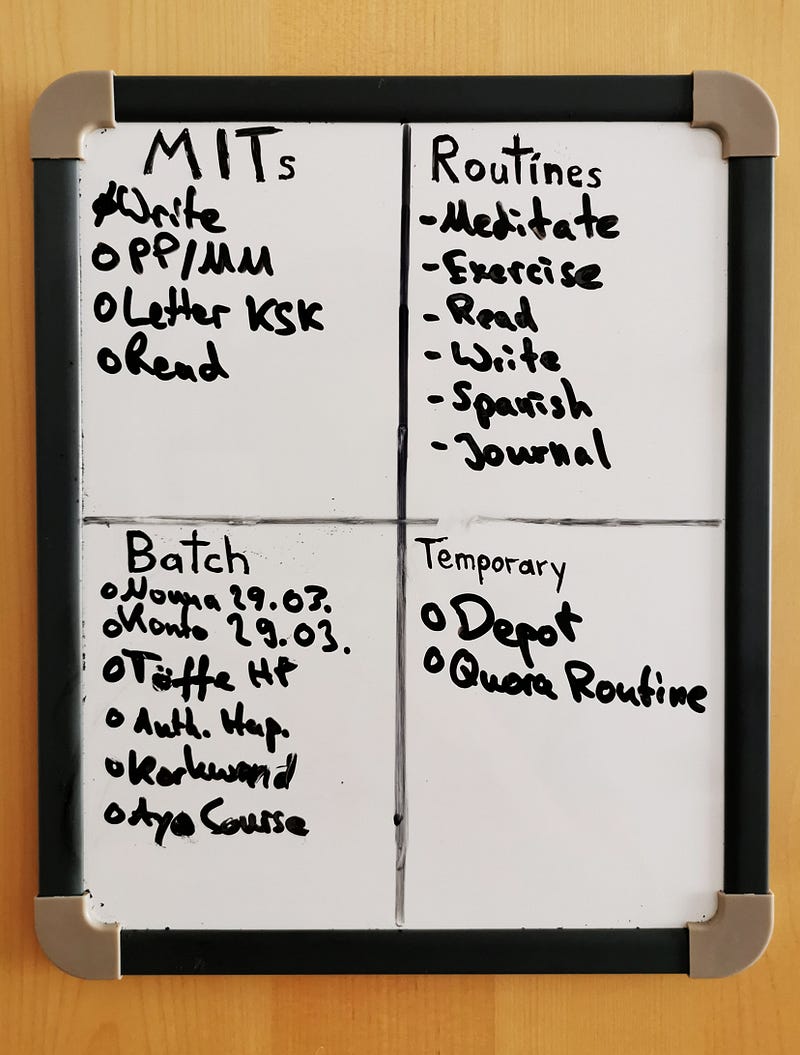
What you see here is a photo of my own, personal to-do list. It fulfills all the criteria I have mentioned above and takes only two minutes a day to maintain.
This small whiteboard has simplified my life and added to my productivity as few other things have.
It will take a little bit of explaining, but once you understand the system behind it, it’s incredibly easy to set up and maintain.
So let me first explain to you the four different parts of my to-do list. Then, I’ll show you how to use it to get the most out of your days.
Most important tasks — MITs
This is the core of it. The heart. Without it, the whole thing wouldn’t work. It relates back to the priority issue I have touched upon above — you know, the whole watering your plants versus calling your boss thing.
In his book Eat That Frog, bestseller author Brian Tracy advocates the law of three. It states that on any given day, you can identify about three core tasks that move the needle the most or are most urgent. Sure, there might be a lot of other things on your plate. But you can usually identify your three most important tasks so that even if you get nothing else done, your day was a win.
In this section, I jot down my three or four most important tasks for the day — my MIT's. I usually jump at the first thing in the morning after my wake-up routine. This is to make sure that I get my most important stuff done first. Even if distractions hit and life happens afterward, I have still accomplished my most significant wins.
Batch tasks
These are all the tasks that are neither a daily routine nor an MIT in your current day. Calling someone, sending out a letter, doing the laundry, finishing a report that is not urgent and important right now as well as other bits and pieces go here.
Apart from some bigger bites that will end up as an MIT in the future, these are things that can be done rather quickly and in a batch-style manner, one after another.
Habits
Pretty self-explanatory. Anything that is a daily routine goes here. It serves as a check-up once I finish my day to make sure I didn’t forget anything.
Temporary
No rocket-science either. This is where all the things go that you haven’t categorized yet — they’re neither batch nor MIT. This part of my list usually fills up during the day when to-dos pop up or ideas come to my mind.
This category’s real value doesn’t lie in the ability to check off things, but rather in putting your mind at ease. Whatever things come up during your day, within a couple of seconds you can jot them down and go back to what you were doing before.
Organizing your list in less than two minutes per day
When I designed my to-do list blueprint, I had one important goal in mind: Make my day simpler, not more complicated. I neither have the time nor the energy to spend ages setting up my to-dos for the next day. In fact, anything above two minutes per day wasn’t acceptable.
So here is how to utilize the list as efficiently as possible.
Set up made easy
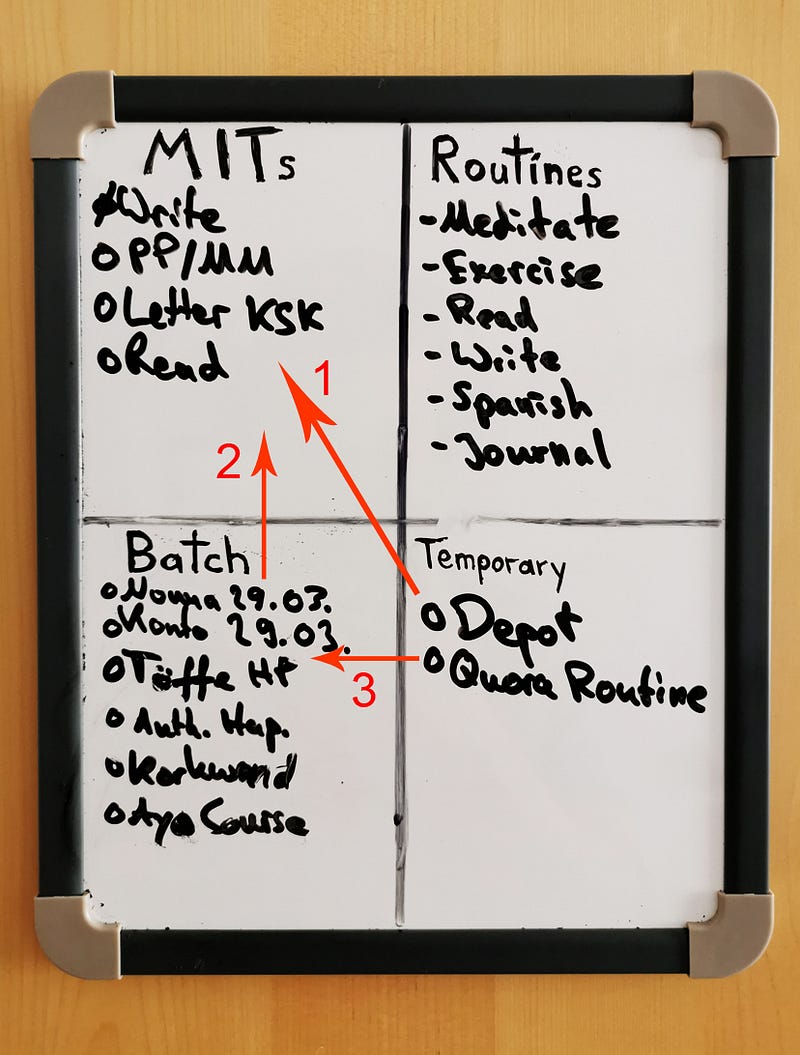
I set up my list at night, so I can start in the morning without wasting my time and energy trying to figure out what I am going to do today. Your preference might differ, but how you use the system stays the same.
First, erase any tasks that you have finished during your day. Boom, done.
Next, look for any items in your temporary and batch columns that you want to move to your MITs for the next day. Anything remaining in the temporary column goes in the batch part. After this, your temporary section should be empty.
Now, you can write down additional MITs for the next day. I usually limit myself to a maximum of four. The goal here is to prioritize hard and focus only on the things that move the needle the most.
That’s it, all done and dusted for the next day.
Using your list during the day
Since you have already prioritized your tasks the night before, your goal now is to get done what’s most important. Start your day with your MITs and don’t work on anything else before you have them finished. This way, you are guaranteed to make the most out of your time.
Once you are done with your MITs and have time left over, you can then turn to your batch list. Since these are mostly odds and ends, I usually wait for a couple of them to pile up. Then I put on some music and check them off one after another. This way you don’t have to pump yourself up every evening to get some extra work done after you already worked so hard on your MITs, but can tend to it when you have some extra time.
There’s only one last thing I want to touch upon before letting you off the hook.
Deadlines — for any task that has a deadline (like paying a bill or handing in a report), I write it down right next to it. Just a simple date, nothing fancy. When you set up your list for the next day, check if any of the dates are close. Give these tasks priority as deadlines come up.
Focus on doing more with less
By choosing the essential, we create great impact with minimal resources. Always choose the essential to maximize your time and energy.
— Leo Babauta, The Power of Less
I am a big proponent of doing more with less. Sure, there always are more things to do or fancy ways and additional tools to add to the arsenal of productivity helpers you already have.
But in the end, you have to ask yourself what these things will add to your life — in terms of complexity and value.
This to-do list does exactly what a to-do list should do. It forces you to focus on what’s most important. At the same time, it gives you a framework and storage room for anything that isn’t and makes sure you don’t forget about it.
Not too bad for two minutes per day.
Being more productive is the coolest thing since the invention of sliced bread. You get more done in less time. Crikey! But have you ever asked yourself why? This piece might help you figure it out:
PS: If you like my style of writing and don’t want to miss out, feel free to subscribe to my tiny little newsletter. No spam, no weird stuff, no requests to wire money to an offshore bank account. Just a simple notification whenever I publish a new article and a lot of love.


