
The ONE Thing — 10X Boost Your Productivity
Focus on ONE thing, which is then the key to success in all areas of life. It’s that simple.

Credits: The ideas of this story are based on the book ‘The One Thing’ (a New York Times and Wall Street Journal Bestseller) by Gary Keller combined with my experience as a multi-business owner and tech Ph.D. graduate with 50+ scientific publications — both are things where you have to be extremely productive.
Before we can talk about productivity, you should be clear about where you want to go at all (i.e., your overall vision or goals).
There is no point in being highly productive if you are going in the wrong direction. It couldn’t be worse.
Given that this story is all about productivity and how you can achieve your goals efficiently, we assume that your goals and vision are what you really want or your ONE thing is clear (I think I’ll do a story about this soon, too).
“Productivity is never an accident. It is always the result of a commitment to excellence, intelligent planning, and focused effort” — Paul J. Meyer.
With these words, Paul J. Meyer emphasizes three key aspects of productivity — namely (1) focus on ONE thing only to achieve excellence, (2) intelligent planning, and (3) focused effort and implementation — which will be discussed in the following.
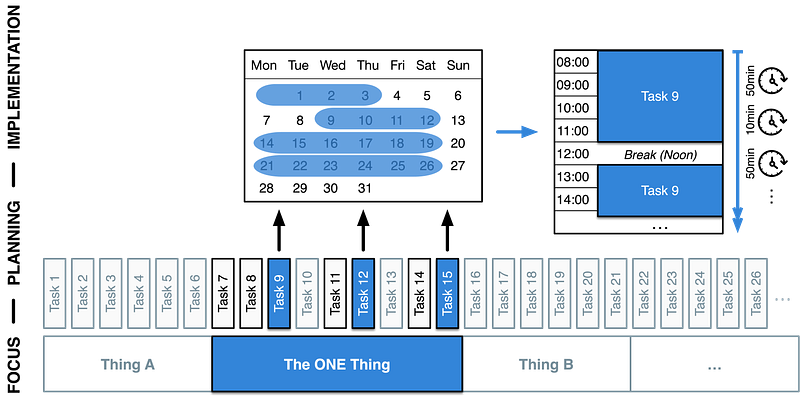
1. Focus: Live For the ONE Thing
“If you chase two rabbits, you will catch neither one!”
The key to high productivity and ultimately to success is simple: FOCUS. Focus on just the ONE thing.
If you don’t know your ONE thing, now is the time to find it out.
For example, the ONE thing for start-ups is usually to implement their ONE business idea and build ONE company — and that’s all you should focus on. Don’t even try to implement another business idea at the same time or pursue a backup plan in parallel, work in a full-time job, or pursue a second time-intensive project (e.g., building a house) on the side.
You will almost certainly never have as much success on two tracks (or even multiple tracks) as if you had only concentrated on ONE thing —in the worst-case scenario, all of them will fail.
Once you have done ONE thing completely (e.g., built up your company and created a structure that no longer requires your full attention), you can still tackle and pursue the next ONE thing.
But the same applies here: Focus again on the ONE thing.
People who know exactly what their ONE thing is and live for this ONE thing see the world with different eyes. They have clarity, which leads to a goal-oriented approach. They make decisions (even unconsciously) that benefit the ONE thing.
Over time, success comes automatically. Because success is a consequence and results from the fact that you always concentrate fully on the ONE thing. You must be aware of this.
2. Planning: Prioritize The Important Over The Urgent
Only when you know with certainty what ONE thing you should focus on can you break it down into smaller tasks.
You probably end up with a long to-do list of things or tasks that you think need to be done to accomplish the ONE thing. When looking at such to-do lists, most people wonder how they can complete them in a reasonable amount of time as new tasks are constantly being added.
“Productivity isn’t about being a workhorse, keeping busy or burning the midnight oil… . It’s more about priorities, planning, and fiercely protecting your time.” — Margarita Tartakovsky”
The answer is simple — and if you are already familiar with project and time management, it’s not surprising:
Instead of a (usually long, unsorted) to-do list, you simply need a short success list that contains only the essential or revenue- or sales-boosting tasks. The completion of such tasks will bring exceptional results and bring you one step closer to success.
..but how do you create such a success list?
The Pareto principle: Filtering and prioritizing tasks
You first need to realize that exceptional results are determined by far fewer things than most people think — namely only the most important tasks.
The Pareto principle (also known as the 80/20 rule), which states that 80% of the results are achieved with 20% of the effort, helps you to recognize and filter these tasks.
However, this rule should not be taken literally. This rule can, of course, assume a different ratio depending on the circumstances (e.g. 90/10, 70/30).
The important thing is to understand the principle behind it and how you can apply it to your to-do list:
- Start with an arbitrarily long list of tasks that you think you need to do concerning the ONE thing to be successful and that covers a larger window of time.
- Filter the tasks and then prioritize them to reduce them to a few relevant tasks. For instance, ask yourself the question of which ones are your most profitable and revenue-generating activities or which ones are activities that must be completed to start and grow your business.
- As not all upcoming tasks fall within your area of expertise and some are more urgent than others, you can now apply the Eisenhower method (see below). The result is a fine-grained prioritization of your tasks, which is ideally suited as a basis for further planning.
The Eisenhower method: Categorizing tasks
With the Eisenhower method, you can divide upcoming (pre-filtered) tasks into categories based on the following two criteria:
- Importance: tasks with the greatest positive and negative impact on your success
- Urgency: tasks with a near-due date
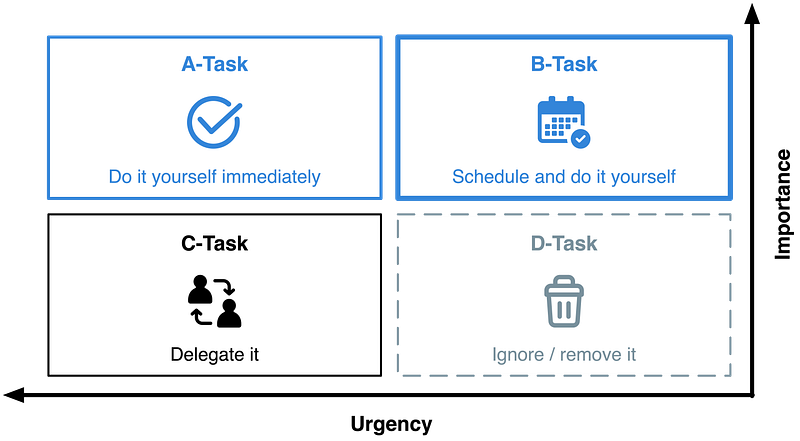
This results in four types of tasks or, from a visual perspective, four quadrants (the so-called Eisenhower matrix), which are characterized as follows:
- A-tasks: These tasks and activities are both important (with a high degree of impact on achieving your goals) and urgent, i.e., they are due immediately. You should therefore complete these tasks yourself immediately. There shouldn’t be any tasks here, as long as the subsequent B tasks are scheduled and completed correctly. Nevertheless, in practice, it is almost impossible to avoid B tasks taking longer than planned and becoming urgent or new (previously unknown) important and urgent tasks.
- B-tasks: These tasks or activities are not urgent in time but are extremely important and have a considerable, usually the highest, impact on achieving your goals. Most tasks for implementing your business idea have this character. They should therefore be scheduled and completed by yourself. It is important to make a relatively precise estimate of how long the task will take. Note that we tend to overestimate what we can achieve in one day or week, and we underestimate what we can achieve in a year (or several years).
- C-tasks: These tasks or activities are not important (i.e., their impact on achieving your goals is rather low) but urgent. Therefore, these tasks should be delegated for prompt execution. One example is tax declaration, which you can simply delegate to a tax consultant: he or she will complete it much faster than you, and you can devote the time you save back to your AB tasks.
- D-tasks: These tasks or activities are neither important for achieving your goals nor urgent. Therefore, these tasks can be delegated or simply deleted if necessary. However, these tasks should only play a subordinate role in planning or be ignored.
Decision-making for task execution
The resulting orderly and prioritized breakdown of the Eisenhower matrix then serves as the basis for your decision (e.g., do it yourself vs. delegate it).
With this simple method, you consciously say ‘yes’ to the important tasks, which also automatically means that you consciously say ‘no’ to the unimportant tasks, because important tasks should never be subordinated to unimportant tasks, even if these do not always attract the most attention.
Performance-oriented people know this and always work with this clear sense of priorities; they do not confuse the urgent with the important.
High achievers even do the essential tasks first that others have planned for later or constantly put off, which only undermines their success.
“It’s not that we have a short time to live, but that we waste a lot of it.”― Lucius Annaeus Seneca
This approach allows you to make the best possible use of your time and achieve as much as possible with less effort.
It also involves overcoming your fear of unfinished tasks. If you stick to the approach described, you will have already completed the most important tasks, and with this good feeling, it shouldn’t be too difficult to leave the less important tasks undone.
3. Implementation: Get Into the Flow State
Now let’s move on to the work you will inevitably have to do to complete the outstanding tasks. Without your commitment, even the best planning is useless.
Be aware that you can only achieve high productivity if you use your available working time properly:
Productivity (simplified) = Effectiveness × Efficiency
Having looked at methods for increasing your effectiveness (doing the right things) in the last two sections, we will now turn our attention to the second aspect or parameter of productivity, namely efficiency (doing things right).
Efficiency can be a measure of your economic efficiency (cost-benefit ratio) or your use of scarce resources (e.g., time). Therefore, we will discuss how you can complete your outstanding tasks as efficiently as possible — with optimal use of your time.
Reserve contiguous blocks of time
First reserve or block one or more contiguous blocks of time over several hours for each task (depending on the scope).
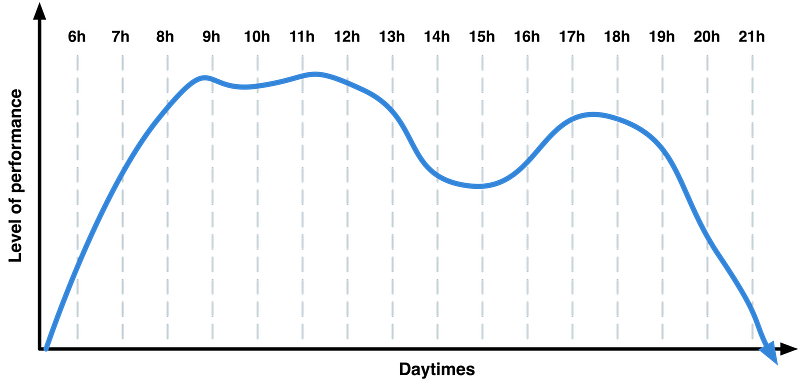
As you can in the figure, the morning hours (7 a.m. to 1 p.m.) and the late afternoon hours (4 p.m. to 7 p.m.) are best suited for this, as this is when the typical performance curve of early risers and normal risers (also known as Kraepelin’s work curve) peaks.
You should reserve these times — especially the morning hours — for your doer time, when you complete your AB tasks, as this is when you have the highest performance level.
Here it would be best if you always started with the biggest frog (those tasks that require a lot of thinking, which you find unpleasant and therefore put off) —this is in line with the well-known ‘Eat that Frog’ principle from American management researcher Brian Tracy.
You can schedule your manager time between the doer times (1–4 p.m.) or afterward (from 7 p.m.), for example, to hold meetings, answer e-mails, or complete other less important (non-thinking or time-consuming) tasks.
Of course, these times are only to be understood as guidelines and must be individually adapted to your activities.
However, you must understand when your performance peaks during the day and use them to work more efficiently.
Use the time blocks properly
Next, let’s take a look at how you can make the best use of the individual time blocks.
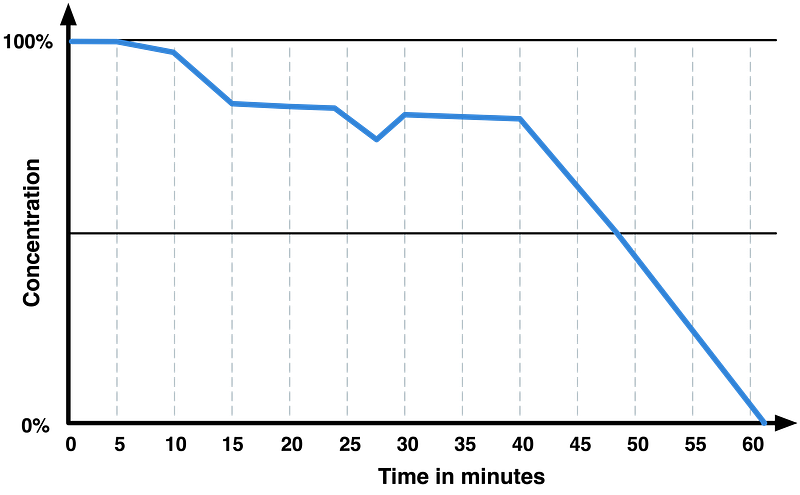
This is particularly interesting for brain workers who work a lot at a desk and perform intensive mental work, as concentration cannot be maintained in the long term: After about 40 minutes, concentration decreases significantly; after about 60 minutes, the concentration level is at its minimum, i.e., brain workers need a break after 60 minutes at the latest.
Therefore, the typical (and maximum) duration of a single time block is one hour (1 hour). Here you can use the Pomodoro technique to make the best use of the 1h time block:
- Work concentrated on a task for 50min and then take a 10min break;
- Repeat this four to five times (4–5x) and then take a longer break (30–45min, e.g., lunch break);
- Repeat the whole thing in a second work block.
It is important that you work through the 50 minutes with maximum concentration and move around during the breaks (e.g., go for a walk around the block and get some fresh air) and switch off (e.g., small talk with people, but don’t check emails or play on your smartphone).
You can use this technique to train your concentration like a muscle.
After just a few days, you will notice that you are much more focused at work and that you enter the so-called flow state more and more often.
In this flow state, you are completely focused on your activity and perform at your best (often without tiring); you then complete the activity with ease and often have more energy afterward than before.
So, practice getting into the flow state as often as possible, as this is when you are most productive and you will see how quickly and conscientiously you get even your unpleasant tasks done.
…but why do so few people manage to get into the flow state? — There are two reasons or — let’s call them — ‘productivity killers’ for this.
Avoid distractions and interruptions
The first productivity killer is the uncontrolled interruption of your work, e.g., during one of your 50-minute time blocks.
Uncontrolled interruptions usually occur due to distractions from technology (e.g., emails, social media, smartphone notifications), noise in the offices, or even from colleagues or family members.
Such interruptions, which take you out of your concentration phase or even out of a flow state, are deadly for your productivity.
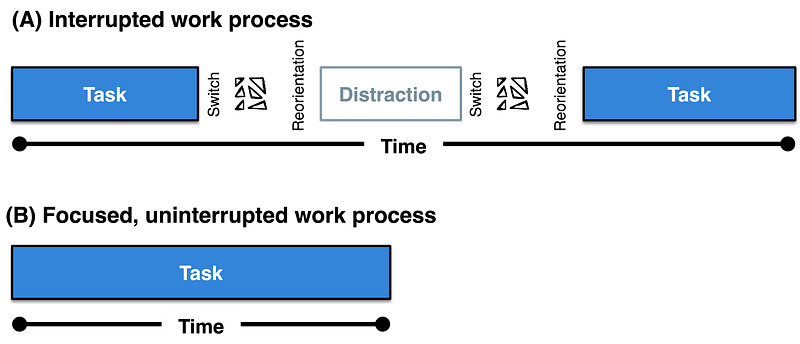
The figure serves to illustrate this: when you are distracted, you not only lose the duration of the interruption but also the time your brain needs to refocus and resume the interrupted task (see A).
This reorientation and resumption of the task takes an average of eight minutes until you return to the concentration phase. It is, therefore, not surprising that an interrupted workflow is characterized by a much higher waste of time than a focused, uninterrupted workflow (see B).
The same applies to multitasking: Every time you switch back and forth between two tasks, you lose time that your brain needs to refocus and resume the interrupted activity. The additional time required for simple tasks is up to 25 percent for simple tasks and even more than 100 percent for very complicated tasks.
Most people are not even aware of the costs associated with multitasking. It is estimated that an average of 28 percent of a working day is wasted in this way.
So, do yourself a favor and consider the following points:
- Use the Pomodoro technique (50 minutes of concentrated work and a 10-minute break in a 1-hour slot) consistently.
- Create undisturbed time slots in which you can work in a concentrated and uninterrupted manner. Talk to your colleagues and family members about this.
- Also, mute all electronic devices so that you no longer receive distracting notifications and are no longer distracted.
- Take notes before every break (especially about your thoughts) so that you can get back to the task at hand more quickly after the break.
- Multitasking is an illusion: only do ONE task at a time; only when you have completed one task (even over several 1-hour blocks of time), you can start a new one.
- Check and answer your e-mails (if possible) at most twice a day in time blocks reserved for this purpose (lunchtime and evening are best suited for this).
- Finally, here are some study results that once again show you the negative consequences of work interruptions: While interruptions can even be beneficial and motivating for simple or monotonous tasks, they are particularly stressful for more complex tasks that require maximum concentration. Even very short interruptions of 2.8 seconds can double the error rate.
- Studies on multitasking come to similar conclusions: It has been shown to have negative effects on brain performance, i.e., the error rate increases, and the perception of how much time a task takes (usually longer than is actually the case) is reduced.
In addition to these performance losses, multitasking also hurts health: the more interruptions, the greater the strain and stress. The stress levels can even extend to leisure time.
Don’t overdo it with the workload
The second productivity killer we would like to mention here is working hours that are too long.
You know when you are highly motivated to pursue your business and want to sacrifice every free minute for it. You can’t think about anything else day and night except new ideas that you want to implement.
The good news is that you have definitely found the right business or activity that follows your passion. The bad news, however, is that you could get bogged down in terms of productivity.
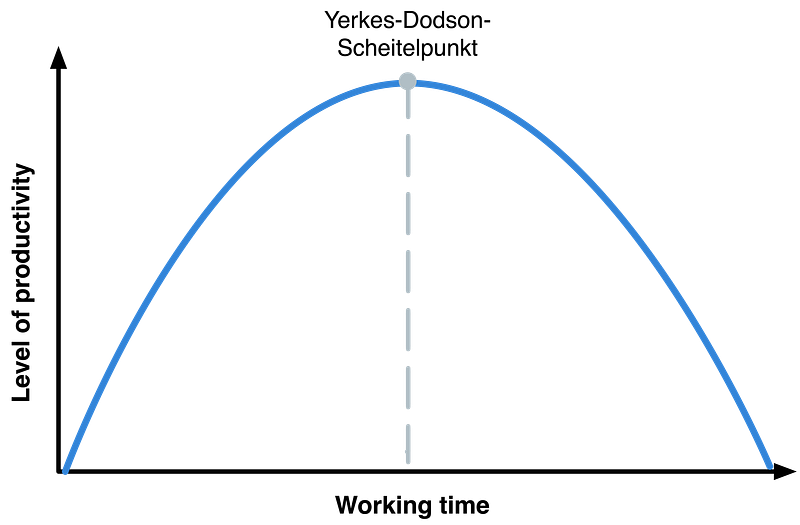
The higher the ‘work input’ (longer working times), the higher the productivity is a myth or a false subjective perception that is only true up to a certain point: This point is also known as the Yerkes-Dodson apex, which you can find in the figure. Up to this apex, the possible productivity level increases with work input; thereafter, the possible productivity level falls with every hour of overtime and the productivity gap increases dramatically.
This is also the area (to the right of the peak) where you burn out, become exhausted, make more mistakes, and need considerably more time to complete tasks.
If you work permanently above this peak, the risk of burnout increases rapidly. You should not underestimate this danger. Burnout can happen gradually and when you have one, it’s like the Grim Reaper is coming:
Nothing works anymore!
Your productivity (and your joy for life) is at an all-time low. Getting out of it takes a few months and you can’t pursue your business activity during this time.
You must be aware of this: In this case, you lose so much more time than you mistakenly believe you can gain through your excessive working hours — because as we have seen, working more is not the same as working productively.
Rather, productivity is primarily about quality, not quantity; you only get that if you are fit and have a clear head.
Now you’re asking yourself, of course, at what (weekly) working time is this peak point? This point is slightly different for everyone (but only plus or minus a few hours).
First and foremost, you should listen to your body and mind (i.e., pay attention to your health!) and then plan time off and rest accordingly. As a guideline, studies have identified this peak at a 50-hour week for most people; after a maximum of 55 hours (per week), the possible productivity level drops radically; anything above that, we hardly produce anything.
Therefore, pay attention to your weekly working hours (≤ 50 hours/week) and plan enough time off for relaxation: You will be much more productive and creative afterward, complete tasks more quickly and in a more relaxed manner, and have even more fun in the process.
Above all, you can take care of your social relationships during your break, which will increase your joy for life: a classic win-win situation!
If you have to work longer hours temporarily (e.g., during a launch and the development phase), you should not overdo it with overtime.
Above all, you should allow yourself enough rest after a stressful work phase and enjoy the tasks you have completed and the successes you have achieved.
Some of my other related well-performing stories:
- The 20 Lessons I Learned in 2023 — Do Better Than Me Next Year
- How I Started My Full-time Business Life With 10X — And How You Can Do the Same.
- Kick-start Your Personal Development and Get an Unfair Advantage over Those Who Do Not.
- The Good Thing about Your Life Crisis
HAPPY READING, HAPPY IMPLEMENTING!
Follow me to get more:


