avatarRicky Lanusse

Free AI web copilot to create summaries, insights and extended knowledge, download it at here

4513

Abstract

se to 7.4 percent of GDP in 2025. The <b>fossil fuel industry <a href="https://www.theguardian.com/environment/2021/oct/06/fossil-fuel-industry-subsidies-of-11m-dollars-a-minute-imf-finds">gets</a> subsidies of $11 million a minute.</b> Or, what is even more disturbing is that <b>for every dollar we invest in climate change, we spend at least five subsidizing what is killing us.</b> Like taking cough syrup while living bare-naked in Antarctica. No wonder things are escalating rapidly, and carbon emissions <a href="https://www.carbonbrief.org/analysis-chinas-co2-emissions-in-q2-2023-rebound-to-2021s-record-levels/">aren’t dropping</a> as they should.</p><figure id="132a"><img src="https://cdn-images-1.readmedium.com/v2/resize:fit:800/1*_nNwc0YTN3Bg51cCJ3FaEQ.jpeg"><figcaption>Source: <a href="https://www.imf.org/en/Topics/climate-change/energy-subsidies">International Monetary Fund</a></figcaption></figure><h1 id="d069">These four irreplaceable materials that sustain our modern world</h1><p id="a691">As <a href="https://www.science.org/content/article/meet-vaclav-smil-man-who-has-quietly-shaped-how-world-thinks-about-energy">Vaclav Smil</a> says, our modern world relies on four essential materials that sustain our way of life, crucial for everything we do. And <b>they all require fossil fuels for their production.</b></p><p id="f483">Think about it: our advanced societies wouldn’t exist without certain materials. We had Concord before Facebook. But to maintain our quality of life, these four materials stand out as the building blocks of our modern world: <b>cement, steel, plastics, and ammonia.</b> They’re needed more than anything else.</p><p id="79c5">Each year, we produce about 4 billion tons of <a href="https://www.greenbiz.com/article/cement-most-destructive-material-world-or-driver-progress#:~:text=In%20recent%20times%2C%20global%20production,than%202%20billion%20in%201995"><b>cement</b></a> (2 entire <a href="https://www.bankrate.com/insurance/car/average-car-weight/">cars-worth</a> of concrete per person), 2 billion tons of <a href="https://worldsteel.org/steel-topics/statistics/world-steel-in-figures-2022/"><b>steel</b></a> (<a href="https://twitter.com/empirestatebldg/status/1113457377339113472">2700 Empire State Buildings</a>), 400 million tons of<b> <a href="https://www.unep.org/interactives/beat-plastic-pollution/">plastics</a></b> (more than <a href="https://ourworldindata.org/plastic-pollution">45 kilos per person</a>), and 250 million tons of<b> <a href="https://www.statista.com/statistics/1065865/ammonia-production-capacity-globally/">ammonia</a></b>. We spend about 17% of our energy to produce these materials, <b>generating 25% of CO2 emissions from fossil fuel combustion.</b></p><figure id="537a"><img src="https://cdn-images-1.readmedium.com/v2/resize:fit:800/1*uohaTrdlMJ2ofjsfCJNMaA.png"><figcaption>Source: <a href="https://ourworldindata.org/emissions-by-sector">OurWorldInData.org</a></figcaption></figure><p id="b7c3">→ Straightforward fact: nitrogen fertilizers, made from <b><i>ammonia</i></b>, feed the world. This is more than just comforts, convenience, or wealth; with ammonia, we would have enough food for the growing 8 billion people population. Yet, its production accounts for about 2% of total final energy consumption from fossil fuels, resulting in a <a href="https://www.iea.org/news/new-iea-study-examines-the-future-of-the-ammonia-industry-amid-efforts-to-reach-net-zero-emissions">CO2 emission</a> equal to South Africa’s.</p><p id="6835">→ Look around you. <b><i>Plastic</i></b> in your hands, pockets, clothes, bottom, all around you. That’s because its demand has <a href="https://www.nature.com/articles/s41558-019-0459-z#change-history">quadrupled</a> over the past four decades. But plastic’s environmental impact extends beyond waste pollution; it’s also among the <a href="https://www.sciencedaily.com/releases/2021/12/211202113504.htm">most carbon-intensive</a> fossil fuel-derived materials to produce.</p><p id="26d4">→ From towering skyscrapers to the tools we use, our world would look very different without <b><i>steel</i></b>. An average car has about 900 kilograms of steel. And every ton of steel manufactured releases 1.85 tons of CO2, collectively contributing <a href="https://www.mckinsey.com/industries/metals-and-mining/our-insights/decarbonization-challenge-for-steel">around 8%</a> of global CO2 emissions.</p><p id="bc0a">→ The <b><i>cement</i></b> industry holds a dubious record as the <a href

Options

="https://phys.org/news/2021-10-concrete-world-3rd-largest-co2.html">third-largest</a> carbon emitter. Modern cities are concrete wonders. Bridges, roads, dams — they’re all concrete marvels. And we now consume in one year more cement than during the entire first half of the 20th century.</p><figure id="9b42"><img src="https://cdn-images-1.readmedium.com/v2/resize:fit:800/1*Xb3sDCegRZ9fT_PtSEAsHw.jpeg"><figcaption>Source: <a href="https://twitter.com/ed_hawkins">@ed_hawkins</a></figcaption></figure><h1 id="b540">A Common Thread</h1><p id="1118">Here’s what these materials share:</p><ul><li><b>They can’t be easily replaced.</b></li><li><b>We need more of them.</b></li><li><b>Fossil fuels are the driving force behind their mass production.</b></li></ul><p id="fc11">Organic fertilizers are not enough and efficient as ammonia. Nothing offers such malleable advantages as plastics. No mass metal is as strong as steel. Nothing compares to concrete for building infrastructure. Modern life needs materials, and they’re all energy-intensive. In the meantime, we’ll keep needing ammonia, steel, plastics, and cement; right now, alternatives aren’t ready to replace fossil fuels on a large scale. Because we are still indiscriminately investing in them instead of strengthening other cleaner sources of energy.</p><p id="0429"><b>The reality is paradoxical: our identity is built around consumption, and for that, we are entirely dependent on fossil fuels, no matter if the price we’re paying is the very Earth we inhabit.</b> This game of <a href="https://twitter.com/ECOWARRIORSS/status/1559537367559684104">endless consumption</a> is wearing thin. Our planet, undergoing a feverish state that is bringing it toward the critical <a href="https://www.ipcc.ch/sr15/chapter/chapter-3/">1.5°C global warming threshold</a>, can’t sustain the magnitude of goods we’re accustomed to. Those goods are burning, dying, and melting away supported by…ourselves.</p> <figure id="218d"> <div> <div> <img class="ratio" src="http://placehold.it/16x9"> <iframe class="" src="https://cdn.embedly.com/widgets/media.html?type=text%2Fhtml&amp;key=a19fcc184b9711e1b4764040d3dc5c07&amp;schema=twitter&amp;url=https%3A//twitter.com/ProfTerryHughes/status/1692465418894807071&amp;image=https%3A//i.embed.ly/1/image%3Furl%3Dhttps%253A%252F%252Fabs.twimg.com%252Ferrors%252Flogo46x38.png%26key%3Da19fcc184b9711e1b4764040d3dc5c07" allowfullscreen="" frameborder="0" height="281" width="500"> </div> </div> </figure></iframe></div></div></figure><p id="4a52">Because we as a civilization seem to be adopting a <b><i>“change as little as possible and hope for the best”</i> strategy. </b>We are making minor adjustments while pretending everything will be alright.</p><p id="1203">The solution demands an economic transformation of unprecedented proportions to move away from fossil fuels. You’re probably well aware of this fact. It’s glaringly obvious. But here’s the dilemma: <b><i>can you see it taking place anywhere?</i></b> Our current approach to climate change is rendering meaningful progress nearly impossible.</p><p id="3e51">But the truth is simple: pedaling the gas isn’t working, and our planet is paying the price.</p><div id="6276" class="link-block"> <a href="https://readmedium.com/drowning-in-carbon-the-paradox-of-water-consumption-67a82dcbf918"> <div> <div> <h2>Drowning in Carbon: The Paradox of Water Consumption</h2> <div><h3>A Fishing Tale Turned Climate Warning: The Day I Realized Our Waters Were Changing Forever</h3></div> <div><p>medium.com</p></div> </div> <div> <div style="background-image: url(https://miro.readmedium.com/v2/resize:fit:320/1*Oywxer0yYJndsd5QEbE2_g.jpeg)"></div> </div> </div> </a> </div><p id="cef4"><i>Thank you for your thorough reading and support!</i></p><p id="b2f3"><i>If you crave more insights into climate change, scientific progress, and geopolitics with a Patagonian twist, subscribe to the newsletter <a href="https://rickylanusse.substack.com/?utm_source=navbar&amp;utm_medium=web&amp;r=271e6q"></a></i><a href="https://rickylanusse.substack.com/?utm_source=navbar&amp;utm_medium=web&amp;r=271e6q"><b>Antarctic Sapiens</b></a> <i>and dive into thought-provoking content weekly.</i></p></article></body>

The One Reason Why The Climate Crisis is Undefeatable

The tab keeps growing faster than we can count
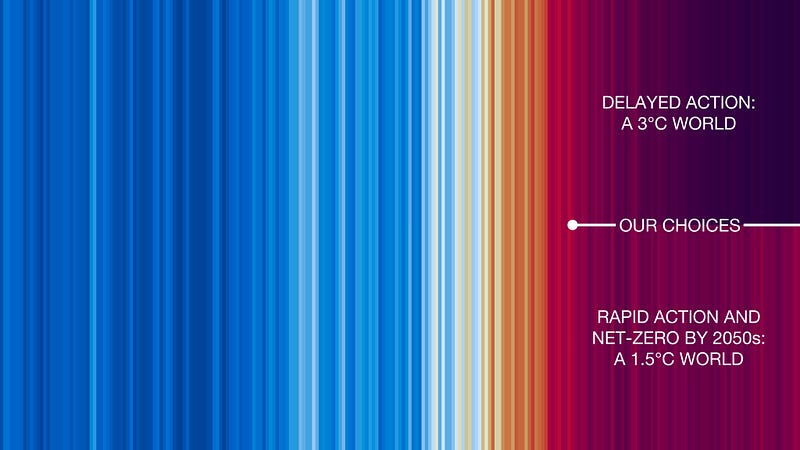
Source: @ed_hawkins

The planet is burning, the oceans boiling, and hurricanes are hitting unexpected locations. People are shocked, shaken, and struggling to understand the situation. How could this happen? Climate change used to be a Hollywood abstraction — now it’s become, all too suddenly, a devastating everyday reality.

And it’s beginning, at last, to enter the collective consciousness.

As it does, a fierce debate breaks out. Just how bad are things?

We don’t have an authoritative estimate of how much climate change is costing because: how can we objectively estimate the cost of Canada’s and Hawaii’s wildfires, ice-melting consequent loss of krill and marine-CO2-absorbing life, floods from Buenos Aires to Frankfurt and China?

The costs are mounting faster than we can count them.

What we’re left with is a spectrum

Morgan Stanley speculated a cost of 650 billion in 2018. A report from Swiss Re estimates climate change to shave as much as $23 trillion by 2050 (11 to 14 % off global economic output). That is an additional 850 billion a year, putting today’s expenses in the best-case scenario of 4,5 trillion.
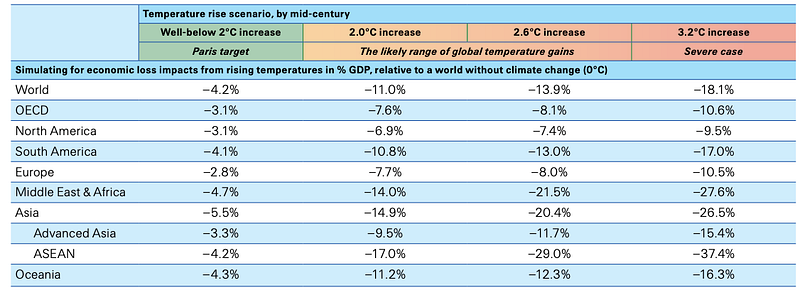
Global temperature rises will negatively impact GDP in all regions by mid-century // Source: The economics of climate change.

These figures, while abstract, hold critical meaning.

Here’s THE fact that everyone should know: even the lowest estimates for climate change costs surpass our investment in fighting it. Let that sink in. It’s the crux of why things are spiraling out of control so rapidly and why the climate crisis is undefeatable. We’re losing more than we’re putting in.

Imagine your house showing signs of wear — leaks, cracks, and damages. Just as you’d repair and maintain it to prevent more significant issues, the same principle applies to the planet. We must invest in climate solutions equal to the costs it’s causing, or we risk a global catastrophe. We should be willing to invest at least as much as climate change costs us to repair it. At least!

Let’s come now to the potential long-term costs of climate change.

A recent World Bank study highlights a potential 25% loss in output. That’s economies shrinking by a quarter by the century’s end. The impact? Almost ten times worse than the pandemic’s worst year, when global GDP shrank by just 3%. The World Bank might be underestimating: we’re heading into a realm, unlike anything we’ve seen.

And we are subsidizing it.

Simplified Explanation: A Troubling Equation

Fossil fuels are far too cheap, considering their production and environmental costs. Globally, they received a subsidy of $5.9 trillion or 6.8 percent of GDP in 2020 — and are expected to increase to 7.4 percent of GDP in 2025. The fossil fuel industry gets subsidies of $11 million a minute. Or, what is even more disturbing is that for every dollar we invest in climate change, we spend at least five subsidizing what is killing us. Like taking cough syrup while living bare-naked in Antarctica. No wonder things are escalating rapidly, and carbon emissions aren’t dropping as they should.
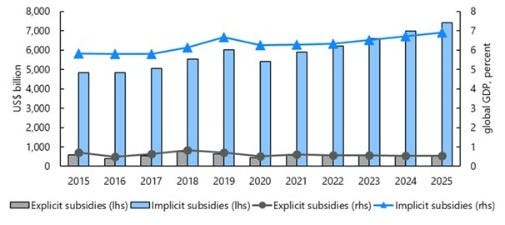
Source: International Monetary Fund

These four irreplaceable materials that sustain our modern world

As Vaclav Smil says, our modern world relies on four essential materials that sustain our way of life, crucial for everything we do. And they all require fossil fuels for their production.

Think about it: our advanced societies wouldn’t exist without certain materials. We had Concord before Facebook. But to maintain our quality of life, these four materials stand out as the building blocks of our modern world: cement, steel, plastics, and ammonia. They’re needed more than anything else.

Each year, we produce about 4 billion tons of cement (2 entire cars-worth of concrete per person), 2 billion tons of steel (2700 Empire State Buildings), 400 million tons of plastics (more than 45 kilos per person), and 250 million tons of ammonia. We spend about 17% of our energy to produce these materials, generating 25% of CO2 emissions from fossil fuel combustion.

Source: OurWorldInData.org

→ Straightforward fact: nitrogen fertilizers, made from ammonia, feed the world. This is more than just comforts, convenience, or wealth; with ammonia, we would have enough food for the growing 8 billion people population. Yet, its production accounts for about 2% of total final energy consumption from fossil fuels, resulting in a CO2 emission equal to South Africa’s.

→ Look around you. Plastic in your hands, pockets, clothes, bottom, all around you. That’s because its demand has quadrupled over the past four decades. But plastic’s environmental impact extends beyond waste pollution; it’s also among the most carbon-intensive fossil fuel-derived materials to produce.

→ From towering skyscrapers to the tools we use, our world would look very different without steel. An average car has about 900 kilograms of steel. And every ton of steel manufactured releases 1.85 tons of CO2, collectively contributing around 8% of global CO2 emissions.

→ The cement industry holds a dubious record as the third-largest carbon emitter. Modern cities are concrete wonders. Bridges, roads, dams — they’re all concrete marvels. And we now consume in one year more cement than during the entire first half of the 20th century.
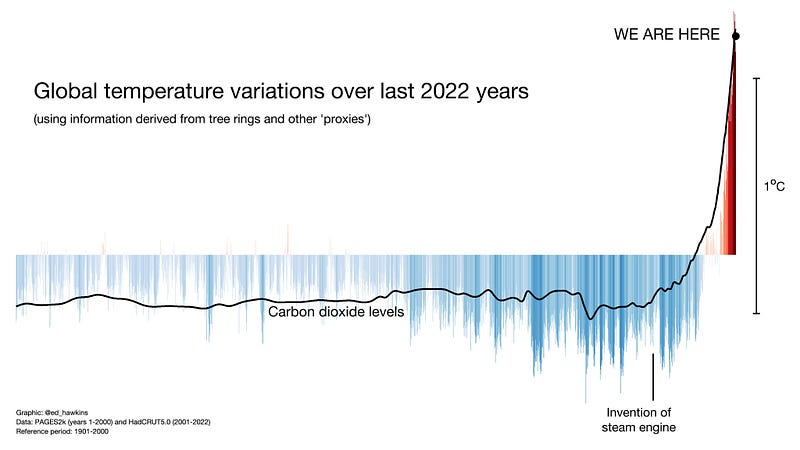
Source: @ed_hawkins

A Common Thread

Here’s what these materials share:

  • They can’t be easily replaced.
  • We need more of them.
  • Fossil fuels are the driving force behind their mass production.

Organic fertilizers are not enough and efficient as ammonia. Nothing offers such malleable advantages as plastics. No mass metal is as strong as steel. Nothing compares to concrete for building infrastructure. Modern life needs materials, and they’re all energy-intensive. In the meantime, we’ll keep needing ammonia, steel, plastics, and cement; right now, alternatives aren’t ready to replace fossil fuels on a large scale. Because we are still indiscriminately investing in them instead of strengthening other cleaner sources of energy.

The reality is paradoxical: our identity is built around consumption, and for that, we are entirely dependent on fossil fuels, no matter if the price we’re paying is the very Earth we inhabit. This game of endless consumption is wearing thin. Our planet, undergoing a feverish state that is bringing it toward the critical 1.5°C global warming threshold, can’t sustain the magnitude of goods we’re accustomed to. Those goods are burning, dying, and melting away supported by…ourselves.

Because we as a civilization seem to be adopting a “change as little as possible and hope for the best” strategy. We are making minor adjustments while pretending everything will be alright.

The solution demands an economic transformation of unprecedented proportions to move away from fossil fuels. You’re probably well aware of this fact. It’s glaringly obvious. But here’s the dilemma: can you see it taking place anywhere? Our current approach to climate change is rendering meaningful progress nearly impossible.

But the truth is simple: pedaling the gas isn’t working, and our planet is paying the price.

Thank you for your thorough reading and support!

If you crave more insights into climate change, scientific progress, and geopolitics with a Patagonian twist, subscribe to the newsletter Antarctic Sapiens and dive into thought-provoking content weekly.

Climate Change
Science
Politics
Environment
Money
Recommended from ReadMedium