The One Book That Help With Mental Health At Work — “No Hard Feelings”
A sneak peek of the book “No Hard Feelings”

We've all been there—that one day at work when everything seems to be going wrong. Maybe you had a disagreement with a coworker, or your project was delayed — whatever it is, it's left you feeling stressed and overwhelmed. It's easy to let emotions get the best of us at work, but managing our mental health is critical if we want to be successful. In this blog post, we'll discuss the book "No hard Feeling" and how it can help us manage our emotions in a professional setting.
What is mental health at work?
Mental health at work can be defined as our emotional and psychological well-being in the workplace. It's not just about avoiding stress or feeling happy all the time — it's about managing our emotions effectively so that we can be productive and successful.
Emotions are an important part of your work-self
We often think of emotions as a hindrance to productivity, but they're an essential part of it. Emotions provide us with information, allow us to communicate with others, and help us make decisions. When we suppress or ignore our emotions, it can lead to problems like decreased productivity, misunderstandings with coworkers, and even job burnout.
In remote work, emotions play an even bigger part
In a remote work setting, it's essential to manage our mental health. Without the traditional office distractions, it can be easy for us to become isolated and overwhelmed. Unfortunately, the temptation to work all hours of the day can also be strong, leading to burnout.
For two years the world we know has drastically changed, and that's especially more true in the office. With working from home being the new norm, setting up boundaries is even more challenging. While I see the value of working from home, it also brings its share of challenges. What you will read in the book will be helpful in every type of work setup. Of course, some examples won't be as accurate today since we are not physically in an office, but we still have interactions with our coworkers, work relationships, stress to manage, and so on.
How does the book "No hard Feeling" help?
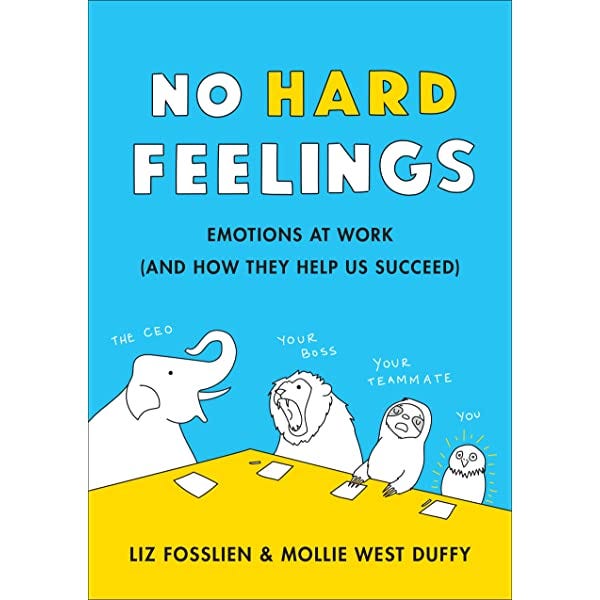
The book "No hard Feeling" is written by Liz Fosslien and Millie West Duffy. It's about emotions in the workplace and how to manage them effectively. The authors interviewed hundreds of people who have experience with emotions at work, sharing their findings in the book.
The book is broken down into multiple sections where the authors will tackle many different topics like Health, Decision making, Communication, Culture, leadership…
Each section includes various tools and tips that can help us manage our mental health at work. One of my favorite things about this book is that it applies to any work setting.
One of the things I like about this book is that it takes a holistic approach to emotions at work. Rather than just focusing on dealing with stressful situations, it also includes chapters on expressing emotions and managing relationships. This makes it a valuable resource for anyone who wants to improve their emotional well.
The book "No Hard Feelings" is an excellent resource for managing emotions in the workplace. It offers practical advice on dealing with challenging emotions like anger, frustration, and disappointment. The authors also discuss coping strategies, maintaining positive relationships with coworkers, and handling difficult conversations.
Below I will discuss some key insights from the book. It's just a sneak peek, and I highly recommend reading the book as the Authors are doing a fantastic job with examples and detailed explanations at making it crystal clear.
Be less passionate about your job, take breaks, take a step back

This is about taking care of yourself while still being into your job. Being less passionate about your job does not mean that you have to be less into it.
No matter what, your health is more important than your job
Always remember that focusing only on one thing (your job in this case) regardless of your health is dangerous. Because the day it does not work anymore, you are left with nothing.
The advice given in the book is primarily common sense, like taking breaks, eating healthy, and getting enough sleep, but it's still good to be reminded of these things. When dealing with stress, the authors recommend that we take a step back and assess our stressors. They also suggest meditation and yoga as ways to manage stress.
Keep yourself motivated and learn how to get back on track

Motivation is one of the most critical aspects of mental health. Let's be real here; we all have moments where we are less motivated — even when we love our job!
The two crucial aspects are how to reduce the likelihood of falling at a low motivation level and how to get back on track if you still lose motivation. The authors discuss a variety of techniques that can help us maintain our motivation, including:
- Setting goals
- Using positive reinforcement
- Keep yourself moving — learn constantly
- Build relationships: you are not alone, have people at work you can talk too
One great tip from the chapter is to find a role model or mentor who can help inspire us to reach our goals. I've found this to be true — having someone I can look up to and aspire to be like is a great way to stay motivated. A mentor can also help you remember the goals you have set up for yourself see the big picture.
Use emotions to your advantage, don't overthink

Emotions can help or hinder our ability to make good decisions. So it can be helpful to think of emotions as data. When we're feeling a certain way, it indicates that something is important to us.
Emotions are data
We often think that emotions are not relevant in the workspace that we should not listen to them. It should not be the case, as in our personal life, emotions can be used to help us understand how we feel about a decision. This does not mean that we have to rely only on emotions to make decisions, but rather that we can use them as a part of the answer.
But beware, some emotions are not helpful! For example, excitement will likely make you too optimistic or even impulsive, sadness could make you lower your expectations, anger also makes you impulsive and overconfident, … When you sense these emotions, take a deep breath and think twice.
Communication and emotions are intrinsically linked

Emotions can help or hinder our ability to communicate. The authors discuss the idea that we should not try to bottle up our emotions but instead express them constructively and helpfully.
One of the main combination of communication and emotion is giving feedback. I won't get too much into details here as there are many articles and books on how to give great feedback. Feedback is an excellent channel of our emotions but should be used carefully. Always think about why you want to give that feedback and make sure you convey your message with empathy and respect.
One good tip also is the authors' advice against using email to communicate when we are feeling emotional as it can often lead to misunderstandings. It is difficult to convey your tone in an email, and emotions are less easy to transcribe. If you need to have a difficult conversation, consider doing it face to face or via phone.
Conclusion
In today's world, managing our mental health is more important than ever. The book "No hard feeling" offers practical advice on how to deal with emotions in the workplace. It's a great resource for anyone who wants to improve their emotional intelligence and maintain their mental health. I highly recommend it! In this blog post, I only highlighted a few of the concepts discussed in this book, mainly those that resonated with me, so don't hesitate to read the full book.
I hope you enjoyed this blog post. If you have any questions or comments, feel free to reach out.
Valentin Mucke
- If you enjoyed it, you can follow me on Medium!
- You can also reach out on Linkedin if you want to connect.
If you're enjoying Medium, please consider using My Referral Link to gain unlimited access to every article, and I will receive a portion of your membership fee at no cost to you!