
The Oldest Customer Complaint In History
3,800 years ago a client sent a very strongly-worded tablet

In the customer service industry, you just cannot avoid complaints: they happen every day, and handling customer complaints in the wrong way can cost you your reputation and, eventually, your business.
To ensure happy, loyal clients you should listen to their criticism and try to resolve the issues they are pointing at… or, you know, you could just keep their money and tell them to get lost, as merchant Ea-Nasir used to do in 1750 BC.
Ea-Nasir was a bigwig international trader dealing in copper ingots, but also buying and selling gold, ivory, coral, lapis lazuli, and occasionally food and textiles. A very versatile businessman indeed — and quite a dodgy one.
His large house, located in the city of Ur (in modern-day Iraq) was discovered during early 20th-century excavations by British archaeologist Sir Leonard Wooley, and more than a dozen tablets were unearthed at the site. Those tablets contained customer reviews — and most of them were not exactly glowing.
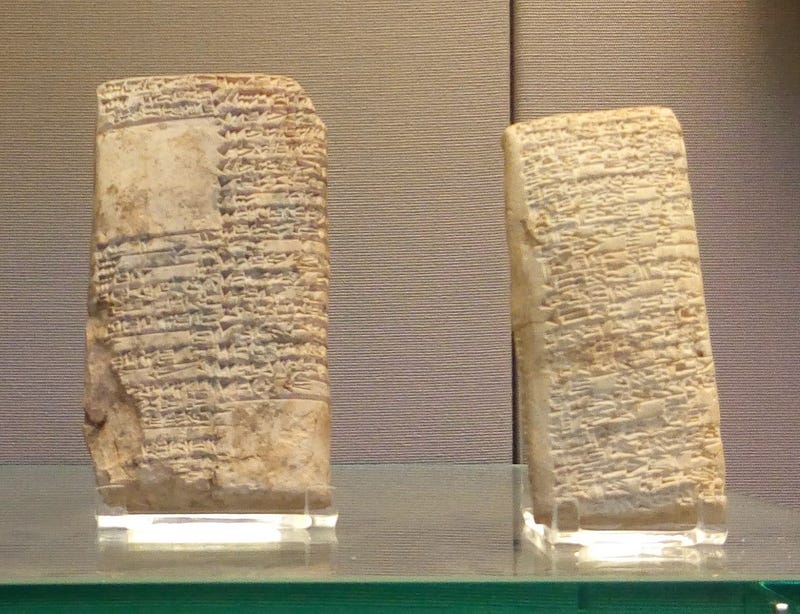
Some guy named Arbituram, for instance, must have been quite irked when he wrote:
“I have made you issue a tablet [a contract]. Why have you not given me the copper? If you do not give it, I will recall your pledges.”
Now, four thousand years ago the process of complaining wasn’t as easy as it is today: you couldn’t send a quick e-mail or call the company to grumble about the fact they lost your order.
You would instead dictate your note to a scribe (a process that could last a couple of hours), and he would painstakingly carve them on a clay tablet. The tablet would then be left to dry and entrusted to a messenger, hoping he would not drop it or handle it too roughly and shatter it into a hundred pieced during the journey. Someone had to then read the tablet to its recipient.
The process was not quick, and it was certainly not cheap. This still did not deter clients from protesting.
Appa, another pissed-off client, told Ea-Nasir
“The copper of mine, give it to Nigga-Nanna [Nigga-Nanna was Ea-Nasir’s business buddy, and another shady character]. Good copper, in order that my heart shall not be troubled.”
Another irate customer by the name Imgur-Sin wrote:
“Now you have had me issue ten shekels of silver. In order that your heart shall not be troubled, give good copper under seal to Nigga-Nanna”
and he concludes with an exasperated
“Do you not know how tired I am of this?”
If that isn’t the Babylonian version of “I’ll leave you a one-star review,” I don’t know what is.
A third one, Ili-Idinnam, sent a sarcastic tablet:
“Now, the work you have done is so good! One year ago, I paid silver in a foreign country; you shall hold back [only] bad copper. Please bring your copper.”
Even one of Ea-Nasir’s business partner, Ilsu-Ellatsu, apparently grew tired of his antics and begged him not to disappoint yet another customer:
“With regard to the copper of Idin-Sin … Show him fifteen ingots, so that he may select six good ingots, and give him these. Act in such a way that Idin-Sin will not become angry.”
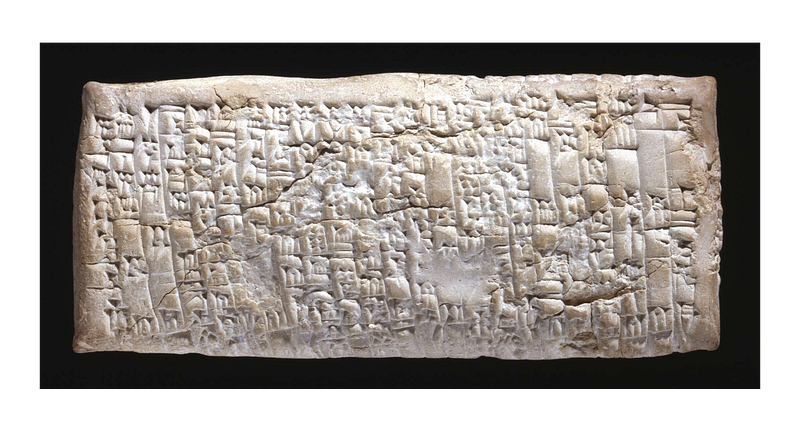
But all of those grievances pale in comparison to the strongly-worded tablet now exhibited in the British Museum. It is about the size of a smartphone, and it miraculously survived for millennia to inform us about just how much of a cheat Ea-Nasir was.
One particularly bad lot of copper ingots was purchased by a customer named Nanni (Nanna was the tutelary god of Ur: he and Nigga-Nanna were named after the city’s patron saint, so to speak)— with his servant Sit-Sin handling the transactions; unfortunately for everyone involved, the copper delivered was of extra-poor quality, and Nanni’s servant complained to Ea-Nasir that he would not accept it.
Now, any guide about how to handle customer complaints would tell you to stay calm, listen to the client’s criticism, acknowledge the issue, and try — when possible — to solve the problem. Clearly, Ea-Nasir had not read one of those guides: he allegedly told Nanni’s servant, Sit-Sin, “If you will take it, take it; if you will not take it, go away.” Rude.
This did not sit well with Nanni, angered both by the bad quality of his purchase and the fact his loyal servant was treated so badly. I’m not sure whether scribes charged by the word: if so, Nanni was willing to shell out quite a lot of money to give Ea-Nasir a piece of his mind.
“What do you take me for, that you treat somebody like me with such contempt?”
he asked, indignant.
“I have sent as messengers gentleman like ourselves to collect the bag with my money. But you have treated me with contempt by sending them back to me empty-handed several times, and that through enemy territory.”
He then went on in the same vein:
“Is there anyone among the merchants who trade with Telmun who has treated me this way? You alone treat my messenger with contempt! On account of that one [measly] mina of silver which I owe you, you feel free to speak in such a way, while I have given to the palace on your behalf 1,080 lbs of copper, and Sumi-Abum has likewise given 1,080 lbs of copper, apart from what we both have had written on a sealed tablet to be kept in the temple of Samas.”
Nanni and Ea-Nasir had sealed their tablet contract in front of religious authorities, as it was often the case; they likely left a copy of the contract in the temple of Samas (the sun god) in case of future disputes — smart move on Nanni’s part, given Ea-Nasir’s rap sheet. Now he was trying to make Ea-Nasir keep his word.
Nanni still wasn’t done with Ea-Nasir, and he demanded a refund:
“How have you treated me for that copper? You have withheld my money bag from me in enemy territory; it is now up to you to restore my money to me in full.
Know that [from now on] I will not accept any copper from you that is not of fine quality. I shall from now on select and take the ingots individually in my own yard, and I shall exercise against you my right of rejection because you have treated me with contempt.”
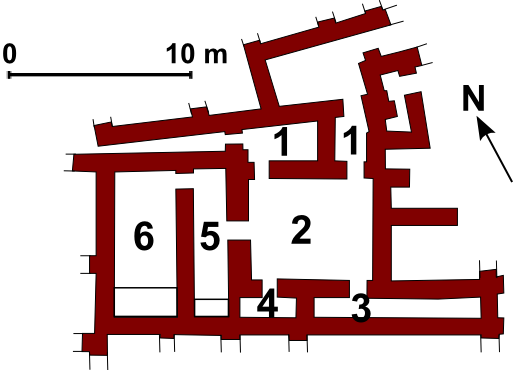
Now, when archaeologists discovered what is believed to be Ea-Nasir’s house, they realized it must have been pretty big, meaning his business was riding high — at least for some time. For context, the rooms identified by the number (1) were entryways leading to the main court (2), then you could find a storage room leading to stairs (3), a lavatory (4), a residential room (5), and another room that was supposedly used as a chapel and an archive, where most of the complaint tablets — about a dozen — were kept (6).
His shenanigans eventually caught up with him, because he was forced to downsize: at some point part of his house was incorporated into the one next door. He was also forced to give up copper and jewelry dealings and get into less lucrative business: namely, he ended up selling second-hand clothing — quite a drop from gold and lapis lazuli.
That being said, maybe think about Ea-Nasir the next time you want to flip off a customer.


