
“The Old Man and the Sea”: It’s Not the Situation, But the Strength of the Spirit
In 1930, Ernest Hemingway nearly perished in a storm, only to be rescued by an elderly fisherman. This fisherman’s tale of a fishing expedition profoundly moved Hemingway. Inspired, in 1951, he crafted a short story of nearly 40,000 words, which upon its release sold five million copies in less than 48 hours, shattering publishing records. This work was Hemingway’s final novel, “The Old Man and the Sea.”
The novel narrates the story of Santiago, an old Cuban fisherman, and his tumultuous journey at sea. Despite being mocked by others, battling a massive marlin, and facing attacks from sharks, Santiago’s unyielding willpower enables him to overcome seemingly insurmountable hardships.
“The Old Man and the Sea” teaches a profound lesson: With a sufficiently strong spirit, there are no dead ends in the world. Hemingway’s tale is not just a story of survival against the odds but a testament to the indomitable human spirit that thrives in the face of adversity.
Life’s Constant is Adversity, Not Tranquility
In Ernest Hemingway’s “The Old Man and the Sea,” Santiago, a fisherman by the sea, faces a stark reality. It’s his 84th consecutive day without a catch, yet not his longest streak, which once lasted 87 days. Every day, other fishermen return with bountiful catches, while Santiago comes back empty-handed. The town whispers of his bad luck, and even the young boy who used to learn fishing from him is sent to another boat by his parents.
With no fish and no income, Santiago struggles even for a meal, often resorting to imagining a pot of fish cooking with yellow rice. Despite the hunger and hardships, he remains undeterred, jokingly saying, “85 is a lucky number. Wouldn’t you like to see me bring back a thousand-pound fish?”
On the 85th day, before dawn, Santiago sets out to sea, aiming far into the horizon with undiminished passion for fishing. This situation mirrors a popular query on Zhihu: “Why do rivers meander instead of flowing in a straight line?” A top answer reads: “Rivers encounter various obstacles in their journey. Only by circumventing these obstacles can they continue to their destination.”
Life is unpredictable, filled with ups and downs. Adversities appear unexpectedly, hindering our progress. However, when you realize that difficulties are just a normal part of life, you understand that overcoming these challenges is the path to your destination. Santiago’s story is not just about fishing; it’s a metaphor for life’s journey, teaching us to navigate through our adversities with resilience and hope.

No Desperate Situations, Only Strong Mindsets
On the 85th day, Santiago, as usual, heads out to sea, this time venturing into waters 700 fathoms deep. Before long, he catches a tuna, boosting his spirits. Soon after, he hooks a massive marlin, but his initial elation quickly turns to realization — this fish is not going to be easy to handle.
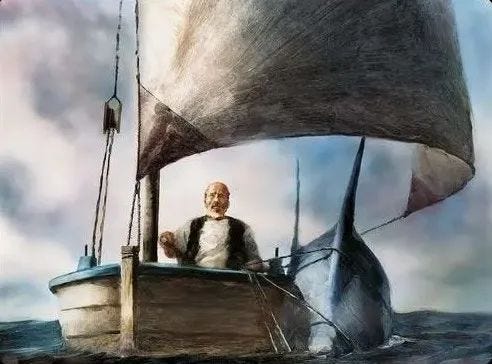
Santiago exerts all his strength in an attempt to reel the marlin out of the water, but instead, the fish drags his small boat further into the open sea. The land, once clearly visible, now vanishes from sight, and the marlin shows no signs of stopping. This moment in Ernest Hemingway’s “The Old Man and the Sea” captures the essence of a pivotal struggle, not just in fishing, but in life itself — a testament to the indomitable human spirit facing seemingly insurmountable odds.
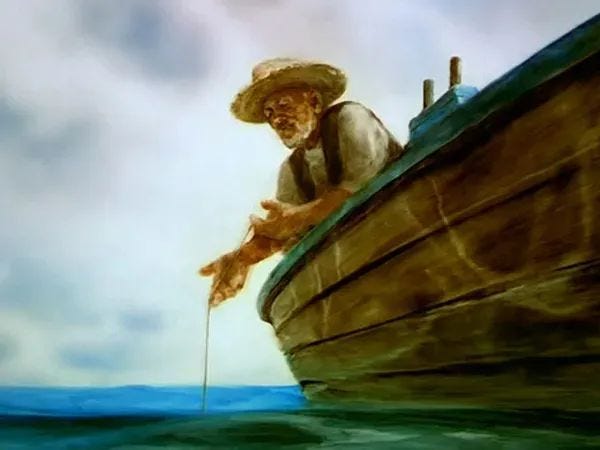
Dragged by the marlin for days and nights on the open sea, Santiago’s physical and mental strength was nearly depleted. The prolonged struggle caused his hands to split and bleed, and his back ached increasingly. Yet, these hardships didn’t deter him from his goal of capturing the marlin; instead, they steeled his resolve. He reassured himself, feeling strong and capable despite the ordeal, and kept his mind clear and focused on his plan.
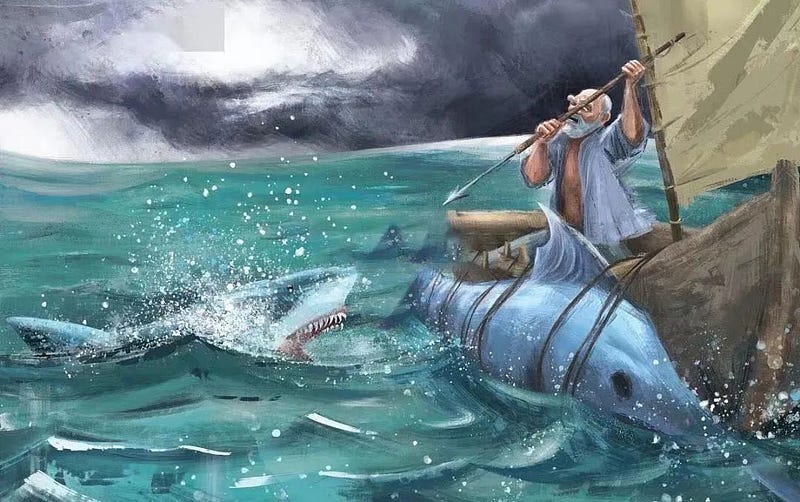
On the third day of the standoff, the marlin surfaced. Santiago seized the opportunity, striking the fish’s heart with his harpoon, finally capturing it. However, the marlin’s blood attracted sharks on his way back. Despite fending off the first shark with his available tools, more followed, each hungrily targeting the marlin. Unfazed, Santiago fought the ensuing sharks with unwavering courage.
As the saying goes, “In the face of ultimate adversity lies the opportunity for rebirth.” People often panic in the face of dire situations, yet few realize that the real adversity is not the situation itself but the feeble mindset in confronting it. The greater the adversity, the more it tests a person’s spirit. Facing such challenges head-on with a heightened mindset is the key to turning the tide and breaking through barriers. Santiago’s story in “The Old Man and the Sea” is not just a tale of survival; it’s a metaphor for resilience and the indomitable human spirit in the face of overwhelming odds.
Though the Body May Be Broken, the Spirit Remains Unconquered
At midnight, Santiago faces another onslaught from a group of sharks. By this point, he has run out of weapons to defend himself. His vision blurs from exhaustion, leaving him to rely solely on his hearing and instinct to fend off the predators with a short stick. When he loses the stick, he wrenches off the boat’s tiller and uses it as a spear against the last shark, which eventually swims away.
Exhausted to the core, Santiago feels an unexpected sense of relief. He reassures himself, “The boat is still intact, undamaged except for the tiller, and that’s easy to replace.” The giant marlin, after repeated attacks by the sharks, is left as nothing but a skeleton. By the time he reaches the shore, all that remains of the once magnificent fish is its bare bones.
This poignant moment in “The Old Man and the Sea” by Ernest Hemingway speaks to the resilience of the human spirit. Santiago’s physical strength may be battered, but his inner fortitude remains unyielding, showcasing the indomitable nature of the human soul against the vicissitudes of fate.
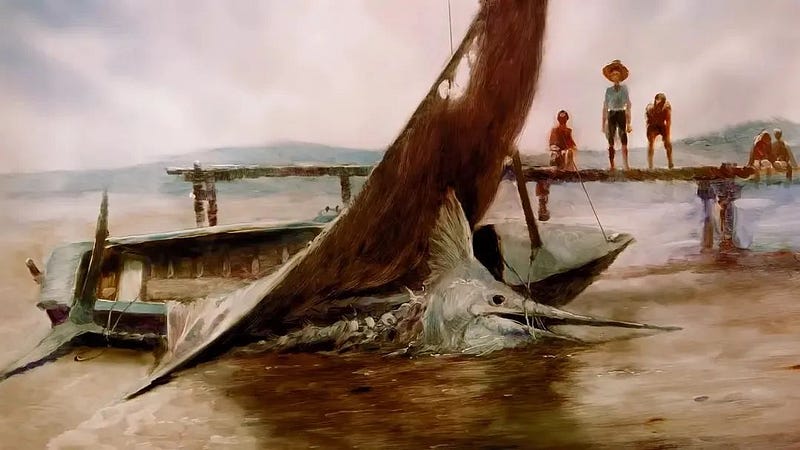
At this point, Santiago no longer cares about the completeness of the marlin. He has conquered both the fish and the onslaught of sharks. The next day, the townspeople gather around the fish’s skeleton, buzzing with chatter. Those who once mocked Santiago now stand in silent reflection. The young boy, previously sent away by his parents, returns to Santiago’s side, resolved to learn fishing from him.
Santiago tells the boy to prepare for their next venture — to get a good spear, sharpen the steel, and ready the fishing knives. It’s clear that Santiago is already planning for his next journey out to sea.
A quote from “Antifragile” encapsulates this sentiment: “Wind extinguishes a candle but energizes a fire.” Life often works in similar ways. Sometimes, we give our all to achieve something, only to fall short of perfection. Yet, the effort we put in becomes etched in our souls. Rather than being a candle extinguished by the wind, it’s better to harness its power and become a blazing fire that burns ever brighter. Santiago’s journey in “The Old Man and the Sea” exemplifies this philosophy, turning challenges into fuel for resilience and growth.
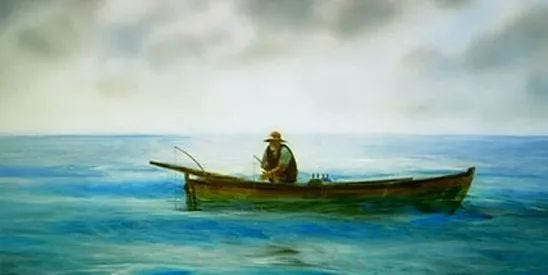
In 1954, Ernest Hemingway was awarded the Nobel Prize in Literature for “The Old Man and the Sea.” To this day, the character of Santiago remains a symbol of perseverance and resilience in the hearts of many. Though Santiago returns with only the skeleton of the marlin, it is a more profound triumph than if he had brought back the entire fish. As the book famously states: “A man can be destroyed but not defeated.”
Santiago may not have had what many consider good fortune. To some, he might seem just an unlucky old man. Each of his challenges could have been enough to overwhelm anyone. However, it was his powerful mindset that turned the tide in his favor. Lu Yao in his novel “Life” writes, “Life is such that it can’t always satisfy us, but we must continue to live it with passion.”
Indeed, everyone encounters similar challenges in life. In facing these challenges, what we need to learn is to elevate our mindset. Maintaining a strong mentality ensures that even the most daunting difficulties will ultimately be overcome. Santiago’s story in “The Old Man and the Sea” is not just a narrative about a fisherman; it’s a metaphor for the human spirit’s capacity to confront and surmount life’s adversities.