
The Offense of the Lord’s Supper
How this practice actually creates division
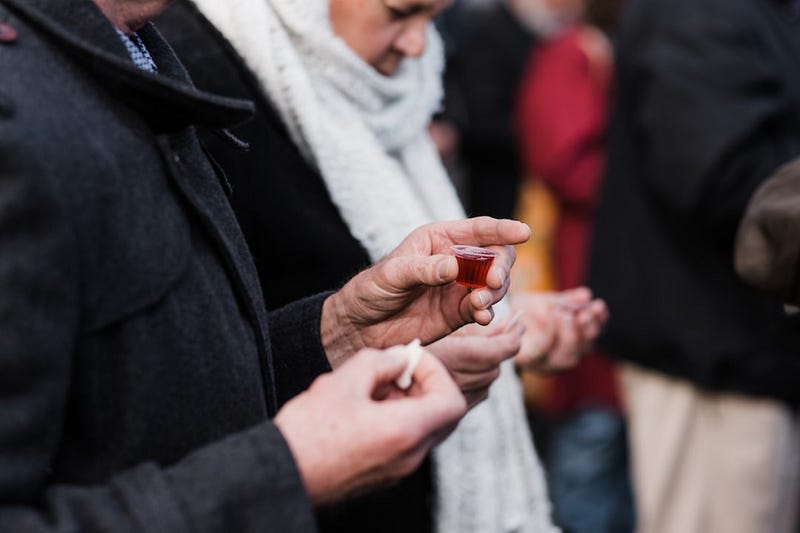
I don’t think I will ever forget the time an entire family stood up and walked out of our church service.
It wasn’t that I said something offensive in my sermon.
It was how we administered the Lord’s Supper.
I began by reading the typical passage for the bread and the cup from 1 Corinthians 11:23–26. Then I issued the warning that follows.
“Whoever, therefore, eats the bread or drinks the cup of the Lord in an unworthy manner will be guilty concerning the body and blood of the Lord. Let a person examine himself, then, and so eat of the bread and drink of the cup. For anyone who eats and drinks without discerning the body eats and drinks judgment on himself.” (1 Corinthians 11:27-29 ESV)
I explained that certain people should abstain from taking the Lord’s Supper.
- Anyone who has not received Christ as Lord through baptism.
- Anyone is not a member of a local church.
- Anyone who is not in good standing with their local church.
These restrictions may give pause to some of you reading this post, but they all have biblical merit.
Members of a Local Church
Paul tells the church of Corinth that taking the bread is a participation in the body of Christ.
“The cup of blessing that we bless, is it not a participation in the blood of Christ? The bread that we break, is it not a participation in the body of Christ?” (1 Corinthians 10:16, ESV)
At first glance, it seems that Paul is merely talking about Jesus’ physical body. But in the following verse, he clarified that he is speaking of the local church.
“Because there is one bread, we who are many are one body, for we all partake of the one bread.” (1 Corinthians 10:17, ESV)
That is, our participation in the Lord’s Supper in not merely an individual communion with Jesus, but also a communion with the church body.
While believers from other congregations should be welcome to participate, the Lord’s Supper is intended to be exclusively for those people who are part of a church.
In Good Standing
But suppose a believer is under church discipline with his own congregation? The Bible says that a local church should restrict such fellowship from professing believers who are in unrepentant sin.
Jesus first said this.
“If he [a brother in unrepentant sin] refuses to listen to them [other believers confronting him], tell it to the church. And if he refuses to listen even to the church, let him be to you as a Gentile and a tax collector.” (Matthew 18:17, ESV)
Paul later affirmed the same.
“But now I am writing to you not to associate with anyone who bears the name of brother if he is guilty of sexual immorality or greed, or is an idolater, reviler, drunkard, or swindler — not even to eat with such a one.” (1 Corinthians 5:11, ESV)
What do the words “not to even eat” mean? Certainly it would apply to social meals and meals in the home, but it would apply to the Lord’s Supper as well.
Now suppose that a man in his own church has fallen into a sin, refused to repent of it, and his church — rightly — applied the principles of church discipline; they forbid him to participate in the Lord’s Supper.
Suppose this same man decided to visit your church instead. Would it be right for your church to undermine his church’s authority by allowing him to partake where they forbid it?
Of course not.
This is why it matters that we clarify who should partake.
One Caveat
I should perhaps clarify that neither I nor any other member of our church have monitored who took the Lord’s Supper. This is not my job.
As the Scripture above noted, “each person must examine himself.”
But I do have a responsibility to warn those who partake, because, “anyone who eats and drinks without discerning the body eats and drinks judgment on himself.”
Paul actually says that it is for this reason some in the church of Corinth have gotten sick or died.
“That is why many of you are weak and ill, and some have died.” (1 Corinthians 11:30, ESV)
So those who hold a different view of the Lord’s Supper, if they partake, I leave it to the Lord to judge whether they have done so in a worthy manner.
Why the Lord’s Supper Offends Us
In the United States, in particular, we hold the equality of all people as one of our highest ideals.
In many ways, this is a good thing.
People should receive equal access to employment, education, voting, etc. regardless of gender, ethnicity, religious beliefs, or sexual orientation.
But God does distinguish between people. He regards those who follow Him differently than the rest of the world.
Even a cursory reading of the Old Testament will show God’s preference for Israel above other nations.
“Then once more you shall see the distinction between the righteous and the wicked, between one who serves God and one who does not serve him.” (Malachi 3:18, ESV)
But even in the New Testament, God distinguishes between sheep and goats…
“Before him will be gathered all the nations, and he will separate people one from another as a shepherd separates the sheep from the goats.” (Matthew 25:32, ESV)
…between sons and slaves…
“Jesus answered them, “Truly, truly, I say to you, everyone who practices sin is a slave to sin. The slave does not remain in the house forever; the son remains forever.” (John 8:34-35, ESV)
…between children of God and children of the devil.
“By this it is evident who are the children of God, and who are the children of the devil: whoever does not practice righteousness is not of God, nor is the one who does not love his brother.” (1 John 3:10, ESV)
We want to believe that God accepts every person just as they are, but nothing in the Bible remotely suggests this.
In our sin, we are separated from God and counted as his enemies.
It is only through the death and resurrection of Christ that we can be counted righteous before God, when we follow Jesus as Lord.
“Or do you not know that the unrighteous will not inherit the kingdom of God? …But you were washed, you were sanctified, you were justified in the name of the Lord Jesus Christ and by the Spirit of our God.” (1 Corinthians 6:9, 11 ESV)
The offense of the Lord’s Supper is the offense of the gospel.
The Lord’s Supper reminds me that, though I am unworthy to come into God’s presence, I have been covered by the righteousness of Christ.
This is why we celebrate his death until he comes.
Live for Jesus.