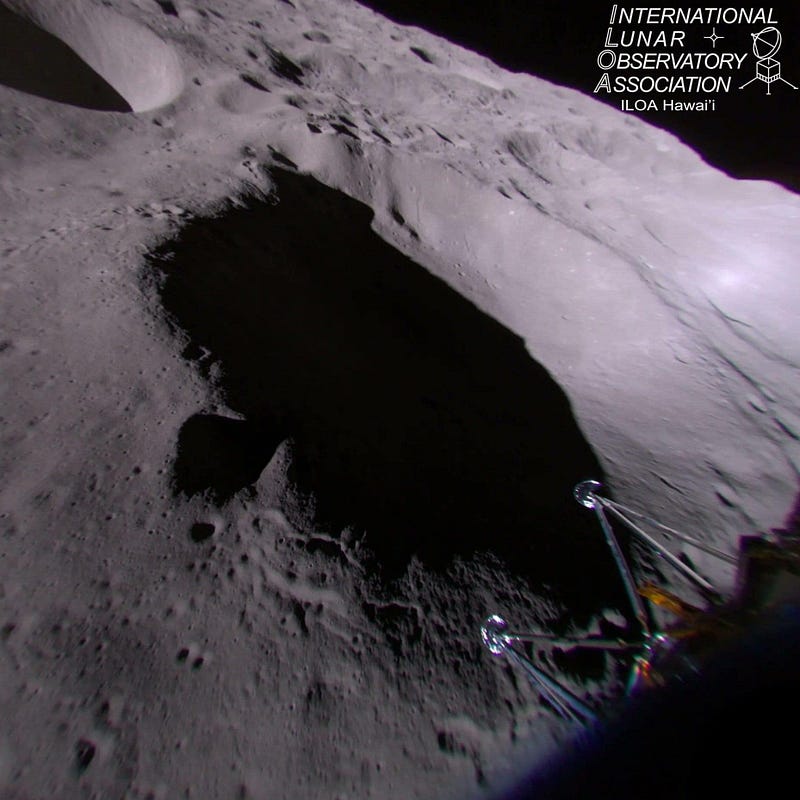
The Odysseus mission took this shot just before its mostly successful landing
Gotta love this oblique shot.
I’ve been looking forward to high-res oblique footage from lunar orbit just about since the Apollo days.
It tipped over, but I just love the idea we’ll be exploring this place (i.e. the moon) soon with the upcoming human landing NASA Artemis-SpaceX-HLS missions.
And congratulations to Odysseus and Intuitive Machines. And SpaceX for another successful launch.
FYI Background & news
ChatGPT-4 generated based on its lookup of the latest news
Background
The Odysseus mission, executed by Intuitive Machines, marked a significant milestone in lunar exploration, being the first United States moon landing in over 50 years and the first commercial spacecraft to achieve a soft landing on the moon.
The Nova-C lunar lander, approximately the size of a British telephone booth with legs, stood 4.0 meters tall and 1.57 meters wide, carrying a total of 100kg of payloads. This included five NASA payloads focused on demonstrating communication, navigation, precision landing technologies, and gathering scientific data on various lunar surface interactions, as well as one commercial payload. Among the notable items aboard was a box from American artist Jeff Koons, containing 125 small stainless steel balls representing the moon’s different phases, intended to honor significant historical achievements.
The mission launched on February 15 from NASA’s Kennedy Space Center in Florida aboard a SpaceX Falcon 9 rocket. After reaching Earth’s orbit and separating from the rocket, the lunar lander navigated through space using an onboard stellar map for orientation, with the goal of operating on the moon for seven days. However, the mission encountered a potentially critical issue when the craft’s laser navigation system failed, requiring the use of an experimental NASA laser system, the Navigation Doppler Lidar, for landing guidance.
This last-minute switch proved successful, and Odysseus landed on February 23 at 6:23pm EST (23:23GMT), beginning its 73-minute descent to the lunar surface after a 400,000km journey.
Landing
Despite initial concerns due to a delay in establishing communication, the lander was confirmed to be transmitting data shortly after landing.
The Odysseus lunar lander, developed by Intuitive Machines, encountered an unexpected setback after its historic touchdown on the lunar surface, as it ended up resting on its side.
Despite this challenge, the lander remains “alive and well” and continues to transmit data back to Earth. This incident occurred after the lander apparently tripped over its own landing feet due to uneven lunar terrain, causing it to tip over and come to rest propped up on a rock. However, the mission team has maintained communication with Odysseus and has been successful in analyzing data from both the commercial and scientific payloads aboard the spacecraft.
Although the lander’s sideways orientation has limited some of its capabilities, notably affecting one of its solar panels and two of its antennae, the mission is still deemed a success. The majority of the NASA science and technology payloads mounted on the vehicle remain exposed and functional for communication. The second solar array on the spacecraft’s side appears to be operational, ensuring that the lander’s batteries remain charged.
Future
This mission represents several significant firsts, including being the first commercially-built lander to reach the lunar surface and the first American spacecraft to do so since the Apollo era. Despite encountering 11 “mission critical” challenges throughout its journey, including communication delays and issues during burn maneuvers, the mission has provided valuable insights into the operation of its liquid methane and liquid oxygen propulsion system in deep space, now proven in flight.
NASA views the Odysseus mission as laying the groundwork for future commercial partnerships in space exploration. As part of NASA’s Commercial Lunar Payload Services program, this mission has contributed valuable data that will support the agency’s Artemis moon missions and eventual trips to Mars. The success of Odysseus, despite its landing position, underscores the potential for commercial entities to play a crucial role in the exploration of lunar and beyond.
The landing of Odysseus is part of a broader initiative by NASA to prepare for future human exploration of the moon, specifically targeting the moon’s south pole believed to contain water ice. This exploration is aimed at gathering vital data to support the establishment of a permanent lunar base and to serve as a launching point for future missions to Mars. The mission represents a shift in how space exploration is conducted, emphasizing commercial partnerships and the development of a lunar economy, where private companies play a significant role in advancing lunar exploration.