The Oceans are Dying
The limits of an “infinite” sink.
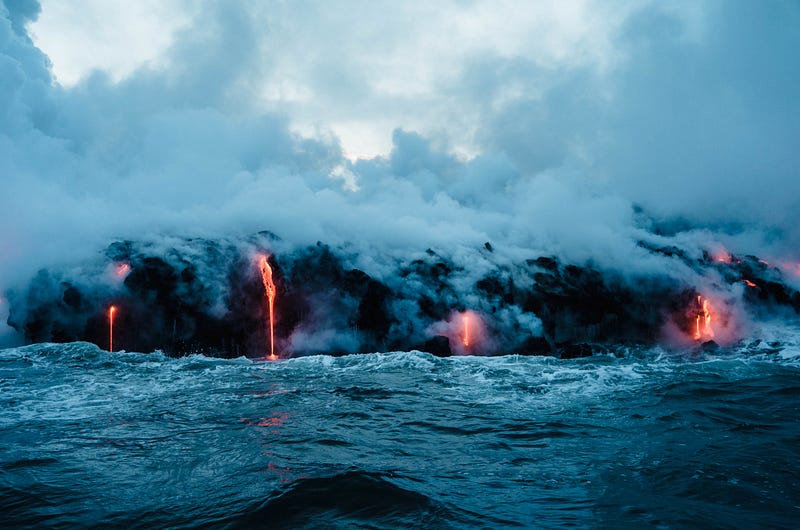
Since the beginning of life on earth, the oceans have had a perceived limitless capacity to absorb and dilute anything that was put in them. Even as early as last century, we thought that “the solution to pollution is dilution”, and dumped our way into compliance.
Not anymore.
We have finally found that the ocean does have a limit. But it’s not a limit of pollutants, or waste, or even oxygen.
It’s heat.
The oceans of the world are warming up, and it’s killing almost everything that lives in them.
Hundreds of Gray Whales are Wash Up Dead
There have been some fairly recent instances of gray whales washing up dead. Two previous cases were 1987–1989 and 1999–2000. In both those times, the main culprit was increased sea ice blocked their migratory path to cooler waters up north.
However, the current instance of gray whale deaths (688 so far) is from the opposite effect: decreased sea ice.
Unlike the two previous events, a historic loss of Arctic sea ice could be to blame for the latest gray whale die-off. That’s because sea ice hosts a carpet of algae on its underside, which decays and showers the seabed with food for bottom-dwellers, including the whales’ preferred crustaceans.
“With less ice, you get less algae, which is worse for the gray whale prey,” Stewart said. Melting sea ice also frees up passage for strong currents that sweep away the sediment and leaves bottom-dwelling crustaceans and other creatures homeless. “All of these factors are converging to reduce the quality and availability of the food [gray whales] rely on,” he said.
The decreased sea ice is due to the overall climate warming, and it contributing to a feedback loop that will decrease sea ice even further.
Sea ice reflects light (heat). When there is not enough reflection, more heat gets to the ice, melting more of it, resulting in more heat, resulting in less ice, etc.
Be ready to see more gray whale deaths in the near future.
The Antarctic Will Melt. Period.
Speaking of sea ice, the southern hemisphere is seeing the same problems as the north, as the Antarctic ice shelves will soon be gone. A recent study shows that no matter what happens with fossil fuel emissions in the next decades, the ice shelves will collapse.
We find that rapid ocean warming, at approximately triple the historical rate, is likely committed over the twenty-first century, with widespread increases in ice-shelf melting, including in regions crucial for ice-sheet stability. When internal climate variability is considered, there is no significant difference between mid-range emissions scenarios and the most ambitious targets of the Paris Agreement. These results suggest that mitigation of greenhouse gases now has limited power to prevent ocean warming that could lead to the collapse of the West Antarctic Ice Sheet. (emphasis added)
The reason for this is that we have already emitted enough CO2e to permanently change our climate, and remediation efforts will take decades to start to reverse those emissions.
…while mitigation of the worst-case climate change scenario still has the potential to reduce Amundsen Sea warming, it will probably not make a difference for several decades. By this time, the impact on some glacier basins of the WAIS could be irreversible, even if ocean temperatures then returned to present-day values.
The study suggests that water temperatures in the Amundsen Sea could increase by at least 2C, which, as you’ll see below, has devastating results not just in ice loss but also animal habitats.
Billions of Snow Crabs Disappeared
While a few hundred gray whales dying over three years sounds bad, it’s nothing compared to the billions (with a “B”) of snow crabs that died, just in 2022.
Come to find out, since crustaceans are cold blooded, their metabolism is regulated by their environment. Most snow crabs live in very cold waters in the Arctic, with temps hovering around 35F.
The problem is that in 2022, the temperature of their habitat raised to around 40F. That might not mean a lot to us warm blooded folks, but it meant a hell of a lot to the snow crabs. Their metabolism is estimated to have quadrupled!
Combine the increased need for food with higher than expected birth rates in the preceding years, and you have a disaster in the making.
Unfortunately, there simply wasn’t enough food to meet the demands of this larger, hungrier population and many of them starved to death. This theory is further supported by the fact that crabs caught after the heat wave began had smaller body sizes than those caught in years prior.
“From 2017 to 2018, the calories they needed quadrupled,” Szuwalski tells NewScientist’s Chen Ly.
In addition, other species likely took advantage of the crabs’ plight. The warmer water temperatures likely allowed other species, such as Pacific cod, to move into the normally frigid crab habitat and feast on the few hungry crustaceans that remained.
And it wasn’t just crabs. Salmon, seabirds, and seals all saw drastic, albeit not catastrophic, population declines.
Nothing lives in a vacuum in this world, and when billions of one animal die, there will be impacts.
There Is Nowhere to Run
If you thought that maybe you could ride out climate change in a remote, coastal outpost in Alaska, then the snow crab disaster just proved you wrong.
The same is true to the continental USA, as there is no true “climate haven” left. Everywhere will be impacted negatively. The best you can do it figure out how to deal with the crises in your area.
Some of the most cited “havens” in research by national organizations and in news media are older cities in the Great Lakes region, upper Midwest and Northeast. They include Ann Arbor, Michigan; Duluth, Minnesota; Minneapolis; Buffalo, New York; Burlington, Vermont; and Madison, Wisconsin.
Yet each of these cities will likely have to contend with some of the greatest temperature increases in the country in the coming years. Warmer air also has a higher capacity to hold water vapor, causing more frequent, intense and longer duration storms.
The other main factor to look at when evaluating where to live is infrastructure.
Most of our cities were built up during the Industrial Revolutions and post-World War II. That’s 120 and 70 years ago.
As someone who has worked for state, city, and local government, it’s also one of the biggest worries for elected officials, but it’s also the one that gets kicked down the road most often because of the astronomical costs to fix these systemic issues.
If you’re looking to move to adapt to climate change, take a look at what the local public works board has been up to the past few years.
The Takeaway
Climate change is heating up the entire world.
Land. Water. Air. Ice.
It’s all coming apart at the seams, and there’s not much that we, the lay persons of the world, can do about it. Take time to look around you and realize that we’re all in this together.
And it’s not like this is old new, either. It was reported that ocean temps were rising faster than even the worst case scenarios predicted back in 2019. Someone might have cared back then, but COVID hit in 2020, and everyone stopped paying attention.