The “Not All” Argument Is Tired and Doesn’t Apply Anywhere
Many Americans have been conditioned to scan arguments for fabricated flaws rather than recognize any kernel of truth
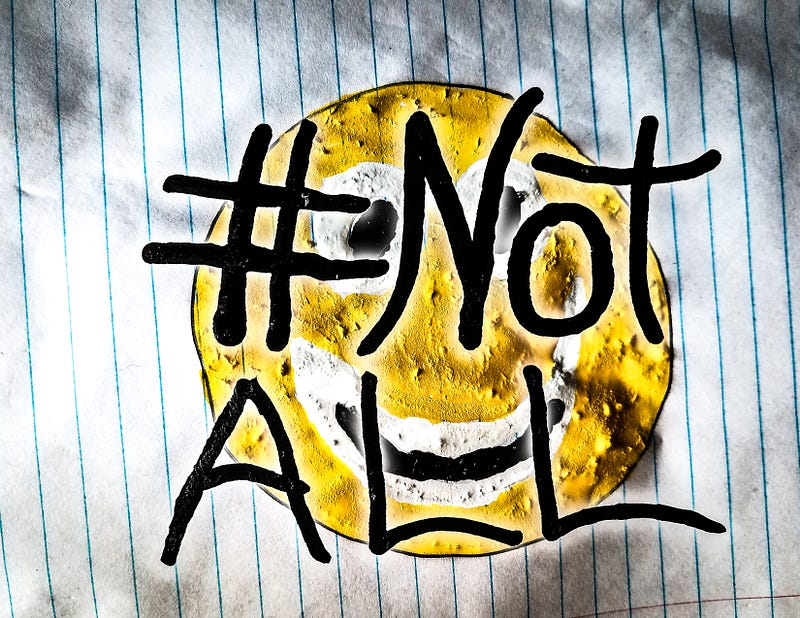
I got into another ridiculous argument on social media recently. There was a meme that contained the phrase, “The media is often biased.” Somebody posted, “As a member of the media, I take strong exception to the suggestion that the media posts biased content.”
I replied, “Have you ever watched Fox News? That’s ‘the media,’ and I consider it a propaganda tool that is used to indoctrinate people. I believe they post biased content all the time.”
The person went on to suggest that even though there were a few examples of bias, it was wrong to imply that all media members were biased.
“Since when is offering pointed criticism an indictment of an entire population?” I asked.
Unfortunately, that’s the false implication that’s frequently used to sabotage any form of potentially productive discourse.
Whether it’s in regard to racism, misogyny, or media bias, I’ve yet to come across an example of the “not all” argument being deployed honestly. The word “all” rarely appears in any headline or meme that false actors find objectionable. The problem with the “not all” response is that it allows stubborn people to dig in and refuse to relent because they feel they have their back up against the wall of irrefutable truth.
Perhaps they do; it’s just that the hill they picked to die on is completely irrelevant.
#Notallmen
This is the first one, and it even got its own hashtag. You see, people leave their “not all men” comments on any discussion about how poorly men treat women in our society.
Do we really need more examples of how awful society can be for women? A poor woman was just abducted and murdered while out on a run in Memphis. When was the last time you remember a man getting abducted and murdered while he was out on a run?
On top of that, you have a whole group that feels they need to victim shame by saying she shouldn’t have been out running so early in the morning. Nobody needs to be making that argument. The focus needs to be on the fact that women in our society have to go through every day of their lives, worried that they’ll be attacked.
A few months ago, a 10-year-old girl was assaulted and murdered in my community. I have two daughters who are about that age. At this point, I have zero compassion for men who have their feelings hurt when they see a headline that says, “Women are fearful of being attacked by violent men.”
If your takeaway is, “Well, not all men are violent!” instead of even a flicker of compassion over the traumatic, life-changing assaults women are faced with, then you’re a jerk.
The best way to prove your “not all men” argument is to put aside your own personal insecurities and do the work to show you’re on the right side of history.
Not all white people
Somebody wrote an article about how there’s even racism against black dogs. People are less likely to adopt black dogs.
Of course, almost immediately, somebody got their “feelings stepped on” and they chirped in with, “not all white people refuse to adopt black dogs; I adopted a black dog.”
Sigh…
Great! If you’ve adopted a black dog, good for you. Obviously, the article doesn’t apply to you. Why are you angry about it?
They could have written, “This is so sad. We adopted a black lab from the shelter a few years ago, and he brings a huge amount of joy to our lives!”
There’s no need for the “not all” statement because it’s idiotic and redundant.
You see it a lot in the comments section on any article about racism. People say things like, “Let’s pump the brakes there, buddy, I’m sympathetic to your point about racism, but first, I advise you to make your argument in a way that can’t possibly offend anyone, otherwise, you’re part of the problem.”
This is an intellectually dishonest statement It is impossible to write anything that doesn’t offend someone. Incidentally, the phrase “you’re part of the problem” really irritates me too.
All white people are racist
I have absolutely no objection when people write, “All white people are racist,” because it’s the truth.
“Well, you’re white, are you aware that comment applies to you?”
Yes, I’m deeply and painfully aware that I’m a flawed human being. We’re so indoctrinated with unjust and evil attitudes that we repeat them without even thinking about it. How often have you heard somebody say, “Well, my parents used to spank me, and I turned out okay.”
No! No, you didn’t turn out okay. You’re a mess. Recognize that you’re a mess! On any given day, I’m fully aware that I’m not good enough as a parent, I’m not good enough as a man, I’m not good enough as a husband, I’m not charitable enough in my beliefs, I’m not vocal enough in my responses to injustice. The criticism makes me better. The criticism isn’t unfair. The world is unfair. It’s not about you.
When you finally manage to pin somebody under the weight of logic, they’ll often reply, “Well, there was only one perfect human being and his name was Jesus Christ.”
This argument is usually allowed to stand, but where is the objection that “not all people are inferior to Christ?”
We’ve been programmed to understand that a “not all” response to this statement is inappropriate. This isn’t logic at work, it’s social conditioning. When I said we were indoctrinated with unjust and evil attitudes, this is an example.
When a member of a church says, “everyone is a sinner,” nobody objects to “not all people.” The reason is that everyone knows “not all” is not a sincere argument. It’s only used by false actors.
People who cling desperately to illogical arguments
Early on in the pandemic, I had a conversation with my conservative cousin. He’d been petulantly opposed to wearing a mask or practicing social distancing. At the time of our conversation, it was clear that his behavior had been in the wrong. Wearing a mask and practicing social distancing was a small thing to ask, and it saved lives.
“Well,” he muttered to himself, “you shouldn’t believe everything the government tells you.”
I just shook my head. On many instances, I’ve managed to talk people right up to the brink of a rational conclusion, only to have them retreat to the comfort of some “irrefutable” belief.
What causes this? In my opinion, it’s largely due to a lack of education. So many people in our society are conditioned to do what they’re told rather than apply their own logic.
With the benefit of hindsight, it was clear that my cousin had done the wrong thing. His actions were irresponsible. He might have gotten people killed. He should have recognized his failings and adjusted his behavior accordingly.
But instead of doing that, he retreated to his prepackaged kernel of truth. “Don’t believe the government.” In his mind, that statement was an absolute, and he could use it to overrule any sense of wrongdoing. In his mind, it was his duty as a decent human being to defy the government. That was his conclusion, and once he arrived at that conclusion, there was no changing his belief.
Digging in your heels
Perhaps all of this is a result of too many standardized tests. One test-taking strategy is to look for the answers that are clearly false and eliminate them. Eliminating wrong answers improves your odds of selecting the correct one.
But what is effective as a test strategy is not effective in real life, particularly when you believe absurd generalizations that compel you to eliminate correct answers.
I think people who lack confidence in their own ability to reason seek out mental markers that they can use to guide their actions. “Rather than take any time to reflect on the argument, I’m going to scan it for the use or implication of the word ‘all,’ and then dismiss it based on the logic that generalizations are always wrong.”
A different cousin hit me with that argument one time. I’ll never forget the look on her face when I replied, “Saying ‘generalizations are always wrong’ is a generalization.”
That actually shut her up. That’s the only time it’s happened, but this argument pops up everywhere. The problem is that most of the time it’s disguised by absurd and illogical hand-waving. Many conversations you get into can be compared to a massive equation that cancels out to nothing. Sure all the coefficients and variables might look impressive, but if you take the time to solve it you realize there is nothing there.
But most people don’t trust their own ability to do the math.
Embrace the complexity
One of the few things I remember from the one journalism class I took in college was that every story contains bias. Even if you write a completely unbiased article, the fact that you picked the topic of that article at the exclusion of others represents bias.
Bias is unavoidable. The so-called “journalist” who objected to the meme in my first example should have known that.
Everyone always wants to oversimplify all the problems confronting our society. It’s easier to blame poor people for being lazy. It’s easier to blame assault victims for being reckless. It’s easier to blame the government rather than take responsibility for your actions. The problem is that all of those arguments are too generalized to be trusted in specific scenarios.
Saying “not all” doesn’t add anything. It would be nice if everyone in our society understood that “not all” is deployed as a diversion tactic to put a halt to productive discourse.
When people get stuck on a perceived truth to the point where they disregard all facts and evidence, intellectual progress comes to a grinding halt. Our society has evolved to a point of complexity where rigid thinking is no longer adequate for solving the problems that confront us. We are no longer hunters and gatherers. We have more choices than simply “off” or “on.”
Outdated thinking that tries to force oversimplifications on complex issues hurts us more than it helps. Keep that in mind the next time some false actor tries to shut you down with a “not all” comment. They’re dug in and are willing to die to defend some oversimplified and inapplicable version of the truth.
Don’t feel any obligation to engage. It’s not your job to convince them. It’s your job to embrace a larger worldview that appreciates the complexity and the beautiful diversity of life.
Subscribe to my emails here.
Sign up to Medium via my referral link here, and THANK YOU!