
The Nobel Connection — Curie Backs Einstein’s Genius
A Glimpse Into the Intersecting Paths of Two Scientific Giants
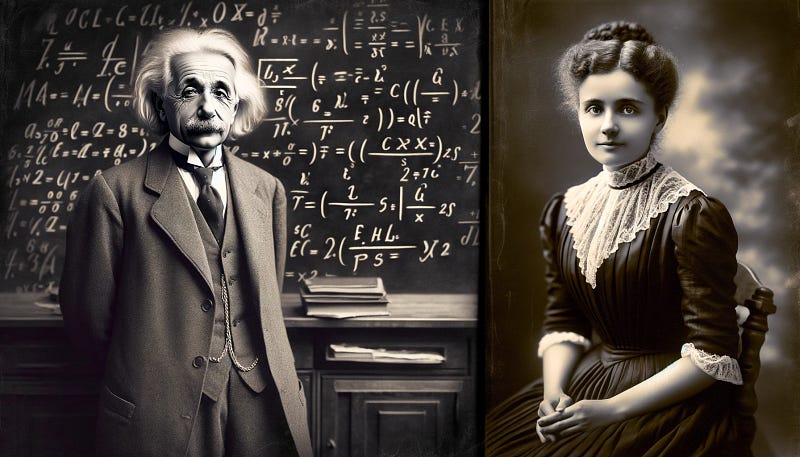
“Nothing in life is to be feared, it is only to be understood. Now is the time to understand more, so that we may fear less.”
During our time of preparing application materials for higher degrees, research positions, fellowships, jobs, etc we need our advisors and mentors to write good words for us.
Letters of recommendation are an essential part of an application procedure as they allow another person to speak for you, to vouch for your experience apart from the rest of the information that portrays who you are.
In this way, the selection committee can better understand your character, future aspirations, career development plan, etc. And I must mention, that it’s not just a formality; it needs proper thought beforehand.
So, it’s always better to ask someone with whom you have an excellent work relationship, who sees your value and can advocate for your ethics. You need to make sure that the person you are asking to recommend yourself is doing it with genuine intentions and with clarity in their mind that you are undoubtedly best suited for the coveted post.
Also, professors love to endorse their favorite students.
At some point in his life, Albert Einstein (1879–1955) — the legend himself, needed someone else’s affirmation when he wanted to apply for a post of professorship at ETH Zurich in the year 1911. He was 32 at that time and was already serving as a professor at a reputable Charles-Ferinand University in Prague, Czech.
Despite his popularity and previous track record, he needed to convince the officials at ETH of his worthiness. So, Einstein thought about reaching out to two of the most distinguished and eminent scientists to write a few words about his suitability; Marie Curie and Henri Poincaré. They both happily wrote for him and he arrived in Zurich a few months later.
Marie Sklodowska Curie (1867–1934), as we all know, was the first female Nobel Laureate who was awarded the prize in two different fields i.e. physics and chemistry. She worked closely with her husband Pierre Curie (1859–1906) and did pioneering work in radioactivity and discovered two important radioactive materials; polonium and radium.
The interaction between Curie and Einstein started in 1909 and after that, they both worked and socialized together in many different instances and attended many international conferences together.
The Letter in Support of Young Einstein
From Marie Curie Paris, November 17, 1911
Dear Sir,
I have just received your letter, in which you asked for my personal impression of Mr. Einstein, whom I recently had the pleasure to meet. You also say that Mr. Einstein wishes very much to return to Zurich and could soon have the opportunity to do so.
I have often admired the papers published by Mr. Einstein on issues dealing with modern theoretical physics. Moreover, I believe that theoretical physicists agree that these papers are of the highest order. In Brussels, where I participated in a scientific conference in which Mr. Einstein also took part, I was able to appreciate the clarity of his mind, the extent of his documentation and the depth of his knowledge. If we consider that Mr. Einstein is still very young, we are right to have great hope in him, and to see him as one of the leading theoreticians of the future. I think that the scientific institution willing to give Mr. Einstein the work he desires, either by appointing him an existing chair or by creating for him the chair in the conditions he deserves, could be greatly honored by such a decision and would certainly be providing a great service to science.
If, by offering my opinion, I could by a small measure contribute to the solution desired by Mr. Einstein, I would be extremely pleased.
Accept, I beg of you, dear Sir, the assurance of my best wishes.
M. Curie
Faculty of Sciences, Paris (General Physics Laboratory)
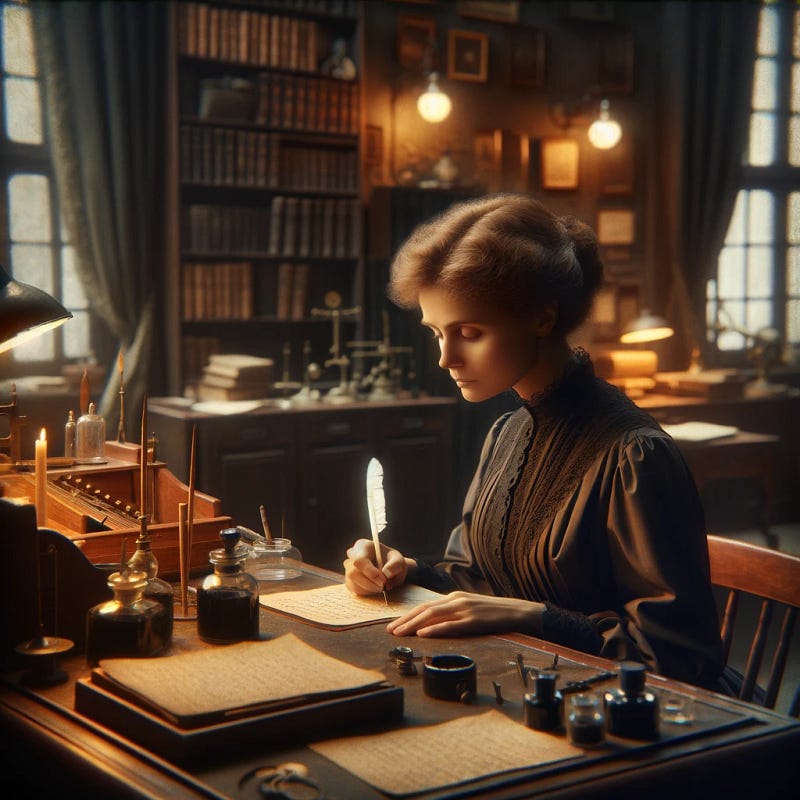
However, the year 1911 was full of hardships for her. She applied for a position to become a member of the French Academy of Sciences where she had to fight for a single vacant seat with a rival named Édouard Branly who was famous for his work on wireless telegraphy.
Critics were primarily debating that she is a woman and women are not capable of taking care of scientific pursuits; therefore she should back off. As a result of continuous antipathy, she lost her seat. She already couldn’t get over the rejection and the unfavorable media coverage that followed added serious insult to injury.
Soon afterward, there came a divulgence of her affair with a married, junior co-worker named Paul Langevin. Her privacy was being completely invaded by a publication that printed the exchange of letters between the two. The news eventually caused severe outrage against her making her feel like a disgrace to the country.
These devastating attacks against Wonder Woman really moved Einstein to write a letter of support to her during such an upheaval in her life.
He wrote: “I am impelled to tell you how much I have come to admire your intellect, your drive, and your honesty, and that I consider myself lucky to have made your personal acquaintance in Brussels. Anyone who does not number among these reptiles is certainly happy, now as before, that we have such personages among us as you, and Langevin too, real people with whom one feels privileged to be in contact. If the rabble continues to occupy itself with you, then simply don’t read that hogwash, but rather leave it to the reptile for whom it has been fabricated.”
Albert Einstein was asked in one of his interviews in the 1950s about the physicist he respected the most. Einstein mentioned about two; one was Hendrik Lorentz and the second was Marie Curie.
He said: “I have always admired… Marie Curie. Not only did she do outstanding work in her lifetime and not only did she help humanity greatly by her work, but she invested all of her work with the highest moral quality. All of this she accomplished with great strength, objectivity, and judgment. It is very rare to find all of these qualities in one individual. In fact, if more European intellectuals had had Madame Curie’s modesty, conditions might have been much brighter.”
Thank you for reading this story and see you again. Feel free to leave a comment if you have any thoughts, feedback, or suggestions about it!
If you’d like to show your appreciation, give this story a maximum number of claps, or else, you can treat me to a cup of coffee ☕️🙂.