
Food for thought
The Nightmare of Total Equality
In Harrison Bergeron, Kurt Vonnegut Jr. describes the nightmare of total equality
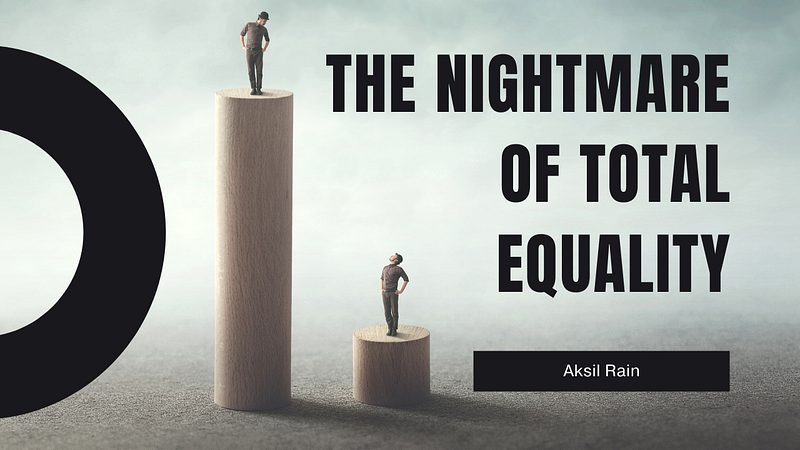
The year was 2081, and everybody was finally equal. They weren’t only equal before God and the law. They were equal every which way. Nobody was smarter than anybody else. Nobody was better looking than anybody else. Nobody was stronger or quicker than anybody else. All this equality was due to the 211th, 212th, and 213th Amendments to the Constitution, and the pass laws. These laws weren’t passed as soon as people stopped being fools. It took generations of education and epidemics and great big wars before everybody realized that all those things that make us different aren’t so important — and that nobody really cares if you’re a boy or a girl.”
“But then everybody got to be equals with each other,” said one character in Kurt Vonnegut Jr.’s book “Harrison Bergeron”. “That’s what it was. Nobody was smarter than anybody else. Nobody was better looking than anybody else.” Vonnegut portrays a dystopian world in which everyone is equally intelligent and equally unattractive, but the story itself is just a harsh satire of any form of equality that exists in the real world today, even if it is not enforced by law.
In Harrison Bergeron, Vonnegut comments on the hypocritical nature of seeking equality in principle but then favoring inequality in practice. Through the unequal distribution of “handicaps” to those deemed above-average, Vonnegut illustrates the prejudice that arises from unequal treatment. He also depicts the inherent dangers of a society in which everyone is equal, such as the idea that “one man’s vulgarity is another man’s poetry. One man’s beauty is another man’s horror.” Although Vonnegut claims everything comes out even for everyone at the end when all can become equally handicapped, he also suggests that people will not be satisfied without their egos and insecurities, which inevitably create inequality even if we try to create equality.
The dystopia that Vonnegut creates is a far cry from the world today, with its endless political divisions, religious conflict, and ethnic violence. In this society, anyone who thinks he or she is better than anyone else is made to be humiliatingly small. The author also depicts the dark side of a society in which everyone is equal — all the hatred from past wars and conflicts still exist despite having been put aside for everyone’s common benefit; as well as prejudice against people with good looks, who are considered vain and useless. However, what Vonnegut communicates most clearly through his novel is the idea that the pursuit of equality can be counterproductive to a vibrant society. By suggesting that anything good can be likened to anything bad, Vonnegut questions the ethics in creating a world where everyone is equal everywhere.
The idea of an egalitarian society is essentially a noble one in its attempt to create equality for all people; however, it can be detrimental to a society’s overall prosperity if pushed too far. Vonnegut’s idea of an egalitarian society is one that is more absurd than realistic. Though many people today strive for equality, no one really believes that everyone can be equal.
Chesterton writes: “When all are sexless there will be equality. There will be no women and no men. There will be but a fraternity, free and equal. The only consoling thought is that it will endure but for one generation..” Vonnegut takes this idea of equality too far with his description of the equalization of all good and bad things. This is a perfect example of dissecting a concept to its extreme, a technique that Vonnegut uses throughout his novel. Inequality in society is not considered segregation — it is instead considered diversity. The way we value or devalue some people over others results in prejudice, but we can learn to appreciate our differences without discriminating against others.
Equality may be an important part of our founding documents and many people’s political views, but the issue really boils down to how much one is willing or able to give up for equality. Vonnegut claims that all people have the right to their differences and that we should not be forced to give them up for the sake of equality.