The Next Major Step to Motivate Climate Action is VR
In March, we all became painfully aware of how unprepared we are as a society to deal with something like COVID-19. Scientists and emergency response officials had warned about something like this. Response plans had been made but discounted and ignored. Resources were available but mishandled. Now we suffer the consequences as a society.
If we listened and took this seriously, our health care infrastructure could possibly have prevented or significantly limited the spread. Our supply chains would have been less fragile and our food system would not be in disarray. Actually, if we listened and adequately invested in our infrastructure and prepared, we wouldn’t need to be talking about our supply chain or food system or economic shutdowns. It would have been managed and this virus would have been a few headlines. There wouldn’t be a shelter in place, 22 million people would not be out of work and there would not be 723,000+ confirmed cases.
COVID-19 and Climate Change
Listening to scientists and experts is important. COVID-19 happens when we discount their opinion. Natural disasters are what happens when we do not listen. You see a lot of effort to try to draw parallels between COVID-19 and climate change. There really is not much of a parallel to draw. It is not a disease, like dengue fever, that is spreading due to warming climate conditions. The only parallel is that both are problems that are clear and present dangers and we largely ignore them until it is too late. Like Covid-19, we ignore our experts and scientists on the threat of climate change.
We see lots of indicators, much of the time they are happening “over there.” The over there is now happening more frequently “over here.”
SARS and MERS were some of our early indicators in the 21st Century that a big nasty bug like COVID-19 was possible. The experts warned us, we largely discounted it. We pushed those warnings under the rug, maybe thinking this is a one-time thing or that it is happening somewhere else, not here. So we have nothing to worry about. We do the same with climate change. We see lots of indicators, much of the time they are happening “over there.” If we do get hit by something, such as Hurricane Harvey, it is a “one-time thing.” At least that is what we want to believe.
How to get people to pay attention? Make it real for them
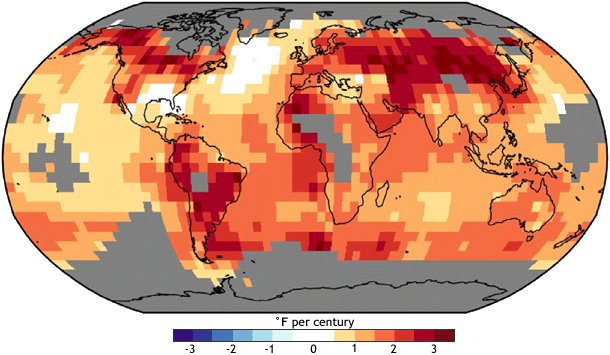
Climate change risk is increasing. The “over there” is going to happen more frequently over here. So, how do we get more people engaged? Our communities need to see what is coming. The experts and scientists need to get this information out of the academic papers, out of the lab, out of their heads and in front of the public. We do not need more of these charts or these heat maps.
Here is a quick dialogue interpreting a heat map:
Person 1: Look I am red and the state next to me is yellow. Now, what does the red mean?
Person 2: A 3 degree Celsius increase.
Person 1: Oh OK. 3 degrees doesn’t seem too bad. More summer days!
People do not relate. There is no connection.
How do we connect? Show the direct pain and discomfort that scientists know is coming. Show what a more intense hurricane looks like to my community and my house. Show what store shelves look like when drought decimates the Central Valley. Show what a more intense wildfire season can do to my favorite national park. It needs to be more real than charts and graphs.
How do we do this? First run the climate risk scenarios. Second, translate those scenarios into virtual reality (VR) and/or augmented reality (AR) scenes that take me to my community. This is possible and not horribly difficult to do.
Climate scientists are running these scenarios now. Every day we are getting a better understanding as to the climate risk to our communities. They are developing these scenarios with downscaled regional climate models (RCMs) and with empirical statistical downscaling (ESD). Some of the RCMs can be downscaled to 10 km or less. This means that it is possible to see the likelihood of a variety of extreme weather events hitting our communities. The models are rapidly developing to where we are becoming more precise on the likelihood and timing of the natural disasters, their intensity/severity and for some events the frequency. Some have become so accurate they are able to assess the physical climate risk of a specific piece of property, such as an electric power plant.
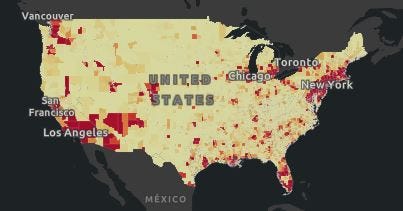
We have the scenarios. Typically, these scenarios are placed on a static map or specific to sea level rise, some more dynamic coastal maps.
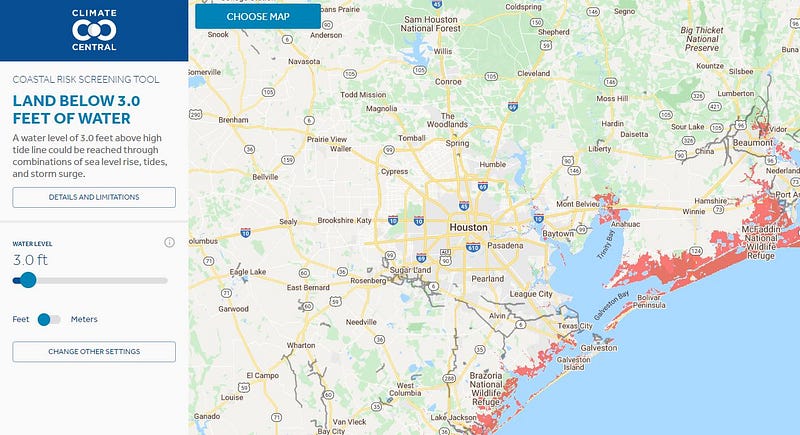
For most of the public, this means nothing. If it does mean something, there is not a true understanding of what XX inches of sea-level rise means for their livelihood or how it impacts storm surge during a hurricane.
I am not completely discounting the graphs and the dynamic maps, as the one shown above. They very much have their purpose when we think about things like infrastructure planning and siting of new commercial hubs or neighborhoods. Insurance companies use these maps and data to better assess their risk and determine insurance premiums, for example. It is helpful information, but it is not really impactful information. It does not really motivate the public to much action. I live in Houston, about an hour north of Galveston, a barrier island. As illustrated above, the climate maps show it underwater in a variety of climate scenarios. People keep building there. They don’t make the connection between the maps and their lives.
They make the connections when they can feel it and see the consequences first hand. The image below is from FloodVR, a virtual reality experience in floodwater. It is not easy to watch, at least for those who have lived through some of these events.
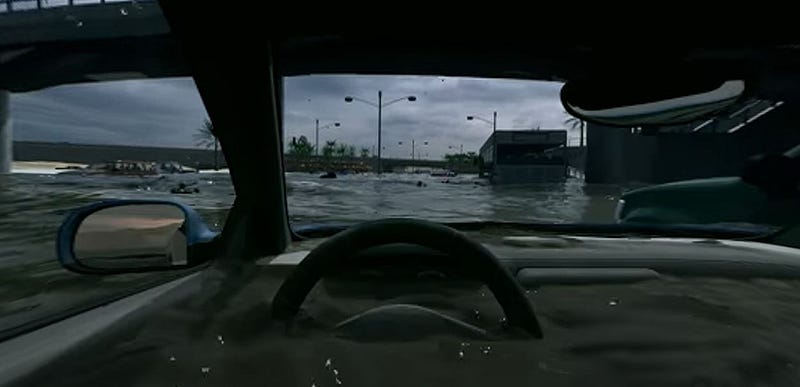
To get people to pay attention, they must have an opportunity to experience it. It must be an immersive experience that tricks the human brain into thinking this is something real. When people have this visceral feeling about a dangerous situation, they start looking for solutions and they start discussing trade-offs.
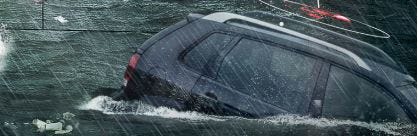
We have the data, the experts have ran these models over and over again. We are beginning to witness the “over there” coming to our communities over here. We seem to forget quickly though. Being able to witness these risks and the dangers more often will keep these risks front and center and push us to take more immediate action. It is called the recency effect. What we experience most recently is where our thoughts are drawn. Where we place the most weight.
Pushing for action must come from the bottom-up. Our government needs the unequivocal signal that its citizens are concerned about their livelihoods and communities due to climate change. Virtual reality, to demonstrate climate risk, is one of those tools that can motivate people to action.
To end with a little PSA…