The New Human Management Post-Pandemic
How to Create The New Human Experience @ Work

The notion of workers as a mere factor of production has evolved from a resource to an asset to human capital into the active creative force in the corporate ecosystem. The emergent HRM challenge is to expand its focus to manage workers as human elements at work and in the marketplace ecosystem.
Increasingly, we are called upon to focus our talent and capability on the wider organisation to influence at the enterprise level, as senior management recognises people to be that definitive decisive technology that underpins the enduring competitive advantage of companies.
People Management (commonly known as Human Resource Management or HRM) is forever a work in progress. Traditionally, HRM focuses on employees in management support functions involving staffing, on-boarding, train and development, pay and benefits, and performance management.
The ultimate goal of excellent HRM is the “human experience”.
HRM professionals have been effective in keeping up with the changing workplace challenges, by accepting each new reality and working within it to accomplish what an organisation has always done. This is no longer enough. HRM professionals must now project their new future role to the present, by re-imagining norms and assumptions in ways that were considered impossible before.
Deloitte (2021) refers to this mindware shift from a “survive” mindset to a “thrive” mindset. The task of the new HRM is to go beyond re-inventing the future by re-architecting and creating the conditions for a holistic “human experience” from the launchpad of the current “employee experience” at work.
The capacility (capacity+capability) of the new HR professional — the more appropriate term being “Digital HR Business Partner” or dHRBP — requires a fundamental shift from a functional mindset to an enterprise and impact mindset, as he/she expands the people focus by extending its influence from process to mission, from the worker to the human within, and from managing workers to re-architect work in a human-centric manner.
The main role of the dHRBP is bridging people, culture and strategy in the organisation.
The new dHRBP mindware drives and empowers new outcomes by creating positive changes, from higher productivity to increased agility to greater innovation for the marketplace so as to impact both the profitability bottom-line and workforce well-being.
First thing first. An organizational transformation to a social enterprise is necessary in order to create opportunities to expand and refresh its “employee experience” to embrace and become the “human experience” at work. It demonstrates the organizational understanding of and empathy for worker aspirations to connect meaningful work to the impact it has on achieving their human aspirations.
When the total worker’s experience is bottom-up and personal, instead of top-down driven and confined only to work-related matter, it enriches and emboldens him/her for the ultimate “human experience”, as illustrated below:
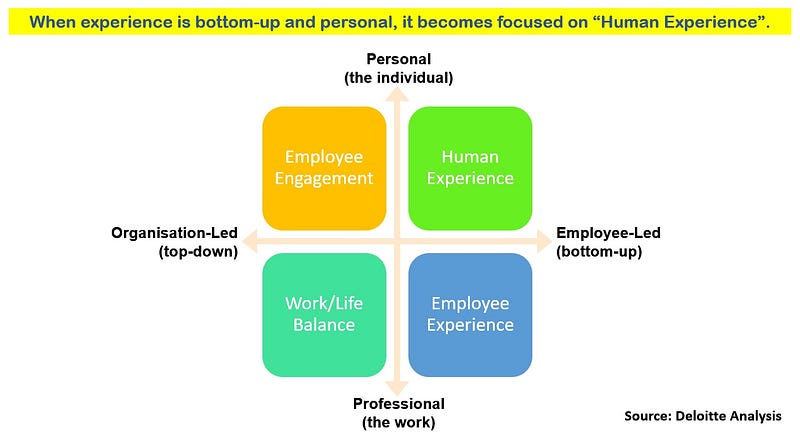
The social enterprise is the vehicle for “human experience”. It is an organisation whose mission combines revenue growth and profit-making with the need to respect and support its environment and stakeholders. This includes listening to, investing in, and actively managing the trends shaping today’s business and workforce realities. The company as a social enterprise serves as a role model for good corporate citizenship, and promotes a high degree of collaboration internally and with the external ecosystem at every level of the organisation (see picture below).
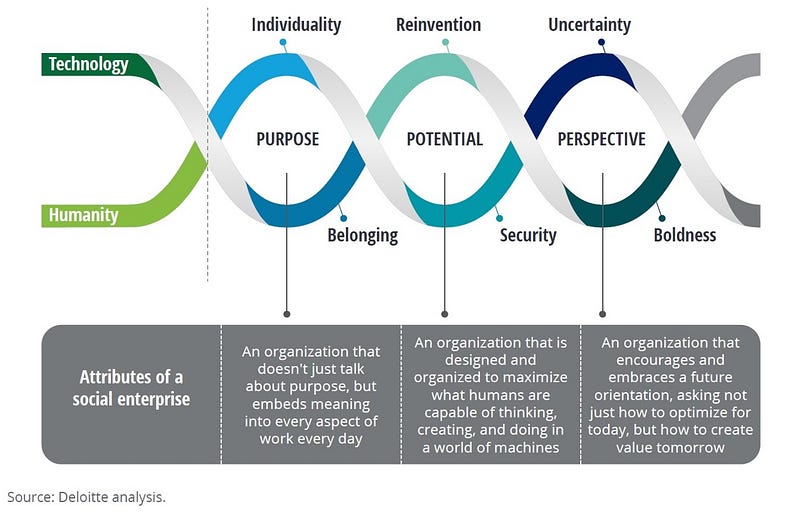
It can be seen (from the above illustration) how the resultant “human experience” in a social enterprise empowers the combined needs of Purpose, Potential and Perspective in their workers.
The “human experience” emboldens in them various essential sense of Belonging, Security and Boldness as they achieve their aspirations for Independence (Individuality), Creativity (Reinvention) and Psychological Safety (Uncertainty). There is alignment and cultural fit between people, values and aspirations with the business.
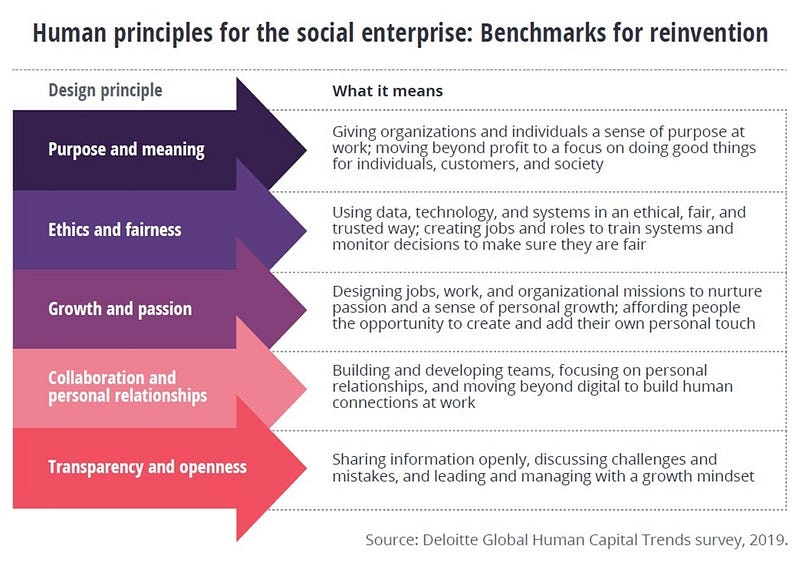
The following describes how human principles are used in the design of the social enterprise to nurture, create and facilitate the “human experience”:
The 3 key focus areas of human management are People and Culture, Systems and Processes, and Technology (see below). Some specific ideas and suggestions are provided to indicate the unlimited possibilities and scope of human-centric initiatives and programs.
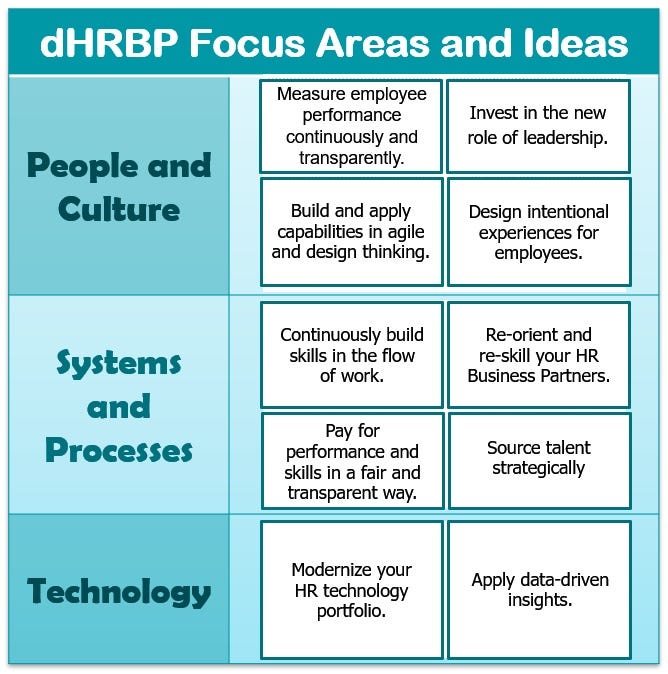
3 KEY ASPECTS OF HUMAN MANAGEMENT
The mindware shift from a “survive” mindset to a “thrive” mindset is critical for the new Human Management approach to HRM. The key aspects of the mindware shift can be summarised as follows:
(1) Humanity is at the heart of the Enterprise
As new business models and global disruptions converge to help transform the enterprise, it is more important than ever to complement the work, skills, and talent of employees organised in human-centric teams with technology for the excellent human experiential impact.
(2) Human management has a business imperative
HR must be radically re-defined and keep lock-steps with business. Guiding principles of personalization, skills at the centre, data-driven decision-making, transparency, and agility are at the core of the new HR journey of human management.
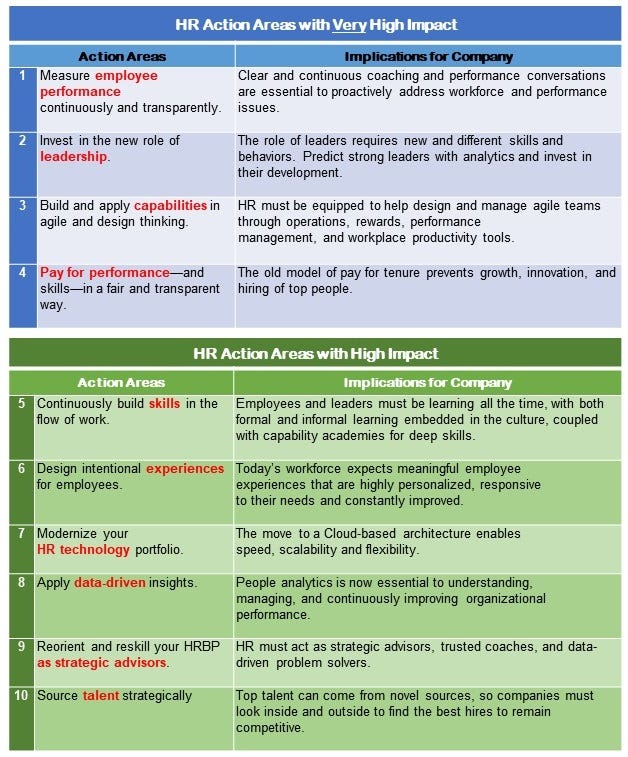
(3) Action Orientation — 10 Action Areas
Ten action areas are trending as emergent HR/Human Management priorities for strategic transformation. Human management provides the fundamental ecosystem platform for the creativity to drive innovation in all of these areas for sustainable business advantages:
Please enjoy my recent Articles.
You can also subscribe to my stories and social media posts via your email. Enjoy more interesting Articles by signing up to Medium here: https://thefuturistoracle.medium.com/membership