The Nazi Hunt for Aryans in Tibet
Heinrich Himmler’s mad mission

The Nazis who ruled Germany from 1933 until their defeat in World War II in 1945 were utterly convinced that the true German people were members of a master race that was destined to rule the world.
This philosophy would eventually result in the appalling obscenity of the Holocaust with its murder of possibly more than six million Jews, gypsies and other “undesirables” who were deemed to be guilty of polluting pure German blood.
Strange Ideas
Their belief stemmed in part from the theories propagated by an organization known as the Thule Society, which began in 1910 and of which many of the early Nazis were members. The Thule Society maintained that the Germans had descended from an ancient northern race known as Thuleans.
Another strand of Nazi racial theory was that a race of light-skinned warriors had once existed somewhere in the Himalayan mountains. These were the Aryans, who had been the founders of the dominant early civilizations of Sumer and Persia.
One of the strongest believers in the Aryan master race theory was Heinrich Himmler, who rose to become second only to Hitler in power in the Third Reich. Himmler had a number of strange beliefs, among which was his conviction that he was the reincarnation of a 10th-century German king named Heinrich. Another was that an elite priesthood had escaped from the lost continent of Atlantis and found its way to Tibet (now a province of China), and it was this race that became the Aryans.
In 1935, with Hitler’s blessing, Himmler set up a department within the German government to study the roots of the Aryan race. Himmler had every hope that he would dispel the doubts held by some fellow Nazis that this was all nonsense, which of course it was.
He set about his research by cultivating anthropologists such as Hans Günther, who took thousands of measurements of the physical characteristics of people in Europe and Asia that pointed towards Aryan descent and which differed markedly from those of lesser races, such as Semitic or Negroid ones. Günther was convinced that there were still Tibetans who displayed Aryan characteristics which could be traced down to the modern Nordic types that the Nazis claimed to be the true “master race” Germans.

The Expedition
Himmler was determined to find these Aryans, so he organized an expedition to explore the region in question in Tibet and track them down.
The leader of the expedition was a young explorer named Ernst Schafer, who came from a wealthy Cologne family and had a strong interest in hunting and animal experiments. Although not actually a Nazi, he was certainly an ardent German nationalist who was happy to be used by Himmler to further the ideology of the Third Reich.
Schafer had made two previous expeditions to Tibet, on the first of which he had achieved the dubious distinction of being only the second white man to shoot a giant panda. He had also dug up a Tibetan skull from a graveyard and brought it back to Germany. On returning from his second expedition he published a book recounting his experiences and so came to the attention of Heinrich Himmler.
Schafer joined Himmler’s elite SS and the two men met in 1936 to discuss how a scientific expedition to Tibet could be organized. Schafer had no time for Himmler’s bizarre theories, such as his belief that the Aryans had been frozen in Himalayan glaciers and thawed out by celestial thunderbolts, but he clearly knew better than to laugh in Himmler’s face and was happy to agree to the proposal that he should lead an all-German scientific expedition to satisfy Himmler’s curiosity.
Schafer was surprised to discover that the Nazis had no intention of actually funding the expedition, which meant that he had to find the money himself, although this was not a huge problem given his personal wealth. The main advantage, from Schafer’s perspective, was that he had a free hand in selecting the members of his team, all of whom were members of the SS.
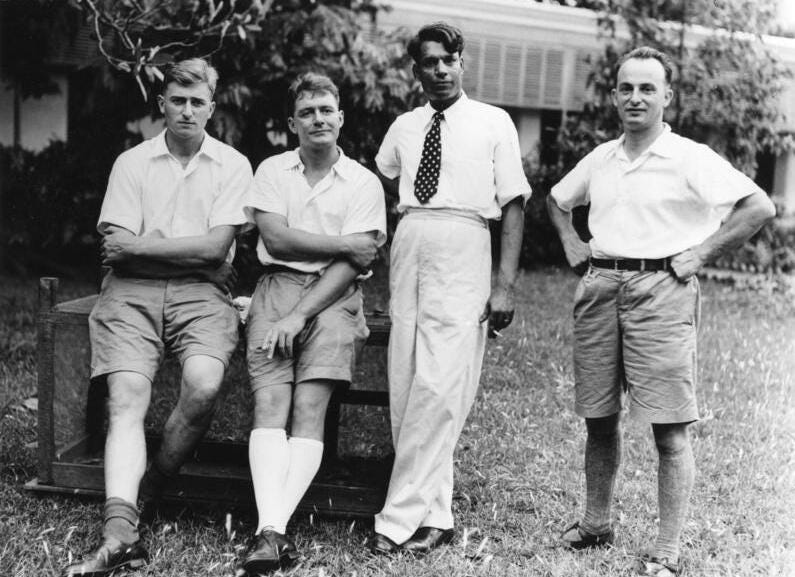
The four scientists were: Ernst Krause, a botanist and entomologist who also doubled as the expedition’s cameraman; Karl Wienert, a geophysicist; Edmund Geer, the expedition’s manager; and anthropologist Bruno Beger. Beger was the scientist who was most closely aligned to Himmler’s thinking in terms of what he called “racial science”, his chief aim being “to collect material about the proportion, origins, significance and development of the Nordic race in this region”.
Reaching Tibet
Schafer’s initial problem was gaining access to Tibet, as this was no longer going to be possible via China thanks to Japan’s invasion of the country. Instead, the only way of getting there was going to be via British India.
The Germans arrived in Calcutta in June 1938 and were able to gain access to the Himalayan state of Sikkim thanks to the help of local British Nazi sympathizers. From Sikkim, it was possible to reach Tibet via a mountain pass, although the party had to cope with torrential rain and mudslides during the Monsoon season.
Bruno Beger began his work while still in Sikkim by looking for potential Aryans with the desired characteristics of blue eyes, straight noses and firm chins. He nearly killed one of his subjects when he placed a plaster cast over his face without making holes through which he could breathe.
It took several weeks for the party to climb the high pass in the depth of winter and descend to the Tibetan plateau which was dotted with small villages and monasteries, a landscape that reminded the Germans of the Alps of Austria and southern Germany — further confirmation, as they saw it, of a link between their own people and the ancient Aryans.
To Lhasa
Schafer was determined to reach the city of Lhasa, which is the holy city of Tibet’s Buddhists and the home of their spiritual leader, the Dalai Lama. At that time, very few Europeans had ever visited the city.
Schafer was well aware that the presence of a group of Germans carrying swastika flags might be less than welcome, especially given the difficult political situation facing Tibet at the time, with the Chinese threatening to seize their territory and the British keeping a very close eye on everything that went on.
Schafer tried to maintain the fiction that he was merely leading a party of tourists, and it was in that spirit that the Germans entered the city on 19th January 1939, to be greeted by Tibetans clapping their hands. What Schafer did not know was that this action was not intended as a welcome but was an attempt by the locals to rid the city of the evil spirits that these foreigners must have been bringing with them.
The Tibetan Regent, who was ruling the country in the absence of the Dalai Lama (a three-year-old boy who had yet to be enthroned), saw the Germans as neither tourists nor scientists but as emissaries of the German government and tried to negotiate an arms deal with them. Schafer was sensible enough not to agree to anything along these lines, knowing that to do so would incur the wrath of both the Chinese and the British.2.0
Leaving Lhasa
By mid-March it was time to leave Lhasa, partly because of the developing political situation in Europe. Had he stayed much longer it is quite likely that the British representatives in the city would have demanded that the Germans be interned as potential enemy agents.
Schafer had been granted permission to make his scientific studies, which his team now did with a vengeance. In particular, Bruno Beger gathered racial information on nearly 400 Tibetans, taking 350 sets of fingerprints and making 25 facial casts. He also took 2000 photographs. Schafer spent his time hunting and collected some 3000 animal skins to be taken back to Germany.
A full record of the expedition was compiled by Ernst Krause who took 40,000 photographs and many feet of film which were later edited as a documentary, narrated by Schafer, which was used as a propaganda document in Germany.
They finally headed south to reach India via Sikkim in late July 1939, by which time it was clear that war between Germany and Britain was inevitable. Indeed, the British had already begun building internment camps in India in which they planned to house any foreign nationals they might capture. Fortunately for Schafer and his party, Himmler had sent a flying boat to Calcutta that was just in time to ferry them to Baghdad, from where they returned to Berlin.
After the Expedition
The expedition members were warmly welcomed on their return, including by Adolf Hitler himself. Schafer was awarded the SS death’s-head ring, which was a sign of Himmler’s personal favor. The newspapers were full of accounts of the expedition, although they were careful not to claim that the origins of the Aryan race had been found. Merely having made a diligent search was good enough for high praise.
Beger, Krause, and Wienert became part of the SS military machine and Schafer was made head of an Inner Asian Research Department, harboring bizarre ideas for gathering bands of Tibetan guerrillas to invade British India.
However, by 1942 Schafer had become concerned by Himmler’s plans for Poland’s Jews, which he learned about during a trip to Poland. Schafer was no murderer, but neither was he unaware of what was going on in the death camps. He therefore did his best to keep his involvement to a minimum.
Bruno Beger’s involvement in the Holocaust, however, was far less minimal. In 1943 he spent eight days at Auschwitz, where he selected 115 male and female prisoners to study for any “Asian” characteristics they might have had.
After he left, they were all gassed and their bodies preserved and sent to the anatomy department of Strasbourg University for further study, albeit not by Beger himself. On his arrest some years after the war, Beger claimed that he had no knowledge of the fate of his subjects of study and was therefore only given a three-year suspended prison sentence.
As for Schafer, he was able to convince the authorities that he had played no part in genocide and was only fined for his SS involvement. In 1949 he moved to Venezuela, where he died in 1992 at the age of 82. It was said by those who knew him in later life that he never came to terms with his Nazi past and had only seized the opportunity, as a young man, to go on an adventurous expedition.
Even so, it cannot be doubted that these people were scientists who lent their undoubted talents to the support of an ideology that led to mass murder and gave respectability to outlandish and absurd theories that had absolutely no foundation in reality.
On the other hand, had the scientific world united in telling Heinrich Himmler and Adolf Hitler that their racial beliefs were complete and utter nonsense, would it have made any difference? It seems unlikely.
Reference:
History’s Great Untold Stories, by Joseph Cummins. Murdoch Books, 2006.
Did you like this? Maybe not! Either way, your comment will be very welcome!
For other similar pieces, see my List:


