y just 500 votes. In Alaska, the Republican Senator Lisa Murkowski pulled off the unthinkable in 2010 when she executed a successful write-in campaign largely mobilized by Alaska Natives in the state.</p><p id="9084">This year, the Native vote is playing a critical role in determining control of thirty-five of 100 Senate seats up for election. One driving factor has been the controversial confirmation of US Supreme Court nominee, Amy Coney Barrett. Despite a filibuster which ended Sunday to oppose Barrett’s nomination from advancing, <a href="https://www.washingtonpost.com/politics/court-barrett-senate-trump/2020/10/25/3f402fb8-16bd-11eb-bb35-2dcfdab0a345_story.html">the final confirmation vote</a> is expected sometime Monday night.</p><p id="ac20">Republicans have a three-seat majority in the Senate but face greater <a href="https://ballotpedia.org/Partisan_risk_caused_by_a_disproportion_in_the_number_of_seats_up_for_election_held_by_each_party">partisan risk</a> this election. Those three seats plus winning the presidency are what Democrats and Biden’s campaign are eyeing. But in an election where nothing is guaranteed, Democratic seats could also go to Republicans, as suggested in Alabama. If that happens, it means the Democrats would have to net four seats.</p><p id="0b65">Four states where Senate races have been tight and that include a small but significant Native American voting population are found in Montana, Arizona, Maine, and North Carolina (Michigan is another state, but polls increasingly indicate a Democratic stronghold.) In each of these four states, Republicans are the incumbents. And signs indicate that each contest may be leaning Democrat, except for one: North Carolina. It’s a wild card.</p><figure id="6f3a"><img src="https://cdn-images-1.readmedium.com/v2/resize:fit:800/1*AiG7BBy99JRmDFNej4AUIw.jpeg"><figcaption><i>Democratic challenger Cal Cunningham, left, and U.S. Sen. Thom Tillis, R-N.C. in a televised debate Oct. 1, 2020, in Raleigh, N.C. (Gerry Broom/Pool)</i></figcaption></figure><p id="2e1e"><b>North Carolina</b></p><p id="c433">In North Carolina, Republican incumbent, Thom Tillis, is trying to hold off his Democratic challenger Cal Cunningham in a state firmly framed around Southern conservatism.</p><p id="3ba5">Two scandals have recently upended the race: Tillis fell ill with the coronavirus after attending an event, maskless, for Judge Amy Coney Barett’s Supreme Court nomination. Meanwhile, Cunningham confirmed reports that he had been sexting with a woman who is not his wife.</p><p id="8b81">It’s anyone’s guess how voters may take these shockwaves, particularly among Lumbee voters where their recognition issue has not been a campaign issue for either candidate. In 2014, Sen. Kay Hagan, a champion for this cause lost her senate seat after winning Robeson County by <a href="https://er.ncsbe.gov/?election_dt=11/04/2014&county_id=78&office=FED&contest=1152">roughly ten percentage points</a> but losing in Cherokee County, home of the Eastern Band of Cherokee, by <a href="https://er.ncsbe.gov/?election_dt=11/04/2014&county_id=20&office=FED&contest=1152">a wide margin</a>.</p><p id="4090">The Cherokees, who are <a href="https://www.census.gov/quickfacts/fact/table/cherokeecountynorthcarolina/INC110218">a much smaller electorate</a> than the Lumbee, successfully run the only casino in the state and have <a href="https://www.theonefeather.com/2020/10/commentary-chief-sneed-responds-to-political-pandering-regarding-lumbee-recognition-act/">long-opposed</a> Lumbee federal recognition, and aggressively so. Whether this will factor into Native voter turnout and outcomes remains to be seen.</p><p id="e97b"><b>Montana</b></p><p id="e225">In Montana, Republican U.S. Senator Steve Daines is in a tight and costly race with the state’s governor, Steve Bullock. Polls indicate that the battle between the two is a toss-up. Native voters — representing eight federally-recognized tribes and roughly seven percent of the state voting population — could determine that race, and it would be Daines’s to lose.</p><figure id="03e3"><img src="https://cdn-images-1.readmedium.com/v2/resize:fit:800/1*cNefAxDoE0gtwXVN-u8JdQ.jpeg"><figcaption>Sen. Steve Daines (R-MT), center, with Kimberly Loring Heavy Runner, right, holding up a banner of her missing Blackfeet sister, Ashley, in Dec. 2019. (S. Daines)</figcaption></figure><p id="cad3">When he was elected in 2012, and after joining the Senate Committee on Indian Affairs, Daines journeyed to tribal communities statewide, including the Northern Cheyenne Reservation. There, tribal leaders were somewhat stunned. A Republican senator had never visited their community before. They welcomed him with a traditional honor dance, as Natives often do.</p><p id="634a">Six years later, and it’s voters like Rhea Real Bird of the Crow Nation who remember Sen. Daines differently. She still hasn’t forgotten how he voted in favor of the 2013 government shutdown.</p><p id="a49b">“More than a third of the Crow Tribe’s workforce was furloughed, the bus service providing transportation across the 2.3 million-acre reservation was closed,” she wrote in a recent <a href="https://billingsgazette.com/opinion/letters/letter-to-the-editor-daines-not-standing-with-native-americans/article_91135a82-512c-55c0-8dd6-3ef0bc18471d.html">Letter to the Editor in the <i>Billings Gazettte</i></a><i>.</i></p><p id="3c97">In Montana, where distances from a tribal community to a county election office can be as far as <a href="https://leg.mt.gov/content/Committees/Interim/2019-2020/State-Tribal-Relations/Meetings/august-2020/hj10-draft-report-july2020.pdf">176 miles round trip</a>, there’s little forgiveness for decisions that make life more difficult. To this end, Native voters may vote along party lines — against the GOP. Such an indication has been revealed by at least five Indigenous-led groups, some affiliated with tribes, <a href="https://www.leftofcenter.org/blog">endorsing Gov. Bullock</a>.</p><p id="ac0b"><b>Arizona</b></p><p id="85c0">Arizona was being closely watched as a key Senate state, until Democrat Mark Kelly, who’s a former astronaut married to Gabby Giffords, started gaining in <a href="https://ballotpedia.org/United_States_Senate_special_election_in_Arizona,_2020">the polls</a>. His o
Options
pponent is incumbent Sen. Martha McSally (R-AZ). In May, Kelly produced a radio ad directed entirely to voters of the Navajo Nation, a sizeable electorate in the state.</p><p id="6346">“Yá ‘át’èèh, shik’éí dóó shidine’é. Mark Kelly yinishyé,” Kelly said, introducing himself in the language of the Dinè. “Hi, I’m Mark Kelly.”</p>
<figure id="c697">
<div>
<div>
<img class="ratio" src="http://placehold.it/16x9">
<iframe class="" src="https://cdn.embedly.com/widgets/media.html?src=https%3A%2F%2Fwww.youtube.com%2Fembed%2F9r2L4kF-hVM%3Ffeature%3Doembed&display_name=YouTube&url=https%3A%2F%2Fwww.youtube.com%2Fwatch%3Fv%3D9r2L4kF-hVM&image=https%3A%2F%2Fi.ytimg.com%2Fvi%2F9r2L4kF-hVM%2Fhqdefault.jpg&key=a19fcc184b9711e1b4764040d3dc5c07&type=text%2Fhtml&schema=youtube" allowfullscreen="" frameborder="0" height="480" width="854">
</div>
</div>
</figure></iframe></div></div></figure><p id="a6db">Sen. McSally was seen as a strong contender, namely for the <a href="https://www.mcsally.senate.gov/news/press-releases/mcsally-secures-billions-financial-relief-tribes-amid-coronavirus-pandemic">credit she claimed</a> for ensuring tribes were included in CARES Act relief legislation to respond to the coronavirus.</p><p id="a8c6">“I told them, ‘We’ve gotta get this money for the tribes!’” McSally said in one of <a href="https://www.nafoa.org/broadcasts/tribal-leader-town-hall-covid-19-phase-3-legislation">the first Tribal Leader Town Halls</a> organized in the early days of the pandemic.</p><p id="0e54">Her latest efforts to court Native voters involved <a href="https://www.mcsally.senate.gov/news/press-releases/mcsally-heinrich-call-on-us-army-to-investigate-fort-hood-deaths">calling on the U.S. Army</a> to investigate the deaths of two Navajo soldiers at Fort Hood. The plea came with a letter signed by the President of the Navajo Nation, Jonathan Nez.</p><p id="3a74">Overall there are roughly <a href="http://www.ncai.org/initiatives/campaigns/NCAI_NativeVoteInfographic.pdf">300,000 Native Americans of voting age</a> in Arizona, making up about six percent of the state’s eligible voter population. Many live in and near urban cities like Phoenix and Tucson, whereas recent attention has been paid to reservation-based communities like the Navajo Nation where mail-in ballot limitations resulted in <a href="https://turtletalk.blog/2020/10/16/ninth-circuit-dismisses-voting-rights-challenge-in-yazzie-v-hobbs/">a lawsuit, recently dismissed</a>.</p><p id="b84a"><b>Maine</b></p><p id="5bd3">In Maine, a state lesser known for its Indigenous affairs could also wield influence in the U.S. Senate where Republican incumbent Sen. Susan Collins is facing what some are calling <a href="https://thehill.com/homenews/campaign/514111-susan-collins-faces-battle-of-lifetime-in-maine">the fight of her life</a>. Democratic challenger Sarah Gideon, who is also speaker of the state house, has raised an eye-popping $40-million in just a few short months, mostly by donors dismayed by Collins’s vote for Justice Brett Kavanaugh. In the run-up to Barrett’s confirmation vote on Monday, Collins sided with Democrats to oppose the nomination from advancing.</p><figure id="dad4"><img src="https://cdn-images-1.readmedium.com/v2/resize:fit:800/1*cGoDKgsOZRnvUu23IcRsEw.png"><figcaption>Sen. Susan Collins (R-ME), right, and Sara Gideon, Democratic challenger, left.</figcaption></figure><p id="e08c">Native voters are likely to cast their ballots for Gideon. Last year, she was a rare advocate during the state’s legislative session confronting Maine’s longstanding rifts with the four federally-recognized tribes in the state.</p><p id="efb8">“The time is long past due that we show tribal communities are our concern,” Gideon said the day she called for <a href="https://legislature.maine.gov/maine-indian-claims-tf">a task force</a> to begin a process of reconciling <a href="https://www.mainepublic.org/post/maine-indian-land-claims-settlement-implementing-act-task-force">forty-year-old grievances</a> over Indigenous land and sovereignty issues.</p><p id="46fd">Back in Lumberton, buzz had started to build the day before Trump’s rally.</p><p id="0d47">“People are gettin’ their hair done,” said Olivia Oxendine, a Lumbee tribal citizen and educator.</p><p id="e81c">Oxendine planned to attend the rally, if for nothing else, to boost her humble campaign; her first ever. She said she was “taking one for the team” — the GOP — when she agreed to run as the Republican challenger for North Carolina House, District 47, the one representing all of Robeson County.</p><p id="335e">“Little by little, money has come my way,” said Oxendine of her meager campaign coffers. She knew it was no match to the fundraising of her Democratic opponent, Rep. Graham, who has held down the district for the last nine years.</p><p id="4f72">That two Lumbees were running for state office, though, is emblematic of the tribe’s active history in politics. For generations, the Lumbee have known their voting power, and this year, with as many as eleven tribal citizens running in state and local elections, it’s merely a reminder of that tradition.</p><p id="bce4">But how the Lumbee may swing their vote in the race for the White House and the U.S. Senate is anyone’s guess, even for Oxendine. She, for one, will be casting her vote for Trump and will likely fall along party-lines in other races, as well.</p><p id="a9ab">“I will always give him the benefit of the doubt because he’s my president and I believe in him,” she said. “I just think that he’s a once in a lifetime president.”</p><p id="6ee6"><a href="https://electionsos.com/fellowship-programs/"><b><i>Election SOS Fellows</i></b></a><b><i> Miacel Spotted Elk</i></b><i> and <b>Tsanavi Spoonhunter</b> contributed to this article.</i></p><p id="163b"><i>Reprints and reposts: Indigenously encourages you to make free use of this article by taking <a href="https://www.indigenously.org/reprints-reposts">these easy steps.</a></i></p><p id="f90f"><i>This article was updated Oct. 24, 2020 to include remarks from President Donald Trump’s campaign rally in Lumberton, NC and to provide an update to the confirmation hearings of Judge Amy Coney Barrett.</i></p></article></body>
The Native Voters Who Could Decide Control of the Senate
In political races that may end with the narrowest of victories, the nation’s Indigenous electorate is playing a key role
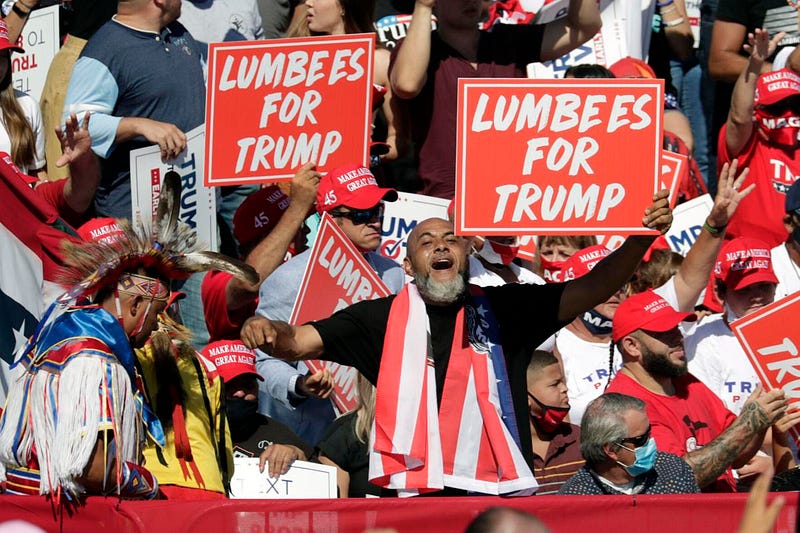
Supporters hold “Lumbees for Trump” signs as President Donald Trump speaks during a campaign rally at the Robeson County Fairgrounds in Lumberton, North Carolina, Oct. 24, 2020 (Chris Seward)
This story is a project of the Indigenously newsletter. Sign up today. It’s free.
Lumberton, North Carolina might not seem like the kind of place influential enough to sway one of the most important outcomes this election year. But in the state’s pivotal U.S. Senate race, the contest is casting light on a little-known but critical Native American swing vote: the Lumbees of Robeson County.
One of the most diverse electorates predictably voting Democrat, the Lumbees went red in favor of Donald Trump in 2016. This year, they may do it again, a choice that could result in voting down party lines in other key races, including one that determines control of the Senate.
“With us today are members of the incredible Lumbee Tribe which has been wrongly denied federal recognition for more than a century,” said President Trump to rally-goers in Lumberton, Saturday. He swept open his arm toward a bleacher full of men and women holding large “Lumbees for Trump” signs who cheered while someone pounded on a large drum.
For Trump, it was the eighth time since August that he has returned to the purple state. “When I’m re-elected I will proudly sign the Lumbee Recognition Act,” he promised. “The people of North Carolina want that.”
The Lumbee represent one of eight tribes in North Carolina, although they lack full sovereignty. Unlike the Eastern Band of Cherokee Indians, situated about 300 miles west of Lumberton, the Lumbee do not hold any tribal trust lands or qualify for federal entitlement programs. Year after year, federal budgets for tribal healthcare, housing, and education have left the Lumbee out, along with another opportunity: gaming.
Despite state recognition as a tribe dating back to 1885, and even a 1956 law passed by Congress that legally identifies them as “Indians,” the Lumbee, with no fewer than 43 bills and resolutions supporting their federal recognition, have seen these efforts to secure this status repeatedly fail.
There’s a sense that this time is different.
North Carolina Rep. Charles Graham whose district represents Robeson County believes the Lumbee recognition issue is going to have an impact at the ballot box. “That’s certainly a big deal here,” said Graham, who is also a Lumbee tribal citizen. “But to be honest with you, it should not be a political issue. It should be a rights issue.”
Both presidential candidates have vowed to support Lumbee recognition. The Democratic nominee, Joe Biden, was first to make this promise in early October, backing a bill introduced by North Carolina Congressmen G.K. Butterfield, a Democrat who’s running for re-election. Trump got behind a similar bill in the Senate — Senate Bill 1368, or the Lumbee Recognition Act. For now, Butterfield’s proposal has yet to clear the full chamber.
Their endorsements signal how candidates everywhere are recognizing the significance of electorates big and small — and of every stripe, including in Robeson County where the Lumbee represent forty percent of the population and one of the state’s hardest-hit communities by the coronavirus. But when Congress passed the $8 billion CARES Act to tribal nations, the Lumbees were left out because they lacked status as a federally-recognized tribe. Rep. Graham says this more than anything emphasizes the tribe’s shortcomings.
“Healthcare is our number one need,” Rep. Graham said. “If we get recognized, that means there will be some health benefits; it will be good for Robeson’s economy.”
Across Indian Country, Native voters have been known to pack a powerful punch at the polls in some of the most narrowest political victories — and not with any particular party loyalty. For tribal citizens, elections aren’t determined by values that run red or blue, but rather those that run sovereign, Indigenously, so.
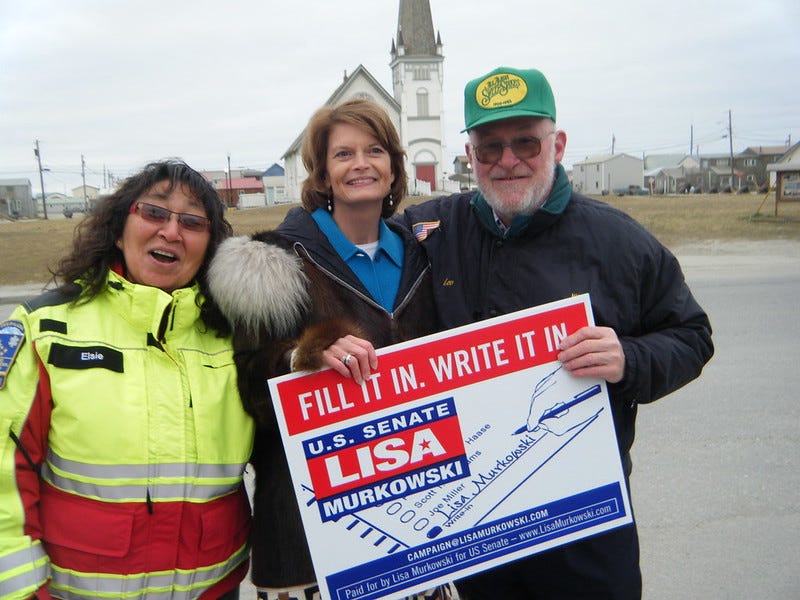
U.S. Sen. Lisa Murkowski (R-AK) in Nome, Alaska in 2010 during a re-election campaign run by an unorthodox write-in ballot strategy. (Lisa Murkowski/Flickr)
In 2002, it was only after final votes were tallied from the Pine Ridge Reservation that Tim Johnson, a Democrat, learned he had won his South Dakota U.S. Senate seat by just 500 votes. In Alaska, the Republican Senator Lisa Murkowski pulled off the unthinkable in 2010 when she executed a successful write-in campaign largely mobilized by Alaska Natives in the state.
This year, the Native vote is playing a critical role in determining control of thirty-five of 100 Senate seats up for election. One driving factor has been the controversial confirmation of US Supreme Court nominee, Amy Coney Barrett. Despite a filibuster which ended Sunday to oppose Barrett’s nomination from advancing, the final confirmation vote is expected sometime Monday night.
Republicans have a three-seat majority in the Senate but face greater partisan risk this election. Those three seats plus winning the presidency are what Democrats and Biden’s campaign are eyeing. But in an election where nothing is guaranteed, Democratic seats could also go to Republicans, as suggested in Alabama. If that happens, it means the Democrats would have to net four seats.
Four states where Senate races have been tight and that include a small but significant Native American voting population are found in Montana, Arizona, Maine, and North Carolina (Michigan is another state, but polls increasingly indicate a Democratic stronghold.) In each of these four states, Republicans are the incumbents. And signs indicate that each contest may be leaning Democrat, except for one: North Carolina. It’s a wild card.
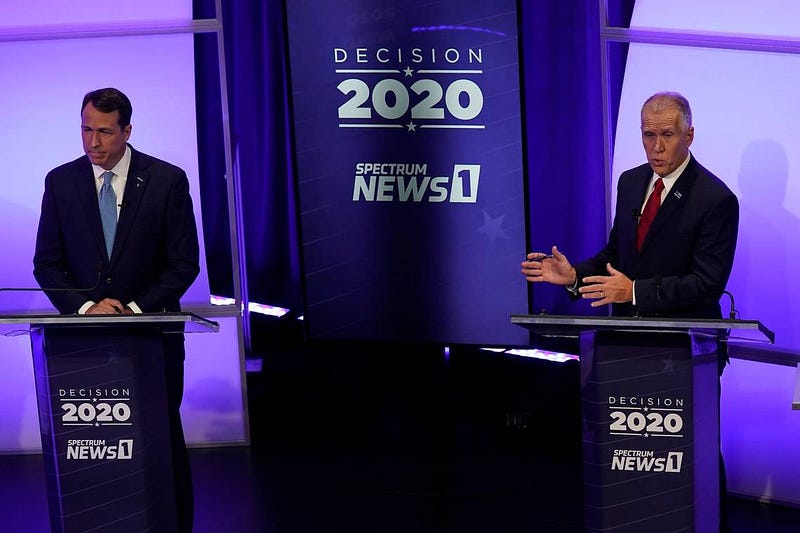
Democratic challenger Cal Cunningham, left, and U.S. Sen. Thom Tillis, R-N.C. in a televised debate Oct. 1, 2020, in Raleigh, N.C. (Gerry Broom/Pool)
North Carolina
In North Carolina, Republican incumbent, Thom Tillis, is trying to hold off his Democratic challenger Cal Cunningham in a state firmly framed around Southern conservatism.
Two scandals have recently upended the race: Tillis fell ill with the coronavirus after attending an event, maskless, for Judge Amy Coney Barett’s Supreme Court nomination. Meanwhile, Cunningham confirmed reports that he had been sexting with a woman who is not his wife.
It’s anyone’s guess how voters may take these shockwaves, particularly among Lumbee voters where their recognition issue has not been a campaign issue for either candidate. In 2014, Sen. Kay Hagan, a champion for this cause lost her senate seat after winning Robeson County by roughly ten percentage points but losing in Cherokee County, home of the Eastern Band of Cherokee, by a wide margin.
The Cherokees, who are a much smaller electorate than the Lumbee, successfully run the only casino in the state and have long-opposed Lumbee federal recognition, and aggressively so. Whether this will factor into Native voter turnout and outcomes remains to be seen.
Montana
In Montana, Republican U.S. Senator Steve Daines is in a tight and costly race with the state’s governor, Steve Bullock. Polls indicate that the battle between the two is a toss-up. Native voters — representing eight federally-recognized tribes and roughly seven percent of the state voting population — could determine that race, and it would be Daines’s to lose.
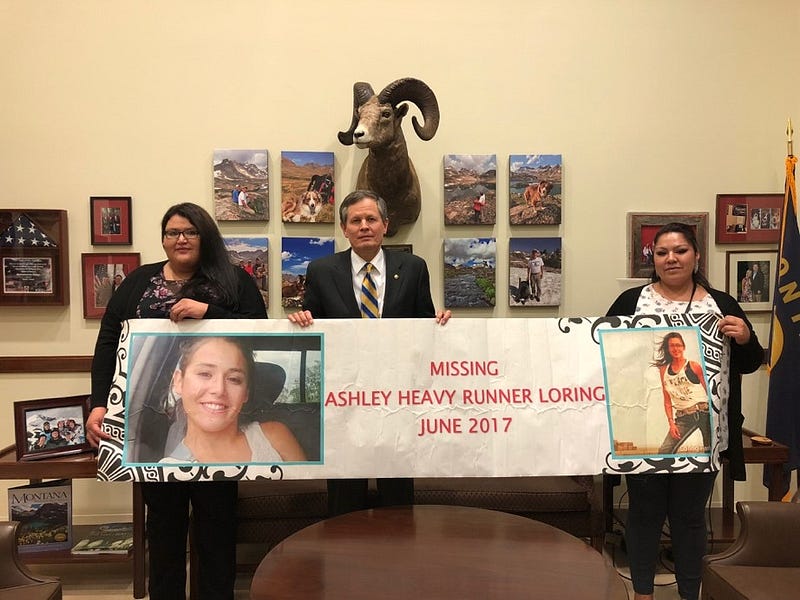
Sen. Steve Daines (R-MT), center, with Kimberly Loring Heavy Runner, right, holding up a banner of her missing Blackfeet sister, Ashley, in Dec. 2019. (S. Daines)
When he was elected in 2012, and after joining the Senate Committee on Indian Affairs, Daines journeyed to tribal communities statewide, including the Northern Cheyenne Reservation. There, tribal leaders were somewhat stunned. A Republican senator had never visited their community before. They welcomed him with a traditional honor dance, as Natives often do.
Six years later, and it’s voters like Rhea Real Bird of the Crow Nation who remember Sen. Daines differently. She still hasn’t forgotten how he voted in favor of the 2013 government shutdown.
“More than a third of the Crow Tribe’s workforce was furloughed, the bus service providing transportation across the 2.3 million-acre reservation was closed,” she wrote in a recent Letter to the Editor in the Billings Gazettte.
In Montana, where distances from a tribal community to a county election office can be as far as 176 miles round trip, there’s little forgiveness for decisions that make life more difficult. To this end, Native voters may vote along party lines — against the GOP. Such an indication has been revealed by at least five Indigenous-led groups, some affiliated with tribes, endorsing Gov. Bullock.
Arizona
Arizona was being closely watched as a key Senate state, until Democrat Mark Kelly, who’s a former astronaut married to Gabby Giffords, started gaining in the polls. His opponent is incumbent Sen. Martha McSally (R-AZ). In May, Kelly produced a radio ad directed entirely to voters of the Navajo Nation, a sizeable electorate in the state.
“Yá ‘át’èèh, shik’éí dóó shidine’é. Mark Kelly yinishyé,” Kelly said, introducing himself in the language of the Dinè. “Hi, I’m Mark Kelly.”
Sen. McSally was seen as a strong contender, namely for the credit she claimed for ensuring tribes were included in CARES Act relief legislation to respond to the coronavirus.
“I told them, ‘We’ve gotta get this money for the tribes!’” McSally said in one of the first Tribal Leader Town Halls organized in the early days of the pandemic.
Her latest efforts to court Native voters involved calling on the U.S. Army to investigate the deaths of two Navajo soldiers at Fort Hood. The plea came with a letter signed by the President of the Navajo Nation, Jonathan Nez.
Overall there are roughly 300,000 Native Americans of voting age in Arizona, making up about six percent of the state’s eligible voter population. Many live in and near urban cities like Phoenix and Tucson, whereas recent attention has been paid to reservation-based communities like the Navajo Nation where mail-in ballot limitations resulted in a lawsuit, recently dismissed.
Maine
In Maine, a state lesser known for its Indigenous affairs could also wield influence in the U.S. Senate where Republican incumbent Sen. Susan Collins is facing what some are calling the fight of her life. Democratic challenger Sarah Gideon, who is also speaker of the state house, has raised an eye-popping $40-million in just a few short months, mostly by donors dismayed by Collins’s vote for Justice Brett Kavanaugh. In the run-up to Barrett’s confirmation vote on Monday, Collins sided with Democrats to oppose the nomination from advancing.
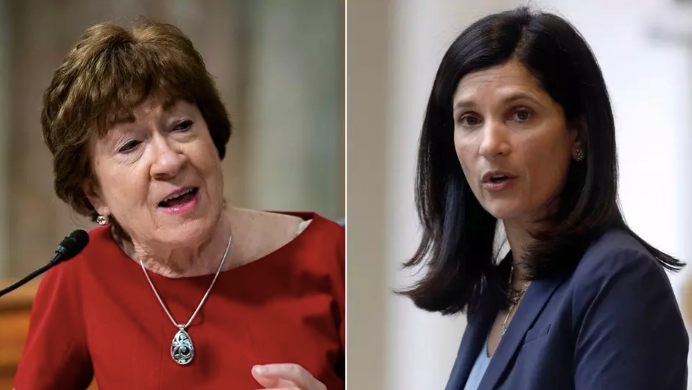
Sen. Susan Collins (R-ME), right, and Sara Gideon, Democratic challenger, left.
Native voters are likely to cast their ballots for Gideon. Last year, she was a rare advocate during the state’s legislative session confronting Maine’s longstanding rifts with the four federally-recognized tribes in the state.
“The time is long past due that we show tribal communities are our concern,” Gideon said the day she called for a task force to begin a process of reconciling forty-year-old grievances over Indigenous land and sovereignty issues.
Back in Lumberton, buzz had started to build the day before Trump’s rally.
“People are gettin’ their hair done,” said Olivia Oxendine, a Lumbee tribal citizen and educator.
Oxendine planned to attend the rally, if for nothing else, to boost her humble campaign; her first ever. She said she was “taking one for the team” — the GOP — when she agreed to run as the Republican challenger for North Carolina House, District 47, the one representing all of Robeson County.
“Little by little, money has come my way,” said Oxendine of her meager campaign coffers. She knew it was no match to the fundraising of her Democratic opponent, Rep. Graham, who has held down the district for the last nine years.
That two Lumbees were running for state office, though, is emblematic of the tribe’s active history in politics. For generations, the Lumbee have known their voting power, and this year, with as many as eleven tribal citizens running in state and local elections, it’s merely a reminder of that tradition.
But how the Lumbee may swing their vote in the race for the White House and the U.S. Senate is anyone’s guess, even for Oxendine. She, for one, will be casting her vote for Trump and will likely fall along party-lines in other races, as well.
“I will always give him the benefit of the doubt because he’s my president and I believe in him,” she said. “I just think that he’s a once in a lifetime president.”
Election SOS Fellows Miacel Spotted Elk and Tsanavi Spoonhunter contributed to this article.
Reprints and reposts: Indigenously encourages you to make free use of this article by taking these easy steps.
This article was updated Oct. 24, 2020 to include remarks from President Donald Trump’s campaign rally in Lumberton, NC and to provide an update to the confirmation hearings of Judge Amy Coney Barrett.