
The Narrative Thrall of an Isabel Allende Book
Through her latest release ‘Violeta’
Disclaimer: I received a review copy of this book from Bloomsbury India. However, all opinions expressed are my own.
An Introduction to Isabel Allende’s Writing
One of my favourite reads of March is Isabel Allende’s latest release, Violeta. I have previously never read any of her works but had read some really good reviews of them. All I know of this author was that she is a very popular Latin American woman author and that she is one of the first to be so. As such, I had always wanted to read her works and so when I finally got the opportunity, I picked it up enthusiastically.
Violeta follows the story of this eponymous character whose life spans a century and as such, we see the world, as well as human relationships, transform under the ravages of time.
Synopsis
Here is a synopsis from Goodreads:
Violeta comes into the world on a stormy day in 1920, the first girl in a family of five boisterous sons. From the start, her life will be marked by extraordinary events, for the ripples of the Great War are still being felt, even as the Spanish flu arrives on the shores of her South American homeland almost at the moment of her birth.
Through her father’s prescience, the family will come through that crisis unscathed, only to face a new one as the Great Depression transforms the genteel city life she has known. Her family loses all and is forced to retreat to a wild and beautiful but remote part of the country. There, she will come of age, and her first suitor will come calling. . . .
She tells her story in the form of a letter to someone she loves above all others, recounting devastating heartbreak and passionate affairs, times of both poverty and wealth, terrible loss and immense joy. Her life will be shaped by some of the most important events of history: the fight for women’s rights, the rise and fall of tyrants, and, ultimately, not one but two pandemics.
Told through the eyes of a woman whose unforgettable passion, determination, and sense of humor will carry her through a lifetime of upheaval, Isabel Allende once more brings us an epic that is both fiercely inspiring and deeply emotional.
Violeta as a Historical Novel
Violeta’s story begins when she is born in 1920 and ends with her death in 2020. As such, it spans a century and paints a tapestry in world history. Although the author nor the narrative voice of the eponymous character reveals the name of the country, an assumption can be made — that this novel is set in the South American country of Chile.
Violeta undoubtedly is a personal story as well as a multigenerational family saga. But at the same time, it is history made personal. Inspired by Allende’s own mother, the character of Violeta narrates the story and it is through her voice that we get to see the world change. As such what is interesting is that apart from the bare historical and political facts, we get to see the implications of these events. We are no more mere readers situated on the earth of 2022. Rather, we are living through the moments, the years, the events, as Violeta describes how they came into the occurrence and how she and her family was affected.
Another important point is that Violeta the book, therefore, becomes a launchpad for many of us and provides a starting point for our own research into South American history.
Allende’s Writing
I admit at the very outset that I still am wondering about what I feel about Allende’s writing.
Yes, it is very potent on the one hand. Allende transports us into the past, masterfully so. In fact, she does it so well that we are now living in that past — that past becomes the reader’s present. In terms of the political, the historical and the social setting, Allende’s writing does fabulous justice.
But on the other hand, I felt that there was a distance in the personal narration of the story. Was it deliberate or am I second-guessing my own review? In some parts, the personal effect felt very superficial and not like what a memoir or in this case, personal heartfelt letters would feel. I felt like there was an impersonal element in this narration. This further makes me question if this is an area that is lacking or if this distance was deliberate to show the gap in age and therefore experience between Violeta and Camilo.
Judging a Book by its Cover
Here I drift a little away from serious ‘literary’ matter and instead shall talk about what many would consider a superficial matter — that of the book cover.
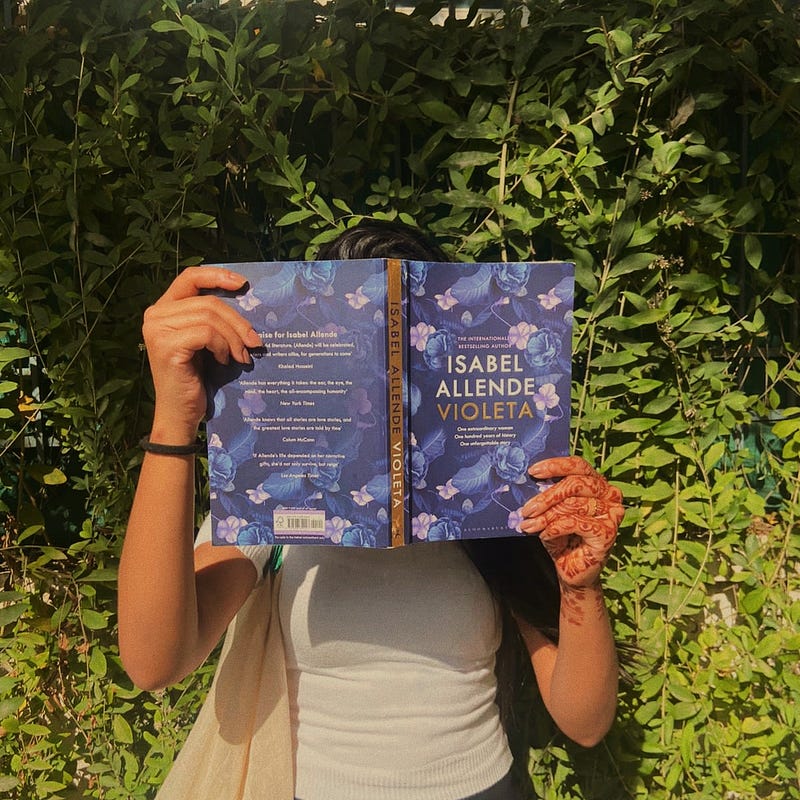
Light and dark flowers and leaves adorn the cover, while the title gets printed in gold foil. A superior combination, and one that immediately catches the eye.
Violeta the Woman
The central character in this book is Violeta, and it is through her eyes that we see the story narrated. As she tells Camilo in the very beginning, this life story of hers is honest and that she committed many sins.
What is however subtly done is how Violeta also changes from how she was as a child to how she slowly matures over the ages. Because of this telling that spans over such long years, it is comparatively easy to look back and analyze the changes that define the growth of not just Violeta but also the other characters around her.
Violeta is a woman who definitely sparks interest in the reader. She narrates her story and introduces herself in such a way that the reader is kept hooked until the very end. Violeta is indeed a formidable, strong and intelligent woman who makes mistakes of course, but also in the telling, narrates what she learns inadvertently and on the same tangent, does not fail to deliver some important life lessons to the readers. I admit I do admire her.
However, here is my grudge: I do believe that in some ways, the story remains a step away from truly unpeeling all the layers of this woman. I feel like I do know her quite a bit, but not completely. The telling was not that compelling and left quite a bit to be desired.
Verdict
I shall end by reviewing by reiterating how much I loved the collaboration between narration and history in this book. There are obviously some things that did not work for me personally, but overall, it definitely is a book that I would encourage readers to pick up if only to get to know a bit more of South American history, although in a more personal way of telling.
If you liked this…
If you liked this book, or are looking for more along similar lines, you could perhaps also check out Memoirs of a Geisha by Arthur Golden. Both are written in the same narrative style and both are female protagonists who live a long life and see much change. Moreover, I believe that Taylor Jenkins Reid’s The Seven Husbands of Evelyn Hugo would also be another great option.
Nayanika Saikia graduated summa cum laude with a Bachelor’s degree in English Literature and was also a Dean’s List student. She is currently pursuing her Master’s degree and is also a Booktuber and Bookstagrammer. She can often be found on her Instagram account Pretty Little Bibliophile. You can support me by Buying Me a Coffee.