
The Myth That Older People Can’t Sleep Well
Midlife is the worst for sleep, new research confirms. Here’s what you should know at any age.
Not sure who started the myth that old people can’t get enough sleep or never sleep well, but at the risk of raising your ire, I have to mention that at age 60 I’m sleeping just fine, as are many other people my age and much older. Anecdotes aren’t science, of course. But this we know scientifically: Poor sleep and even diagnosable insomnia can affect anyone at any age.
Now, a clever new study adds to other research that soundly debunks the sleepless seniors myth. Instead, midlife is when lack of sleep is most likely to become a nightmare.
The latest study, involving 730,187 people in more than 63 countries, finds sleep duration declines through early adulthood, gets stuck in a trough from mid-30s to mid-50s, then rises.
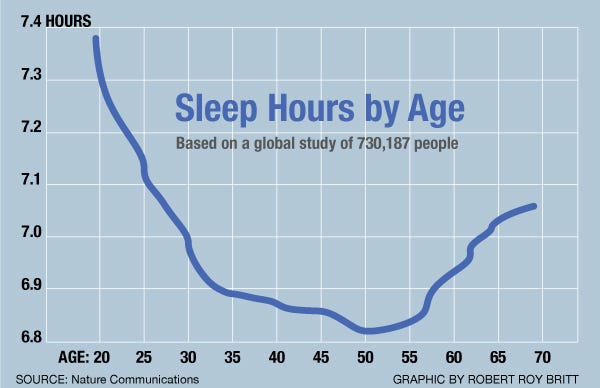
“Previous studies have found associations between age and sleep duration, but ours is the first large study to identify these three distinct phases across the life course,” said study co-leader Hugo Spiers, PhD, director of spatial cognition research at University College London. “We found that across the globe, people sleep less during mid-adulthood, but average sleep duration varies between regions and between countries.”
The study, detailed in the journal Nature Communications, was based on some unique data from participants in a mobile game called Sea Hero Quest, a citizen-science venture created for neuroscience research that asks people about their demographics, sleep patterns and other aspects of life.
On average, people sleep seven hours a night, the study concluded. Women get 7.5 minutes more than men.
“The decline in sleep during mid-life may be due to demands of childcare and working life,” the researchers said in a statement. That fits with what other research has suggested—though we can safely add “lots of bills” and “other pressures of life” to the mix. But it speaks to only part of the problem with sleep these days.
Duration is only half the equation
Sufficient, quality sleep can be hard to come by at any age for some people, due to underlying health conditions, behavioral choices like drinking alcohol and sitting too much, or stress and anxiety that afflict an increasing number of people of all ages.
As we age, the odds rise for the emergence of sleep-destroying health conditions. Along with that, people are more likely to be on medications that can disrupt sleep. But falling asleep, staying asleep, and sleeping deeply to get the full dose of rejuvenating benefits can prove challenging for people of any age.
A much-cited 2013 Gallup poll found U.S. adults 65 and older sleep more than any other adult age group. Percentage of respondents who said they regularly sleep at least seven hours:
18–29: 54% 30–49: 56% 50–64: 62% 65+: 67%
Surveys like these are never perfectly accurate. Results vary in part based on how questions are posed, and also because most people don’t really know how long they sleep, so answers are often best guesses. But however you read them, they add up to one clear conclusion:
A lot of older individuals sleep quite well, and when someone doesn’t sleep well — at whatever age — often it’s due to underlying, addressable behaviors or medical conditions.
As part of the research for my book on how to sleep better, I did a survey of 103 adults of all ages. Though not a scientific poll, the results were telling: Seniors scored as well as younger adults on my Sleep Score questionnaire, which is designed to assess how well one sleeps. Also, those who slept poorly cited the same main reasons, regardless of age: stress or anxiety, an underlying health issue, or an unhelpful sleep-disrupting behavior — what I call sleep kryptonite.
What you need
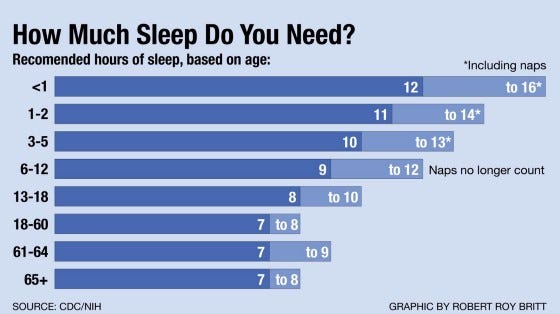
There is no agreed-upon guideline for exactly how many hours of sleep each person needs. Sleep experts advise at least seven hours for most adults, but genetics and numerous lifestyle factors can affect whether an individual needs more or less. Federal guidelines are oddly vague in older age groups, and wrongly suggest that when young people turn 19 they somehow need less sleep.
However, as other new research has shown: Poor-quality sleep can be just as bad for you as not getting enough hours of shut-eye. If you want to get a handle on how well you actually do sleep, and how to improve the quality of your sleep, you can learn more here:
Your support makes my health and wellness writing possible. You can sign up for emails when I publish on Medium, or join Medium to directly support me and gain full access to all Medium stories, get my health news briefs on Mastodon, or check out my book: Make Sleep Your Superpower: A Guide to Greater Health, Happiness & Productivity (paperback or Kindle version). — Rob


