
The Myth of the Slavery-Capitalism Connection
A clever lie which must be lied to rest
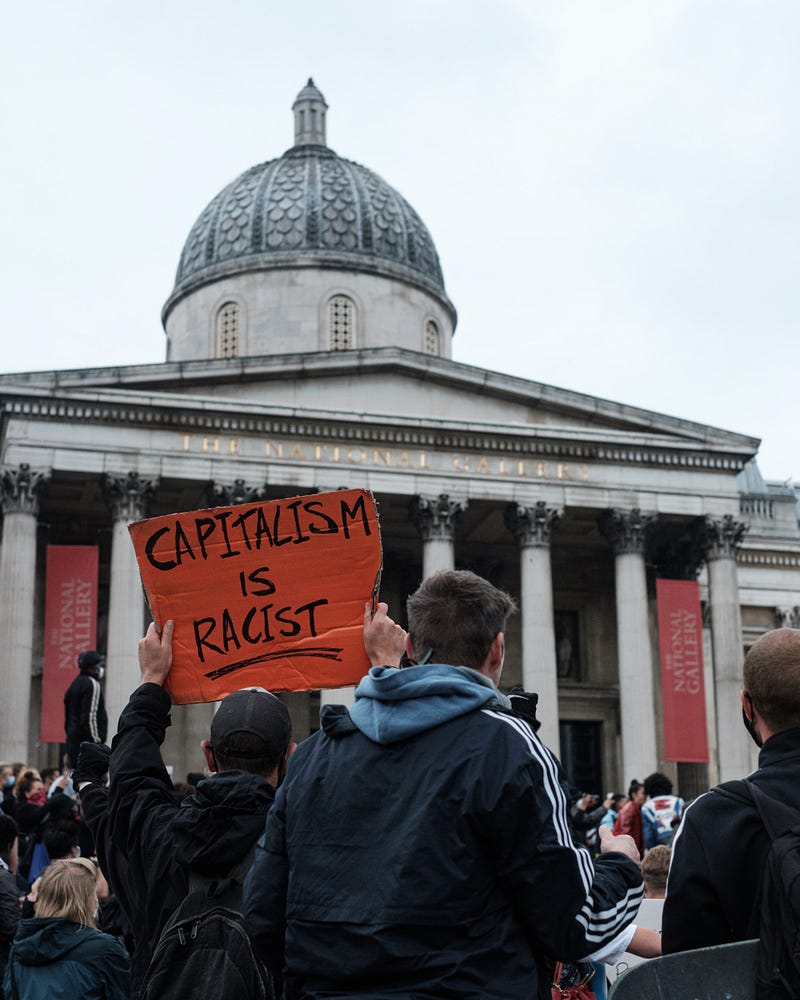
“In order to understand the brutality of American capitalism, you have to start on the plantation.”
– Matthew Desmond, NY Times 1619 Project
“Fundamentally, there are only two ways of co-ordinating the economic activities of millions. One is central direction involving the use of coercion — the technique of the army and of the modern totalitarian state. The other is voluntary co-operation of individuals — the technique of the market place.”
– Milton Friedman, Capitalism and Freedom
We all know the story. In 1776, Adam Smith, the father of modern economics, published On the Wealth of Nations where he articulated the fundamental workings of capitalist economies. The very next day, there were lines around the block at every slave auction in the United States and Great Britain.
Of course, that’s not how it went. Slavery and other forms of injustice pre-dated capitalism by thousands of years. But listening to many of today’s anti-capitalist elites, you could be forgiven for thinking otherwise. We read it in the New York Times 1619 Project, and in articles by The Guardian. We see it in the push for reparations, articulated by prominent influencers like Ta-Nehisi Coates and Charlamagne tha God.
The argument goes that the West was built on the backs of slaves and that the wealth created in its economies would have never been possible without the shackles and whips of the plantation.
But as it goes with most things social, economic, and political, the truth is not as simple as it seems.
The reality is that not only does the success of Western capitalism owe nothing to slavery, but slavery owes its demise to capitalism and to the principles that underly the market economy.
The following will explain.
Slavery and injustice are not unique to America, the West, or any of its economic systems
The ideas of limited government and free-enterprise were novel at the time of America’s founding. But slavery — as well as all other forms of oppression — were as old as time. It was also pervasive across a multitude of cultures, political, and economic systems. That is because the desire to conquer others for the gain of one’s tribe is an innate flaw of the human animal.
Economist Thomas Sowell put it best:
“Of all the tragic facts about the history of slavery, the most astonishing to an American today is that, although slavery was a worldwide institution for thousands of years, nowhere in the world was slavery a controversial issue prior to the 18th century. People of every race and color were enslaved — and enslaved others. White people were still being bought and sold as slaves in the Ottoman Empire, decades after American blacks were freed….
…You could research all of the 18th century Africa or Asia or the Middle East without finding any comparable rejection of slavery there. But who is singled out for scathing criticism today? American leaders of the 18th century.”
Source: The Thomas Sowell Reader
As we can see it was the West that slowly began the process of dismantling the notion that one person should own another. It was the ideals espoused in the Declaration of Independence — that the individual is sovereign, is equal with his fellow human, and is entitled to self-ownership — that provided the moral impetus for the universal rejection of slavery in the West.
One of the other outcomes of those ideals was a new way of thinking about economics: that people, being entitled to “certain alienable rights,” should be free to create wealth for themselves and others without undue interference from the state. This way of thinking formed the philosophical foundation for capitalism.
Capitalism and slavery are polar opposites in principle
History aside, slavery and capitalism couldn’t be more juxtaposed in their underlying principles. That is because capitalism, understood in its most basic sense, is an economic system that is based on private property and freedom of exchange.
A common, misguided critique of capitalism is that it is immoral, being a system based on greed. But it is more accurate to say that capitalism allows for greed since it honors human freedom. Just the same, the 1st Amendment to the U.S. constitution is not immoral even though it’s honoring of free exchange (of words and ideas) allows for religious cults, misinformation, and Miley Cyrus records.
Obviously, slavery doesn’t allow for much freedom nor for the universal ownership of property.
This was acknowledged by one of the most prominent slavery apologists in the 19th century, George Fitzhugh, who wrote in his book, Sociology for the South or the Failure of Free Society, published in 1854:
Political economy is the science of free society. Its theory and its history alike establish this position. Its fundamental maxim Laissez-faire and “Pas trop gouverner,” are at war with all kinds of slavery, for they in fact assert that individuals and peoples prosper most when governed least
If anything, slavery has much more in common with socialism. It denies an entire group of people their right to private property, puts wealth and the means of production under the ownership of a governing elite. It then rations that wealth to the population in the form of food, clothing, and other basic needs.
In Fitzhugh’s own words, “Slavery is a form, and the very best form, of socialism.”
The Abolition of slavery would have been much more difficult without the advent of industrial capitalism
The abolition of slavery and the dawn of the industrial revolution occurred at roughly the same time for both the US, and Britain. Although for Britain, abolition came some 30 years prior.
The world was changing. We were moving from an agrarian-based way of living to an industrial one. The American South was resistant to both the abolition movement and to the industrial transition, and the reason is significant: slavery went hand in hand with the agrarian lifestyle. Britain, and the American North were able to shed or avoid their dependence on slave labor because their economies developed to become less dependent on farming, and were instead driven more by manufacturing.
This transition marked a departure from humanity’s primary method of subsistence that had existed since our Paleolithic ancestors first learned how to farm, some 10,000 years ago. It was that transition that enabled the abolition movement by making it economically feasible.
Just as the principles of classical liberalism provided the moral impetus for abolition, the dawn of industrial capitalism did the same in economic terms.
The success of capitalism occurred despite slavery, not because of it
It might seem intuitively obvious that capitalism’s success was built upon the backs of slaves, but that assumption reveals ignorance of the most fundamental principles of modern economics.
Economies grow not simply by producing goods. Economies grow synergistically. That is, they grow by consumption — a process in which the spending of one is the income of another, multiplied millions of times over each day, gradually increasing the wealth available in an economy. Just as powerfully, economies grow through the investment and reinvestment of human capital — skills, inventions, innovations, entrepreneurship etc.
Slavery was much more likely a drag on what would have been even stronger economic growth in its absence. That is because it severely restricted the investment of human capital as well as consumption for an entire subset of the population. Slavery also prolonged America’s dependence on crop production, which slowed its transition into the industrial age.
The exact outcome that would have resulted if the US had abolished slavery much sooner, or had never had it in the first place, is impossible to tell. There is some solid economic data, however, that supports the above hypothesis.
In 2013 Mini Narayan Datta, and Kevin Bales of the University of Richmond published a paper entitled, Slavery is Bad for Business: Analyzing the Impact of Slavery on National Economies. Their research concluded the following:
“Our analysis examines the relationship between the prevalence of slavery in a country (in terms of the proportion of the population enslaved) and several economic measures (the United Nations Human Development Index, GDP in terms of purchasing power parity, access to financial services, and the Gini coefficient). In each instance, controlling for alternative explanations, greater levels of slavery are associated with a decline in economic growth and human development. The findings imply that…slavery is objectively harmful for total economic output…”
The paper finally concludes that “slaves, though practically invisible, exert a strong, negative pull on local and national economies throughout their lack of full economic participation.”
Analysis done by economist Scott Summer, Director of the Program on Monetary Policy at the George Mason University, makes similar claims. In an article entitled, Ending Slavery Made America Richer, Summer notes that the abolition of slavery coincided with a dramatic increase in industrial and real estate capital — an increase of more than 100%.
Summer points to several observations to argue that abolition was a decisive factor in spurring the robust growth of the US economy following the Civil War.
For one, Brazil abolished slavery in the 1880s, and saw no advantage over countries that had abolished it. Brazil is, in fact, still considered a developing nation.
Two, “when the American South abolished Jim Crow, incomes in that region began to converge on those in the North,” suggesting that more freedom tends to increase economic productivity.
Three, Summer observed that “most…rich countries around the world were places with free labor in the 19th century. Places that had slavery tend to be much poorer.” He argues that the American North, and South themselves served as a crude economic experiment in the so-called benefits and the very real downsides of slavery. Summer notes that “the North was far more dynamic, industrializing rapidly, and drawing more immigrants from Europe.”
Summer, Datta, and Bales’ conclusions fit well with the observations of Adam Smith, who wrote in his book, On The Wealth of Nations, that when individuals are free to make economic decisions in their own self-interest, the effect is overall economic gain:
“and he is in this, as in many other cases, led by an invisible hand to promote an end which was no part of his intention…by pursuing his own interest he frequently promotes that of the society more effectually than when he really intends to promote it.”
As we can see, Smith’s “invisible hand” was effectively shackled by the institution of slavery.
Conclusion
In a sense, capitalism does have a connection to slavery because without it, we would all be slaves — to hunger, to poverty, to sickness, and to ignorance — just as the vast majority of humanity was for the vast majority of human history. It was the dawn of the industrial revolution, even with all of its problems, that opened the floodgates of inventions, ideas, innovations, and opportunities that led to the unprecedented abundance that we now take for granted in the West.
Before that, it was the adoption of Enlightenment ideals — enshrined in the Declaration of Independence most famously — that provided the moral impetus for the enormous social progress we have seen over the past several hundred years, including but not limited to, the abolition of slavery. It was those same ideals that gave birth to capitalism.
Next time someone claims that capitalism and racial oppression are related, know that nothing could be further from the truth.
For articles like these delivered to your inbox subscribe to https://carmelosanpaolo.substack.com


