avatarAli

Free AI web copilot to create summaries, insights and extended knowledge, download it at here

7756

Abstract

pan> → <span class="hljs-number">790</span><span class="hljs-number">395</span><span class="hljs-number">1186</span><span class="hljs-number">593</span><span class="hljs-number">1780</span><span class="hljs-number">890</span><span class="hljs-number">445</span><span class="hljs-number">1336</span><span class="hljs-number">668</span><span class="hljs-number">334</span><span class="hljs-number">167</span><span class="hljs-number">502</span><span class="hljs-number">251</span><span class="hljs-number">754</span><span class="hljs-number">377</span><span class="hljs-number">1132</span><span class="hljs-number">566</span><span class="hljs-number">283</span><span class="hljs-number">850</span><span class="hljs-number">425</span><span class="hljs-number">1276</span><span class="hljs-number">638</span><span class="hljs-number">319</span><span class="hljs-number">958</span><span class="hljs-number">479</span><span class="hljs-number">1438</span><span class="hljs-number">719</span><span class="hljs-number">2158</span><span class="hljs-number">1079</span><span class="hljs-number">3238</span><span class="hljs-number">1619</span><span class="hljs-number">4858</span><span class="hljs-number">2429</span><span class="hljs-number">7288</span><span class="hljs-number">3644</span><span class="hljs-number">1822</span><span class="hljs-number">911</span><span class="hljs-number">2734</span><span class="hljs-number">1367</span><span class="hljs-number">4102</span><span class="hljs-number">2051</span><span class="hljs-number">6154</span><span class="hljs-number">3077</span><span class="hljs-number">9232</span><span class="hljs-number">4616</span><span class="hljs-number">2308</span><span class="hljs-number">1154</span><span class="hljs-number">577</span><span class="hljs-number">1732</span><span class="hljs-number">866</span><span class="hljs-number">433</span><span class="hljs-number">1300</span><span class="hljs-number">650</span><span class="hljs-number">325</span><span class="hljs-number">976</span><span class="hljs-number">488</span><span class="hljs-number">244</span><span class="hljs-number">122</span><span class="hljs-number">61</span><span class="hljs-number">184</span><span class="hljs-number">92</span><span class="hljs-number">46</span><span class="hljs-number">23</span><span class="hljs-number">70</span><span class="hljs-number">35</span><span class="hljs-number">106</span><span class="hljs-number">53</span><span class="hljs-number">160</span><span class="hljs-number">80</span><span class="hljs-number">40</span><span class="hljs-number">20</span><span class="hljs-number">10</span><span class="hljs-number">5</span><span class="hljs-number">16</span><span class="hljs-number">8</span><span class="hljs-number">4</span><span class="hljs-number">2</span><span class="hljs-number">1</span></pre></div><p id="6f05">As demonstrated above, the journey to 1 varies vastly depending on the starting number. While 26 quickly reaches 1,<b> 27 embarks on an extensive journey with multiple peaks and valleys before ultimately arriving at one after a staggering 111 steps.</b> It’s fascinating to observe that such closely associated numbers can embark on vastly different trajectories.</p><blockquote id="6974"><p>If you’re interested in further exploring this mathematical enigma but wish to spare your pencil the toil of manually jotting down each step, try an <a href="https://goodcalculators.com/collatz-conjecture-calculator/"><b>online Collatz calculator</b></a>. These calculators efficiently perform the computations for you, allowing you to focus solely on the emerging intriguing patterns.</p></blockquote><h2 id="e900">The Connection Between the Collatz Conjecture and Life</h2><p id="0e04">I didn’t dwell too much on the Collatz conjecture but found a connection between it and life.</p><p id="6340">The parallels between the Collatz Conjecture and life’s journey are indeed uncanny. As we traverse our life’s path, we encounter highs and lows, much like the sequences of numbers in the Collatz Conjecture. Some days start with a burst of positivity, akin to a high starting number, and we make decisions that elevate our living standards materially and spiritually.</p><figure id="a730"><img src="https://cdn-images-1.readmedium.com/v2/resize:fit:800/1*FYzRSDUDlWGeLy84HVpPaQ.png"><figcaption>A StackExchange user created graphs of the number of iterations vs. the integers up to 10⁷, one of which I’ve shown below for integers up to 2⋅10⁶. | Source: <a href="https://math.stackexchange.com/questions/1201942/a-general-question-about-the-collatz-conjecture-and-finding-that-integer-that-do"><b>StackExchange</b></a></figcaption></figure><p id="fc10">Yet, life’s unpredictability strikes, and we feel like an odd number in the Collatz Conjecture being halved. Our circumstances improve slightly, only to deteriorate once more. As we age, these fluctuations become a familiar pattern. Inevitably, we reach the end of our journey, symbolized by the number 1. It’s a testament to the cyclicality of life and the depths of mathematical theories.</p><figure id="a0f1"><img src="https://cdn-images-1.readmedium.com/v2/resize:fit:800/1*zZkFuEe9FCS4Ev-Ya1hTFw.png"><figcaption>Collatz sequence for n = 27</figcaption></figure><figure id="c673"><img src="https://cdn-images-1.readmedium.com/v2/resize:fit:800/1*0x42Wkd7h5AMqZV7FwpQ_A.png"><figcaption>Collatz sequence for n = 100</figcaption></figure><figure id="7fcc"><img src="https://cdn-images-1.readmedium.com/v2/resize:fit:800/1*fkswL72YquctK2V3TbGswQ.png"><figcaption>Collatz sequence for n = 111111</figcaption></figure><p id="9a1c">Governments, too, fall under similar patterns. Some administrations are ephemeral, akin to a low starting number in the Collatz Conjecture. They ascend to power and reach their peak, and much like the sequence reaching 1, they dissipate, leaving nothing but a fleeting memory. On the contrary, others, much like higher starting numbers, hold onto their reigns for extended periods. They oscillate between states of stability and instability, reflecting the multiple peaks and troughs in the number sequence. But, they, too, inevitably reach their terminus, symbolizing the inevitable fall of even the most enduring dictatorships.</p><p id="0a9f">This phenomenon isn’t limited to political spheres; it also extends to sports. The 2015–2016 English Football team, Leicester City, is a classic example. They were relatively unknown for years, much like a low initial number 27 in the Collatz Conjecture. However, <b>in 2016, akin to a sudden jump in the sequence, they clinched the Premier League title, catapulting them to global fame.</b> They maintained their elevated status for a while, reflecting the plateaus in the Collatz Conjecture. <b>As of now, they’ve regressed from their peak and are no longer in the Premier League, symbolizing the eventual descent to 1.</b> The rise and fall of Leicester City serve as a vivid real-world manifestation of the Collatz Conjecture.</p><figure id="07c4"><img src="https://cdn-images-1.readmedium.com/v2/resize:fit:800/1*5NlSrnD8YMaqv7qX3NKTsw.jpeg"><figcaption>On this day in 2016: Leicester win first ever Champions League match | Source: <a href="https://www.beinsports.com/en-us/soccer/championship/articles/on-this-day-in-2016-leicester-win-first-ever-champions-league-match-2023-09-14"><b>beinSports</b></a></figcaption></figure><h1 id="e94c">“Mathematics is not yet ready for such problems.” — P. Erdös</h1><p id="6e1c">When Lothar Collatz visited his friend

Options

Helmut Hasse in 1952, he posed the same question. However, Hasse showed little interest in the question, relegating it to obscurity for a considerable period. <b>It was not until 1971 that the question resurfaced when Collatz published a paper affirming his conjecture’s validity for all positive integers less than 500,000. </b>This proclamation reignited attention toward the question, prompting numerous mathematicians to plunge into the quest to substantiate or refute Collatz’s statement.</p><p id="d8ce">Indeed, the Collatz Conjecture has a notorious reputation in the mathematical community, with many renowned mathematicians avoiding it. Paul Erdős, the prolific Hungarian mathematician known for his extensive work in number theory, graph theory, and combinatorics, expressed his skepticism regarding the Collatz Conjecture. He is famously quoted saying, <b><i>“Mathematics is not yet ready for such problems,”</i></b> refraining from delving into the labyrinthine complexities of the problem.</p><p id="8d59">Equally noteworthy is Jeffrey Lagarias, an esteemed mathematician from the University of Michigan. Despite his diversified mathematical interests, he expressed his reservations about the Collatz Conjecture in no ambiguous terms. He said, <b><i>“This is a really dangerous problem. People become obsessed with it, and it really is impossible.” </i></b>His words serve as a stern warning to mathematicians intrigued by the deceptive simplicity of the Collatz Conjecture, cautioning them about the many compelling and frustrating paths this conjecture can lead them down.</p><blockquote id="c2ee"><p>After decades of interest and exploration into the enigma of the Collatz Conjecture, Jeffrey Lagarias made a significant contribution to the field. He compiled all the knowledge and insights he had gathered over approximately 40 years into a comprehensive volume. In 2010, he published this work, aptly titled <a href="https://amzn.to/3RBcoYf"><b>“The Ultimate Challenge: The 3x + 1 Problem.”</b></a> The book provides a deeper understanding of the notorious Conjecture, offering readers a glimpse into the captivating world of this mathematical mystery.</p></blockquote><figure id="79d2"><img src="https://cdn-images-1.readmedium.com/v2/resize:fit:800/1*TsXibC0bltnMqaSJENeR-g.png"><figcaption>The Ultimate Challenge: The 3x + 1 Problem Jeffrey Lagarias | <b>You can get the book on Amazon.</b></figcaption></figure><p id="b1b8">Today, powerful computers are employed to test the Collatz Conjecture, crunching through numbers individually. As of recent counts, <b>all of the 295,147,905,179,352,825,856 numbers up to ²⁶⁸ have been tested by the Collatz method, and all have ultimately returned to 1.</b> However, it’s crucial to underscore that no amount of computer testing, regardless of the scope of numbers tested, can substantiate the Collatz Conjecture definitively. This is because testing a finite set of numbers, however vast, cannot prove the conjecture for all integers.</p><p id="11b9">Recently, eminent mathematician Terence Tao, widely recognized as a mathematical genius of our time, announced a significant breakthrough. He claims to have come incredibly close to solving the Collatz Conjecture, asserting that <b>he has proven it for ALMOST all numbers.</b> Despite this tremendous progress, it’s crucial to note that Tao’s finding does not equate to complete proof of the Collatz Conjecture. For those interested in delving into the details of Tao’s work, <a href="https://terrytao.wordpress.com/2019/09/10/almost-all-collatz-orbits-attain-almost-bounded-values/"><b>his proof and its rigorous mathematical reasoning are available for scrutiny on his blog.</b></a></p><figure id="483b"><img src="https://cdn-images-1.readmedium.com/v2/resize:fit:800/1*NQtYJcYAMxWCjH0jZL65LA.jpeg"><figcaption>The Singular Mind of Terry Tao | Source: <a href="https://www.nytimes.com/2015/07/26/magazine/the-singular-mind-of-terry-tao.html"><b>The New York Times</b></a></figcaption></figure><h2 id="8caa">The Connection Between the Collatz Conjecture and Art</h2><p id="f843">Some mathematicians have turned to the Collatz Conjecture for inspiration in the entwining of mathematics and art. One example is <a href="https://maxwelldemon.com/"><b>Edmund Harriss</b></a> from the University of Arkansas, who astoundingly transformed the Collatz series into captivating visual art. Harriss’s mesmerizing creation can be viewed on his Twitter account.</p> <figure id="0261"> <div> <div> <img class="ratio" src="http://placehold.it/16x9"> <iframe class="" src="https://cdn.embedly.com/widgets/media.html?type=text%2Fhtml&amp;key=a19fcc184b9711e1b4764040d3dc5c07&amp;schema=twitter&amp;url=https%3A//twitter.com/Gelada/status/846751901756653568&amp;image=https%3A//i.embed.ly/1/image%3Furl%3Dhttps%253A%252F%252Fabs.twimg.com%252Ferrors%252Flogo46x38.png%26key%3Da19fcc184b9711e1b4764040d3dc5c07" allowfullscreen="" frameborder="0" height="281" width="500"> </div> </div> </figure></iframe></div></div></figure><p id="7881">To gain a deeper understanding of his creative process, watch the enlightening video available on Numberphile. For those intrigued enough to create their own iteration, <b>check out this <a href="#">link</a>.</b></p> <figure id="d34a"> <div> <div> <img class="ratio" src="http://placehold.it/16x9"> <iframe class="" src="https://cdn.embedly.com/widgets/media.html?src=https%3A%2F%2Fwww.youtube.com%2Fembed%2FLqKpkdRRLZw%3Ffeature%3Doembed&amp;display_name=YouTube&amp;url=https%3A%2F%2Fwww.youtube.com%2Fwatch%3Fv%3DLqKpkdRRLZw&amp;image=https%3A%2F%2Fi.ytimg.com%2Fvi%2FLqKpkdRRLZw%2Fhqdefault.jpg&amp;key=a19fcc184b9711e1b4764040d3dc5c07&amp;type=text%2Fhtml&amp;schema=youtube" allowfullscreen="" frameborder="0" height="480" width="854"> </div> </div> </figure></iframe></div></div></figure><p id="2bf2">A coloring book called <a href="https://amzn.to/3v0aM1h"><b>Patterns of the Universe by Alex Bellos</b></a> tells us how the Collatz conjugate is visualized in the video above. If you wish, you can take the book and do activities like the one below.</p><figure id="f402"><img src="https://cdn-images-1.readmedium.com/v2/resize:fit:800/1*7BjbThd9KjUzC0U5D23TqQ.jpeg"><figcaption></figcaption></figure><figure id="6e0f"><img src="https://cdn-images-1.readmedium.com/v2/resize:fit:800/1*oavHgViGhTaRsBZgbjjsAA.jpeg"><figcaption><i>Patterns of the Universe and Visions of the Universe by Alex Bellos and Edmund Harriss | Source: <a href="https://bookzoompa.wordpress.com/author/bookzoompa/"></a></i><a href="https://bookzoompa.wordpress.com/author/bookzoompa/">Paula Beardell Krieg</a></figcaption></figure><p id="86b8">Finally, let me end this article with Gauss. When the great mathematician was asked why he was not interested in Fermat’s Last Theorem, he replied that he could make up a lot of connectors like Fermat’s theorem, which is very simple to ask but impossible to solve, so he was not interested at all.</p><blockquote id="6943"><p><b>Note 1:</b> <a href="https://beyondeuclid.substack.com/"><b>Beyond Euclid!</b></a> is my weekly newsletter that brings you only high-quality math and science stuff to ensure you are having a good week. Please do yourself a favor by subscribing to Beyond Euclid and enjoy it! And <a href="https://beyondeuclid.substack.com/"><b>if you can be a member and support my work,</b></a> that would be awesome! Thank you!</p></blockquote><blockquote id="06df"><p><b>Note 2:</b> I get commissions for purchases made through links in this post.</p></blockquote></article></body>

The Mystique of the Collatz Conjecture: An Unresolved Mathematical Puzzle

Collatz Feather by MICHAEL SPILSBURY

Consider this your official warning: The mathematical puzzle I am about to plunge into, known as the Collatz Conjecture, holds a potent allure that can be overwhelmingly addictive. Much like the disclaimers you encounter at the start of a film, cautioning of flashing lights or intense action sequences, or the heart disease warnings that precede nail-biting soccer games, this notice serves the same purpose. The Collatz Conjecture, a seemingly simple premise, and yet maddeningly elusive solution, can draw you in with its seemingly straightforward premise. Proceed with caution.

Shizuo Kakutani, a renowned mathematician who began teaching at Yale University immediately after World War II, is a testament to the perplexing charm of the Collatz Conjecture. Known for his popularity among students, Kakutani was so captivated by the Collatz Conjecture that he introduced it to everyone around him, igniting a wave of intrigue that pulsated throughout the entire mathematics department at Yale. For an entire month, the math department was consumed by this confounding problem, with everyone immersed in vibrant discussions and attempts at resolution. Kakutani once commented on the experience:

For about a month everybody at Yale worked on it, with no result. A similar phenomenon happened when I mentioned it at the University of Chicago. A joke was made that this problem was part of a conspiracy to slow down mathematical research in the U.S.

Shizuo Kakutani was a Japanese-American mathematician, best known for his eponymous fixed-point theorem. | Source: The Royal Society

Indeed, the enchanting allure of the Collatz Conjecture was so potent that it stirred the imagination of the American public to the point of conspiracy theories. The pervasive obsession with the problem even led to the development of a popular theory that its very existence was a Soviet plot aimed at slowing down the progress of American science.

What is the Collatz Conjecture?
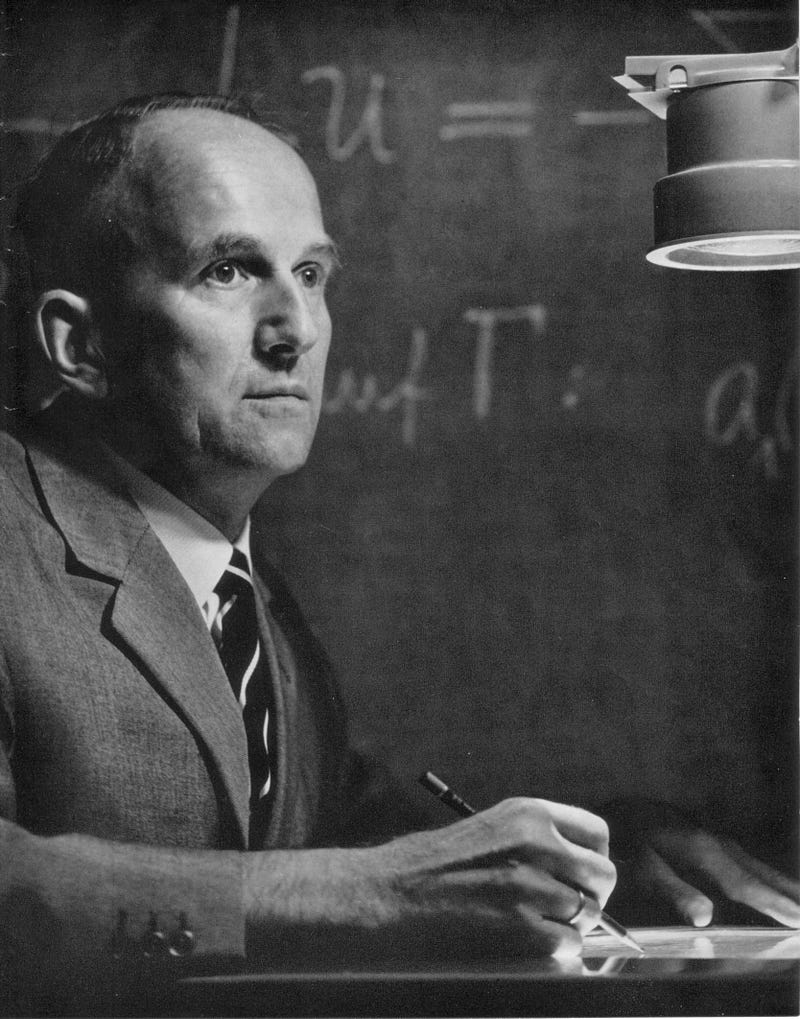
Lothat Collatz — From researchers and scholars. | Source: The University of Hamburg

In 1937, the German mathematician Lothar Collatz found himself pondering an intriguing question: if one starts with any positive integer and follows a simple set of rules — divide the number by two if it’s even, or, if it’s odd, calculate one more than three times the number — will the sequence always reach the number 1, regardless of the initial number chosen?

To illustrate how the Collatz Conjecture works, let’s start with the number 10. According to the rules, we divide it by two as an even number, yielding 5. Five is an odd number, so multiply it by three and add 1, resulting in 16. Continuing with this process, 16 (even) divided by 2 equals 8; 8 (even) divided by 2 equals 4; 4 (even) divided by 2 equals 2; and finally, 2 (even) divided by 2 brings us to 1. At this point, one might be tempted to apply the odd number rule (multiply by three and add 1), but doing so would lead us back to 4, sparking an endless loop of 4, 2, 1, 4, 2, 1, and so on. Thus, the process stops once we reach 1.

Let’s choose my favorite number, 7. The numbers we get are as follows:

7 -> 22 -> 11 -> 34 -> 17 -> 52 -> 26 -> 13 -> 40 -> 20 -> 10 -> 5 -> 16 -> 8 -> 4 -> 2 -> 1 -> 4 -> 2 -> 1.

At first glance, the Collatz Conjecture may appear deceptively simple, given its straightforward process. This simplicity has continually drawn enthusiasts and mathematicians alike to its unsolved mystery. You may instinctively presume that, as the calculations involve multiplying certain numbers by three and dividing by two, the resulting numbers would inevitably escalate towards infinity. Surprisingly, this isn’t the case.

Regardless of their initial value, the numbers analyzed so far have consistently returned to 1. Even sequences derived from consecutive numbers have exhibited seemingly unrelated behavior, yet they, too, find their way back to 1. This paradoxical nature of the problem, where simplicity breeds complexity, is a key aspect of its enduring allure.

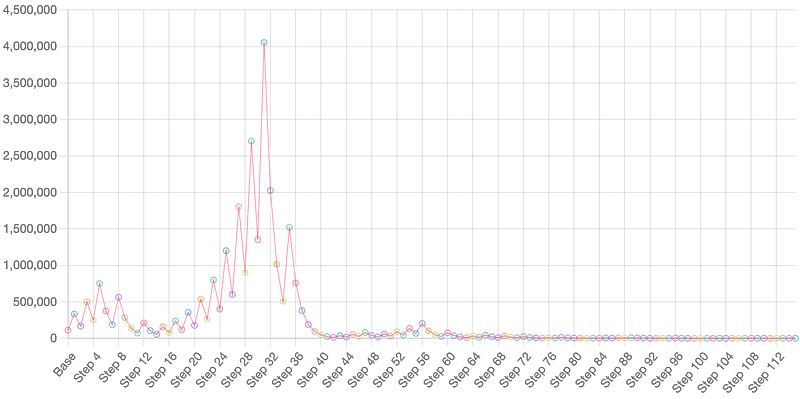
Let’s examine 26 and 27, for example.

26134020105168421
27824112462319447142712141073221614842421213641829127413741220610331015546623370035017552626379039511865931780890445133666833416750225175437711325662838504251276638319958479143871921581079323816194858242972883644182291127341367410220516154307792324616230811545771732866433130065032597648824412261184924623703510653160804020105168421

As demonstrated above, the journey to 1 varies vastly depending on the starting number. While 26 quickly reaches 1, 27 embarks on an extensive journey with multiple peaks and valleys before ultimately arriving at one after a staggering 111 steps. It’s fascinating to observe that such closely associated numbers can embark on vastly different trajectories.

If you’re interested in further exploring this mathematical enigma but wish to spare your pencil the toil of manually jotting down each step, try an online Collatz calculator. These calculators efficiently perform the computations for you, allowing you to focus solely on the emerging intriguing patterns.

The Connection Between the Collatz Conjecture and Life

I didn’t dwell too much on the Collatz conjecture but found a connection between it and life.

The parallels between the Collatz Conjecture and life’s journey are indeed uncanny. As we traverse our life’s path, we encounter highs and lows, much like the sequences of numbers in the Collatz Conjecture. Some days start with a burst of positivity, akin to a high starting number, and we make decisions that elevate our living standards materially and spiritually.
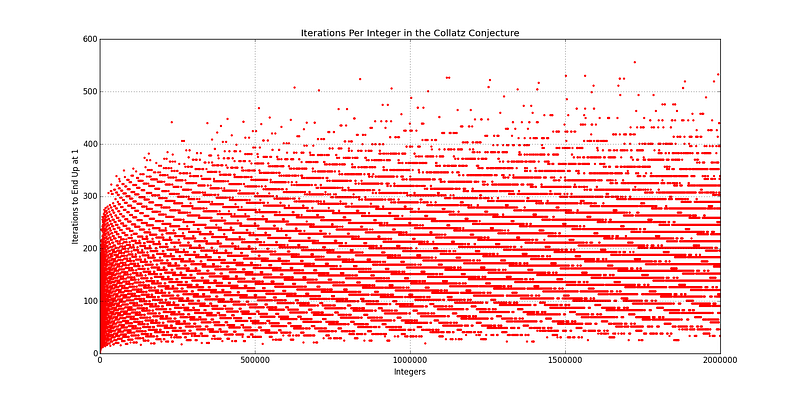
A StackExchange user created graphs of the number of iterations vs. the integers up to 10⁷, one of which I’ve shown below for integers up to 2⋅10⁶. | Source: StackExchange

Yet, life’s unpredictability strikes, and we feel like an odd number in the Collatz Conjecture being halved. Our circumstances improve slightly, only to deteriorate once more. As we age, these fluctuations become a familiar pattern. Inevitably, we reach the end of our journey, symbolized by the number 1. It’s a testament to the cyclicality of life and the depths of mathematical theories.
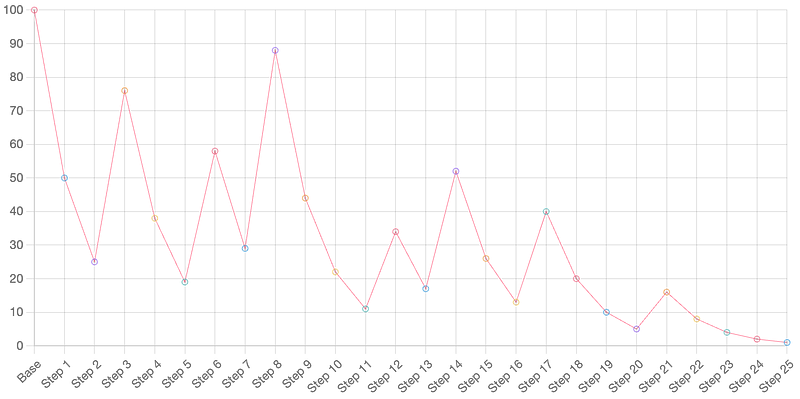
Collatz sequence for n = 27
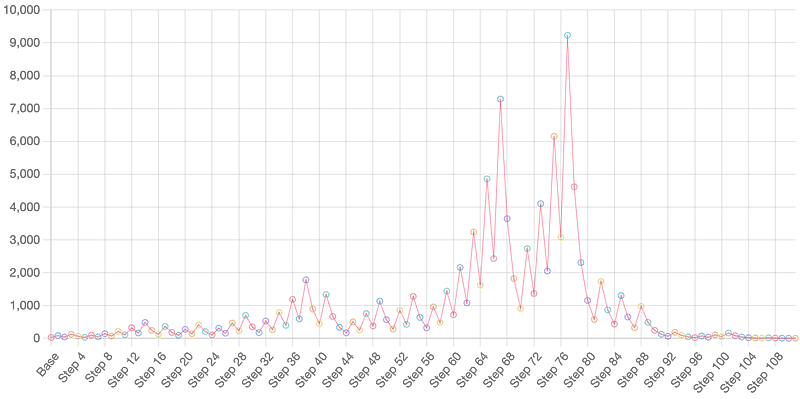
Collatz sequence for n = 100
Collatz sequence for n = 111111

Governments, too, fall under similar patterns. Some administrations are ephemeral, akin to a low starting number in the Collatz Conjecture. They ascend to power and reach their peak, and much like the sequence reaching 1, they dissipate, leaving nothing but a fleeting memory. On the contrary, others, much like higher starting numbers, hold onto their reigns for extended periods. They oscillate between states of stability and instability, reflecting the multiple peaks and troughs in the number sequence. But, they, too, inevitably reach their terminus, symbolizing the inevitable fall of even the most enduring dictatorships.

This phenomenon isn’t limited to political spheres; it also extends to sports. The 2015–2016 English Football team, Leicester City, is a classic example. They were relatively unknown for years, much like a low initial number 27 in the Collatz Conjecture. However, in 2016, akin to a sudden jump in the sequence, they clinched the Premier League title, catapulting them to global fame. They maintained their elevated status for a while, reflecting the plateaus in the Collatz Conjecture. As of now, they’ve regressed from their peak and are no longer in the Premier League, symbolizing the eventual descent to 1. The rise and fall of Leicester City serve as a vivid real-world manifestation of the Collatz Conjecture.

On this day in 2016: Leicester win first ever Champions League match | Source: beinSports

“Mathematics is not yet ready for such problems.” — P. Erdös

When Lothar Collatz visited his friend Helmut Hasse in 1952, he posed the same question. However, Hasse showed little interest in the question, relegating it to obscurity for a considerable period. It was not until 1971 that the question resurfaced when Collatz published a paper affirming his conjecture’s validity for all positive integers less than 500,000. This proclamation reignited attention toward the question, prompting numerous mathematicians to plunge into the quest to substantiate or refute Collatz’s statement.

Indeed, the Collatz Conjecture has a notorious reputation in the mathematical community, with many renowned mathematicians avoiding it. Paul Erdős, the prolific Hungarian mathematician known for his extensive work in number theory, graph theory, and combinatorics, expressed his skepticism regarding the Collatz Conjecture. He is famously quoted saying, “Mathematics is not yet ready for such problems,” refraining from delving into the labyrinthine complexities of the problem.

Equally noteworthy is Jeffrey Lagarias, an esteemed mathematician from the University of Michigan. Despite his diversified mathematical interests, he expressed his reservations about the Collatz Conjecture in no ambiguous terms. He said, “This is a really dangerous problem. People become obsessed with it, and it really is impossible.” His words serve as a stern warning to mathematicians intrigued by the deceptive simplicity of the Collatz Conjecture, cautioning them about the many compelling and frustrating paths this conjecture can lead them down.

After decades of interest and exploration into the enigma of the Collatz Conjecture, Jeffrey Lagarias made a significant contribution to the field. He compiled all the knowledge and insights he had gathered over approximately 40 years into a comprehensive volume. In 2010, he published this work, aptly titled “The Ultimate Challenge: The 3x + 1 Problem.” The book provides a deeper understanding of the notorious Conjecture, offering readers a glimpse into the captivating world of this mathematical mystery.

The Ultimate Challenge: The 3x + 1 Problem Jeffrey Lagarias | You can get the book on Amazon.

Today, powerful computers are employed to test the Collatz Conjecture, crunching through numbers individually. As of recent counts, all of the 295,147,905,179,352,825,856 numbers up to ²⁶⁸ have been tested by the Collatz method, and all have ultimately returned to 1. However, it’s crucial to underscore that no amount of computer testing, regardless of the scope of numbers tested, can substantiate the Collatz Conjecture definitively. This is because testing a finite set of numbers, however vast, cannot prove the conjecture for all integers.

Recently, eminent mathematician Terence Tao, widely recognized as a mathematical genius of our time, announced a significant breakthrough. He claims to have come incredibly close to solving the Collatz Conjecture, asserting that he has proven it for ALMOST all numbers. Despite this tremendous progress, it’s crucial to note that Tao’s finding does not equate to complete proof of the Collatz Conjecture. For those interested in delving into the details of Tao’s work, his proof and its rigorous mathematical reasoning are available for scrutiny on his blog.

The Singular Mind of Terry Tao | Source: The New York Times

The Connection Between the Collatz Conjecture and Art

Some mathematicians have turned to the Collatz Conjecture for inspiration in the entwining of mathematics and art. One example is Edmund Harriss from the University of Arkansas, who astoundingly transformed the Collatz series into captivating visual art. Harriss’s mesmerizing creation can be viewed on his Twitter account.

To gain a deeper understanding of his creative process, watch the enlightening video available on Numberphile. For those intrigued enough to create their own iteration, check out this link.

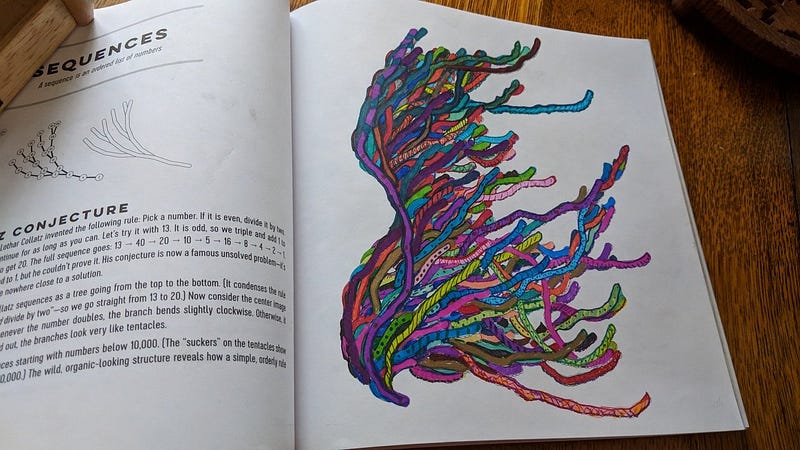
A coloring book called Patterns of the Universe by Alex Bellos tells us how the Collatz conjugate is visualized in the video above. If you wish, you can take the book and do activities like the one below.
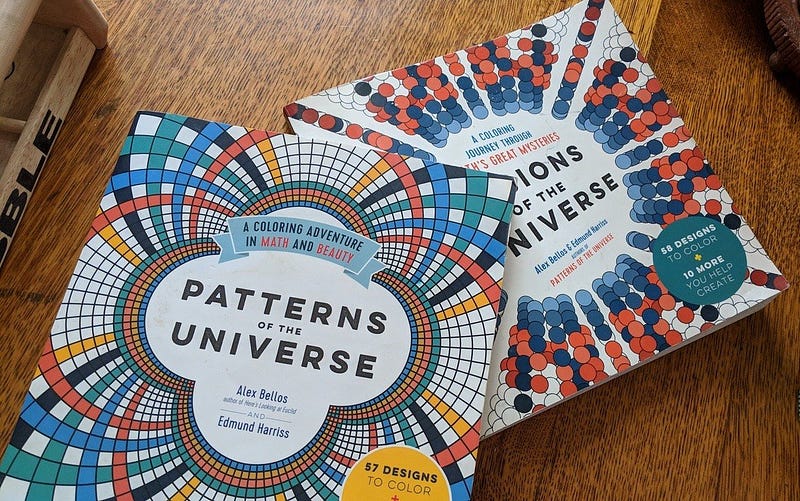
Patterns of the Universe and Visions of the Universe by Alex Bellos and Edmund Harriss | Source: Paula Beardell Krieg

Finally, let me end this article with Gauss. When the great mathematician was asked why he was not interested in Fermat’s Last Theorem, he replied that he could make up a lot of connectors like Fermat’s theorem, which is very simple to ask but impossible to solve, so he was not interested at all.

Note 1: Beyond Euclid! is my weekly newsletter that brings you only high-quality math and science stuff to ensure you are having a good week. Please do yourself a favor by subscribing to Beyond Euclid and enjoy it! And if you can be a member and support my work, that would be awesome! Thank you!

Note 2: I get commissions for purchases made through links in this post.

Mathematics
History
Education
Art
Recommended from ReadMedium