
The Mystery of South African Airways Flight 295–1987
We Will Probably Never Know What Caused This Disaster
Background
Some plane crashes are about more than just aviation. To understand such events and people’s responses to them, we need the context. In this case, knowing about apartheid reminds us of South Africa’s pariah status in 1987, and shows how so many conspiracy theories developed about Flight 295.
South Africa is now a racially-mixed country with 11 official languages, but it was not always so. Like most of Africa, its borders were created by European colonists. Dutch Boers (farmers) from (1652–1795 and 1803–1806) and the British Empire (1795–1803 and 1806–1961) both colonized South Africa.
The British and Boers fought two wars, (December 1880-March 1881) and October 1899–1902) for the chance to exploit South Africa’s extensive mineral wealth and fertile agricultural land. Neither power cared much about indigenous Africans.
Part 1: Apartheid South Africa — a brief history
In 1948, South Africans elected a far-right National Party government, which institutionalized racial segregation — apartheid, or “separate development.” From 1949, inter-racial marriage and sexual relations were illegal; all children had to be registered according to race.
Whites were in charge; Non-Whites had to live in designated areas. All public services were racially segregated and White people’s services were far superior to those for everyone else.
Apartheid was condemned by most other nations, and sanctions were imposed. South Africa was banned from sporting events, notably rugby, cricket, and athletics. In 1977, the United Nations (UN) made a previously voluntary arms embargo mandatory, then did the same in 1987 with an oil embargo.
There was opposition to apartheid within South Africa too, and continuing violence, by both the government and its victims.
South Africa was also involved in neighboring countries. In 1975, with the help of Zaire, the South African government launched “Operation Savannah,” invading Angola to try and prevent a Marxist regime taking power on independence from Portugal. The left-wing MPLA was supported by the USSR and Cuba, which sent troops and weapons.
Its enemy, the tight-wing UNITA was allied to South Africa, which was having trouble getting sufficient weapons. Later, some theories related this to the crash of South African Airways 295.
From 1978, South African Defence Forces continued their attacks. The turning point of this war was the siege of Cuito Carnavale, from October 1987-June 1988. Living in Cuba, I knew people who fought in the battle, including my brother-in-law. His mother said he was never the same after his experiences there. One ex-soldier called it “Angola’s Stalingrad.”
Angola and its allies fought off the invasion, but at a price.
South Africa found limited ways to trade, but not enough. Their economy was largely closed. As always, the least advantaged suffered most. In South Africa, these were Black Africans and “Coloureds.”
Lack of foreign investment meant scarce resources were limited to Whites. Trying to keep the peace involved high administration and defense costs. The country’s human capital received little funding and economic growth was non-existent.
Two very wise men knew this could not continue
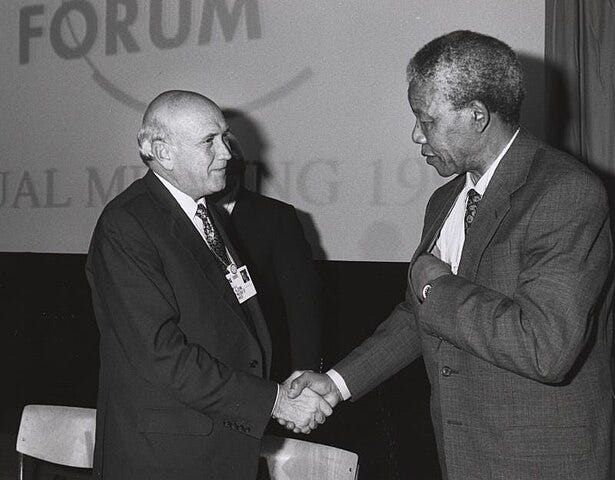
On 11 February 1990, President F. W, de Klerk’s government released Nelson Mandela, leader of the African National Congress (ANC) jailed for his anti-apartheid activities, after 27 years’ imprisonment. On 4 May 1990, after negotiations with Mandela, the government repealed apartheid legislation and the following year most sanctions were also repealed.
In 1993, South Africa adopted a new constitution which enfranchised Non-Whites. The same year F. W. de Klerk and Nelson Mandela shared the Nobel Peace Prize for organizing the transition. National elections in 1994 saw Nelson Mandela become President, leading a Black majority government.
Part 2: South African Airways Flight 295
Back in 1987, sanctions against apartheid South Africa included its national airline being banned from overflying many countries. This made routes considerably longer. To arrive from the north involved flying round the immense African continent.
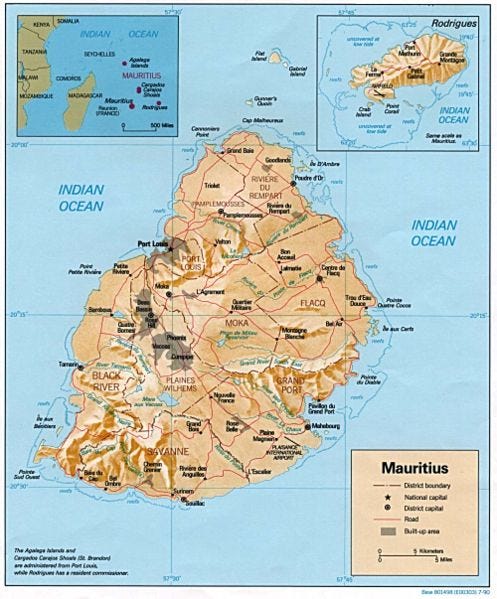
On 27 November 1987, only a few years before the collapse of apartheid, a plane took off from Chiang Kai-shek International Airport in Taiwan at 14.23UTC*, enroute to Jan Smuts International Airport in Johannesburg. It had a planned stopover at Plaisance Airport, Plaine Magnien, in Mauritius, one of few African states that accepted South African flights.
*UTC — Co-ordinated Universal Time is used throughout this article.
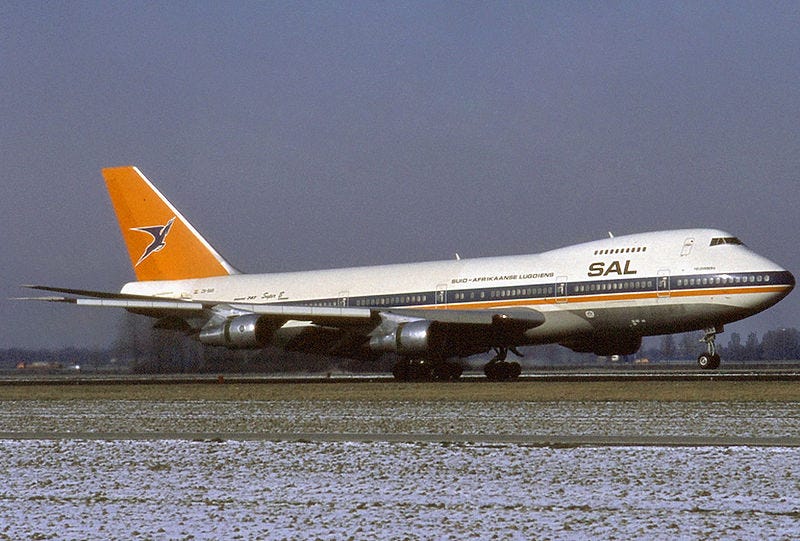
The plane was a Boeing 747–200BM Combi named Heiderberg, after a South African mountain range. Its registration was ZS-SAS, and its callsign was “Springbok295.” South African Airways had bought it, new, in 1980. The Combi is a 747 which can be adapted for passengers, cargo, or both — a moveable partition allows the airline flexibility in its use.
The front of the fuselage had seating for passengers; the rear cargo compartment had space for seven large pallets, of which Flight 295 carried six. The seventh space, at rear, was empty.
The freight was inspected by ground handling agents in Taiwan, who found nothing suspicious. The pallets contained: medical supplies, textiles, sporting equipment, tools, computers, electronic components and parts.
Nothing listed on the cargo manifest should have caused a flash fire. But something did.
The flight crew were: Captain Dawid Jacobus Uys (49), a former South African Air Force pilot, 13,843 flying hours, 3,884 on 747s; First Officer David Attwell (36), 7,362 flying hours, 4,096 on 747s; and Flight Engineer Guiseppe “Joe” Bellagarda (45), 7,804 flying hours, 4,254 on 747s. They were on the flight deck when the fire broke out.
There were 140 passengers, cabin crew, and relief flight crew members for this long flight; making a total of 159 people on board. And a total of 47,000 kg (104,000lbs) of baggage and cargo.
A fire, a tragedy, and an ongoing mystery
At 22.30UTC, the plane made routine contact with ATC at Plaisance Airport, Mauritius. At 23.42, a fire alarm can be heard on the CVR recording.
At 23.48, Captain Uys contacted Mauritius again, requesting descent to 14,000 feet, and reporting “smoke problems.” They then report loss of the electrical system, and declare emergency.
The last communication Mauritius ATC received from Flight 295 was at 00.04UTC on 28 November 1987. They heard no more from them. Mauritius had cleared them for an emergency landing on Runway 14; they never got a chance to use it.
The fire was already uncontrollable by the time they knew what was happening. There are sounds of circuit breakers popping, and other noises probably caused by failing electrical systems.
Springbok295 broke up and crashed into the Indian Ocean 248km (134 nautical miles) northeast of Plaisance Airport, Mauritius. Floating wreckage was seen the next day, including two broken wristwatches, stopped at 00.07UTC. There were no survivors.
The NTSB worked on the investigation with the Republic of South Africa. Wreckage underwater was not found until 28 January 1988. They found no evidence of sabotage, explosion, or incendiary devices.
Much of the wreckage was scorched; it included fire extinguishers with evidence of use. Most heat damage was in the main cargo compartment.
The flight data recorder was never found. The cockpit voice recorder, which had spent a year at the bottom of the Indian Ocean by the time it was found, shows the crew trying to solve the problem.
Evidence showed a fast-developing, high temperature fire, originating in the front right pallet. The plane broke up in flight, and autopsies showed some passengers were already dead from smoke inhalation.
The investigation report included criticism of the smoke detection and firefighting resources in the Combi. Also, the pressure difference between the cargo hold and passenger cabin was not sufficient to stop smoke.
Conspiracy Theories
With the complicated history of South Africa, and because the source of ignition still remains unknown, the proliferation of conspiracy theories is unsurprising.
I’m not a fan of such theories, because very few are supported by evidence which can be proven. Without factual evidence, I believe it’s wiser to admit that we don’t know, rather than adopt a hypothesis as “certain.” Also, using Occam’s Razor, you find most conspiracy theories use too many assumptions to be viable.
Popular theories include that the South African government was trying to subvert the arms embargo by using Combi flights with passengers to transport weapons illegally.
This accident happened to coincide with the ongoing battle for Cuito Carnavale in Angola. But correlation is not causation, and South Africa co-operated fully with the NTSB, and did not appear to have anything to hide.
There were also allegations that the crew were “ ordered not to land.” This makes no sense, because pilots always need to land in an emergency. Exactly who could make such an order is never mentioned.
Disasters mostly develop through a series of factors which are individually harmless but which coincide in a specific way. Sometimes we know all the steps, but with Flight 295 we don’t.
In-flight fires have been the cause of many aviation disasters, such as Swissair 111 on 2 September 1998 where the cause was a short circuit in the electrics of the entertainment system, and UPS Flight 6 on 3 September 2010, where lithium ion batteries combusted.
Some of the computers in the cargo had nickel-cadmium or lithium batteries, but investigators stated these were packed in such a way that they were unlikely to ignite or explode.
In several cases where such batteries did combust, they were in a very large quantity, which was not the case with Flight 295. However, such batteries were fairly new in commercial use in 1987, so hazards connected to them would not have been well-known.
Another thing we don’t know is whether the contents of the cargo hold were recorded accurately.
We may never know what started this sudden and intense fire, but an unlucky coincidence, such as items packed together in a particular way, seems most likely.
Or at least far less improbable than most of the theories about it.
Sources
https://www.britannica.com/topic/apartheid
https://www.southafricanmi.com/south-africas-economic-history.html
https://www.aerotime.aero/articles/32753-south-african-airlines-crash-combi-fire-mystery
https://en.wikipedia.org/wiki/South_African_Airways_Flight_295


