
The Mystery of Shakespeare’s Wife
Two views of Anne Hathaway might make you wonder: Why did she marry such a space cadet apart from their hot sex?

Anne Hathaway is easy to defame. So little is known about William Shakespeare’s wife that you can make up just about anything about her and get away with it.
That fact may help to explain a stage version of Hamnet, Maggie O’Farrell’s much-honored novel about Shakespeare’s only son, who died in childhood.
The Royal Shakespeare Company’s “disappointingly meek” production opened recently in London after a sold-out run in Stratford-upon-Avon, and to judge by the British reviews, it does Hathaway few favors.
The play “defames Anne as a surly hysteric who wastes her time cooking, gossiping, preparing herbs, minding the sick and scolding the young,” one critic wrote. She has three children, whose births “involve volcanic eruptions of petulant screaming,” and she scolds her husband after Hamnet dies: “Where’s your despair?”
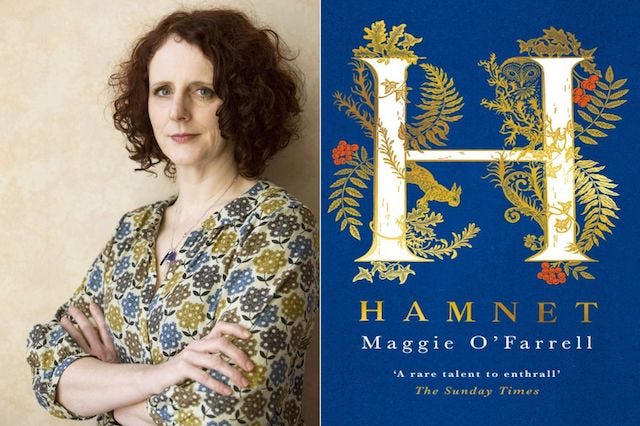
O’Farrell certainly doesn’t defame Hathaway in the novel adapted for the RSC play. Her heroine gives birth, alone and stoically, in a forest, lowering herself to the ground as another pain arrives: “She turns, she crouches, she pants through it, as she knows she must, holding tight to a tree root.”
But the novel has limits of its own. O’Farrell is a graceful and intelligent writer who nonetheless relies heavily on overwrought details. She tells us that when Hathaway met young Will, she felt something elusive: “of which she had never known the like”:
“She knew there was more of it than she could grasp — that it was bigger than both of them.”
O’Farrell stacks the metaphors when her heroine and Will first have sex:
“It made her think of a hand drawing on a glove, a lamb slithering wet from a ewe, an axe splitting open a log, a key turning in an oiled lock.”

Then there’s O’Farrell’s instinct for the coy, which surfaces when Hamnet’s grandfather tells his grandson he’s as bad as his father, William:
“No backbone. No sense. That was always his problem. Couldn’t stick at anything.”
In case we don’t get the point that you can be a Tudor-era space cadet and grow up to be the world’s greatest playwright, Hathaway reflects on what people say about her husband after he buys her a large house: “he was always such a useless hare-brain, soft in the head, his gaze up in the clouds” and “how can money like that have come from working in a playhouse”?
Was young Shakespeare really such an airhead? Was his wife an ill-tempered gossip?
And have you ever had sex that felt like an “axe splitting open a log”? If so, wouldn’t it do to say “splitting a log” instead of splitting it “open”?
Critics have heaped praise and prizes on O’Farrell’s novel, and some are hailing its author as the next Hilary Mantel for her skilled portrayal of the Tudor era.
But there’s a hole at the center of Hamnet: O’Farrell can’t get around the skimpy facts available about the life of Hathaway and, to a lesser extent, Shakespeare himself: She’s always writing around them.
Well-written as it is, Hamnet offers theories about Anne and Will, not an acutely credible portrait of a marriage and the effect on it of a son’s death.
Anne might have been the testy gossip of the new RSC production, or she might have been the more even-tempered wife of Hamnet. Or — as seems most likely — she was something neither the play nor the novel captures.
@JaniceHarayda is an award-winning critic and journalist who has been the book columnist for Glamour and the book editor of a large newspaper.
You might like two of my other stories about Shakespeare:


