
The Mysterious Disappearance of the Mary Celeste
Looking into the enigma of an abandoned ship that vanished on the high seas.
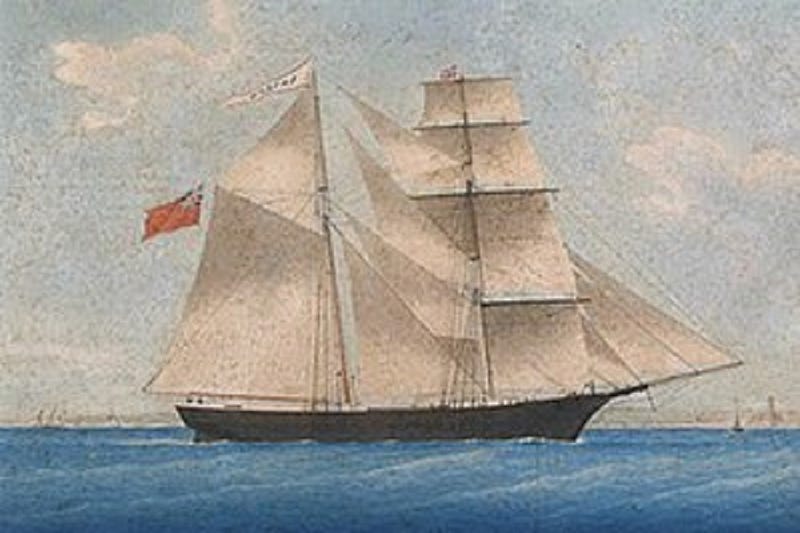
.jpg)
The Mary Celeste, an American brigantine, is arguably one of the most enigmatic and enduring maritime mysteries.
Launched in 1861 inNova Scotia, the vessel sailed through the tumultuous waves of intrigue before it was discovered adrift and abandoned near the Azores Islands on December 4, 1872.
The ship, albeit weather-beaten, was largely intact, with its cargo of denatured alcohol undisturbed, provoking fervent speculation about the fate of its crew and the circumstances surrounding its deserted state.
The riddle of the Mary Celeste has been dissected by myriad maritime historians, detectives, scriptwriters, and scientists, all delving into a perplexing conundrum shrouded in maritime lore.
The Voyage to Mystery:
The Mary Celeste embarked on its fateful voyage from New York City on November 7, 1872, captained by Benjamin Spooner Briggs.
Aboard were his wife, Sarah; their two-year-old daughter, Sophia; and a crew of seven, all seasoned sailors.
Their destination was Genoa, Italy, bearing a cargo of 1,701 barrels of industrial alcohol.
The crew of the British brigantine Dei Gratia found the Mary Celeste floating aimlessly in a strange way. The experienced seafarers on Dei Gratia immediately sensed something awry; a ship aimlessly adrift hinted at an untold story of a sudden departure.
Upon investigation, the Dei Gratia’s crew discovered the Mary Celeste in a state of eerie abandonment — the ship was seaworthy, the cargo intact. Still, the staff and the lifeboat were conspicuously absent.
The last entry in the ship’s log recorded eleven days before its discovery, showed no signs of distress.
Clues Amidst the Silence:
Resources such as maritime records, logbooks, and correspondence from the period yield clues that offer glimpses into the fateful journey, yet they concomitantly magnify the enigma.
The possessions of the crew and passengers remained untouched. The ship’s provisions were ample, discounting theories of piracy or a shortage-induced abandonment.
Notably, the ship’s chronometer and sextant were missing, leading to speculation about navigational miscalculations and catastrophic errors.
Research into contemporary weather reports unveiled the occurrence of turbulent waters and tempestuous winds in the ship’s path.
However, the intact condition of the ship and its cargo contrasts with the hypothesis of a monstrous sea assaulting the vessel, compelling the crew to abandon the ship.
The cargo of denatured alcohol, analyzed by forensic experts and maritime historians, holds the potential for elucidation.
The substance, known for its volatile nature, could have triggered an explosion, perceptibly alarming the crew and catalyzing a hurried evacuation.
However, the lack of evident fire or explosion damage on the ship challenges this proposition too.
The Search for Answers:
Theories regarding the crew’s fate are as numerous as they are speculative.
Some researchers hypothesize a mutiny, citing potential tensions among the crew.
However, the absence of signs of a struggle or conflict aboard debunks this assumption.
Others ponder over a water spout encounter, speculating that a sudden influx of water could have induced panic, causing the crew to abandon the ship, thinking it was sinking.
However, the lack of any evidence of excessive water inside the ship renders this theory disputable.
Another widely debated theory posits that Captain Briggs was a devoutly religious and disciplined man. He might have ordered the abandonment due to his miscalculation of the ship’s condition amidst a storm that might have led the crew into the lifeboat and a subsequent tragic fate.
This is the only theory that makes sense because it is supported by a piece of supposed evidence — the absence of the ship’s navigational instruments.
This theory remains plausible, highlighting the human element in this maritime puzzle.
Maritime historians and oceanographers have also explored the role of natural phenomena like rogue waves and waterspouts in deciphering the Mary Celeste enigma.
Scientific re-examinations and reconstructions of maritime conditions suggest the reasonable impact of such phenomena that might have potentially overwhelmed the crew and induced abandonment.
However, the ship’s undamaged state presents a contradictory piece in this intricate puzzle.
Legacy and Lore:
The saga of the Mary Celeste transitions from maritime history into the realms of cultural lore and literary endeavor.
Sir Arthur Conan Doyle’s sensational rendition of the story, published in 1884, heightened the mystique surrounding the ship.
The story interweaves facts with imaginative flourishes that amplify the enigma in the public imagination.
The ship’s eventual fate was as ignominious as its journey was mysterious. It was wrecked off the coast of Haiti in 1885 under dubious circumstances.
The Mary Celeste continues to sail through the currents of maritime folklore, a spectral ship enveloped in mystery, leaving a legacy of unanswered questions and unending intrigue.
Final Words
The mystery of the Mary Celeste remains one of the most intriguing maritime enigmas. It is an intricate puzzle interlacing myriad possible explanations, each shadowed by its own set of contradictions.
The quest for answers spans diverse disciplines; weaving together maritime history, oceanography, forensic science, and cultural studies in a multidimensional exploration of a perplexing disappearance.
While advances in technology and research methodologies have expanded the horizons of inquiry, Mary Celeste continues to challenge contemporary understanding, symbolizing the eternal human fascination with the unknown and the unresolved.
The ship’s spectral journey into oblivion reverberates through the annals of maritime lore, a perpetual reminder of the ocean’s enigmatic depths and humanity’s enduring quest to navigate through the mysteries of existence.
Resources:
“The Mary Celeste: An Unsolved Mystery from History” by Jane Yolen and Heidi Elisabet Yolen Stemple
“Ghost Ship: The Mysterious True Story of the Mary Celeste and Her Missing Crew” by Brian Hicks
Maritime Logbooks and Records from 1872
Correspondences of Captain Benjamin Spooner Briggs
Contemporary Weather Reports (1872)
Sir Arthur Conan Doyle’s “J. Habakuk Jephson’s Statement” (1884)