
The mutation consortium.
A warning for dilettantes.
When the devil has nothing to do, he plays at combining mutations in the coronavirus genome.
(Diabolic saying anonymous).
SARS-CoV-2 pandemic causing COVID-19 appeared on the public scene in December 2020. The virus was already carrying mutations. It is a rule followed by its genome of almost 30,000 letters. A matter of chance. More viruses, the greater the chance of mutating.
According to the WHO, the coronavirus zoonotic origin is in some species of horseshoe bat (Rhinolophus spp.). It is unknown whether the coronavirus passed later through some animal intermediary. In this case, it could increase the possibility of new adaptive adjustments.
SARS-CoV-2, as an RNA virus prototype, was born in nature, comes from animals, and continues to mutate in humans. There are many amino acid mutations in all segments of the long viral genome. And deletions (loss of some amino acids). All changes have importance. But, as in George Orwell’s Animal Farm, some (changes) are more important than others.
Mutations and deletions in protein S (Figure 1) seem to be the most critical. They can affect viral behavior: contagiousness and clinical severity. The changes could affect therapeutic options, too, with a worse response to monoclonal antibody treatments. And, also, to preventive measures: lower efficacy of current vaccines.
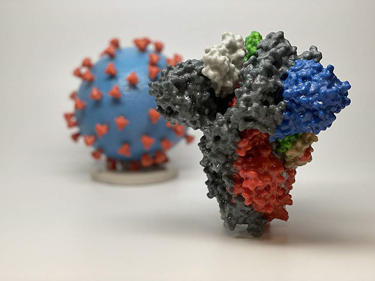
From a structural point of view, the spike is similar in shape to a segment of broccoli or cauliflower (Figure 1, forefront). The virus must bind to the cell plasma membrane receptor (ACE2) before entering cells. The matter is somewhat more complex (e.g., the role of co-receptors and furin), but enough for now. The spike is also an antigen with the capacity to generate a natural or vaccine-induced antibody response.
Viral mutations are many and different. They give rise to several variants. The changes detected in the spike so far vary in number and transcendence. Some of them stand out for changing the functionality of the virus. Their importance, as far as we know, is very different. I highlight those that appear to be the most notable. I selected here five mutations.
A consortium of mutations.
The selected five mutations are present in the four variants of concern (VOC). Also, they take part in some variants of interest (VOI). So far, none is a variant of high consequence. It means a non-response to the non-pharmacological measures.
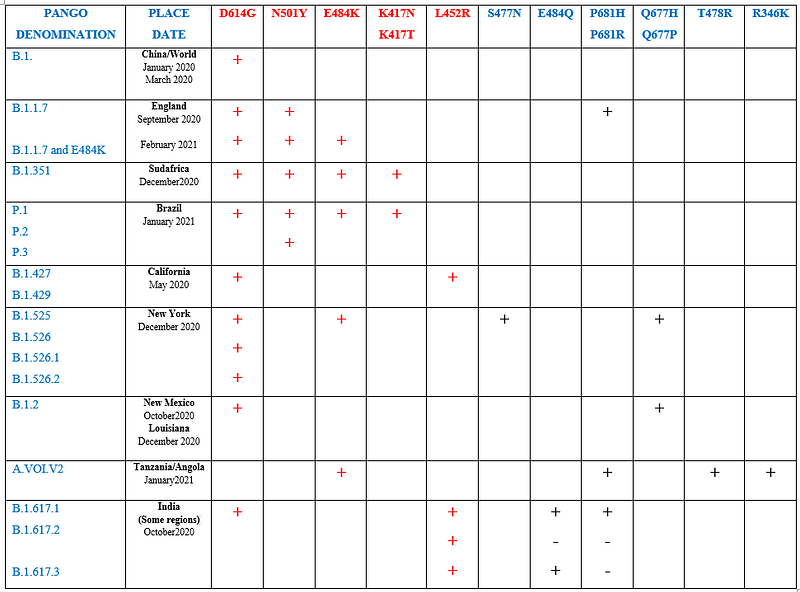
We can say that together they form a consortium of mutations (Table 1). A consortium is an association of companies or entities with shared interests. Its interest is to take part in an important project or business. Here, the companies or entities are the mutant viral variants. The common interests lie in dominating over other viral variants. They are the virus that lacks such genetic changes. It is pure evolution.
D614G mutation.
Shortly after the “original” virus (Wu-Hu-1) began to devastate humanity, D614G’s mutation appeared. It means the change of a single amino acid (aspartic acid or D for glycine or G). This fact allows the virus a better binding to the cellular ACE2 receptor. The beginning of the process is that the virus needs to reproduce itself in thousands of new copies.
It is a biological phenomenon in which errors surge by chance. The errors are new mutations. Most of them do not go further. Some make the virus more efficient among its congeners and allow it to become dominant.
It happens like in the soccer championships. In this case, it is Darwin’s super league. By this fact, the D614G mutation became dominant in two to three months. Thus, it occupied the world statistics by 90% for almost the entire year 2020. As a curiosity, this mutation seems linked to the loss of smell (anosmia) suffered by many patients.
E484K mutation.
In South Africa, some investigators detected a variant called B.1.351 in May 2020. Its star mutation is K484N. A change from glutamic (K) to lysine (N). It allows viruses to evade to varying degrees. That to say, natural and vaccine antibodies intended to neutralize them. It is an escape mutation.
The B.1.351 variant also has the D614G and N501Y mutations. Thus, besides its ability to elude immunity, it is more widespread. It is more transmissible (50%), and it is unknown whether it causes greater severity.
In Manaus (Brazil), in November 2020, some investigators detected a variant like B.1.351. It has D614G, N501Y, and E484K mutations. Its name is P.1. Only two months later, it appeared at Tokyo airport (Japan). The cases were a family of four returning from Manaus (Brazil).
There are two more subvariants of P.1. They are P.2 and P.3. P.1 variant, like its relative B.1.351, is more transmissible. It is unknown whether it is more severe. The efficacy of vaccines is also unknown.
The E484K mutation is present in some B.1.1.7 variant genomes. Its name is “B.1.1.7 with E484K”.
N501Y mutation.
In September 2020, British investigators detected a new variant. It happened in the county of Kent (southwest England). It is B.1.1.7 (the press and many communicators call it the British variant). It has the N501Y mutation in the spike due to changing the amino acid asparagine (N) to tyrosine (Y). Too, there are D614G, five other mutations, and two deletions (69/70 and 144/144). All allow the virus to better bind to the cellular receptor ACE2.
As an epidemiological trait, it has higher infectiousness (50%). It may cause more severe disease, although vaccines still appear to be effective. Today (early May 2021), B.1.1.7 is the dominant variant in the world.
L452R mutation.
California, especially in Los Angeles, ended 2020 with an increase of COVID-19 cases. Previous genomic studies detected a change of the amino acid leucine (L) by arginine (R).
The L452R mutation makes the B.1.427/B.1.429 variant more transmissible (20%). It may cause greater severity and appears to respond to vaccines. There are suspicions of possible T-cell resistance. This variant seems to decline. That happened in March 2020 with the so-called Danish Cluster 5 associated with minks.
It is also vital, along with two other mutations: i.e., E484Q and P681H/R as a component of variant B1.617.1. The misnamed India’s variant. The subvariant B.1.617.3 has the same mutation, but not the subvariant B.1.617.2.
It is interesting to note that E484K and E484Q are very similar but different. In the former, lysine (K) replaces glutamic acid (E), and in the latter, glutamine (Q) replaces glutamic acid (E). Each mutation reduces the antibody response by a factor of 10 and 6. The association E484Q and L452R (misnamed “double mutant”) reduce it by four.
An Israel study (few cases) shows that Pfizer’s vaccine against this B.1.617 variant reaches an efficacy of 98%.
K417N/T mutation.
It means the change of the amino acid lysine (K) by asparagine (N) or threonine (T). It is a mutation present in two of the variants or lineages of concern: B.1.351 and P.1. So, it adds to its qualities the ability to bind more to the cellular receptor ACE2.
Comment.
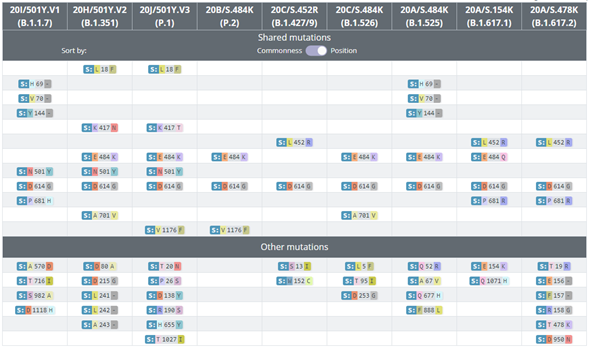
This article is a brief and a bit superficial review of SARS-CoV-2 mutations. They do not include all amino acid changes. There are many (Figure 2), but here is a sample of those of concern circulating now around the world.
The viral mutant phenomenon is dynamic. It seems that it is due to convergent evolution. That to say, the biological process that underlies such a complex and random matter. The virus does its work. And humans too?
In human behaviors lies the key to the variant’s emergence. And the rapid spread of new lineages around the world. From California to New York, from England to Spain, Italy to France, or Brazil to Argentina. An inappropriate behavior underlies the phenomenon — the fact driving the virus spread. It is an opinion now supported by a recent study referred to as Washington State.
What is happening in India is the most dramatic example. It does not seem, for the moment, that the B.1.617 variant, with its spike mutations, is to blame for the disaster. Or, at least, it is not the only cause.
As more genomic studies increase, there will be more information on mutants. It seems reasonable to think that there is a lack of pandemic control. Where mutants appear, there are traveling carriers but infected local persons too.
The consortium of mutant viruses is only a warning that we humans are not doing things as we should. Not even with current vaccines. Be careful!
References.
The redaction of this article is a summary from several references. GISAID, Covariants.org, Nextstrain.org, Outbreak.info, PANGO lineages, U.K. Government Website, the CDC, The New York Times tracker, and various scientific articles from the international literature. Twitter and Facebook, too, of course.


