avatarTimothy James Lambert

Free AI web copilot to create summaries, insights and extended knowledge, download it at here

2613

Abstract

d Jesus, “Tell us, what can the kingdom of heaven be compared to?” He said to them, “It can be compared to a mustard seed. Though it’s the smallest of all the seeds, when it falls on tilled soil it makes a plant so large that it shelters the birds of heaven.”</i></p><p id="4d72">Not much help there. However, there is one aspect of the <i>Gospel of Thomas </i>that I have yet to mention.</p><p id="1ce4">Saying 22 discusses making two into one. Merging the inner and the outer, and the upper and the lower, making male and female into a single one.</p><h2 id="f7fc">Saying 22: Making the Two into One²</h2><p id="756b"><i>… Jesus said to them, “When you make the two into one, and make the inner like the outer and the outer like the inner, and the upper like the lower, and so make the male and the female a single one so that the male won’t be male nor the female female; when you make eyes in the place of an eye, a hand in the place of a hand, a foot in the place of a foot, and an image in the place of an image; then you’ll enter [the kingdom].”</i></p><p id="e3f2">I interpret this in a couple of different ways, one of which is a means for unlocking meanings hidden within the sayings found in the <i>Gospel of Thomas</i> themselves. For instance, two consecutive sayings within Thomas can be merged to create a key to unlock a hidden reading.</p><h2 id="06c9">Saying 20: The Parable of the Mustard Seed</h2><p id="ef47"><i>The disciples asked Jesus, “Tell us, what can the kingdom of heaven be compared to?” He said to them, “It can be compared to a mustard seed. Though it’s the smallest of all the seeds, when it falls on tilled soil it makes a plant so large that it shelters the birds of heaven.”</i></p><h2 id="7d91">Saying 19: Five Trees in Paradise³</h2><p id="d144"><i>Jesus said, “Blessed is the one who came into being before coming into being. If you become my disciples and listen to my message, these stones will become your servants; because there are five trees in paradise which don’t change in summer or winter, and their leaves don’t fall. Whoever knows them won’t taste death.”</i></p><p id="c0d6">When we merge these two sayings into one thematic whole, some things become immediately apparent.</p><p id="db2f">The mustard plant is one of the five plants in paradise. The mustard plant is an annual, of which there are two sorts, summer, and winter. These sorts never change, meaning summer annuals never become winter annuals and vice versa. Also, annuals do not shed their leaves, rather the leaves shrivel on the branches.</p><p id="92f8">More importantly, those who know of these

Options

five plants will never taste death.</p><p id="3451">The term,<i> to never taste death, </i>has a couple of possible interpretations. One is that a person will never experience death, with the verb <i>taste </i>being used as a metaphorical stand-in for <i>experience. </i>The other interpretation is more literal, in that one will be unable to taste the taste of death.</p><p id="c41a">Does death have a taste? If it does, it will surely be described as tasting like chicken. And why is that? Why are strange meats so often described as tasting like chicken?</p><p id="2681">Because chicken has almost no taste. Taste is generally a feature of fat and chicken has very little fat which is generally the rule for birds, especially for birds that can fly.</p><figure id="83a0"><img src="https://cdn-images-1.readmedium.com/v2/resize:fit:800/1*ngs2NYEha3Qdi0XlauPWNw.jpeg"><figcaption></figcaption></figure><p id="a12c">Let’s look back at Mark describing the mustard plant shooting out great branches under which the <i>fowls of the air</i> may shelter. Those great branches shooting out are symbolic of mustard’s spicy flavor which makes even the flesh of birds that fly palatable.</p><figure id="8f4c"><img src="https://cdn-images-1.readmedium.com/v2/resize:fit:800/0*BrvuPoqpg3B1GTs9"><figcaption>Photo by <a href="https://unsplash.com/@attpedro?utm_source=medium&amp;utm_medium=referral">Pedro Durigan</a> on <a href="https://unsplash.com?utm_source=medium&amp;utm_medium=referral">Unsplash</a></figcaption></figure><p id="8b4b">This parable’s hidden meaning isn’t as disturbing as the others, but it amazing that no one has pointed out this obvious solution before. Only, of course, parables have never been seen as puzzles in need of solving but rather analogies in need of interpreting.</p><ol><li><a href="https://www.gospels.net/thomas">https://www.gospels.net/thomas</a></li><li>Ibid.</li><li>Ibid.</li></ol><div id="ed6c" class="link-block"> <a href="https://timothyjameslambert.medium.com/membership"> <div> <div> <h2>Join Medium with my referral link - Timothy James Lambert</h2> <div><h3>As a Medium member, a portion of your membership fee goes to writers you read, and you get full access to every story…</h3></div> <div><p>timothyjameslambert.medium.com</p></div> </div> <div> <div style="background-image: url(https://miro.readmedium.com/v2/resize:fit:320/0*LO2tKPbtXGpLFJ4T)"></div> </div> </div> </a> </div></article></body>

The Mustard Seed, Becomes So Great a Tree, That Birds May Shelter in Its Branches

Wait … what?
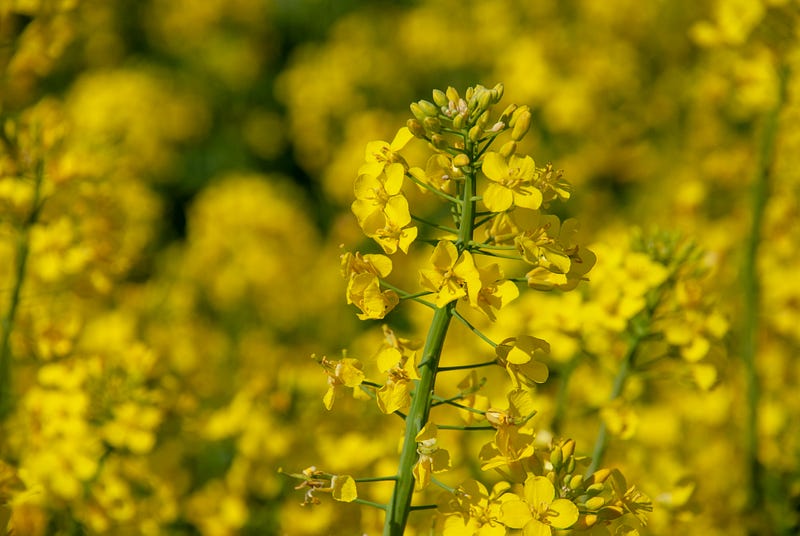
Photo by Denes Kozma on Unsplash

This is the second article to deal with the four possible parables that could be identified by the label: The Seed. The first article can be found here and it deals with the parables The Growing Seed and The Weeds.

This article will focus on the parable of The Mustard Seed.
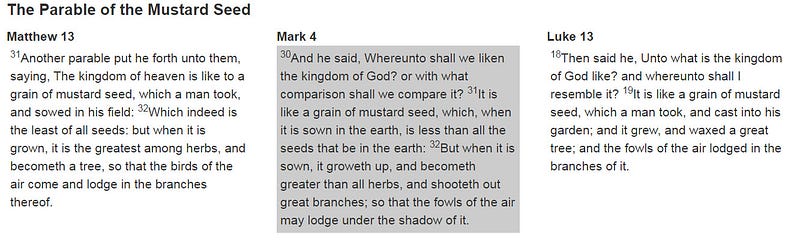
A nice and short parable that can be found in all three synoptic Gospels. Mark gives us the first version. The kingdom of God is like a mustard seed in that it is really small when it is planted, but it becomes greater than all the herbs and shoots out massive branches so large that birds can roost in their shadows.

Matthew changes things a little bit by comparing things to the kingdom of heaven. Also, Matthew’s birds live in the branches and not in their shadows. Luke splits the difference by using Mark’s kingdom of God with Mathew’s birds' lodging in the branches.

Rather than focus on the parable’s meaning, which is apparently that the kingdom of God or heaven grows from small beginnings, I feel that the parable's literal impossibility should be noted.

The mustard plant is an annual plant. It isn’t a tree with mighty branches by any stretch of the imagination.
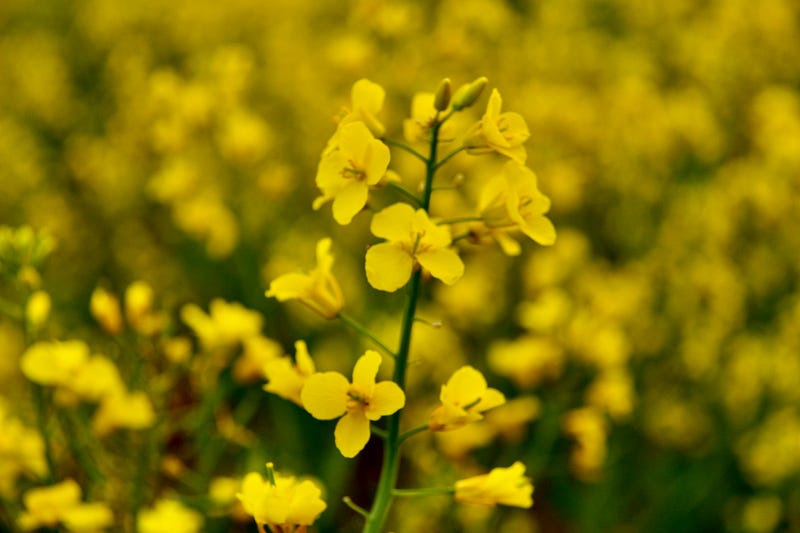
Photo by Sonia Benhamou on Unsplash

To understand this parable's secret message we must turn to the Gospel of Thomas which contains its own parallel to this parable.

Saying 20: The Parable of the Mustard Seed¹

The disciples asked Jesus, “Tell us, what can the kingdom of heaven be compared to?” He said to them, “It can be compared to a mustard seed. Though it’s the smallest of all the seeds, when it falls on tilled soil it makes a plant so large that it shelters the birds of heaven.”

Not much help there. However, there is one aspect of the Gospel of Thomas that I have yet to mention.

Saying 22 discusses making two into one. Merging the inner and the outer, and the upper and the lower, making male and female into a single one.

Saying 22: Making the Two into One²

… Jesus said to them, “When you make the two into one, and make the inner like the outer and the outer like the inner, and the upper like the lower, and so make the male and the female a single one so that the male won’t be male nor the female female; when you make eyes in the place of an eye, a hand in the place of a hand, a foot in the place of a foot, and an image in the place of an image; then you’ll enter [the kingdom].”

I interpret this in a couple of different ways, one of which is a means for unlocking meanings hidden within the sayings found in the Gospel of Thomas themselves. For instance, two consecutive sayings within Thomas can be merged to create a key to unlock a hidden reading.

Saying 20: The Parable of the Mustard Seed

The disciples asked Jesus, “Tell us, what can the kingdom of heaven be compared to?” He said to them, “It can be compared to a mustard seed. Though it’s the smallest of all the seeds, when it falls on tilled soil it makes a plant so large that it shelters the birds of heaven.”

Saying 19: Five Trees in Paradise³

Jesus said, “Blessed is the one who came into being before coming into being. If you become my disciples and listen to my message, these stones will become your servants; because there are five trees in paradise which don’t change in summer or winter, and their leaves don’t fall. Whoever knows them won’t taste death.”

When we merge these two sayings into one thematic whole, some things become immediately apparent.

The mustard plant is one of the five plants in paradise. The mustard plant is an annual, of which there are two sorts, summer, and winter. These sorts never change, meaning summer annuals never become winter annuals and vice versa. Also, annuals do not shed their leaves, rather the leaves shrivel on the branches.

More importantly, those who know of these five plants will never taste death.

The term, to never taste death, has a couple of possible interpretations. One is that a person will never experience death, with the verb taste being used as a metaphorical stand-in for experience. The other interpretation is more literal, in that one will be unable to taste the taste of death.

Does death have a taste? If it does, it will surely be described as tasting like chicken. And why is that? Why are strange meats so often described as tasting like chicken?

Because chicken has almost no taste. Taste is generally a feature of fat and chicken has very little fat which is generally the rule for birds, especially for birds that can fly.

Let’s look back at Mark describing the mustard plant shooting out great branches under which the fowls of the air may shelter. Those great branches shooting out are symbolic of mustard’s spicy flavor which makes even the flesh of birds that fly palatable.

Photo by Pedro Durigan on Unsplash

This parable’s hidden meaning isn’t as disturbing as the others, but it amazing that no one has pointed out this obvious solution before. Only, of course, parables have never been seen as puzzles in need of solving but rather analogies in need of interpreting.

  1. https://www.gospels.net/thomas
  2. Ibid.
  3. Ibid.
Parables Of Jesus
Mustard
Religion
Spirituality
Philosophy
Recommended from ReadMedium