
The Mundane Parts of Life are the Best Parts of Life
And they make up most of it
We snap pictures and hire photographers for the big moments in life. We go on vacations with family and take hundreds of pictures of moments that will soon be lost to time. We can’t wait to capture them for posterity. Our phone galleries are filled with special moments.
But what about the rest of life? The other 99% of it?
A few years ago I read about a little project called “1 Second Everyday.” It was based on the idea of taking a one-second clip of footage from everyday life and compiling it into a video. I did it for a couple of years and the results were mind-boggling. Every day, even if I wasn’t doing much, I’d take a video of my yard, my kids, or my drive to work.
What it showed me over time was how much of life disappears, never to be thought of again. Thousands of thoughts, images, moments, interactions — all gone.
And then I read that each time we recall a memory, our brain changes it just a little bit. Since we can’t remember every detail, our mind fills in the blanks with random information.
Scientists have learned that, as years go by, much of what we remember is false. Our brains can’t store every detail we experience, so we recall the gist of events — enough to create a story that makes sense to us. They fill in missing pieces with other information, and the memory ends up evolving over time. It’s why eyewitness testimony is unreliable and why two people watching the same event will recall it in two completely different ways.
As upsetting as that can be, I can’t help but wonder what happened to my memories that I purposefully scrambled with alcohol.
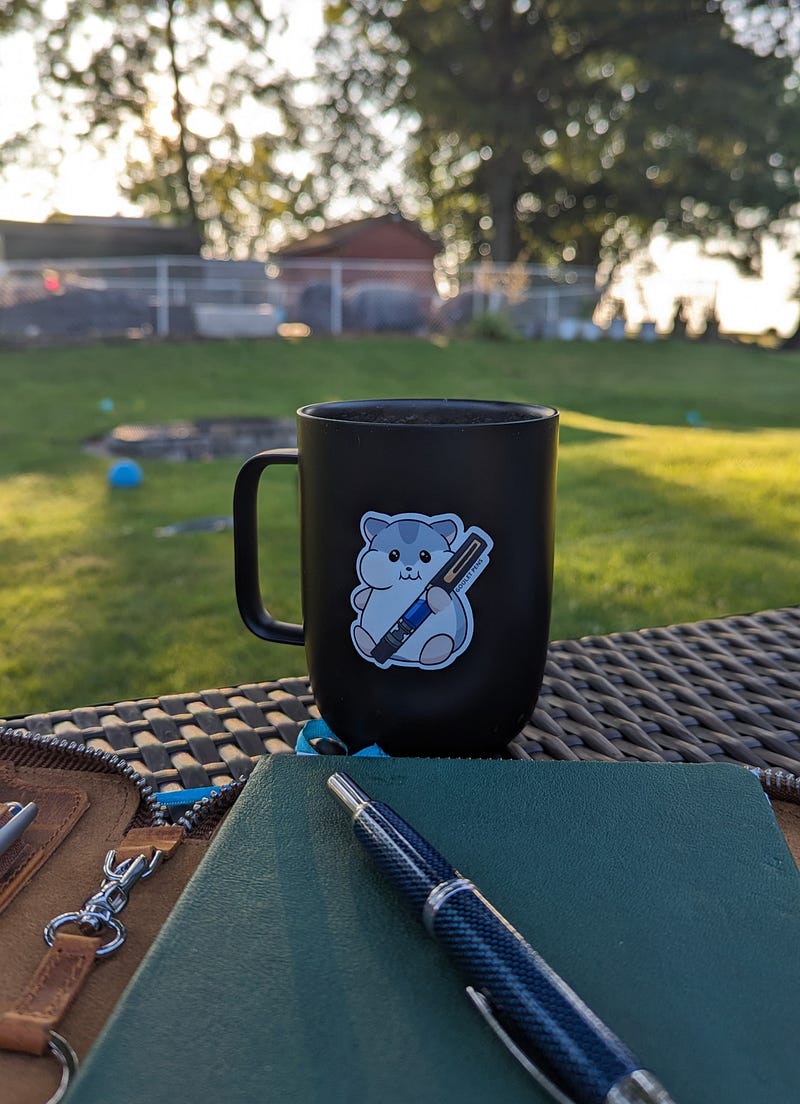
I stare at the innocent, simple coffee cup on my desk. Lost in thought, I wonder how many have held it in their hands. I reflect on how many times I’ve filled it up and held it to my nose, taking in the aroma of a roasted bean from a faraway land. I think about that little bean and all its friends growing on a tree together, being picked, shipped, roasted, packaged, and shipped to my door allowing me the pleasure of pouring water over them to drink.
I think of the molecules that enter my being and make their way through my cells and are routed to the different parts of my body for processing before ultimately being returned to the land from which they came.
I think about all this as I hold this lowly cup, this vessel for beverages. It’s a magic cup, I think. It can hold anything I want it to hold, really. What kind of potential does it hold?
I don’t think about much else at this moment, only the cup. It is magnificent in its simplicity. I have a sticker on the side of it of a hamster holding a fountain pen. It’s an ode to two of my favorite hobbies — writing and drinking coffee.
There’s a Japanese philosophy called Mottainai that expresses the desire to waste nothing. It’s not a direct correlation but represents an appreciation for mundane things. Rooted in the Shinto belief that every object has a “kami” or spirit, I can’t help but think about my simple cup and how well it serves me.
I want to care for my cup. It is my companion. My friend. It nourishes me and brings me peace — and coffee, of course.
This is one of those mundane moments I love. There’s nothing to it. Nothing is happening. I sit and stare at my cup, thinking my weird little thoughts.
My kids come out, run across the deck, and into the yard. They get into some inane argument over who gets which swing. They play for a bit, then come and ask for their tablets.
This moment is forgetful. It’s mundane. Almost meaningless, but ones like it make up the majority of the time we spend here on Earth.
All the years I was drinking, I wonder how many moments I’d missed like this. The thoughtful, peaceful moments. The regard for the simplest parts of life. The air, the grass, the earth beneath my feet, and all that it contains. The miles and miles of mycorrhizal network just below the surface carrying information between the trees.
It’s the slow contemplations I was missing the most. So much time was spent thinking about alcohol — the search for, management of, and recovery from.
While my mind was busy doing all this, it was not doing the things it needed to be doing. I wasn’t thinking about my daughter who was likely showing early signs of struggle. I wasn’t thinking about my wife or my marriage or planning a date, and I wasn’t caring for myself the way I should have been.
The simplicity of a peaceful sunrise and birdsong and squirrels frolicking. The crackling of a campfire. The distant giggles of my children on a trampoline.
It’s a sick irony that I was aware of the fleeting nature of those moments but lacked the clarity to observe them fully. That is one of my biggest regrets.
I look up at the sun and remember how it seemed extra bright after I’d had a few drinks. Life was more vivid, yet dull and distant at the same time. It’s like that sensation of the “dolly zoom” in Jaws.
I still remember the feeling of guilt after drinking. That heavy feeling that I couldn’t shake — that I had done something wrong. The guilt for failing once again to control something thats very job is to take away control.
While I was under its spell, I wasn’t there. I wasn’t living. I wasn’t myself, and I was missing out on my life. Time moved faster and my mind moved slower, missing the mundane nothingness that comprises the vast majority of our lives.
I often wonder if the ability to enjoy mundanity is a feature of aging. I wonder if it’s a matter of perspective or a learned skill. If my twenty-something self could see me now, he may be appalled at my penchant for bonsai care and lawn maintenance.
Regardless, I revel in the fact that I can see things more clearly now than I ever did. I love that I enjoy the simpler things.
Bring on the lawnmowing, the pensive moments, the blanket of quiet in a snowstorm. Allow me the enjoyment of driving to work with the windows down, wiping the tears from my child’s face, the harsh reality of the passage of time, and the awareness that it will all end someday.
Mundanity is extraordinarily beautiful.
Special thanks to my friend Jacqueline Dooley for inspiring this piece. The loss of her daughter serves as a reminder to slow down and embrace the mundane.