
The Most Visited Cemetery in Europe: The Merry Cemetery in Sapanta, Maramures, Romania
We’re usually pious in cemeteries, and the words engraved in stone are full of tears. But in the Merry Cemetery in Săpânța, Maramureș, Romania, things sometimes take a different turn.
In north-western Romania there’s an enchanted region called Maramures. It’s a land with centuries-old, UNESCO World Heritage wooden churches with tall tapering steeples, where locals gather in traditional garb every Sunday. It’s a land with large wooden gates with ancient motifs such as solar disks, the tree of life, and crosses, and many festivals with origins lost in the sands of time. A place where many people continue to live according to the old ways: washing blankets and carpets without detergent in a wooden funnel with the water whirling at the center; growing vegetables; raising chickens, rabbits, pigs, cattle, goats, and other fowl and livestock; making yogurt and cheese; and working the fields to have food for their animals, and wheat and corn for their bread, pastries, polenta, and corn and cheese soup. (Locals have been using corn in Maramures since the 17th century.)
Landscapes and life in Maramures feel steeped into a different time. When I visited Sighetu Marmației (Sighet), a municipality that at the 2022 census had 41,220 inhabitants, I had this clear sense of time resting between grand buildings. There was no rush, no hurried pace of life, just quiet and some big, old colorful structures.
Walking through the center of the city there are several churches, including one of the nine Orthodox parish churches in Sighet; a cathedral from 1985–1988 dedicated to St. Archangels Michael and Gabriel, built on the site of an Orthodox chapel from 1921; a Baroque Catholic Church; a Gothic and neo-Gothic Calvinist (Reformed) church; a Ukrainian Orthodox church built in Neoclassical style by Greek Catholic worshippers between and 1791 and 1807 on the site of an older church; a Sephardic synagogue from 1902, the only one remaining of the six synagogues Sighet had before 1944; and other places of worship.
Aside from these landmarks, lining the streets are many neoclassical buildings and a surprising Art Nouveau Palace of Culture. There’s also the Ethnographic Museum of Maramures, one of several museums in Sighet, among them an outdoor village museum that was closed on one of the occasions I was there. And then there are the famous Memorial to the Victims of Communism and the Memorial House Elie Wiesel, both of which I vividly remember.
The first time I was in Sighet, however, fresh from a very old train taking me up into the northernmost reaches of Romania, very close to the border with Ukraine, I was there to take a bus to travel the 18.6 remaining kilometers to the Merry Cemetery of Sapanta, one out of many thousands of tourists that year drawn by this unique tourist attraction in a region once inhabited by some of the Dacians that remained free during the Roman conquest of 106–271 CE.
To this day, the people of Maramures pride themselves as being the descendants of Dacians only, “the bravest and most just of all the Thracians,” (in the words of the Ancient Greek historian Herodotus), that people who in the majority of the areas that comprise today’s Romania were conquered by the Romans, as I mentioned above, a historical process which eventually led to the birth of the Romanian people and the Romanian language as a Romanic language by the 8th century CE, incorporating Slavic elements after Slavic people migrated to the region starting with the 6th century CE.
Coming back to the Dacians who continued to live free of Roman occupation outside the borders of the Roman province Dacia, they believed in the supreme god Zamolxis, who, according to Herodotus, promised them a place of life beyond life, where they will be “living forever, enjoying all good things.” As Herodotus also tells us, The Dacians offered sacrifices to Zamolxis and were especially brave on the battlefield, having no fear of death.
This attitude of considering death as the passage toward a new life, a belief that predates Christian times, is why in parts of Romania, even today, some people organize their wake while they are alive. In that way, they get to celebrate their lives with family and friends and thus enjoy their last party.
Stan Ioan Pătraș (1908–1977), who created the first cross in his famous Merry Cemetery style in 1935, was also a religious person, but as an artist he reached well beyond his Greek-Catholic upbringing to an expression of life and death that resonates with everyone.
The epitaphs on his crosses and those of the carpenter and artist he mentored, Dumitru Pop Tincu, tend not to use religious language and texts but rather talk about the deceased in a folk layman’s manner, using the flavor of the local speech.
For Romanians, these epitaphs are, indeed, joyful reading, because they are alive both with the wit of the two master craftsmen and the vibrancy of the lives they rhapsodize about.
Since 1935, Stan Ioan Pătraș and Dumitru Pop Tincu created over 1,200 crosses in the Merry Cemetery. They are famous for their Sapanta blue background color, their geometric decoration, and their naive bas-reliefs scenes and inscriptions. Here are the epitaphs on a few of them. Note that the commemorative words in the inscriptions rhyme in Romanian.
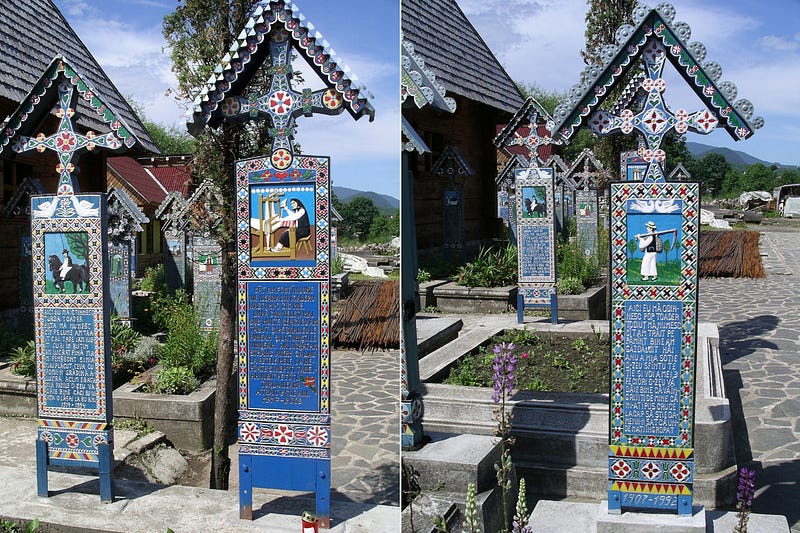
On the cross with the man riding a horse:
“Here I rest. Turda Toader Bilta is my name. As long as I lived, I loved horses; I worked with them in Butin until I retired. And I liked something else as well: to work with trees in the garden. Now my dear family will work with them. May God keep you well and give you good things. I left life at 80 years. 1914–1994.”
On the cross with the woman weaving:
“While I was in the world, they called me Ileana of Toaderu Nasti. As you can see above, I wove many blankets and hung them on the face, and sold them to tourists. I worked, and I amassed a fortune to give to my daughters, granddaughters, and grandsons. I loved them all dearly. Turda Ileana. She lived 86 years. 1917–2003.”
On the cross with the man carrying two bundles and a scythe:
“Here I rest. Pop Toader Todiuț is my name. While I lived on earth I was a great host. My dear wife, Saintly God keep you well. And you, my three sons, may God keep you well and give you good things for laying a cross above my head so that people in the village would know where you buried me. 1907–1992.”
Some epitaphs are funnier than others.
On a cross with a man surrounded by sheep and blowing a trumpet:
“Here I rest. Ștețca Toader is my name. When I was in my time, I greatly enjoyed going into the mountains with my sheep and my trumpet. I would blow my trumpet to soothe my soul. The sheep would bleat loudly and the dogs would bark proudly. To you looking at us I wish you sheep. I left life at 71 years. Dead 1981.”
The most famous funny epitaph is, perhaps, one about a mother-in-law. It’s full of folk humor and also rhymes beautifully in Romanian: “Under this heavy stone lies my poor mother-in-law. Three days longer had she lived, it would have been me lying here and her reading this. You who pass by here try not to wake her up, for if she comes back home she will be carping on me again. I will behave so she won’t come back. Those of you who read here take heed not to have this happen to you. Find a good mother-in-law and live well with her. Lived 82 years. Died 1969.”
There are also several crosses about people who liked their booze too much.
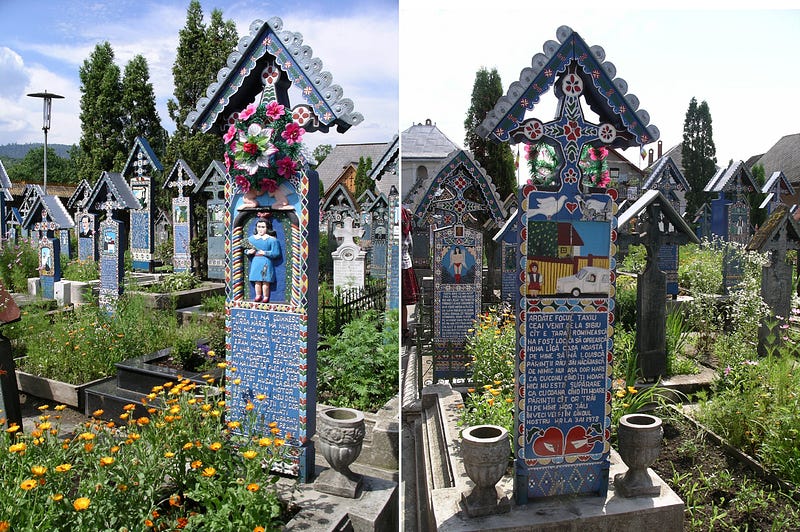
Many of these crosses have two sides, both of them with an image and a section of text, but when I was visiting I was with a group that was rushing through everything, and I didn’t have time to photograph enough in the cemetery. It would have been most interesting to see both sides of a cross, as the info on the back completes that on the front, as in this case of a cross for a girl run over by a car:
“Here I rest. Turda Mărie is my name. From my short childhood they called me Mărie Monghi. I was a little girl in kindergarten. Death, a bad tyrant, didn’t let me go to school; came in a great hurry and I had to die hit by an engine coming out of my own yard. I had to leave my parents yearning and my grandparents in mourning. Forever they will be upset that they don’t have me. [Can’t read the last two lines — with the age and years — because of flowers covering part of the text.]”
The text on the back of the cross reads:
“Burn in hell taxi from Sibiu. In the whole of Romania you found no place to stop but by our house, to hit me, my parents to upset hard. There’s no greater yearning than when a kid of yours dies. My parents will mourn me as long as they shall live. You’ll be forever in our thoughts. Dead at 3 years old. 1978.”
(So death is not always laughed in the face in the Merry Cemetery, after all.)
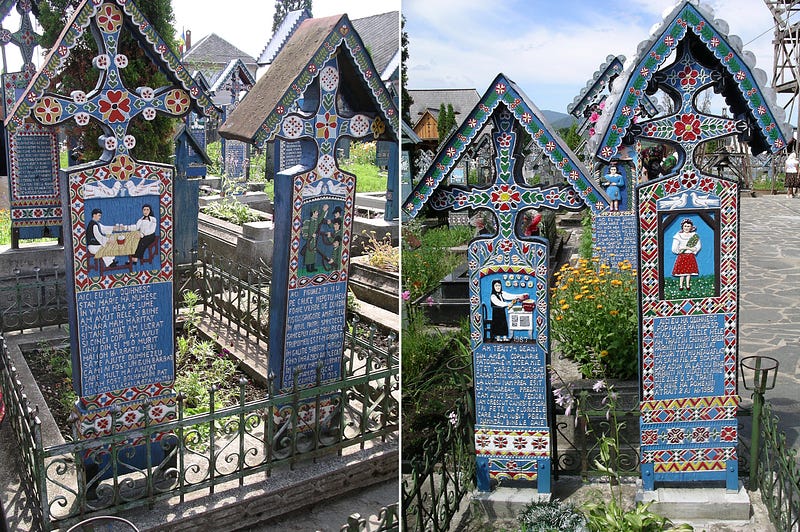
Behind this cross, as you can see in the photo, there’s a strange cross with an adolescent girl portrayed as an angel but with red boots and panties (!). And with the heads of two young men looking at her (!). I don’t know what to make of all that, honestly. Involuntary humor, I guess! The text talks about a young woman who left her sister. She asks her sister to come weed her grave and plant flowers. It also says, “Don’t forget me till you die. I had a good sister and we couldn’t be together.”
Dumitru Pop Tincu, who continued Stan Ioan Pătraș’s work in the Merry Cemetery, began his apprenticeship with Pătraș as a carpenter and painter at 9 years old and began building crosses on his own at 22, after a period where he studied in a professional school to be a mechanic, worked as a mechanic in a factory, and did his compulsory military service.
Dumitru Pop Tincu died on December 15, 2022, aged 67. His work is continued by his son-in-law, who happens to be a great-great-grandson of Stan Ioan Pătraș.
If you were wondering, a cross in the Merry Cemetery can these days cost up to 800 EUR/close to $900.
If you want to see more painted bas-relief scenes by Stan Ioan Pătraș, the creator of these famous crosses, you can visit his Memorial House in the vicinity of the Merry Cemetery.
Thank you for reading. If you’d like to stay abreast of my new pieces on Medium, you can sign up for emails here.
But first, you may need to join Medium to be able to read them. If you do so with my referral link — Mira G. Eliodora — I’ll get a small commission at no extra cost to you. For only $5/month you’ll also get full access to every story on Medium and will get to support the writers you read most.
To a happier, healthier life,
Mira