
The Most Telling Fear of Death
And the paradox of finite persons
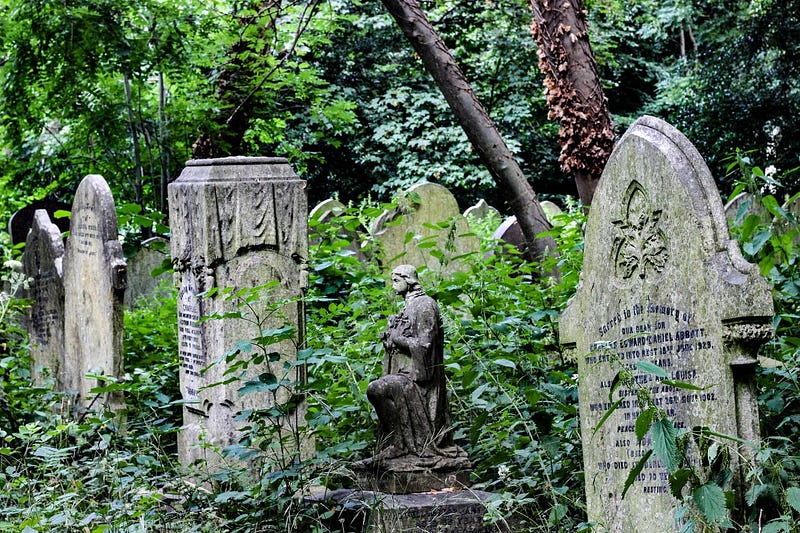
Nothing is more fearsome than death. The tyrants and conquerors that have terrorized the masses over the millennia have only expedited their victims’ inexorable end, laying claim to a horror no one is monstrous enough to have devised. Death is the doing of the universe at large.
Most of the reasons we fear death are as obvious as death’s reality: in our last moments we may regret wrong turns we made, be saddened we’ll miss out on the world’s future developments, or be burdened by irrational anxiety about divine punishment; we may dread the pain and helplessness of dying or be terrified of the great unknown.
But perhaps the most consequential reason to fear death isn’t well-recognized. Above all, death is palpable proof of our finitude, which means that, in defiance of our coveted certitude to the contrary, death demonstrates that we’re ultimately just things.
All things come to an end. They exist in space and time. They’re physical objects that have length, width, and height, and a beginning, middle, and end.
Persons as Non-Things
We happily concede that our bodies are things in that sense, which is why we dissociate from them; like hermit crabs we imagine we huddle within our mammalian shells, our true selves being immaterial and immortal. At our core, we assume, we’re spirits that will never perish.
As I have previously explained, we’re likely misled here by the strangeness of consciousness. We’re the limbos conjured by the labyrinthine folds of our brain. The brain is a most marvelous thing but a thing nonetheless, and its alienated neural signals are anomalous things, too, that mistake their sum for a transcendent non-thing.
We’d prefer to be nothing than just another physical thing that moves hither and thither and that begins and is eventually transformed or aged and terminated. The myths of our spirituality enlist so many symbols of an anticipated otherworldly nothingness, of the hope we have that qualia, the subjective aspects of our mental states point to a supernatural home to which we’re heir.
We live, then, not as things but as people, as citizens of this or that country; as fathers, mothers, or children; as the rich or the poor and as artists, laborers, soldiers, engineers, or some other social type. We enslave, hunt, and exterminate the animals we treat as just things, on the grounds that their mentality doesn’t rise to the human level.
We establish societies to feed our comforting self-image, abiding by our unnatural laws that dare to impose another order of being on nature. We speak of morality, of religious and artistic visions, of what should be but isn’t, and we pride ourselves on our efforts to make our ideals a reality. We boast of the gods with whom we’re on a first-name basis.
Death and the Laughingstocks
This is why the grim fact of our inevitable death is so haunting because death mocks the entire human rigmarole. Our humanitarian conceits, religious dogmas, and personal plans are nullified by our underlying physicality. This isn’t just because we won’t live long enough to complete everything we wanted to and because there’s no do-over, but because mere things can somehow only be fooled into treating themselves as non-things, as people with rights, honors, obligations, private properties, and divine destinations.
We can’t fathom how we could be mere things or objects, because we identify not so much with our bodies but with our subjectivity. More or less as Rene Descartes said, we exist as thinking things because we think we do, and we refute ourselves if we try to think otherwise. Our subjectivity and personhood are indubitable within those mental domains of thoughts and feelings.
But that doesn’t stop the rest of the world from negating what for us is self-evident. Just because we can’t doubt our humanity while acting as human persons, doesn’t mean the forces of physicality can’t erase all our history and every living flame and vainglorious boast with a wave of their mindless appendages.
We can’t imagine how we could be mere things, because we have to exercise our subjectivity to do so. We’d have to be conscious of that unflattering conception and we’d have to understand it using reason and to feel the collapse of our wrongheaded worldview, which would only reinforce our personhood, thus undermining our reduction to thingness.
We can say we’re physical in so far as we’re subject to natural laws and we can understand the theories and equations as an intellectual matter, but we can’t escape the more intimate acquaintance with our personality.
The universe isn’t likewise bound to “make it personal,” to respect our political borders or our cultural fashions. Death is monumentally impersonal.
We’re divided by our myriad human presumptions, but we’re equal in death, as in reality, the universe’s total expenditure of energy is conserved. Nothing escapes nature’s grasp; nothing is unaccounted for, since everything is only transformed eventually into something else — until nature, too, may come to an end.
Our bodies will decay, our minds will expire when our brain shuts down, and our corpse will fertilize new growth, preparing the next round of forms to be disintegrated.
“As for man, his days are like grass — he blooms like a flower of the field; when the wind passes over, it vanishes, and its place remembers it no more” (Psalms 103:15–16).
Our real hope isn’t in the next lines of that psalm, which offers a theological promise: “But from everlasting to everlasting the loving devotion of the LORD extends to those who fear Him, and His righteousness to their children’s children.”
That promise is only a fiction and fiction are comforts for the living, whereas now we’re recognizing that somehow, as mere things all along, we must be already dead. We’ve always been dead, since fundamentally we’re impersonal things. Unfathomably, our subjective life as persons must be an illusion, a mass hallucination, a giant fraud.
Tragicomedy and the Threat of Nihilism
The philosopher Ray Brassier says something similar in Nihil Unbound, in which he criticizes upbeat modern philosophy for attempting to preserve meaning from the threat of nihilism unleashed by the secular Enlightenment.
According to Brassier, we should think of the inevitable extinction not just of us but of all things as a sign of the emptiness at the heart of reality. To know the truth is to suffer the trauma caused by the fatalistic realization that in the big picture, from nature’s point of view as it were, everything is already extinguished because that’s where everything’s headed: to extinction.
In his words,
“If everything is dead already, this is not only because extinction disables those possibilities which were taken to be constitutive of life and existence, but also because the will to know is driven by the traumatic reality of extinction, and strives to become equal to the trauma of the in-itself [of the objective, finite physicality of things] whose trace it bears. In becoming equal to it, philosophy achieves a binding of extinction, through which the will to know is finally rendered commensurate with the in-itself.”
That’s the promise and the power of death: as it turns our body to “dust,” so death reduces our myths and fictions to laughingstocks. But in that absolute humiliation is a mystery overlooked by nihilists like Brassier.
The finitude of things establishes not just their inner absurdity but their grandeur. Even if physical reality were disappointing for being godless, its emptiness would be both tragic and comical, which are nonarbitrary aesthetic values since they’re based on this existential realism.
The universe isn’t empty, if only because intelligent creatures evidently evolve within it to appreciate what they really are. Again, this is both tragic and comical, and those subjective reactions to the horror of nature have real-world consequences since we’re thereby driven to modify the wilderness, to humanize things by injecting them with purpose and intention in the form of civilization.
The Anthropocene, which is the merger of human history with geology, testifies to our species’ existential revolt against the fact that the universe consists mostly of mere things. That revolt may prove futile in the end; in any case, physicality and finitude are enchanted since they play this last joke on those things that are poised, by evolution and by a series of shocking discoveries, to laugh at themselves.
With his last heartbeat he slumped in his seat, wafted his final breath, sublime shibboleth — the end of all his fears and the airs of his erstwhile peers.


