

The most studied female face in history, after the Mona Lisa
Lena, the playboy model whose image became the standard for testing algorithms for image processing.
Puedes leer la versión en español dando clic aquí.
In November 1972, like every month, Playboy published its magazine dedicated to the adult male audience. However, of all the select models who posed for the magazine in the 1970s, and perhaps in the entire history of the brand, no one could have imagined becoming an icon beyond the eroticism that the magazine aims to do.
Photographer Dwight Hooker captured the iconic image that for almost 50 years would be used by hundreds of researchers.
Just this happened to Lena Forsén (previously Söderberg), a Swedish model, who at age 21 became the magazine’s playmate of the month. His moment at the magazine would have been like many others models, had it not been for the fact that a year later, Alexander Sawchuk, an assistant professor at the University of Southern California (USC), saw the urgency of getting a good image to be scanned to be used in the documentation of a conference. And tired of the conventional images used then, he opted for the portrait of Lena. How did he access that image? There isn’t much to imagine, but Sawchuk sure didn’t know the extent of his final choice.
A seemingly superficial choice.
Even being the image that it is, one may wonder, why the photo of that particular model? Sawchuk was looking for a human face with a sufficient brightness that, when discretized, has a radiometric resolution that allows him to compare results from different algorithms.
Rather than receive sarcastic and mocking comments about the audacity of choosing that image, Alexander gave a key image that would remain decades in the area of image processing.
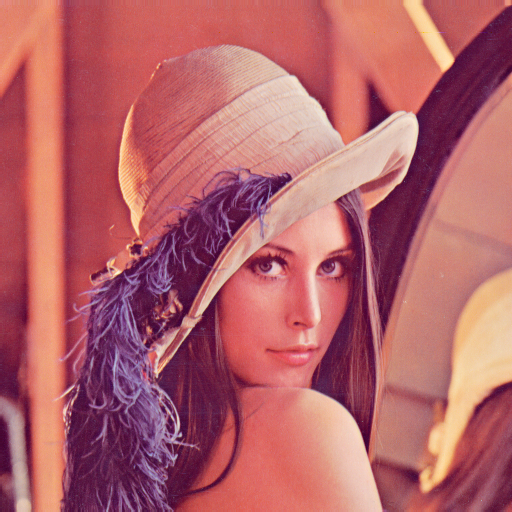
The full photo of Lena shows her entire body, but for various reasons, only the model’s face was scanned in a 512 x 512 pixel image. As a potentially useful image for research, it was added to the database of the USC School of Engineering. This, together with the then difficulty to access or making their own digital images, facilitated the expansion of the image in the research community, and allowed it to become a standard test image for algorithms used in digital image processing. Lena had conquered the digital world.
It is important to point out that it has not been the only erotic image used in the treatment of images, but due to its digital characteristics it was widely used in various investigations. And like this one, there have been various historical images used in image processing.
Nowadays, Lena, the name received the image, not only can be found in dozens of books and in hundreds of scientific articles whose central theme is Digital Image Processing. But in signal processing, in general, even in areas where a digital photography is not usually expected. For instance, it has been treated as a seismic model!
Interestingly, in a world plagued by copyright, Playboy was understanding and allowed the image to be used freely as long as it was for scientific and educational purposes.
On the other hand, in a world where sexism has gained relevance in recent decades, the use of this image also has generated controversy. More than one has raised their voice and pointed out that this image is an example of how women have been excluded from the technology industry.
Today women take a more important role in science and technology, so it is prudent to ask why still use this image? Times have changed, and technology has advanced. The image has been removed from the database of the USC School of Engineering, where if you access, you will be able to read that the image, like others, is no longer useful for future research. To balance the availability of images for research, in 2013 the work of two researchers from the Claremont McKenna College was published, who used a photograph of the Italian model and actor Fabio Lanzoni.
Fifty years ago digitizing an image was quite a task, a very different case from today. Similarly, processing images must have been quite a challenge. At that time, programming languages already existed, including Fortran, dedicated to scientific computing. I mention Fortran because it is the language I had to learn when I was in college. I am very fond of it, but dealing with images with Fortran is a complete headache. At least I was not able to work with images satisfactorily while taking imaging courses.
Currently, high-level languages such as Python allow you to manipulate images in a way that 50 years ago you would not have imagined.
At the time I heard of him, but it took me a few years to learn to program in Python. In fact, I’m still learning to program in that language. One of the virtues that Python has is its wide community that constantly works on the construction and improvement of libraries for various purposes, mainly mathematical and scientific. One of these libraries is SciPy, which has several functions, among them are those that allow the convolution of two signals, in one or two dimensions: scipy.signal.convolve and scipy.signal.convolve2d.
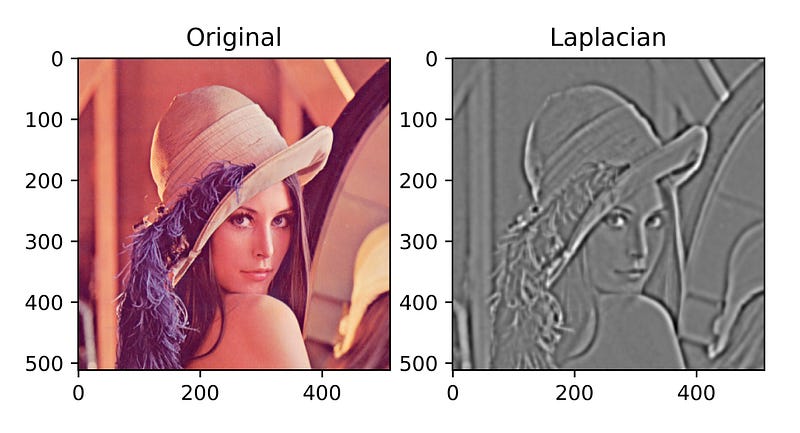
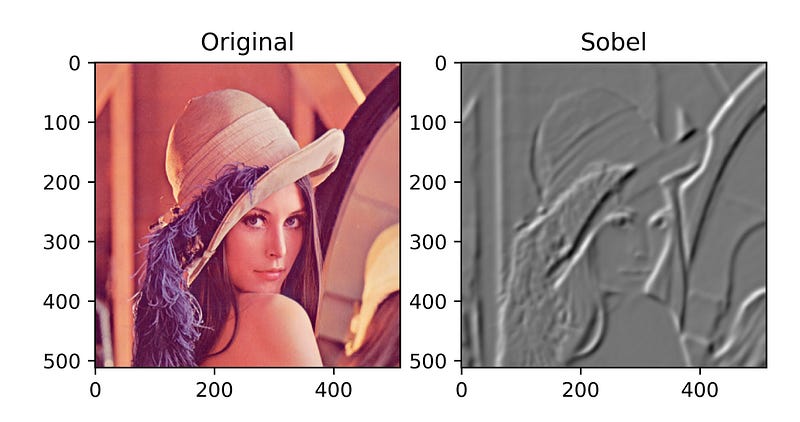
It is the second function that allows you to filter images in space, which I find a blessing after dealing with Fortran. The convolution of an image with a matrix of much smaller dimension, called kernel, allows us to highlight information of our interest.
To make a humble tribute to the protagonist of this story, with the convolve2d function I show the result of the convolution of two of the most important high-pass filters in history, the Laplacian filter and the Sobel filter, applied to Lena’s face.
And what about Lena?
She is fine. She currently lives in her native Sweden, with a formed family. Retired from modeling, she just hopes to retire from digital technology. She turns 70 on the date of the publication of this text (31/03/2021).
Does she know of her fame? It took more than 2 decades to find out. It was in 1997 when a group of engineers invited her to the IS&T 50th anniversary congress, where she introduced herself for the first time to the community that have seen her face for a long time. She has declared to be pleased with appointments such as “lady of the internet.”
Everything indicates that in a short time her image will be completely obsolete, and will only be part of the historical anecdotes that have made the investigation a more unique environment.