
Most. Problematic Simpsons Moments. Ever!
Content Warning: this article discusses things regarding racism, violence, transphobia, sexism and sexual assault.
Scroll down to skip to the list
I love the Simpsons. Even after years of watching the same episodes over and over, memorising an infinite number of lines of dialogue, and inevitably referencing the most tenuous and obscure Simpsons moments in real life, I still watch it regularly.
But…
*tugs collar*
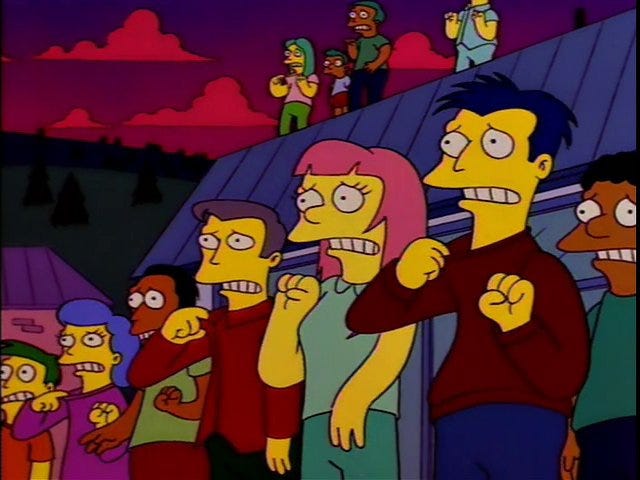
…that doesn’t mean that I’m ignorant towards the many issues that have accidentally or intentionally cropped up over the years, especially after its heyday.
Of course, every article discussing the Simpsons must include the obligatory reference to its undeniable decline since the late 90s. And of course, the author has to tell you their personal stance on when exactly the Simpsons eventually went from a golden icon of TV, to a yellow-ish blob of animated shit.
But this article isn’t about the quality of the show overtime, it’s about dead-white-male bashing from a PC thug.
Pretty much every episode of the newer lot leaves a nasty taste in my mouth, with a lot of the newer writing material feeling like it would be more suited coming out of Peter Griffin’s mouth than anyone in Springfield. It’s undeniable that the Simpsons is essentially a completely different show to the one it started out as, and for the most part that includes its political and social leanings too.
It’s undeniable that the Simpsons is essentially a completely different show to the one it started out as…
Don’t let places like r/theSimpsons fool you, there is little to be gained from anything beyond the golden era.
An important part of enjoying any piece of media understanding why we like particular pieces of art over others. In comedy I think this is particularly revealing as the medium is so reliant on its audience’s approval that the content is directly sculpted around audience reception. Likewise, what makes something funny is also incredibly revealing. It opens a small window into the popular narratives of an audience. We can gauge a very large amount about an artist’s personal views on a topic by how they present said topic within their art. The same, if not more so goes for comedy. Making fun of certain people makes us laugh. Why? Is it because of who they are? Or what they stand for? Is it always ethical to laugh?
In a show like the Simpsons, it is very easy to get a feeling of some kind of comment on society or ideology. For example, the joke in which Moe says:
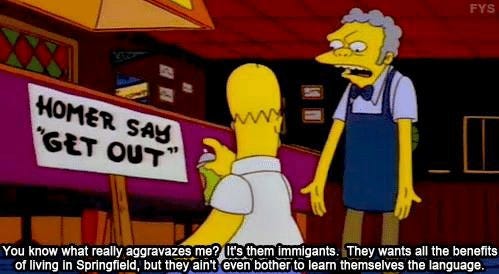
We as an audience understand that Moe is wrong for his comments on immigrants and the bit draws the hypocrisy of fervent anti-immigration believers into view, and is actively critical of those views.
On the other end of the spectrum, we might have jokes that rely on the mockery of marginalised groups or the rights of others etc. These kinds of jokes are genuinely dangerous as they begin to normalise toxic ideologies. This humour doesn’t punch up, but down. It is, in a word, (deep breaths) problematic.
As the resident far-left, SJW Simpsons fan, I feel it’s my duty to delve into the crud bucket that is the entirety of the Simpsons canon and pull out the most egregious examples of its problematic attitudes over the years. Especially after recent events in the show’s history. There are bad takes galore in later years, but don’t think the golden age is safe either.
So here they are, the blurst of all Simpsons moments in no particular order:
THE MOST PROBLEMATIC SIMPSONS MOMENTS:
Homer is raped by a panda
So yeah. This is a fairly well known instance. I had the misfortune of seeing this when I was younger as a result of the episode being added to the ‘Simpsons Christmas 2’ DVD collection, despite most of the episode not really being about Christmas. Not to forget that the whole panda rape thing isn’t really what springs to mind around the holidays.
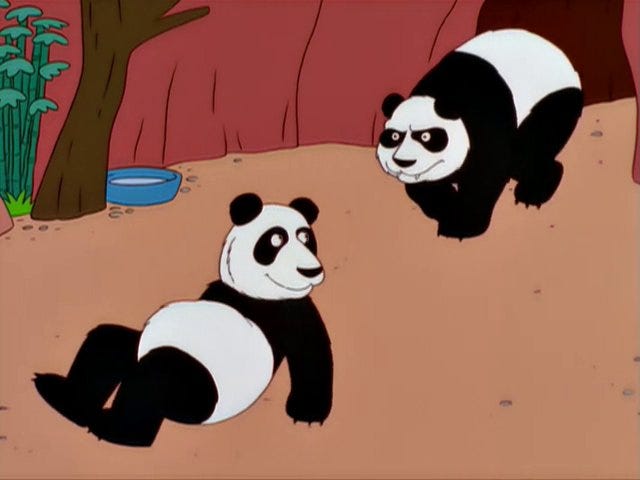
It don’t think I really have to explain why this one is bad. Homer is raped by a panda, whilst in a panda costume. What’s worse, Mr Burns (after orchestrating this ‘prank’) is fully aware of it happening and presumably gets amusement out of it. I know Mr Burns is evil, but he was always evil in a sort of ridiculous way. His was more about blocking out the sun than getting people sexually assaulted. Although, he does sexually assault Marge in ‘Marge Gets a Job’, but in that episode the idea of sexual assault is clearly wrong and is not meant to be the joke.
Homer is raped by Marge
Fuck, there’s so much weird shit in this episode.
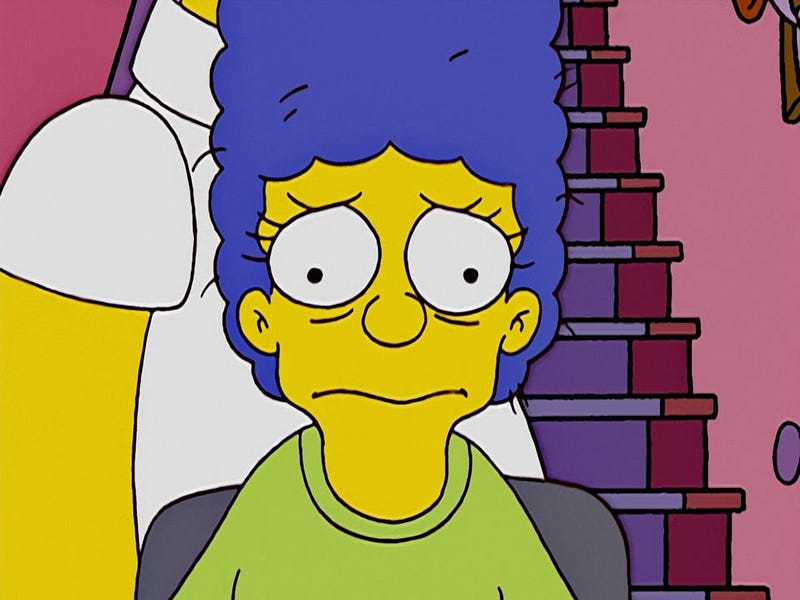
Apparently the writers got a flavour for depicting sexual assault against Homer, as just two seasons later we get another scene where him being raped is again the butt of a joke.
In season 14’s “Strong Arms of the Ma” we see Marge develop agoraphobia after being mugged outside the Kwik-E-Mart. Following this, Marge develops an unhealthy relationship with lifting weights in response to her vulnerability after her attack and eventually develops a dependence on steroids.
Now that’s a lot to take in, and honestly it’s bizarre how this episode plays out.
I actually like the idea of tackling mental illness in the Simpsons and I think the episode ‘Moaning Lisa’ did that pretty much perfectly for a show in the 90s. This episode however, gives us a really poor representation of mental illness. Marge develops agoraphobia and gets over it without any real insight to how it affected her beyond a few gags because it has to make way for the weightlifting plot line.
What was the point of Dr Hibbert coming on and diagnosing her with agoraphobia, if they aren’t going to actually represent it properly? They could have just made Marge nervous about going outside and as an excuse to stay at home, she takes up weights. Instead it comes off like a gimmick. It’s a kind of plot device the writers needed to get the episode moving.
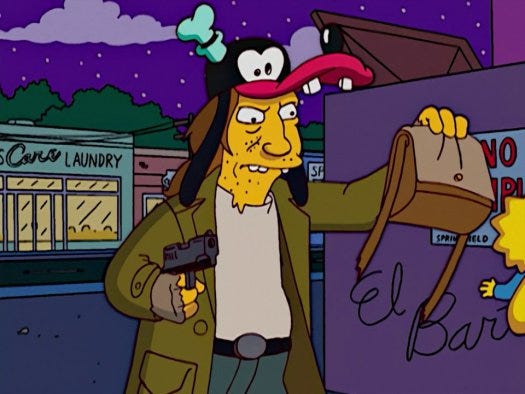
Okay, so now let’s talk about Marge’s mugger. Although unnamed, the mugger is associated with a group of ‘crackheads’ mentioned in a joke told less than a minute prior. Donning a Goofy hat, as an audience we are to assume that this person, is too a member of said ‘crackheads’.
So ignoring the socio-economic factors that are likely to leave someone addicted to crack-cocaine and then potentially lead them to steal from others in order to facilitate their addiction, this guy is evidently supposed to be an antagonist towards Marge, and in a later scene Marge beats the shit out of this guy.
Even though it’s a movie reference, this scene is really unnerving in its weird amount of violence. Like, the guy is just taking this pure beating from Marge, and it’s so excessive, and no one around her even questions her about pummelling someone until they’re unconscious. It’s very Family Guy chicken fight. Maybe it’s the fact the scene mirrors the Godfather shot nearly exactly, to the point that it looks rotoscoped, is what gives it this weird uncanny valley feel.
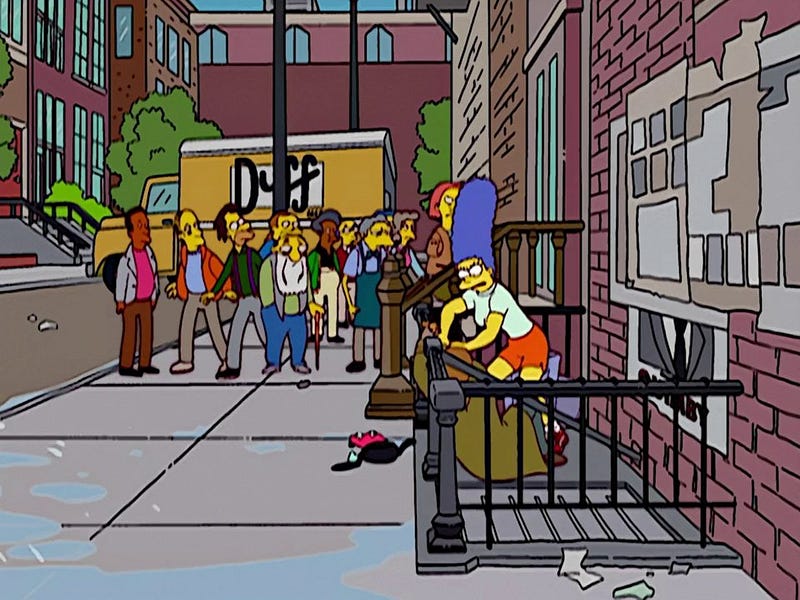
As of writing this, in the Wikipedia article for this episode the plot description is actually pretty funny in it’s bluntness towards Marge’s violence:
She runs into her mugger; even though the mugger does not move a finger against Marge, she beats him to a bloody pulp out of revenge in a scene that references the 1972 film The Godfather
So eventually after a series of weightlifting related jokes, we get the infamous bedroom scene with Marge and Homer. Honestly, the script for this part is genuinely unsettling when its detached from any sort of visual aspect. Not that it’s any better when it’s coming out of Marge’s mouth, but I suppose when you’re watching it you understand that it’s meant to be a joke, even though it’s not funny.
M: I could use a good-luck snuggle.
H: I’d rather talk about our feelings. I feel that illegal performance-enhancing drugs are too common these days. Rebuttal?
Marge gets atop of Homer, holding his arms down.
( grunts )
M: Let’s do it
H: Oh, uh… Uh, listen, my bulky flower, I-I have an early day…
M: I wasn’t asking.
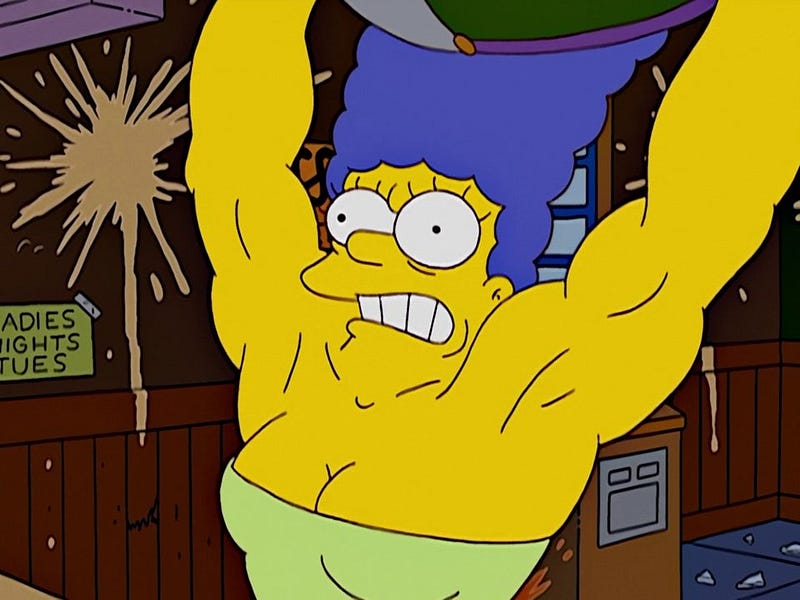
The morning after Homer is seen hobbling, evidently sore after the ordeal. What even needs saying? The whole thing is just insulting to rape survivors, and only helps to perpetuate that the idea of men being raped is funny.
With all of the stuff this episode throws at us we also get a lot of ‘women with muscles are ugly’ jokes, and just the general fact that steroid abuse is treated so flippantly and as a cheap way to pull drama out of thin air.
Oh, and this episode also ruins Ruth Powers and features her last speaking role to date.
SJWs at Yale
If you’re like me you might have seen this segment as a result of it popping up on your YouTube recommendations bar.
One of the more topical examples on this list, this section of the season 28 (jesus christ) episode ‘The Caper Chase’ has Mr Burns visit his alma mater Yale in search of new potential nuclear technicians. To Burns’ horror, Yale has been taken over by *gulp* social justice warriors.
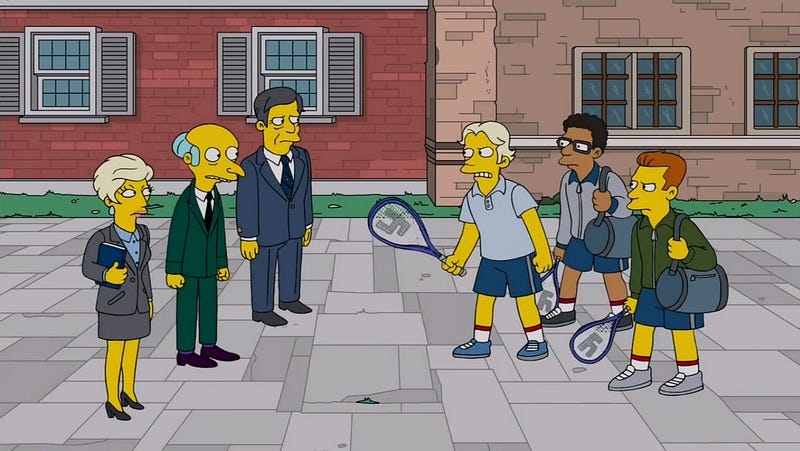
You know it’s bad when Mr Burns is supposed to be the voice of reason.
The bit is basically the Simpsons hopping on board the anti-SJW bandwagon. Quite the gut punch to see such an initially centre-left leaning show to fall so far. But hey, I suppose Matt Groening is an old fart now, so it’s probably on-brand.(that old clip show gag really shows how good the Simpsons were at predicting stuff eh?)
In this scene, we’ve got all the hallmarks of a great SJW roasting session, with banal reactionary ‘takedowns’ of overly-sensitive liberal students using terminology like:
highly entitled wusses
self-identified pansexuals
hetero-patriarchal
multi-cultural empathisers
safe space
cis-gender normative
I think all we’re missing is a triggered and a few blue-haired lesbians and we’d have a bingo.
There’s not even an attempt to argue against any of these terms that are apparently so laughable, the joke is basically ‘haha these words are said by people who I think aren’t smart’.
What’s more is that it doesn’t even commit to the anti-SJW narrative consistently. At one point in the episode, Mr Burns is introduced to a selection of teachers who were fired by the “holier than thou” Ivy League schools. One of them was fired after they “celebrated Columbus day”, another after they “referred to God as he” and the last after they “got five students pregnant”. Wait, are we supposed to be laughing at the SJWs or the anti-SJWs? ‘Cos, that last one seemed to muddy the waters a little.
Moreover, the episode takes shots at how universities are, how Mr Burns puts it, “coven(s) of capitalism”, to which the Yale heads are in agreement. It makes a promising point of how universities (as in, those who actually run them) are only ‘progressive’ in an incredibly superficial way. But this point goes no further, and it regresses back to owning the libs.
The whole episode kind of just tows the line like this, never really committing to any real statements or ideas. Fuck off back to South Park. Next!
(P.S. out of all the things the Simpsons is given credit for ‘predicting’, I suppose they did actually kind of do the recent NPC meme at the end of this episode before it was a thing)
Homer Is Accused of Sexual Assault
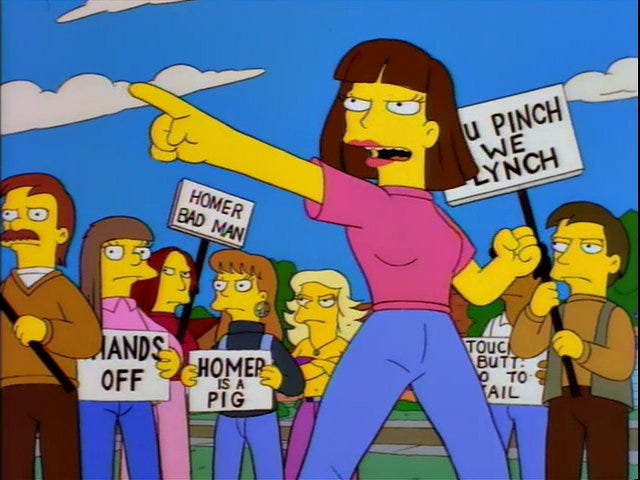
Jesus CHRIST this episode has not aged well.
In light of the #MeToo movement, and more recently the appalling revelations during the high-profile Brett Kavanaugh case, an entire episode that centres around Homer being falsely accused of sexual harassment is a bit of an iffy viewing these days to say the least.
The episode ‘Homer Badman’ is victim-blaming through and through. Although the parodying of media circuses and sensationalist media is really funny, the attitude behind it is incredibly misogynistic and down right nasty in its intentions. I hope that the writer’s intentions were more focused on mocking tabloid media, but that core message just seems to be wrapped in a veneer of woman-hating bullshit.
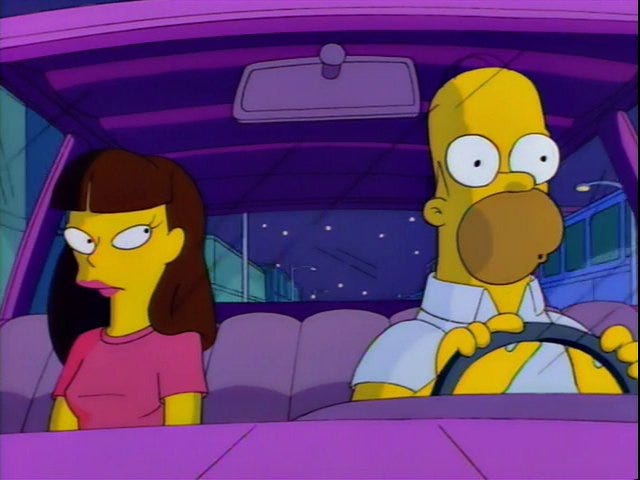
All of the people who believe Ashley’s side of the story are presented as overly-emotional, student-looking progressives. It’s also good to note that most of these characters are women. Now, Ashley doesn’t lie about what Homer did. From her perspective Homer looks to be quite clearly sexually harassing her. And to the show’s credit, Ashley herself is never made out to be a villain in all of this, but everyone who supports her side is.
It’s incredibly insulting considering that a third of people believe women who flirt are at least partially responsible for being raped. So it’s safe to say that a lot of public opinion is not on the side of women when it comes to rape.
Yet, the sensationalist news TV show Rock Bottom sides with Ashley, intentionally making Homer appear guilty through sneaky (albeit really funny) video editing.
It would actually be more accurate if Rock Bottom sided with Homer, and instead presented Ashley and her supporters as a bunch of over-zealous, obstructive, liberal, trendy-clothes-wearing…oh, wait…
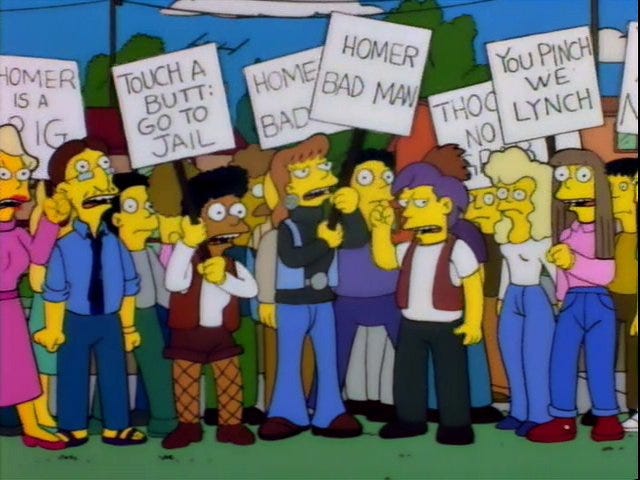
I guess the writers already got there first.
And before you say: BUT THAT’S NOT HOW I INTERPRETED THIS EPISODE, a sizeable amount of people also saw it the way I did. But instead of being uncomfortable with what sort of narratives the episode seemed to be pushing, they were instead excited that their beliefs were being confirmed.
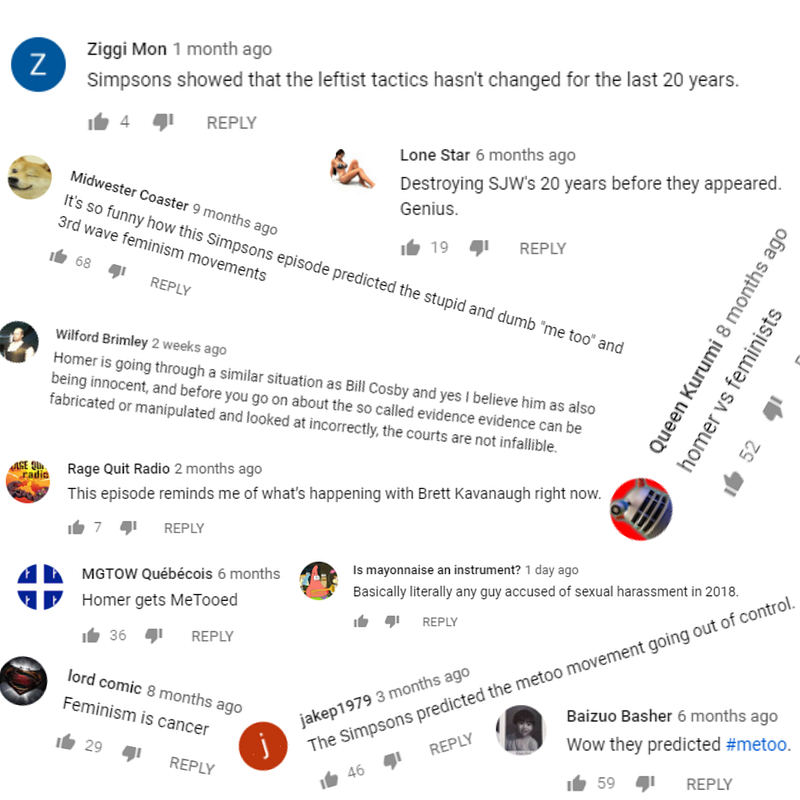
I’d like to draw attention to one YouTube comment in particular that I think summarises the point I’m trying to make fairly succinctly. Here it is:

Now the part of the episode the Joker’s timestamp is referring to is the following line:
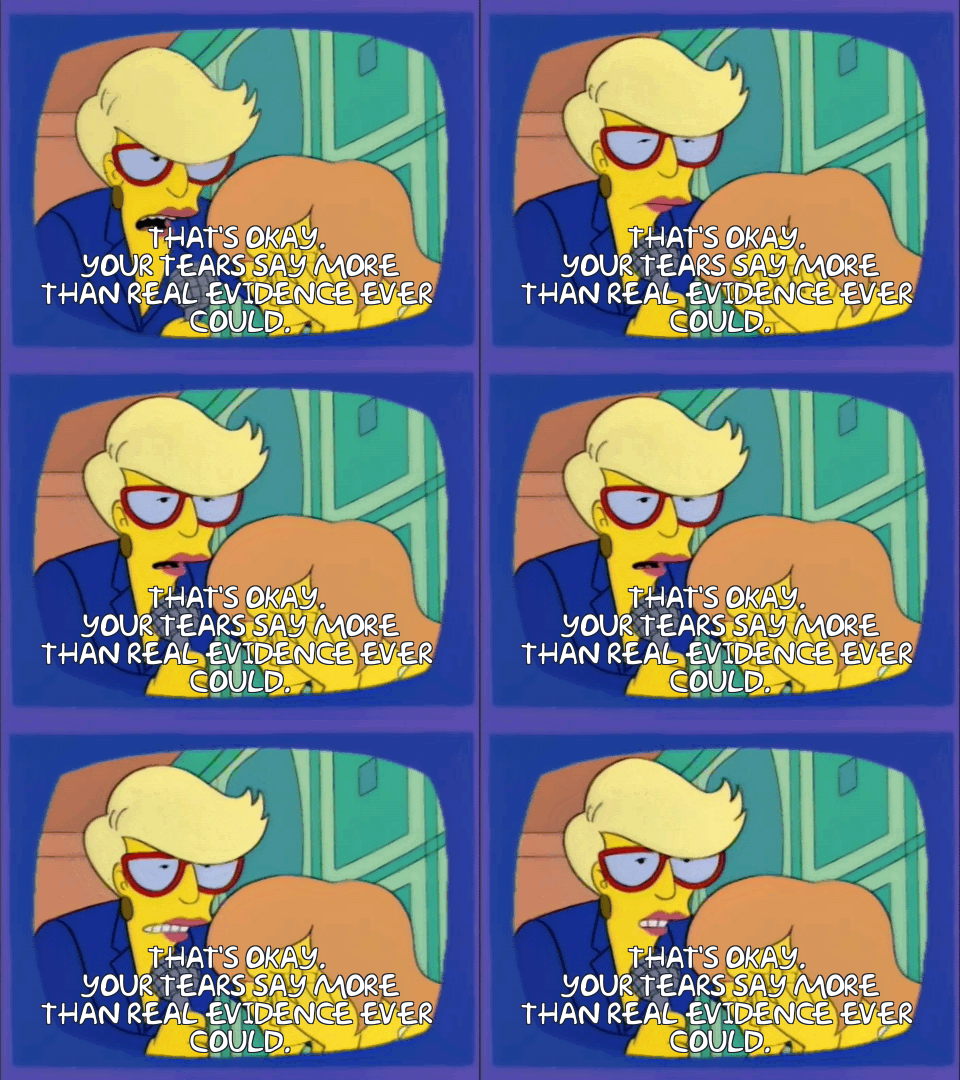
Ouch.
I’m not here to point out individual sexists online, but what a disgusting thing to say.
This line of dialogue actually makes me feel sick. Such a sore thumb in the golden era. I’m honestly surprised this quote hasn’t been adopted by MRAs or Redditors and isn’t plastered all over the internet. It actually hurts a little to see this in my favourite show of all time.
I’d just like to point out that around 15% of people who experience sexual violence report it to the police, and out of those reported crimes only 5.7% end in a conviction. But wait sorry, we were making fun of hysterical women weren’t we! Haha silly woman, you are so emotional , where are your facts and logic? Where is your evidence?
Transphobia
Originally, I had one or two instances in my mind when I asked myself if there was any transphobic Simpsons jokes I could think of. But thanks to a fantastic video by a like-minded SJW Simpsons fan, who collected a bunch of the transphobic jokes that have been delivered by our favourite Springfielders over the years, we’ve got plenty to sift through.
Unfortunately, our first example comes from the otherwise great season 4 episode ‘Lisa’s First Word’.
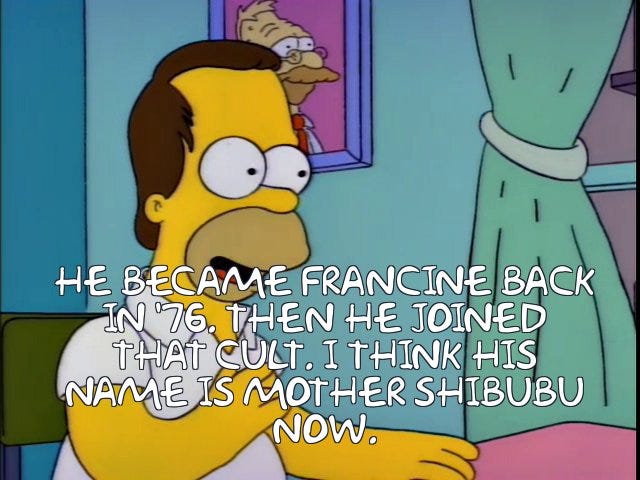
To my and the video’s knowledge, this is the very first and only moment in the golden era of the Simpsons that references or alludes to trans folk. Here the joke is that Homer’s unheard of uncle Frank, due to childhood mistreatment, was warped into transitioning to a woman. It should be obvious to most of us that trans people do not exist as a result of neglect, abuse or childhood trauma.
Things start to ramp up a bit around the season 10 mark, where there’s this odd fondness for the word she-male.
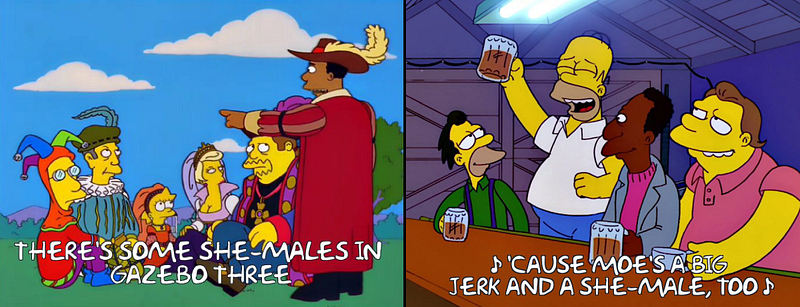
Then there’s this part from season 10’s ‘Thirty Minutes over Tokyo’
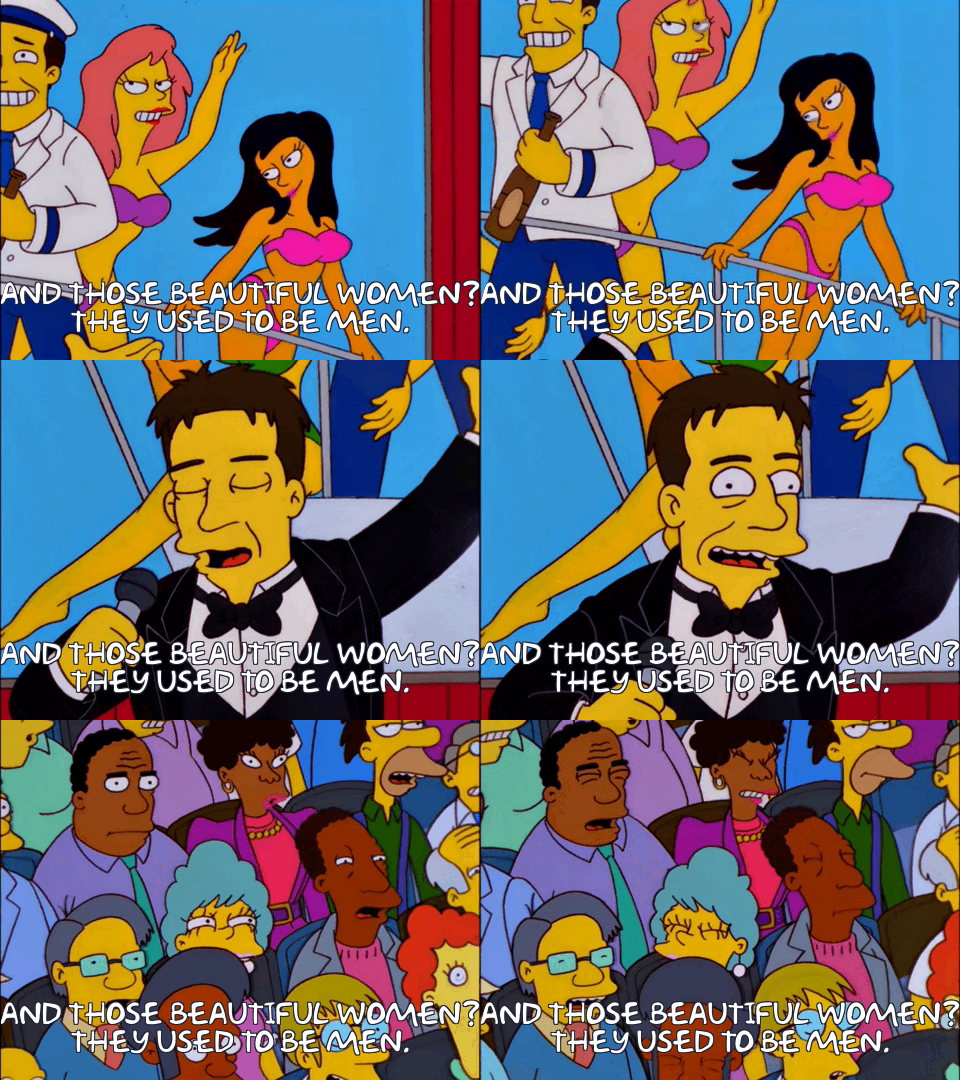
Unfortunately, it only gets worse from here.
In the episode “There’s Something About Marrying”, the show tackles Patty’s coming out story as a lesbian. This is one of the show’s three ‘gay’ episodes, when every so often the show wants to pat itself on the back for not being incredibly bigoted.
During the episode Homer becomes an ordained minister in order to marry the influx of gay couples that arrive to Springfield after the town legalises same-sex marriage. Patty tells Homer she now has a fiance and that she needs him to marry them, and the big surprise is that Patty is actually engaged to a woman named Veronica.
Marge is upset by the news of Patty’s sexuality and can’t seem to come to grips with the idea of her marrying a woman. To cut to the chase, it’s revealed to Marge and eventually everyone else, that Veronica is actually a man in disguise.
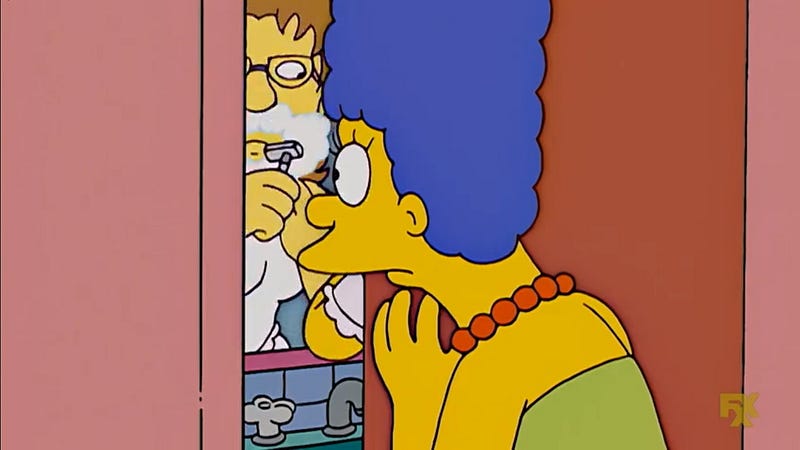
What’s increasingly uncomfortable throughout this episode is the obvious connections you can make as a viewer between Veronica and the vitriolic myth that trans women are men disguised as women, in order to trick or deceive others or to “invade women’s spaces”. With such few depictions of trans people in the media, especially so in 2005, its clear to see that this episode is steeped in the early 00s’ very own special brand of transphobic humour.
I guess the whole plot-line of Veronica actually being a man in disguise is supposed to be a funny joke. What’s significant however is that the character of Veronica is clearly a reference to professional golfer Mianne Bagger, who was the centre of a minor sport controversy after becoming the first openly trans woman to play in a professional golf tournament. To nobody’s surprise, this caused a lot of anger from a lot of transphobes that a transwoman would be allowed to compete in a female tournament.
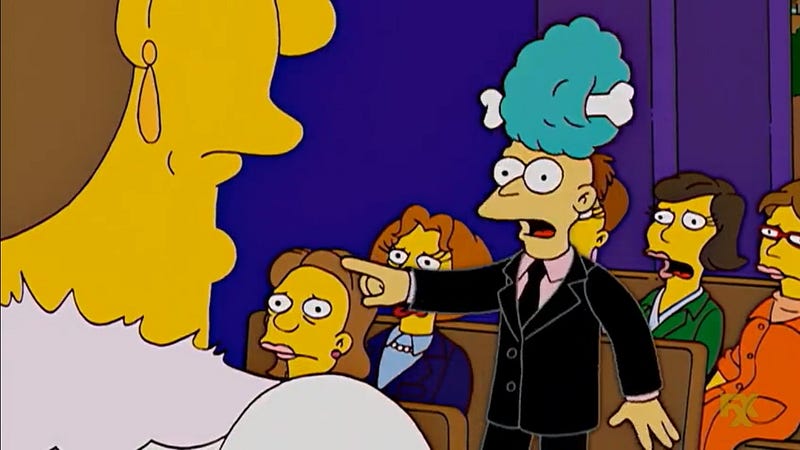
Leslie, AKA Veronica, admits to Patty that he disguised himself as a woman in order to compete in a Ladies Professional Golf Association tournament, being a pretty clear allusion to Bagger, despite Bagger being a woman, as this episode aired just one year after the controversy (thanks again to the video for that information). It’s obvious that this is just another example of the old and tired ‘conniving, secretly a man’ routine.
It’s no surprise that this episode has small set of fans within the TERF community. It proves to be quite embolding for those who incorrectly see trans women as male. See here this video’s comments by user babyradfem tv (hmm, note the username).
Next stop on our transphobic trip is the season 24 episode ‘Gorgeous Grampa’. In this episode, Marge for some reason desperately wants old Abe to be gay after discovering equipment from his secret wrestling past, assuming them to be drag costumes. This a noticeable pattern with the Simpsons, to associate drag and homosexuality as if the two are mutually inclusive (see Flaming Moe).
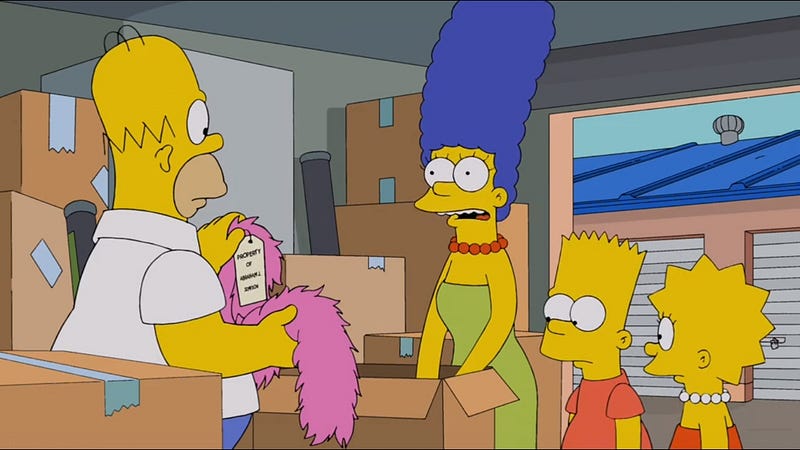
“Are you sure you're not just doing all this because it's cool to be accepting of a gay family member?” Bart says (has society as a whole ever considered this to be cool?).
Marge retorts: “Oh, honey, that’s just silly.” Then mutters to herself “This’ll show Helen Lovejoy. Always bragging about her he-she cousin”.
The “he-she cousin” line is redubbed in syndication to “Helen Lovejoy’s transgender cousin”. Personally, I saw this episode on Channel 4 in the UK and it used the ‘transgender’ line. You can see fans discuss this obscure, transphobic piece of Simpsons trivia here.
Later on, the joke is called back to, when Helen Lovejoy and the previously mentioned cousin appear on screen. The unnamed cousin is traditionally masculine in their design. Broad shoulders, defined cheek bones, taller than the other women on screen. There’s no real dialogue in this bit, so the punchline of the joke is her appearance, specifically how she doesn’t ‘pass’ for female.
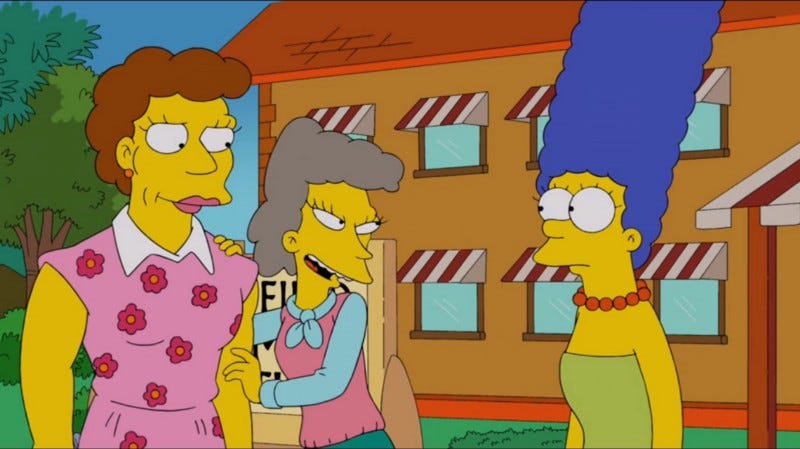
There is also an element of satire against a supposed social point-scoring, with people battling it out on who can be more tolerant or progressive. This narrative that exists within the first half of the episode really doesn’t sit right with me. Groups such as gay or trans people face massive struggles in everyday life, either systematically or socially. To act like these groups have swathes of people fighting over themselves to make them feel accepted, is at best, bizarrely uninformed, or at worst, incredibly insensitive.
Last, but certainly not least, we have the infamous ‘Flaming Moe’. In the twenty second season episode, Moe and Smithers undergo a business partnership in order to transform Moe’s Tavern into a gay bar, and during which the writers successfully manage to conflate cross-dressing, homosexuality and being transgender, presenting all three as being one in the same.
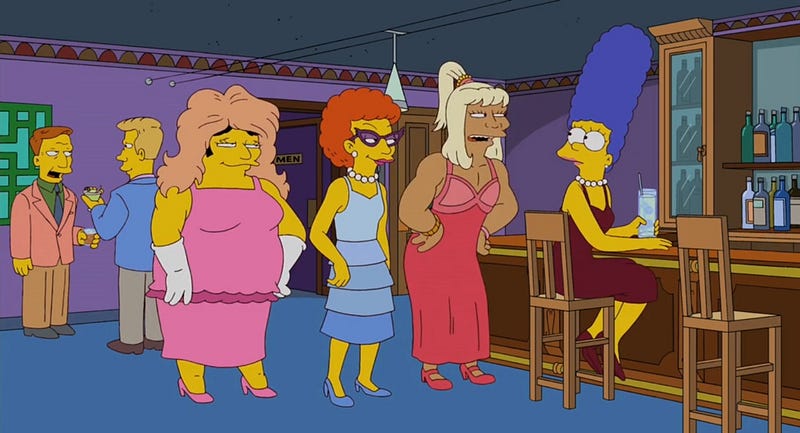
As the aforementioned video rightly points out, this part seem more like a nod to Ru Paul’s Drag Race, yet the writers seem to have no clue what they’re supposed to be referencing. Seems like a weird, muddy understanding of a lot of things, really.
Just recently, the show aired the episode ‘Werking Mom’ which features Marge being mistaken for a drag queen, and also features RuPaul as a guest star. Seems that the writers have managed to learn what drag actually is. So good for them, I suppose.
Apu
Oooh boy. If the other sections didn’t get people upset, I’m sure this bit will.
Quite the contentious talking point as of late. After Hari Kondabolu’s 2018 documentary focused on the impact and influence of Apu Nahasapeemapetilon within American popular culture, the internet got mad.
Like really mad.
Mad enough to get a nice chunk of YouTube video reactions to the news of the controversy. This was later amplified by Adi Shankar’s false claim that Apu was going to be taken out of the show in response to the documentary. What a messy business. Reactionary YouTuber types really took the bait with this one, and the whole thing even got Paul Joseph Watson in on the action!
(side note -PJW says “The bumblebee man” in his video. Not really a flaw in his arguments but quite illustrative of his general knowledge on the subject of the Simpsons.)
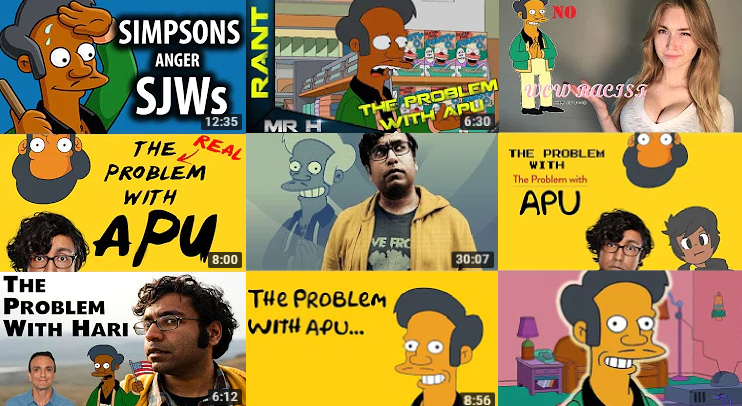
Now unlike most of these YouTubers, I actually watched Kondabolu’s documentary. It was a pretty decent, earnest documentary detailing a unique viewpoint and experience in the face of a unique pop culture environment.
Hari doesn’t actually put forward anything incredibly earth-shattering. It’s a pretty down-to-earth look at a show that, by his own admission, means a tremendous amount to him, and I think he covered the whole situation fairly. Despite the alarmist nature of the slew of YouTube reaction videos, Kondabolu never actually asks for Apu to be removed from the Simpsons and finds himself in a difficult position between offensive portrayal and representation.
It’s brought up in the documentary that the Simpsons addressed the situation regarding Apu in 2016 in the episode ‘Much Apu About Something’, in which Utkarsh Ambudkar plays Apu’s nephew. Ambudkar’s character is in stark contrast to all that Apu has come to represent. He has no thick accent, he is forward thinking, and he actively confronts Apu on his stereotypical behaviour.
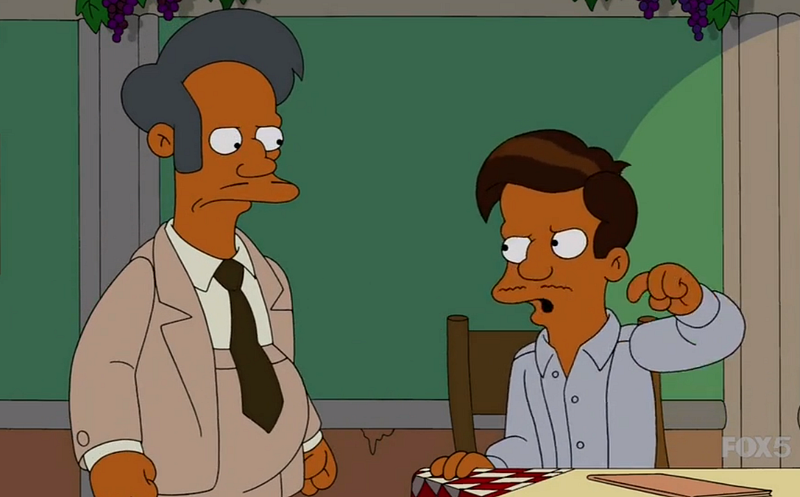
It’s also shown in the documentary that Ambudkar wasn’t pleased with the final cut of the episode, as a section of the episode has Luigi (Springfield’s resident Italian stereotype) appear, to deliver some kind of message from the writer’s room to the audience. After hearing Jamshed call his uncle a stereotype, Luigi walks in and declares “ Stereotype-a? Who’s a stereotype-a? That’s a spicy accusation.”
The whole narrative of the episode seems to be centrered around acknowledging that Apu is an outdated stereotype. Yet the subtext seems to be also stating that it doesn’t matter and that Apu is fine the way he is.
The show simply dusts its hand of any responsibility, it offers no solution and things, as always, return back to the way they were at the start of the episode. There’s a kind of intertextual analysis at play as the show struggles with its incredibly unique situation of being on the air for so long that they have to now question the ethics behind the creation of one of its most recognisable characters. But the writers decide to wrap this up with a ‘Mama mia!’ and call it a day.
We can see this apathetic approach being mirrored again in the more publicised instance of when the show had to respond to the Problem With Apu documentary.
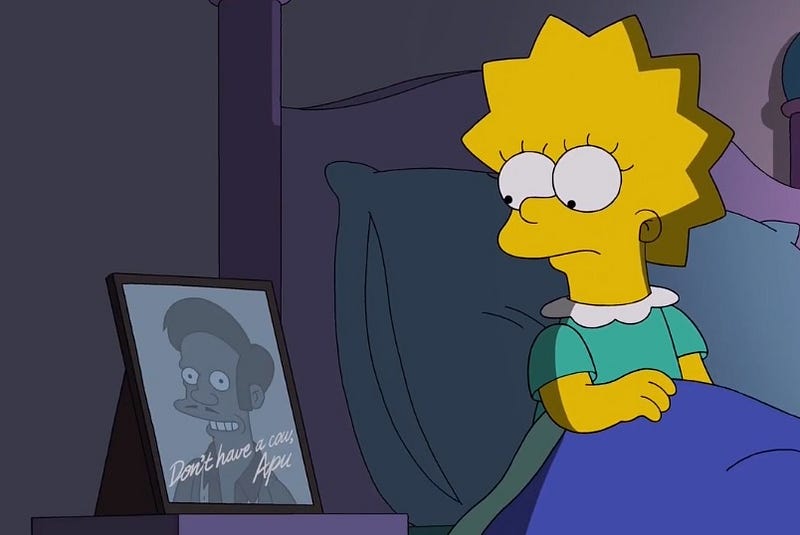
Out of all the characters, we get Lisa Simpson, the show’s progressive point of view, breaking the fourth wall to stare the audience in the face and say:
“Something that started decades ago and was applauded and inoffensive, is now politically incorrect. What can you do?”
One of the sections I remember quite clearly from the Apu documentary was the part in which a collection of adult Indian Americans state that they suffered bullying as children in reference to Apu. So, how exactly was this inoffensive back in the day? Wasn’t the entire point of Apu’s character to be an offensive caricature? According to the conflicting stories on Apu’s inception, the stereotypical Indian voice that Azaria provided was funny enough to keep in permanently, so it doesn’t really appear like a well-meaning blunder on the show’s part. Ultimately, it was the choice of the writers to create Apu, and the choice of the people involved to have a white guy voice him.
They could have easily got an actual Indian actor to come in and voice Apu, especially since Joe Mantegna isn’t part of the regular voice cast, but has regularly voiced his character Fat Tony since 1991.
The show has acknowledged that there is something inherently wrong about Apu’s existence, twice in fact. But instead of doing something about it, the show simply reacts to it. It goes well it was okay in the past, and now it’s not, but what’re you gonna do? It simply dusts its hands of the entire situation.
So hopefully you made it through all of that. Without rambling too much more, there were a lot of things I could have included that didn’t make the cut to prevent a very long article on what is ultimately a cartoon that hasn’t been good for 21 years. I didn’t even get to talk about gay representation in the show! Maybe another time. Hopefully, nobody got too upset by me getting upset. Catch you on the flip side dudemeisters.


