avatarTim Ward, Mature Flâneur

Free AI web copilot to create summaries, insights and extended knowledge, download it at here

3983

Abstract

her own life to break the spell, which could only be done by weaving each brother a shirt from thistledown (that’s what she carries in her arms). The down had to be harvested by moonlight in the moor of the trolls. It’s a harrowing tale of courage and deception, well worth reading.</p><p id="6d35"><b><i>Statue of João de Deus</i></b></p><p id="f8c3">João de Deus was a<b> </b>famous Portuguese poet, educator and politician of the 19th century, known for his personal rigor and political independence — he never joined a political party. I first spied him behind the wrought-iron fence of the bandstand, beneath a flowering jacaranda tree. I was struck by the upright posture of this diminutive man, whose large head makes his body seem quite short. He seems both humble and strangely dignified. The school just next to the park bears his name.</p><figure id="8f29"><img src="https://cdn-images-1.readmedium.com/v2/resize:fit:800/1*aeDwRbM0gqRFE2mGSJzDDA.jpeg"><figcaption></figcaption></figure><figure id="4ae8"><img src="https://cdn-images-1.readmedium.com/v2/resize:fit:800/1*Rdpx0_erF17KsclJQRzgXA.jpeg"><figcaption><b><i>Statue of João de Deus, </i></b>Photo credit <a href="https://medium.com/@timward-changermakers">Tim Ward</a></figcaption></figure><p id="1291"><a href="http://João de Deus">Wikipedia </a>says this about him: <i>Next to <a href="https://en.wikipedia.org/wiki/Cam%C3%B5es">Camões</a> and perhaps <a href="https://en.wikipedia.org/wiki/Almeida_Garrett">Almeida Garrett</a>, no Portuguese poet has been more widely read, more profoundly admired than João de Deus; yet no poet in any country has been more indifferent to <a href="https://en.wikipedia.org/wiki/Public_opinion">public opinion</a> and more deliberately careless of personal fame…</i></p><p id="a737">Oh my! He sounds like a man with the heart of a flanêur!</p><p id="8abb"><b>The Digger</b></p><p id="edfb">This statue of a farmer tilling the soil with a hoe was erected in 1913 — the first statue added to the garden after the monarchy was abolished and Portugal became a republic in 1910. Framed behind a spreading banyan tree, the sculpture seems a fitting public expression to mark the political transition. Notice how clearly the man’s rough clothing and strong arms are depicted.</p><figure id="b28c"><img src="https://cdn-images-1.readmedium.com/v2/resize:fit:800/1*VRzrc-Vg6Jq4Eb_Zy5jlXQ.jpeg"><figcaption></figcaption></figure><figure id="495f"><img src="https://cdn-images-1.readmedium.com/v2/resize:fit:800/1*Mmwdr0ZTGSEluXeCJmKCEQ.jpeg"><figcaption><b>The Digger, </b>Photo credit <a href="https://medium.com/@timward-changermakers">Tim Ward</a></figcaption></figure><p id="90f5">But that look in his eyes — it’s not that of a victorious peasant embracing his nation’s freedom, is it? To me, he is looking up anxiously, almost fearfully. Perhaps he symbolizes the entire nation, still working hard just to survive, gazing towards an uncertain future of the 20th Century. Would the eyes of a similar statue created in Portugal in 2022 look much different?</p><p id="9db7"><b><i>The Awakening, </i>or<i> Laziness</i></b></p><p id="63ea">This 1915 statue of a naked young woman arising in the morning is said to be the most popular in the park. It’s easy to see why. From a distance, under an umbrella tree, her white figure is eye-catchingly sensuous.</p><figure id="bc1a"><img src="https://cdn-images-1.readmedium.com/v2/resize:fit:800/1*TF9bpof_j_CsX-TGmmujiw.jpeg"><figcaption></figcaption></figure><figure id="bad8"><img src="https://cdn-images-1.readmedium.com/v2/resize:fit:800/1*ZLkvFnO6AuilU8w-GmC68g.jpeg"><figcaption></figcaption></figure><figure id="d824"><img src="https://cdn-images-1.readmedium.com/v2/resize:fit:800/1*A7jfG84KajFHeRTFEXZV4g.jpeg"><figcaption><b><i>The Awakening, or Laziness. </i></b>Photo credit <a href="https://medium.com/@timward-changermakers">Tim Ward</a></figcaption></figure><p id="e9bd">Up close, though, it is the expression on her face that m

Options

akes her so utterly beguiling — that satisfied, languorous smile, those half-opened eyes! Though one of her arms is missing, the other is clearly in the middle of a stretch. I love the two very different words the woman supposedly embodies: <i>Awakening</i> and <i>Laziness</i>. Is she rising to meet the day, awakening to the possibilities and hopes of her future — much as the young republic was awakening? Or has she already risen too late to do anything productive with her youthful energy? It’s hard not to think about her fellow statue, the <i>Digger</i>, not 50 meters away, who has been toiling away, probably since dawn.</p><p id="b189"><b><i>Statue of Antero de Quental</i></b></p><p id="6365">Antero de Quental was a 19th Century realist poet and political philosopher, but his statue is the last edition to the park. It was installed in this private grove of ivy-covered trees in 1951. It makes me laugh to see a “realist” poet dressed in the robes of an ancient Roman! I hope he has a good sense of humor in whatever immortal realm of the poets he resides.</p><figure id="8d7d"><img src="https://cdn-images-1.readmedium.com/v2/resize:fit:800/1*PT6UGWPttWt00Lorro6j-A.jpeg"><figcaption></figcaption></figure><figure id="7fb0"><img src="https://cdn-images-1.readmedium.com/v2/resize:fit:800/1*9zk7Z1UcGbzulw0IDhmT9w.jpeg"><figcaption><b><i>Antero de Quental. </i></b>Photo credit <a href="https://medium.com/@timward-changermakers">Tim Ward</a></figcaption></figure><p id="b1c4">As a young poet, de Quental declared the role of poets, in an era of great transformation, was to be messengers of the day’s great ideological questions. He emerged as a socialist, advocate of the proletariat, and eventually an anarchist. To me it’s surprising his defiant-seeming statue was installed in the midst of Portugal’s repressive Salazar dictatorship.</p><p id="ad7f"><a href="https://en.wikipedia.org/wiki/Antero_de_Quental">Wikipedia</a> has this to say about the great poet, and the sad ending of his life: <i>Throughout his life, de Quental oscillated between pessimism and depression; afflicted with what might have been <a href="https://en.wikipedia.org/wiki/Bipolar_disorder">bipolar disorder</a>…he committed suicide by <a href="https://en.wikipedia.org/wiki/Multiple_gunshot_suicide">two gunshots to the stomach</a> while seated on a bench in a local garden park. He died approximately an hour later. “Of all things, the worst is having been born,” he wrote in a poem.</i></p><p id="a483"><b><i>Allegory (Man with a Dog)</i></b></p><p id="c1f9">This final statue I encountered reclines at the edge of another little lake in the park, and has an “unknown provenance.” Seen below, shrouded behind palm trees, it features a man in a robe with wild curly hair and a long beard that appears blown back as he leans slightly into an invisible strong wind. His large, powerful hands hold protectively onto his little dog. Its lips form a wide “O” because its mouth is also the spout of a fountain.</p><figure id="1de3"><img src="https://cdn-images-1.readmedium.com/v2/resize:fit:800/1*0wkvYjyApxCDRrQppoRmmA.jpeg"><figcaption></figcaption></figure><figure id="9d6a"><img src="https://cdn-images-1.readmedium.com/v2/resize:fit:800/1*pctY4WqiFegK5P2HQopytQ.jpeg"><figcaption><b><i>Allegory (Man with a Dog). </i></b>Photo credit <a href="https://medium.com/@timward-changermakers">Tim Ward</a></figcaption></figure><p id="9cd9">There is something loveable about this sculpture. I suppose it is the forcefulness of the man juxtaposed with the gentle way he holds his companion. It made me smile and think of all the old men and women I’ve seen in Lisbon, even in Estrela Park, out walking their little dogs.</p><p id="c5a4">The future might be wild and uncertain, but we can do the best we can to take care of the ones we love, whether dogs or ducks or a whole nation, even a continent, once again in the midst of turbulent times and perhaps a great transformation.</p></article></body>

The Most Peaceful Place in Lisbon

Estrela Park: an oasis in a once-turbulent city.
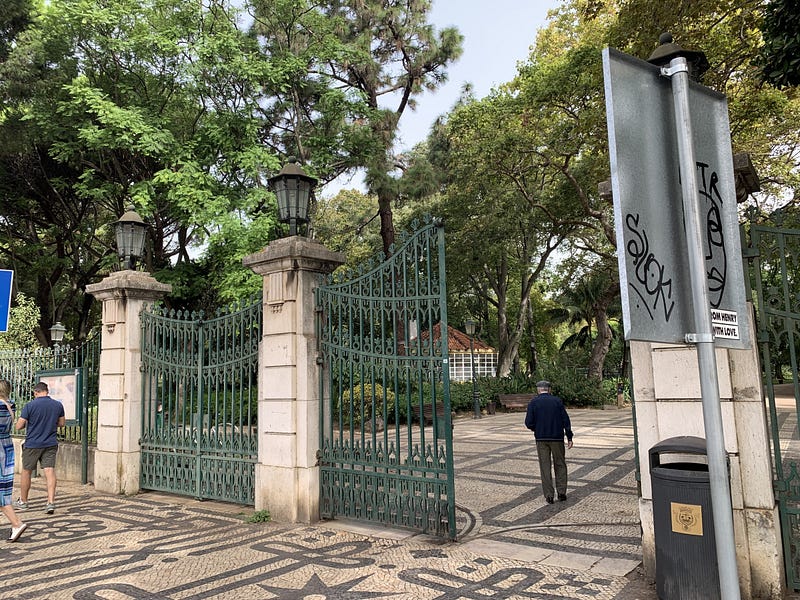
Estrela Park. Photo credit Tim Ward

I love the bustle of Lisbon: the up-and-down streets, the beauty of the multicolored azulejos façades on the buildings, the decorated cobblestone streets and sidewalks, and even the grittiness of the poorer neighbourhoods. But sometimes you want a break, a place without busy-ness, without touristy-ness. A place where you can feel calm and reflective for few hours. I discovered such a place in Estrela Park, a few blocks from the gleaming and grand Portuguese Parliament Buildings, and just opposite the Basilica da Estrela.
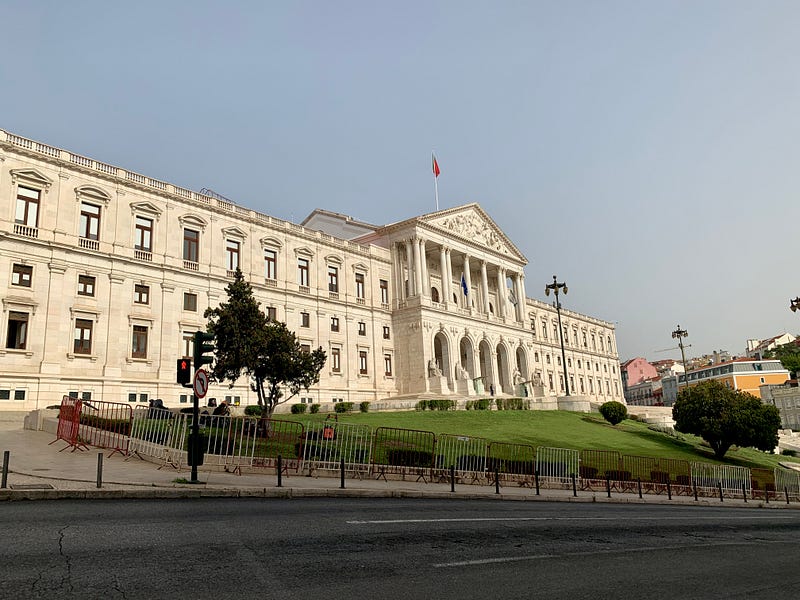
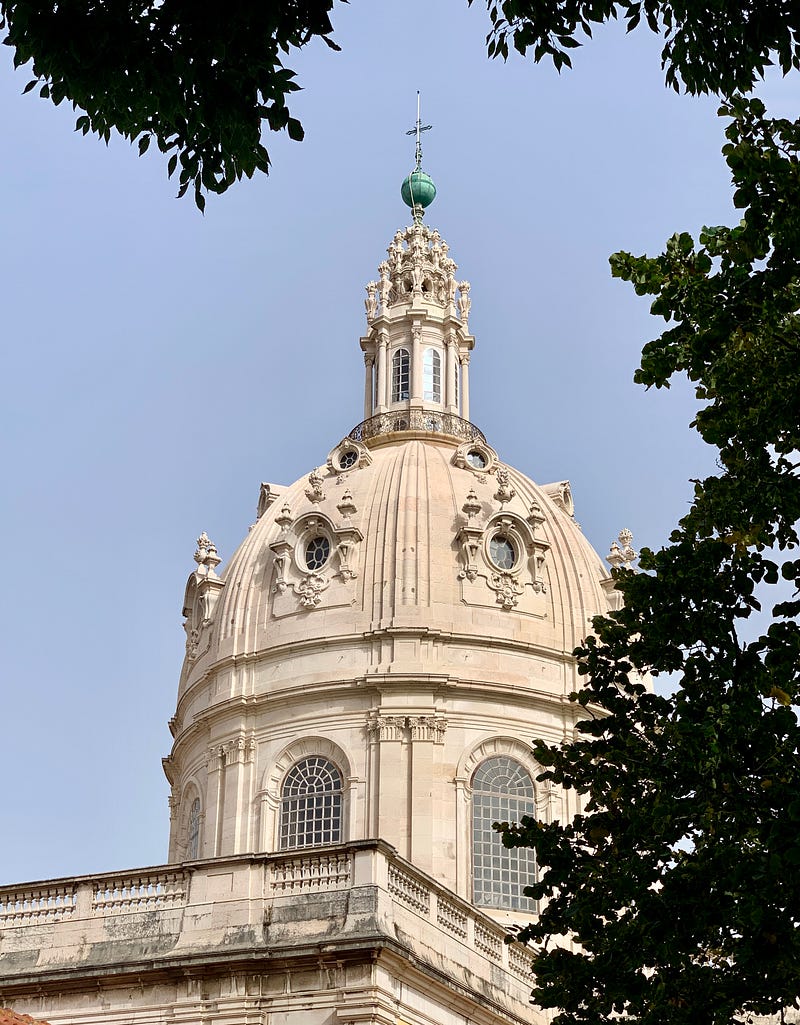
Left, São Bento Palace, Portugal’s Parliament buildings; right, The Basilica. Photo credit Tim Ward

In contrast to these grand and gleaming buildings, Estrela Park feels intimate and a bit wild. Its main features are the exotic plants and trees from around the world that grow tall and lush within its gates. The park was designed in 1842 as a place for the working classes of Lisbon to relax and forget the toil and the stress of city living. Ironically, funding for construction dried up due to political instability, and the park was not completed until thirty years later. This was a tumultuous time for Portugal, as the nation veered precariously and at times violently between monarchists and republicans.

The tranquil green spaces are punctuated by several beautiful stone statues. It occurred to me that this juxtaposition between art and nature, white and green, would be worth a photo essay, showing the statues at a distance, half-hidden by the foliage, and then up close, where the depth of their expressiveness is unconcealed. But then, as I learned the stories behind these statues they revealed themselves to be much more than decorative. I’m presenting them in the order I came across them as I explored the park (and with gratitude to this Wordpress article, which helped me fill in the blanks about their origins):

The King’s Daughter, Guardian of the Ducks

She stands amid the rushes in the center of a pond, carrying a bundle of straw or something; a gaggle of stone ducks flocks around her feet. Up close, the naturalistic Art Nouveau style of the sculpture shows her in motion, walking along, yet looking down with care and affection at the ducks she guards. But wait: why would anyone guard ducks?
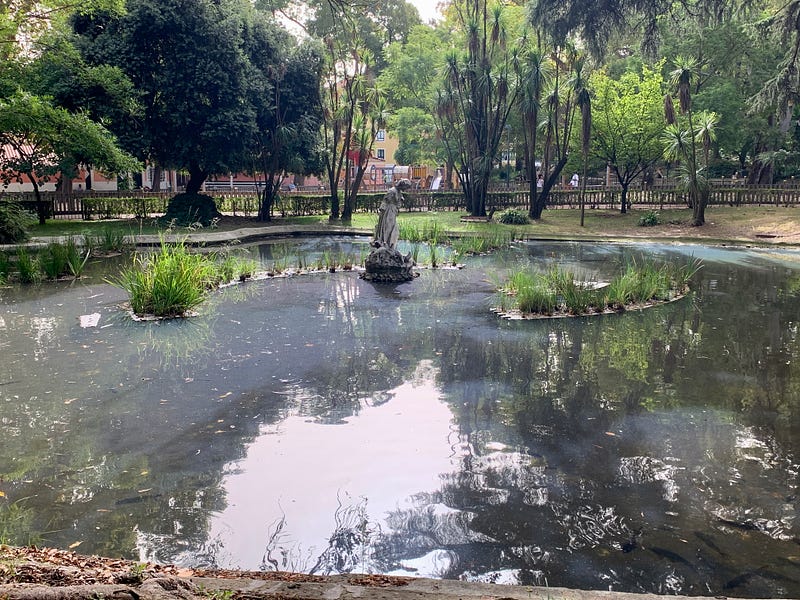
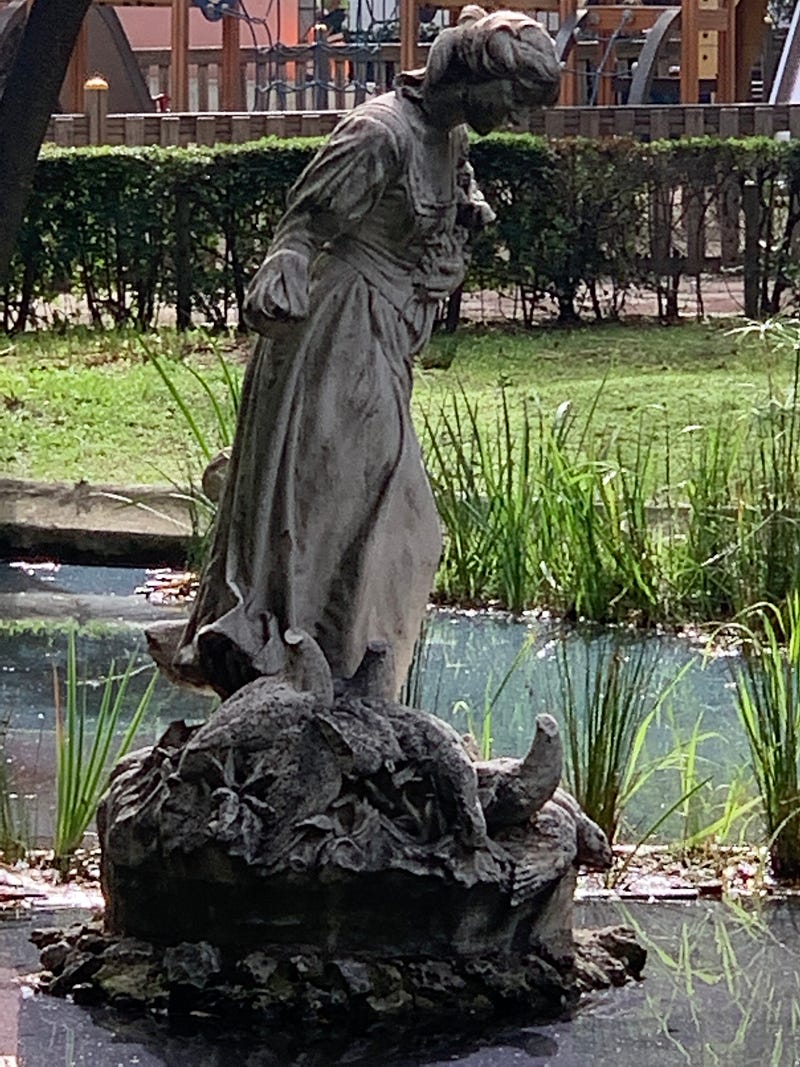
The King’s Daughter, Guardian of the Ducks. Photo credit Tim Ward

I discovered online that the statue was inspired by the Norwegian fairy tale of the same name, which I had never before heard of. The ducks, it turns out, are actually the 12 brothers of the princess. They had been enchanted by an evil witch. The princess risked her own life to break the spell, which could only be done by weaving each brother a shirt from thistledown (that’s what she carries in her arms). The down had to be harvested by moonlight in the moor of the trolls. It’s a harrowing tale of courage and deception, well worth reading.

Statue of João de Deus

João de Deus was a famous Portuguese poet, educator and politician of the 19th century, known for his personal rigor and political independence — he never joined a political party. I first spied him behind the wrought-iron fence of the bandstand, beneath a flowering jacaranda tree. I was struck by the upright posture of this diminutive man, whose large head makes his body seem quite short. He seems both humble and strangely dignified. The school just next to the park bears his name.
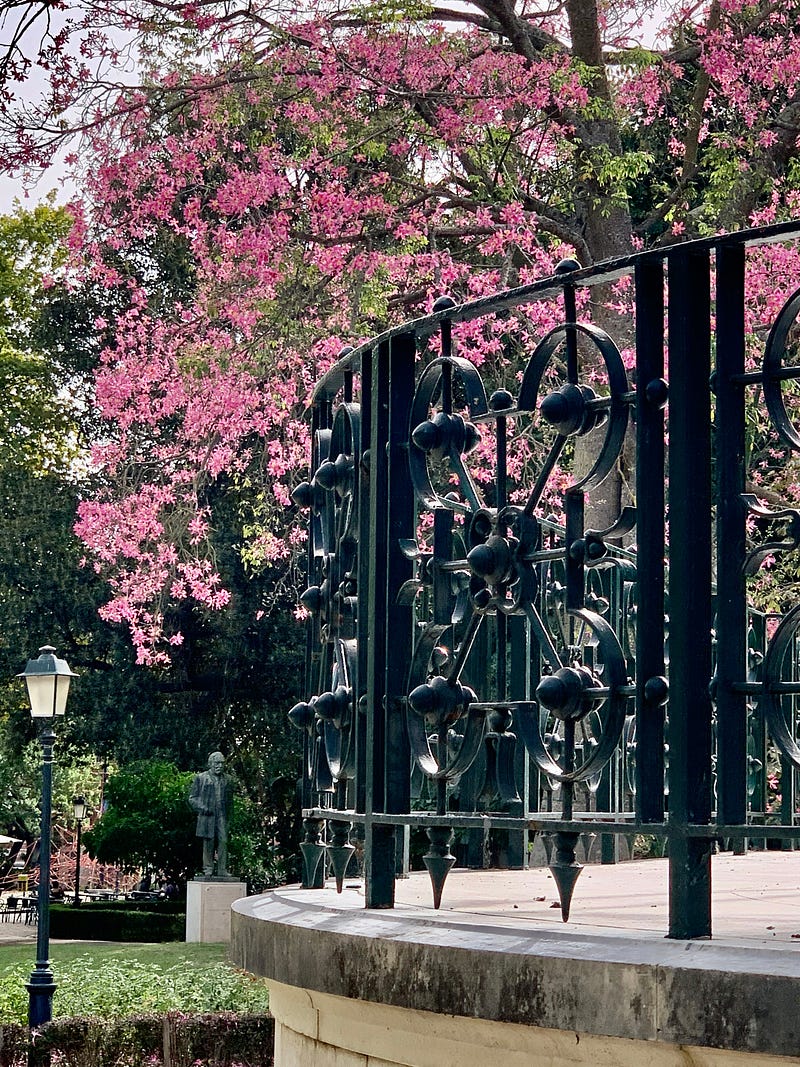
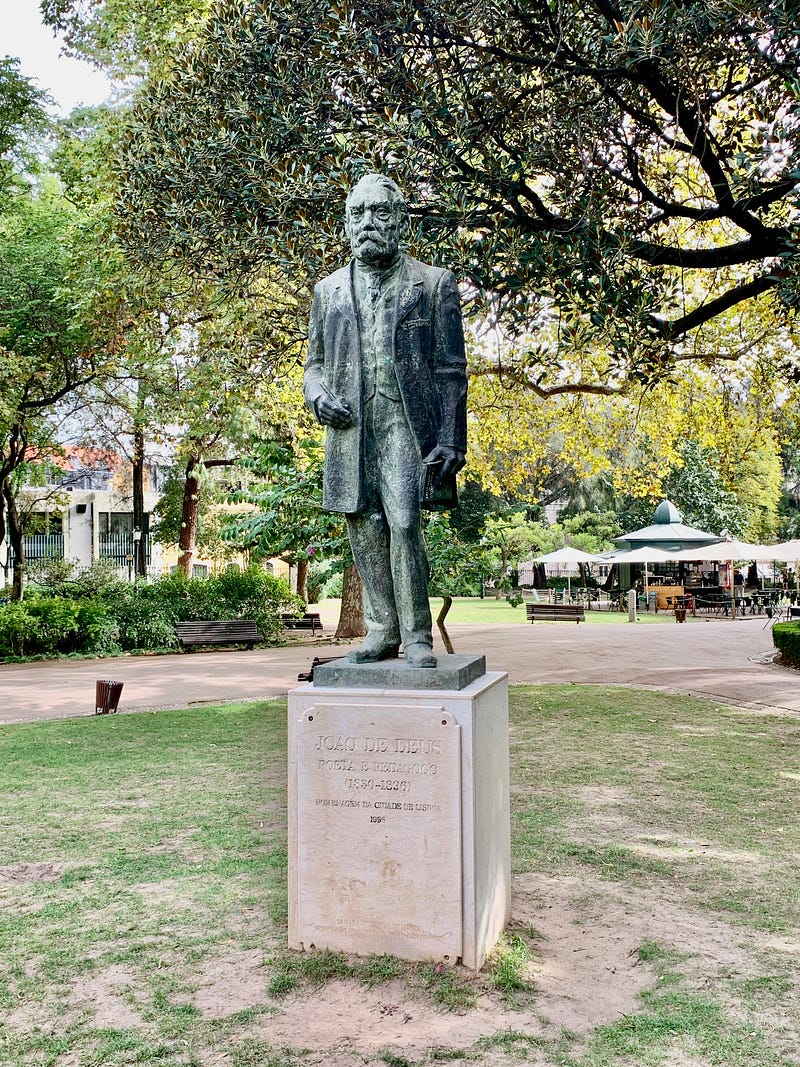
Statue of João de Deus, Photo credit Tim Ward

Wikipedia says this about him: Next to Camões and perhaps Almeida Garrett, no Portuguese poet has been more widely read, more profoundly admired than João de Deus; yet no poet in any country has been more indifferent to public opinion and more deliberately careless of personal fame…

Oh my! He sounds like a man with the heart of a flanêur!

The Digger

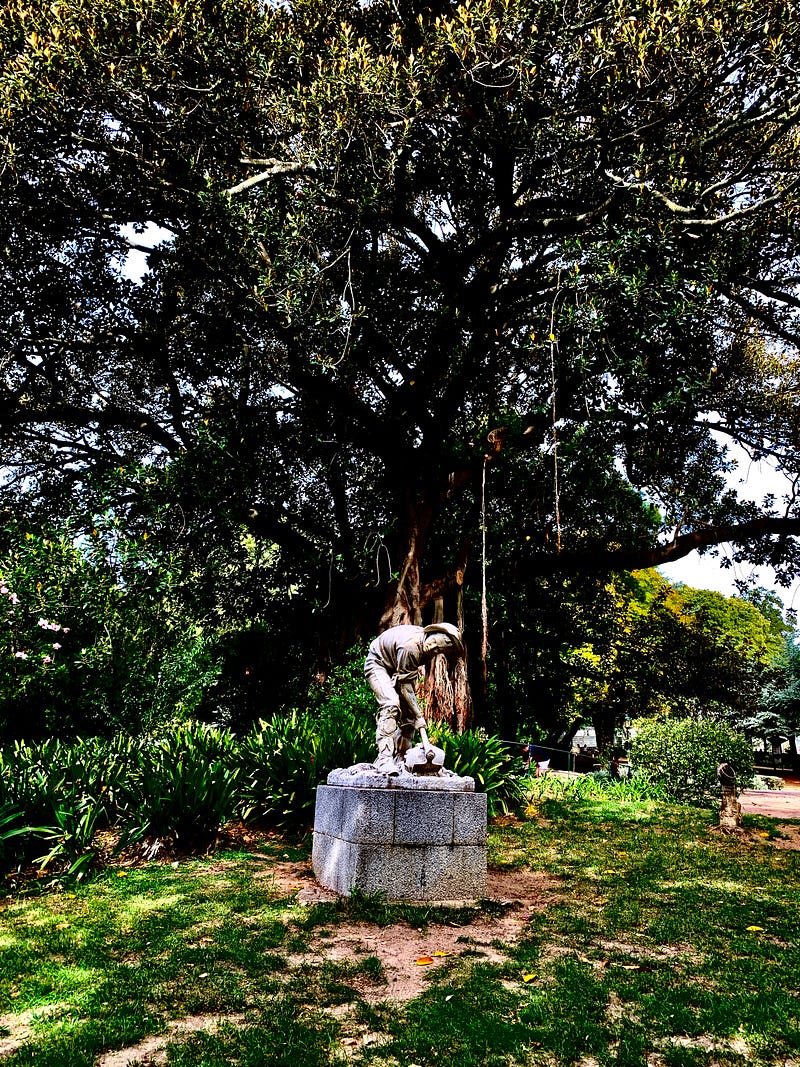
This statue of a farmer tilling the soil with a hoe was erected in 1913 — the first statue added to the garden after the monarchy was abolished and Portugal became a republic in 1910. Framed behind a spreading banyan tree, the sculpture seems a fitting public expression to mark the political transition. Notice how clearly the man’s rough clothing and strong arms are depicted.
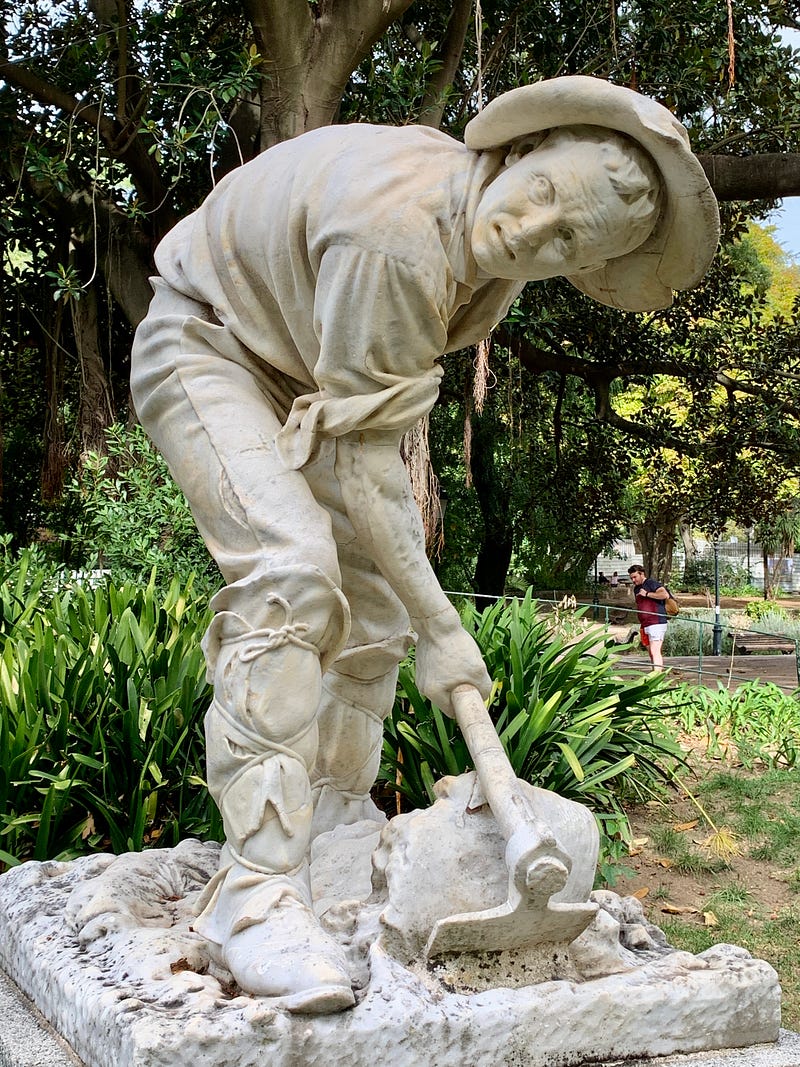
The Digger, Photo credit Tim Ward

But that look in his eyes — it’s not that of a victorious peasant embracing his nation’s freedom, is it? To me, he is looking up anxiously, almost fearfully. Perhaps he symbolizes the entire nation, still working hard just to survive, gazing towards an uncertain future of the 20th Century. Would the eyes of a similar statue created in Portugal in 2022 look much different?

The Awakening, or Laziness

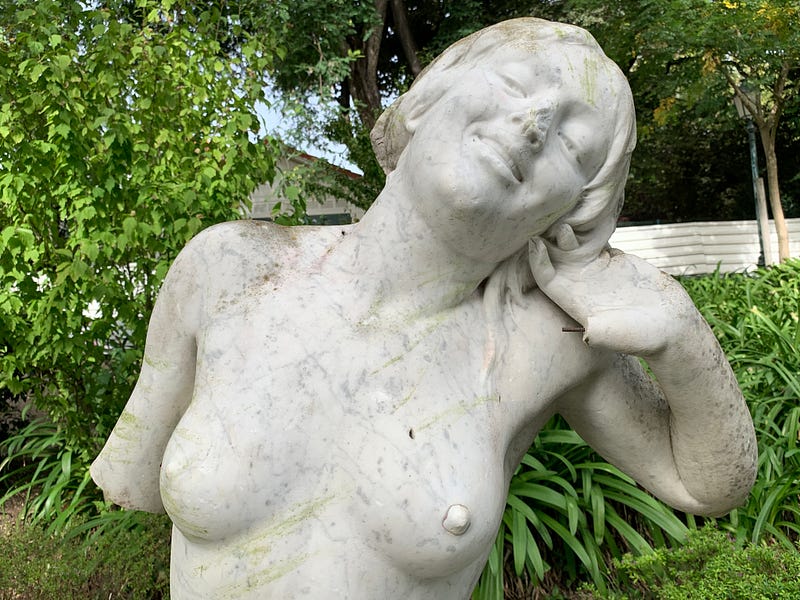
This 1915 statue of a naked young woman arising in the morning is said to be the most popular in the park. It’s easy to see why. From a distance, under an umbrella tree, her white figure is eye-catchingly sensuous.
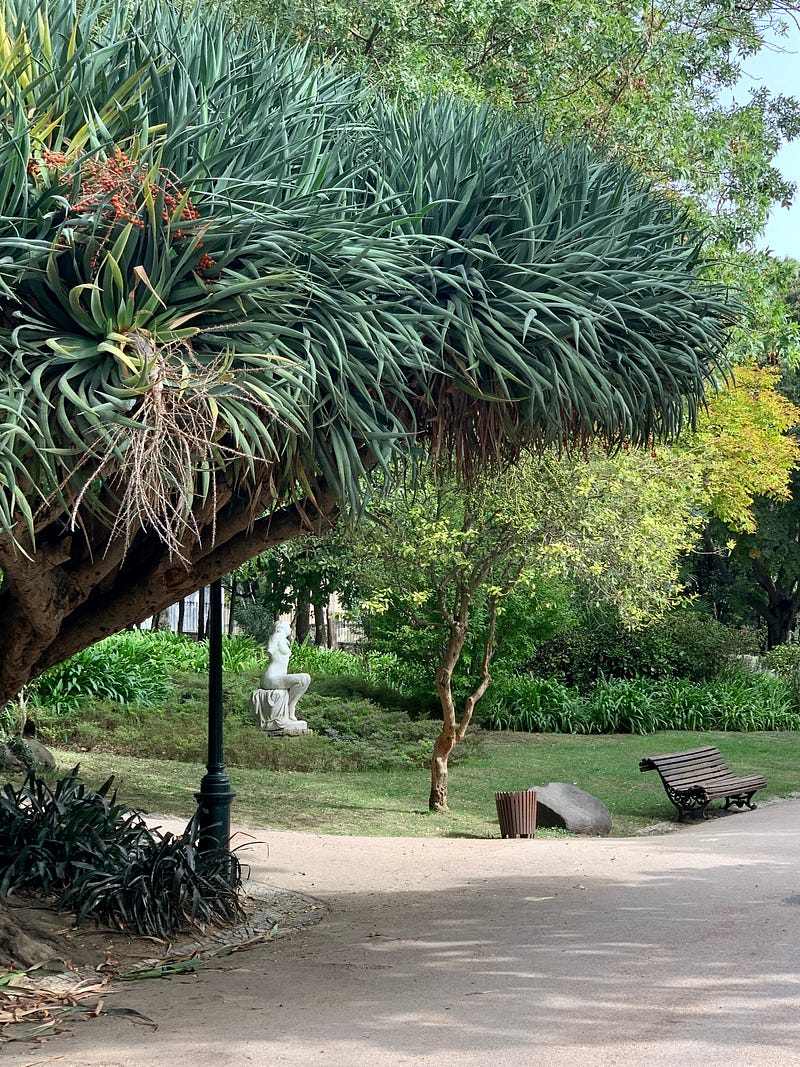
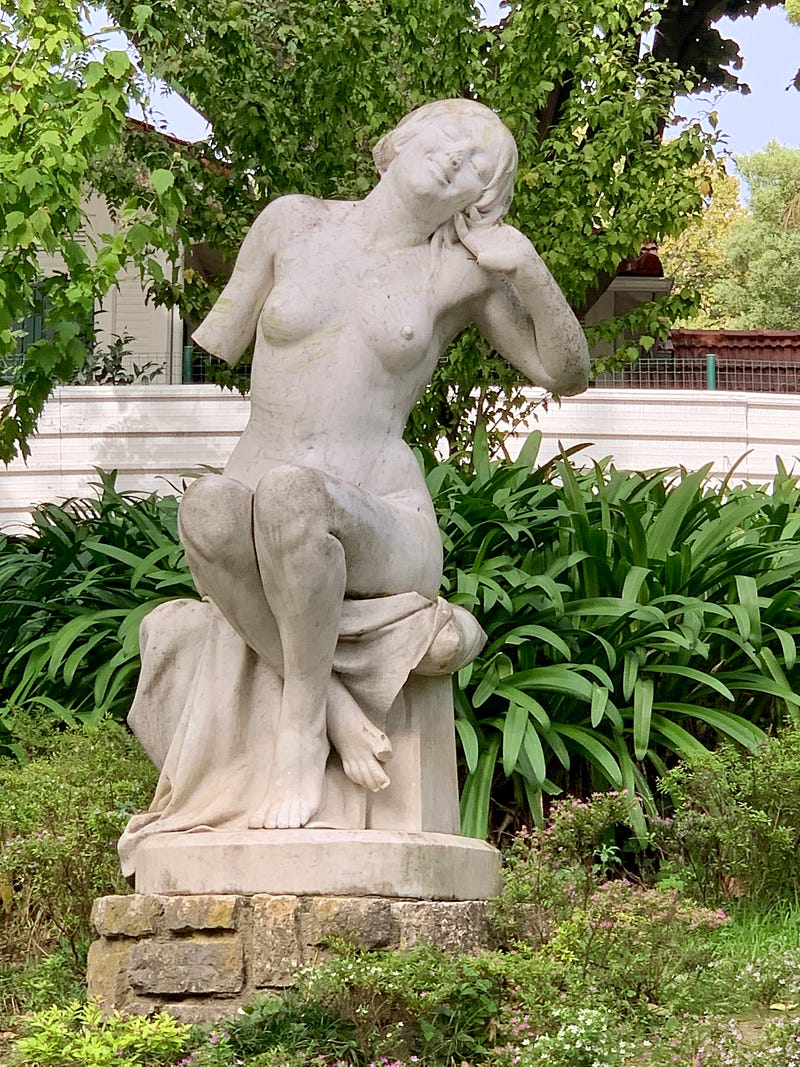
The Awakening, or Laziness. Photo credit Tim Ward

Up close, though, it is the expression on her face that makes her so utterly beguiling — that satisfied, languorous smile, those half-opened eyes! Though one of her arms is missing, the other is clearly in the middle of a stretch. I love the two very different words the woman supposedly embodies: Awakening and Laziness. Is she rising to meet the day, awakening to the possibilities and hopes of her future — much as the young republic was awakening? Or has she already risen too late to do anything productive with her youthful energy? It’s hard not to think about her fellow statue, the Digger, not 50 meters away, who has been toiling away, probably since dawn.

Statue of Antero de Quental

Antero de Quental was a 19th Century realist poet and political philosopher, but his statue is the last edition to the park. It was installed in this private grove of ivy-covered trees in 1951. It makes me laugh to see a “realist” poet dressed in the robes of an ancient Roman! I hope he has a good sense of humor in whatever immortal realm of the poets he resides.
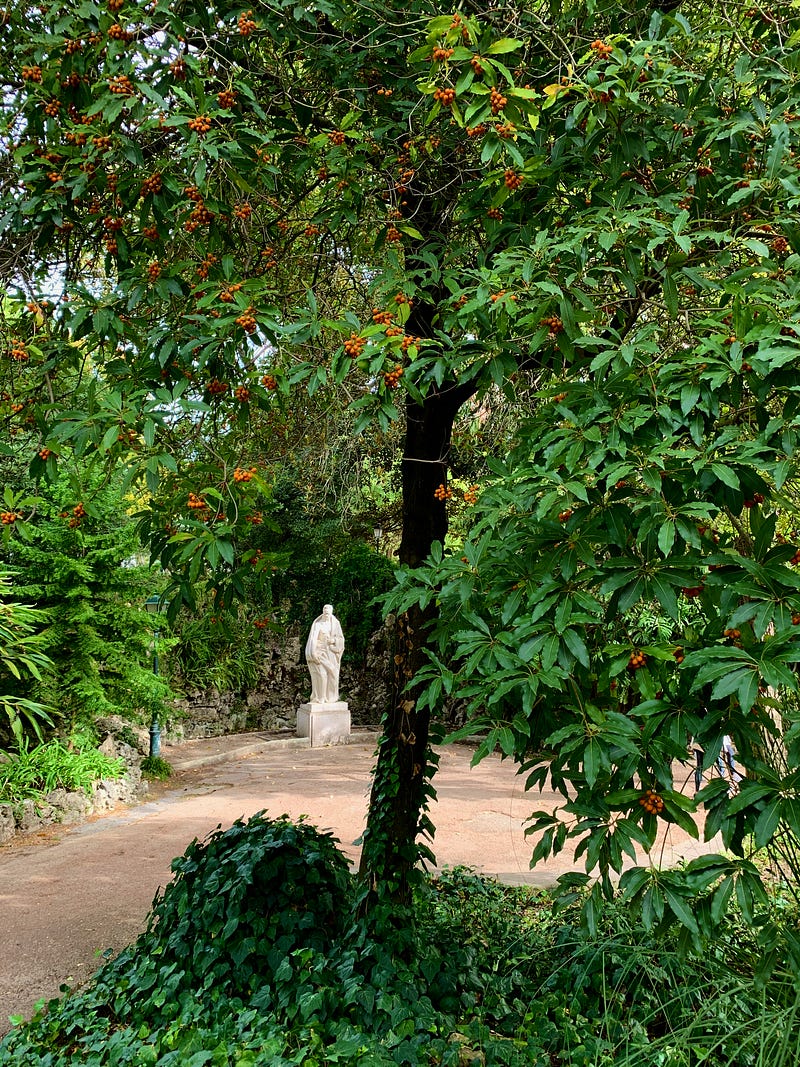
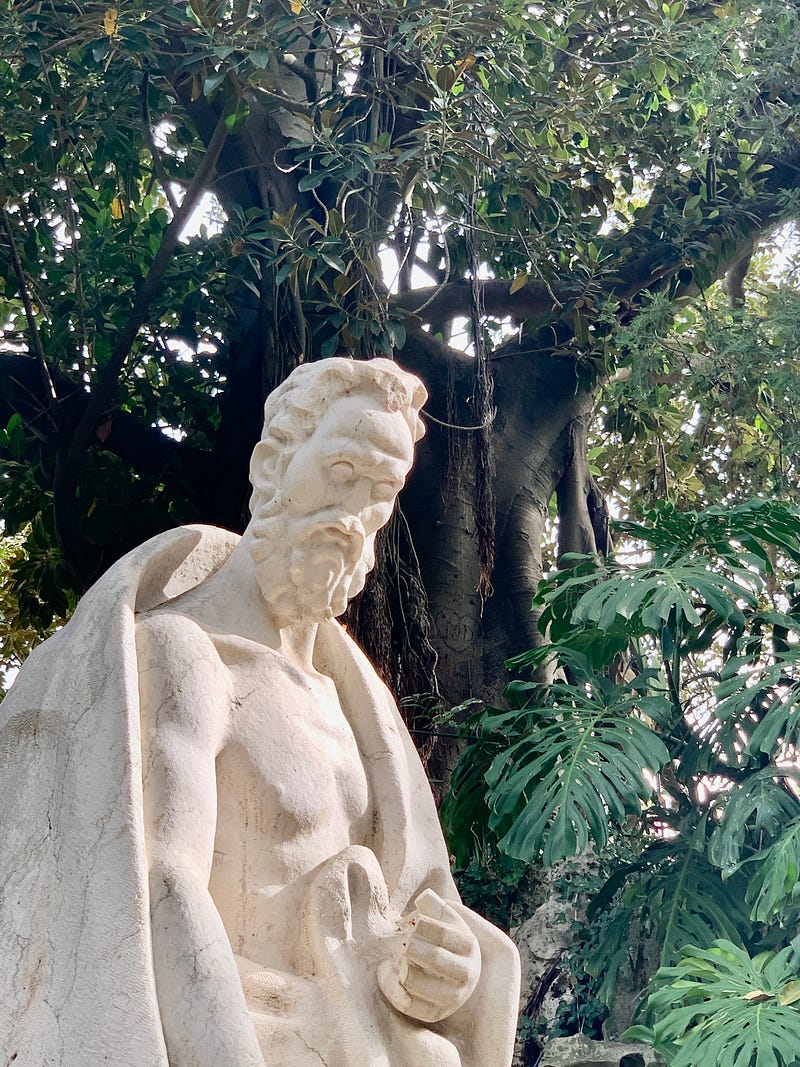
Antero de Quental. Photo credit Tim Ward

As a young poet, de Quental declared the role of poets, in an era of great transformation, was to be messengers of the day’s great ideological questions. He emerged as a socialist, advocate of the proletariat, and eventually an anarchist. To me it’s surprising his defiant-seeming statue was installed in the midst of Portugal’s repressive Salazar dictatorship.

Wikipedia has this to say about the great poet, and the sad ending of his life: Throughout his life, de Quental oscillated between pessimism and depression; afflicted with what might have been bipolar disorder…he committed suicide by two gunshots to the stomach while seated on a bench in a local garden park. He died approximately an hour later. “Of all things, the worst is having been born,” he wrote in a poem.

Allegory (Man with a Dog)

This final statue I encountered reclines at the edge of another little lake in the park, and has an “unknown provenance.” Seen below, shrouded behind palm trees, it features a man in a robe with wild curly hair and a long beard that appears blown back as he leans slightly into an invisible strong wind. His large, powerful hands hold protectively onto his little dog. Its lips form a wide “O” because its mouth is also the spout of a fountain.
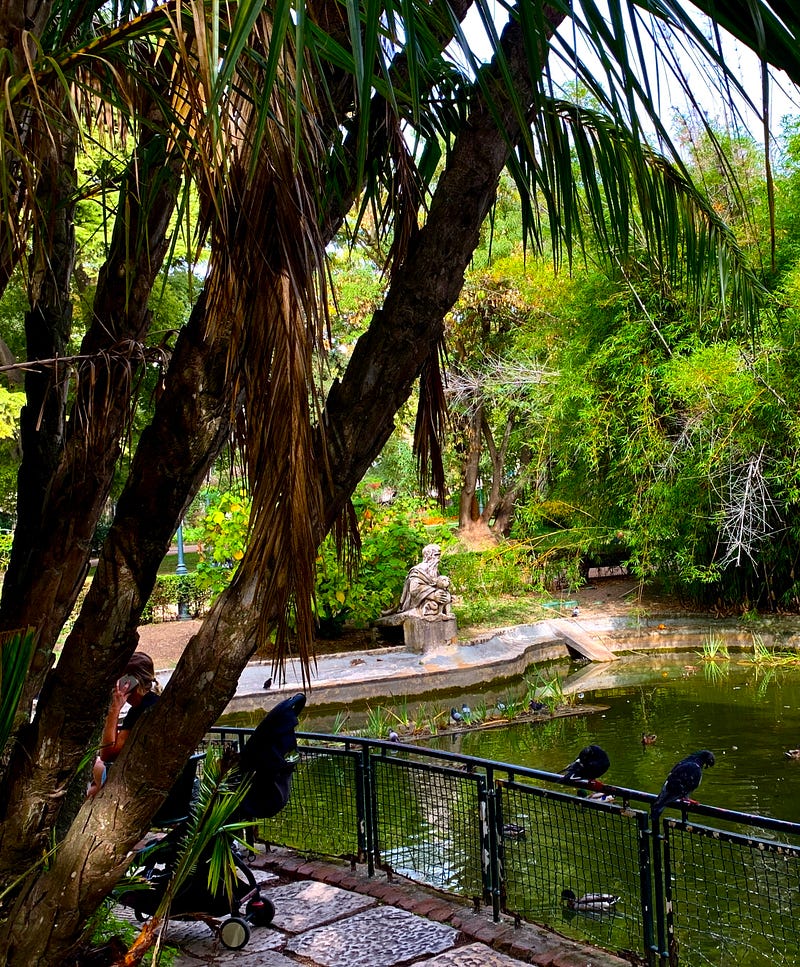
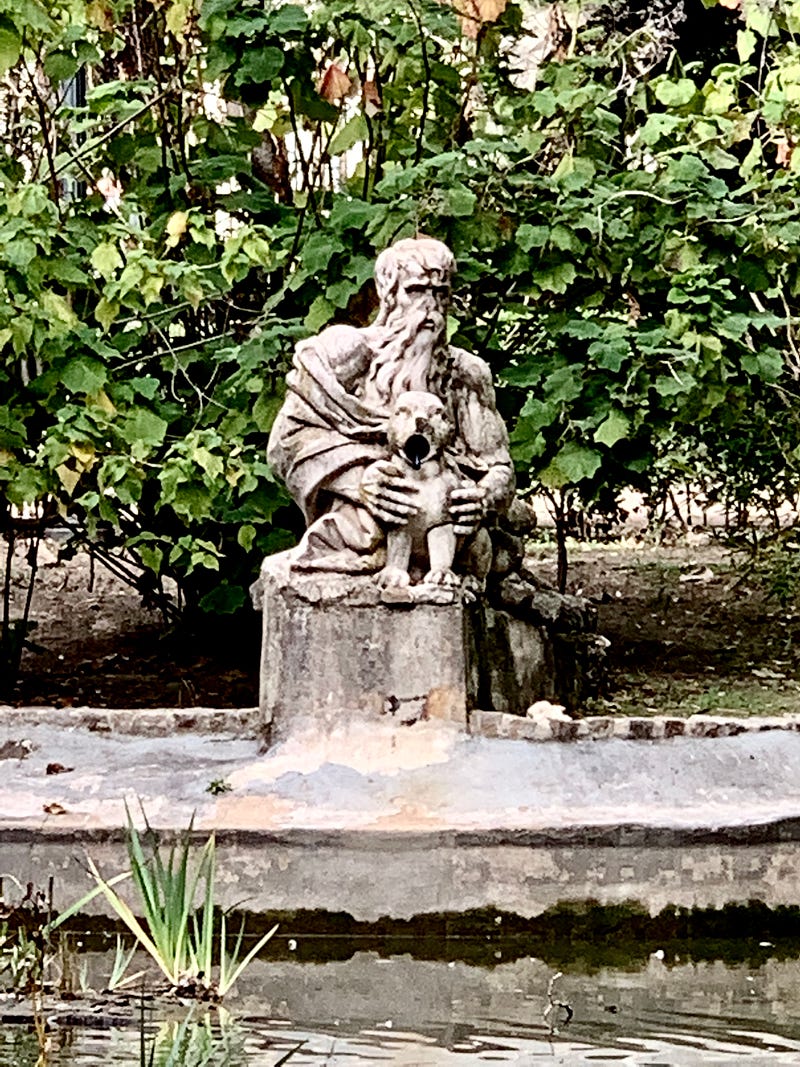
Allegory (Man with a Dog). Photo credit Tim Ward

There is something loveable about this sculpture. I suppose it is the forcefulness of the man juxtaposed with the gentle way he holds his companion. It made me smile and think of all the old men and women I’ve seen in Lisbon, even in Estrela Park, out walking their little dogs.

The future might be wild and uncertain, but we can do the best we can to take care of the ones we love, whether dogs or ducks or a whole nation, even a continent, once again in the midst of turbulent times and perhaps a great transformation.

Portugal
Lisbon
Globetrotter
Flaneur
Travel
Recommended from ReadMedium