
The Most Interesting Thing About Being a Scuba Diving Instructor Happened After I Quit
I thought the best years were behind me, but I was wrong
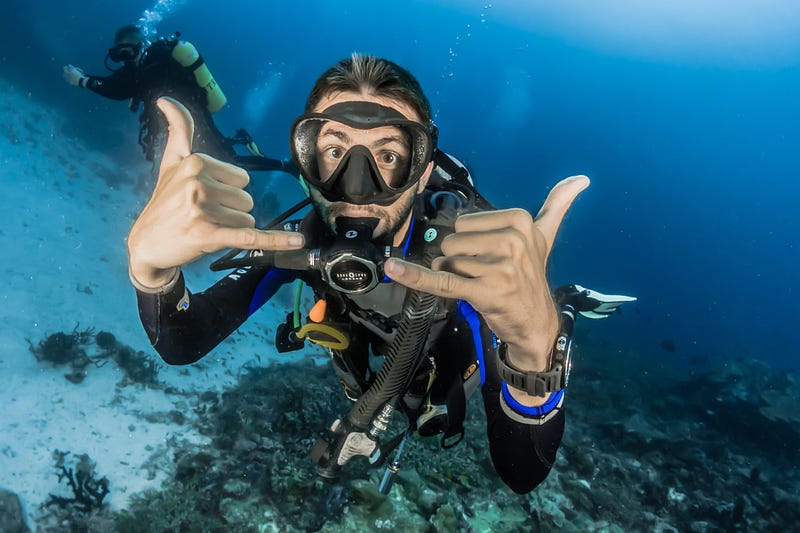
Much of my adult life has been defined by two events — the first time I breathed underwater and the first time I did a breathwork session. This post is about both, although they happened seven years apart.
My First Scuba Diving Experience
I remember it well. I had just signed up for my first course, and after lifting all the heavy equipment onto my back, placing the already foggy mask over my face, and shuffling my way to the edge of the boat, I wondered if I’d made a grave mistake.
There was no turning back at that point, so I took a few quick, panicked breaths before jumping in the water and feeling the first drops of ocean seep through my wetsuit.
Upon surfacing, I made sure to give the “OK” sign, which is expected of every diver who feels safe enough to do so, even though this was far from my truth. The truth was it was 8 am, I was about to explore the Great Barrier Reef for the first time, and I was crapping myself.
As I descended into the deep blue and took my first few breaths underwater, however, I knew my life had changed. There’s something unforgettable about taking a breath in a place that doesn’t exist, especially when it’s among gorgeous coral heads and beautiful sharks.
As magical as that moment was, there was something that kept nagging me: I knew nothing about my breath. I had no idea that my emotional state affected its rhythm, and its rhythm affected my emotional state. All I knew was that I felt tense and unsure in the water and this made my breath short and sharp.
Short and sharp breaths underwater affect both buoyancy control and stress levels so not only was the quality of my experience being affected but so was the length of it. On the same tank of air, for instance, I lasted just 20 minutes while the rest of my group lasted 55.
Apart from feeling embarrassed at being escorted back to the boat 30 minutes before everyone else, I was also confused. Once everyone had resurfaced and was safely back onboard, my instructor comforted me by saying:
“Experienced divers tend to breathe slower, deeper breaths in and out, so their air lasts much longer. Newer divers like you tend to breathe shorter, sharper breaths, so your air runs out much faster.”
Fortunately, I had signed up for another dive 45 minutes later so I could test his theory out. And he was right. As I became more relaxed in the water, my breath slowed down, and I lasted twice as long.
Years later, I learned the significance of this in terms of health, happiness, and the longevity of our lives out the water, too.
Since that awesome day 13 years ago, I have become a scuba diving instructor myself, teaching hundreds of students all over the Caribbean.
One of my favourite things to do was to witness my student’s first breath underwater as it reminded me of my own. Then I did my first breathwork session and everything changed.
My First Breathwork Session
I was in a home I knew well, perched on the edge of a volcano around the beautiful Lake Atitlan in Guatemala and I felt safe to play and explore. So, as the music encouraged me to take deeper and deeper breaths in and out, I watched my lungs fill up with fresh oxygen while everything else tingled and dissolved, including the 20 years of anxiety I had been living with.
It was a bizarre feeling, one that felt like I was simultaneously moving backward in time and forward in space as if I was travelling to a world so familiar yet so foreign; to a place where I was becoming more of myself even though less of “me” was there.
This experience unlocked something deep inside and because it happened through the breath (and the breath breathes close to 20,000 times a day), I knew I could access it over and over again.
That was a very liberating feeling. Ever since then, I have done countless trainings to become the best facilitator I can be for others.
When I left the scuba diving industry behind I genuinely thought the best days were behind me. But then I joined the breathwork community and I realised they had only just begun.
One Thing Has Stayed With Me More Than Anything Else
The thing that has struck me most about this 13-year-long journey is that it didn’t seem to matter which direction I took in life or the language I studied in, the culture it belonged to, or how old each technique was because they each expressed in their own unique way, that slow, deep breathing supports long-term health while short, sharp breathing does not.
This is one of the joys of breathing. It always has consistent outcomes, regardless of whether it’s underwater or on land.
Speed it up, and the heart, brain, and nervous system will all speed up. Slow it down, and they will all slow down. This not only affects stress levels and blood pressure, but it also greatly influences digestion, sleep, the secretion of hormones, and so much more.
Another thing that becomes clear when working with the breath is that it’s the one thing that connects all 8 billion humans together. Roughly half of us will inhale at the same time, and roughly half of us will exhale at the same time. This, for the average person, occurs every 3.3 seconds.
Each one of those breaths, regardless of where they’re breathed in the world or the age, gender, race, status, or health condition of the body who breathes them, will activate all ten systems in the body — skeletal, muscular, nervous, endocrine, cardiovascular, lymphatic, respiratory, digestive, urinary, and reproductive.
For each breath forms the density of bones, teeth, and sheaths of muscle fibre, it repairs, maintains, and regulates organ functionality; it aids digestion; it adds and subtracts weight; it directly communicates with the nervous system; it regulates the body’s temperature, removes toxins, releases hormones and endorphins known to cause stress and relaxation, and balances the body’s pH levels.
It does this breath after breath, from birth until death, every single moment we are alive, and it never ever stops.
Some breaths cause inflammation and fatigue. Others, if sustained long enough, can even change bone structure. What I inadvertently found out while I was scuba diving on the Great Barrier Reef back in 2010 was a truth that underpins the fabric of life. And that is that the quality of life is directly linked to the quality of the breath. But, more importantly, it can be controlled in specific rhythms to produce outcomes that are beneficial to health.
“Breath is a tool with which to explore the truth about oneself” — S.N. Goenka
Conclusions and Takeaways
Prior to my love of scuba diving and breathwork, breathing played an important role in my life because my older brother had asthma. Watching his breath get weaker and weaker while his airways closed up was a scary thing in childhood, especially because it all seemed to happen so fast. One minute, we were playing football in the park, and the next minute, he was scrambling for his inhaler. The real panic set in when he couldn’t find it.
I have also experienced this urgency because I have lived with anxiety for 20+ years. During some of the more severe attacks, my throat would squeeze up, and I would find it hard to breathe. This, among other things, taught me how precious life can be and how wretched it can become when the breath gets taken away.
So, to close, I’d like to leave you with something Giovanni Papini once said because I concur: “Breathing is the greatest pleasure in life”
I so wish we could explore the ocean together but, unfortunately, that’s not possible. What I can do is share my other love of breathwork with you so we can breathe the same breaths.
Here is one of my all-time favourite breathing exercises that slows the breath down and harmonises all the systems inside.
Box Breathing (Sama Vritti)
Box breathing is great for building emotional resilience, relieving stress, and creating a calm inner state. It has gained tremendous popularity in recent years ever since the Navy SEALs revealed it’s what they use to reduce stress in intense situations.
Putting it into practice:
- Breathe in deeply and smoothly through your nose for 4 seconds
- Hold your breath at the top for 4 seconds
- Breathe out softly and calmly through your nose for 4 seconds
- Hold your breath at the bottom for 4 seconds
- This is one complete cycle
- Continue for 25–50 breaths or 5–10 minutes
- To deepen the experience, increase the number of seconds you breathe in and out and hold for (5 or 6 seconds, for example) if it feels right to do so
Here is another one that I love to do while observing marine in the ocean. It also activates the vagus nerve, so it’s great for relieving stress.
Create “Soft” Eyes
Our eyes, like the breath, often reflect our inner state of being. Sharp, dilated, focused eyes, for example, reveal a heightened sense of alertness. Soft, open eyes, on the other hand, reflect a sense of ease and relaxation. So, by creating “soft eyes,” the nervous system relaxes.
This practice is great for relieving stress, reducing anxiety, and relaxing the body. It’s one of the ways wild animals can be hunted one minute and graze upon the grass as if nothing has happened the next.
Putting it into practice:
- Sit comfortably and allow your body to relax
- Look straight ahead and land your gaze on an object in the distance
- Begin to connect to your peripheral vision while continuing to look straight ahead
- Now, expand your awareness to the spaces up, down, and to the side without moving your eyes.
- Allow your focus to be on ‘all things’ as your eyes begin to ‘soften.’
- Stay connected to your breath
- Remain here for as long as it feels good to do so


