
The Most Important Question To Ask When Trying To Improve Anything
The chain is strongest at its weakest link.

What’s the one key to success?
Hard work? Patience? Grit? Network? Consistency? Showing up every day?
Your answer is most likely different to mine, so, what’s the lesson in that?
There’s no one key to success — in anything.
Whatever the objective you’re trying to achieve, it hardly ever happens that one and only one factor can predict whether you’ll be successful or not.
Although, the limitation of our minds would prefer to hear, “do this one thing and you will be successful”, the reality of the world we live in is that usually many “causes” come together to produce the “effect” or objective you seek.
Take, for example, how do you build a successful business? Which single factor guarantees business success? None. Great marketing alone does not a great business make. A great product alone does not guarantee business success. Many factors must come together — great product, great marketing, sales process, a price point that ensures profit but one the customer is willing to pay, etc — to make a successful business.
Another example, it’s clear that the farmer’s objective is to get a bumper harvest from the grains he’s buried in the soil. But to achieve this objective, a whole lot of things must come together: a good supply of sunlight, air, water, and nutrients like nitrogen, phosphorus, potassium, soil with good microbial activity, weed and pest control etc.
None of the above-listed factors would guarantee success on their own. Great supply of sunlight without enough water or nutrient will still lead to suboptimal harvest. Whereas, all of the factors working together in tandem make success — a bumper harvest— more likely.
You could make an example of almost anything where an objective is defined and you’ll see that it’s always an interplay of various factors that produce success or improvement — none of which can guarantee success on their own.
You need a number of things to work together to guarantee success. Success in anything is like a long chain with a whole lot of links (factors) that must come together to produce the result you seek.
The power of this understanding is that if you have an objective but something is not working as you expect it to, or as it should, or you’re not getting the result you want, asking just one question will almost certainly put you back on track to real, tangible progress.
Whenever you want to improve anything, the most important question you can ask is: What’s the weakest link in the chain? What’s the resource that’s most scare in relation to need?
This is the idea presented by the famous “Liebig’s Law” or the “Law of the Minimum”, a principle developed in agricultural science by Carl Sprengel in 1840 and later popularized by Justus von Leibig.
Liebig’s law states that growth is dictated not by total resources available, but by the scarcest resources (limiting factor).
Dr Dobenecks used the image of a barrel — often called “Liebig’s barrel” — to explain this law. Just as the capacity of a barrel with staves of unequal length is limited by the shortest stave, so also, success in anything is limited by the scarest needed resource.
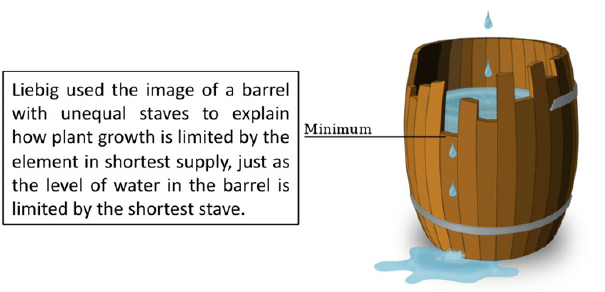
Take the farming example, it doesn’t matter how much nitrogen is available to the grain if what’s short is phosphorus. It does no good to pour on more phosphorus if the problem is low potassium.
Bread will not rise without yeast, no matter how much flour it has. Children will not thrive without protein, no matter how much carbohydrates they eat. A business can’t thrive without customers no matter how great a product it has.
What Does This Mean For Your Improvement Efforts?
When you’re trying to achieve an objective, or you’re trying to improve anything, especially without much success, the most important question you can ask is:
Where is the weakest link in my chain? What’s the most limiting factor to improvement?
Here’s why that’s important: focusing your effort anywhere else but the weakest link would yield suboptimal result at best or frustration at worst.
For instance, if you build a great product that no one is buying it because no one knows about it, there’s no point trying to improve the quality. Put more emphasis instead on the marketing — getting it into the hands of more people. In an increasingly noisy world, if you build it, they won’t come. You have to go find where they are and get it to them!
It sounds like a no-brainer but we often fall into this trap of seeking improvement by strengthening an already strong link while neglecting the weak link that would easily give more improvement per effort expended.
Many times, we do this because we don’t feel comfortable giving what’s it takes to strengthen the weak link, so, we, instead, choose to go on a journey of self-deception.
For instance, let’s say I am a really good writer, but a lousy marketer, I will almost certainly want to focus on writing (which I do well), while neglecting marketing my work (which I do poorly). And this makes sense.
But to the extent to which marketing is critical to my professional writing success, how much success I’ll enjoy will almost certainly be limited by my ability to put my supposedly spellbinding prose in front of readers.
When your painstaking effort tends to yield little to no result, the simple question to ask is, what’s the weakest link in my chain and put immediate focus on that. No other activity will give you a better bang for your buck.