
“The Most Important Achievement In AI — Ever” according to Forbes
How AI is revolutionizing medical research! Not sci-fi anymore: AI is helping researchers find more efficient & cheaper drugs.
This achievement marks a significant milestone in the field of drug discovery, highlighting the potential of AI to accelerate the development of new treatments for diseases!
Medical research is an ever-evolving field, constantly seeking new ways to improve the health and well-being of people around the world.
With the advent of Artificial Intelligence (AI), it has taken a giant leap forward. Thus, AI has emerged as a powerful tool for medical researchers, providing them with unprecedented access to vast amounts of data and enabling them to analyze it in ways that were once impossible.
In this blog post, we’ll revisit one the most important breakthroughs in AI, reshaping medical research, and we’ll highlight how it is already successful accelerating drug discovery: the story of automatic drug discovery made possible thanks to AI & AlphaFold!
But first, If you like this topic, please consider supporting this effort
🔔 clap & follow 🔔
Automatic Drug Discovery with AlphaFold
From Protein 3D structure prediction, to drug discovery
“In 1972, in his acceptance speech for the Nobel Prize in Chemistry, Christian Anfinsen made a historic prediction: it should in principle be possible to determine a protein’s three-dimensional shape based solely on the one-dimensional string of molecules that comprise it.” (source)
Why is it important? Well, protein 3D structure is crucially important because it directly relates to protein functions.
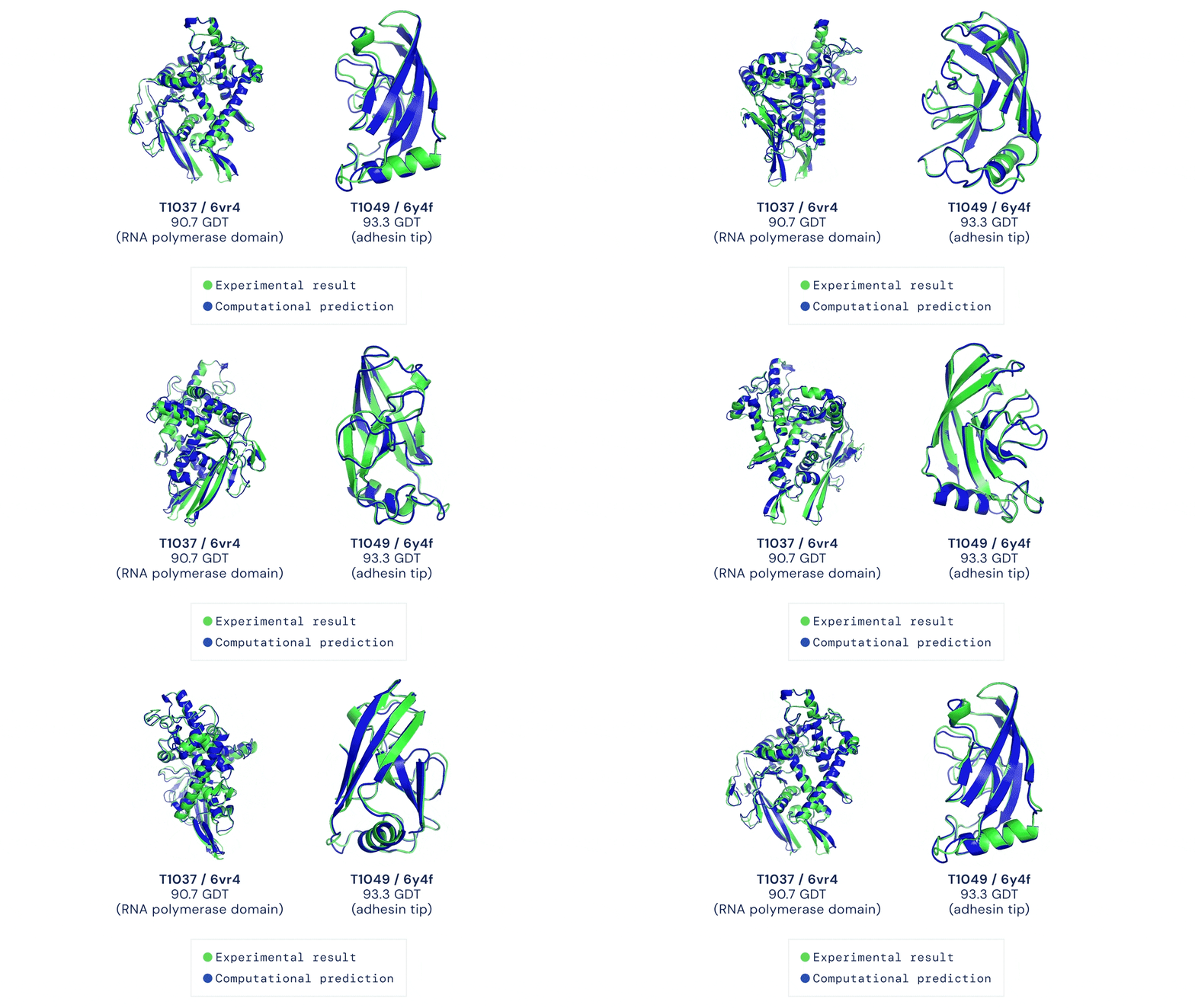
The specific shape that a protein takes enables it to carry out its biological role, such as catalyzing chemical reactions, transmitting signals, or forming structural components of cells and tissues.
For example,
- The shape of an enzyme determines which molecules it can interact with and how it catalyzes a particular reaction.
- Antibodies, which are proteins that recognize and bind to specific molecules or pathogens, have a highly specific 3D shape that enables them to bind to their targets with incredible precision.
As a natural consequence, understanding protein function, knowing the 3D structure of a protein, opens the way for automatic drug discovery and design! As a matter of fact, many drugs work by binding to specific proteins and altering their function, and designing drugs that fit perfectly into a protein’s active site requires knowledge of the protein’s 3D structure.
And this isn’t speculation or AI hype, this is a reality today!
Can we predict the 3D structure of a protein?
Short answer: yes, thanks to AlphaFold!
Christian Anfinsen’ historic prediction remained an open challenges for decades … until November 2020 and AlphaFold.
What is AlphaFold: it’s an AI system developed by DeepMind. It uses a deep neural network to predict the three-dimensional structure of a protein from its amino acid sequence. In 2020, DeepMind announced that AlphaFold made significant breakthroughs in predicting protein structures and was able to accurately predict the structures of previously unknown proteins.
In Deepmind’s own words:
- “According to Professor Moult, a score of around 90 GDT is informally considered to be competitive with results obtained from experimental methods.”
- “In the results from the 14th CASP assessment, released today, our latest AlphaFold system achieves a median score of 92.4 GDT overall across all targets. This means that our predictions have an average error (RMSD) of approximately 1.6 Angstroms, which is comparable to the width of an atom (or 0.1 of a nanometer).”
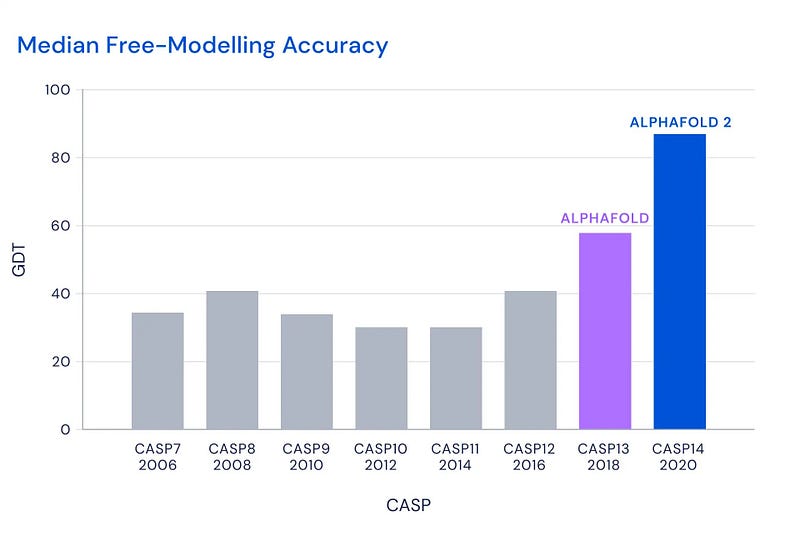
AlphaFold’s breakthrough opens the way to fast compound screening & drug discovery!
No wonder then that Forbes deems AlphaFold as “The Most Important Achievement In AI — Ever”!
You can learn more about DeepMind’s mission and recent achievements (e.g., nuclear fusion, medicine, optimal compute, etc.) in our previous post:
In 2023, First successful trials led by AlphaFold empowered medical researchers
What’s new since Nov 2020 and AlphaFold’s breakthrough?
Well two key dates to keep in mind:
- July 2022: OpenAI releases a database with the predicted 3D structure of 200 million proteins!! “we’re now releasing predicted structures for nearly all catalogued proteins known to science, which will expand the AlphaFold DB by over 200x — from nearly 1 million structures to over 200 million structures — with the potential to dramatically increase our understanding of biology.” Simply put in the journal Nature: “covering almost every known protein on the planet”.
- Jan 2023: AlphaFold is leveraged to accelerate drug discovery (source): “We successfully applied AlphaFold to our end-to-end AI-powered drug discovery engines, including a biocomputational platform PandaOmics and a generative chemistry platform Chemistry42. A novel hit molecule against a novel target without an experimental structure was identified, starting from target selection towards hit identification” in less than 30 days!
This achievement marks a significant milestone in the field of drug discovery, highlighting the potential of AI to accelerate the development of new treatments for diseases!
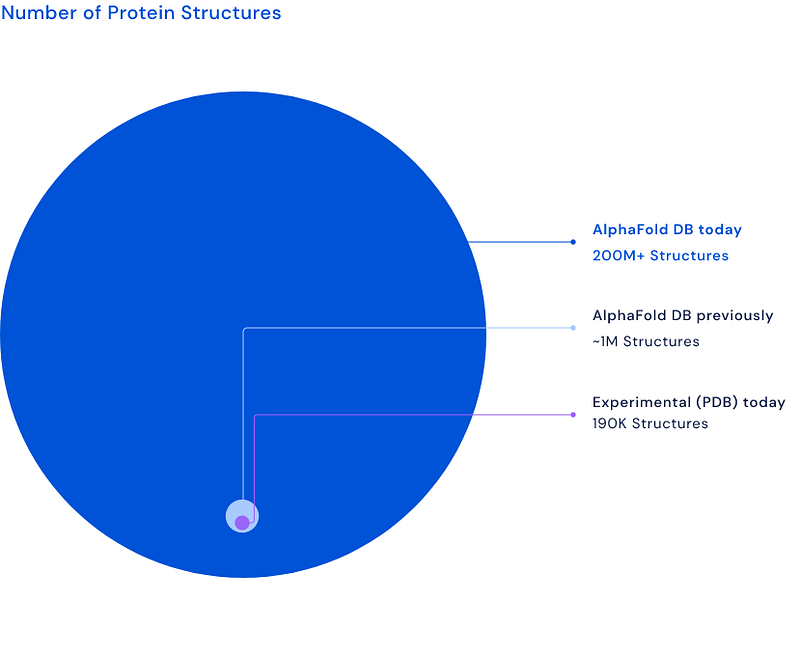
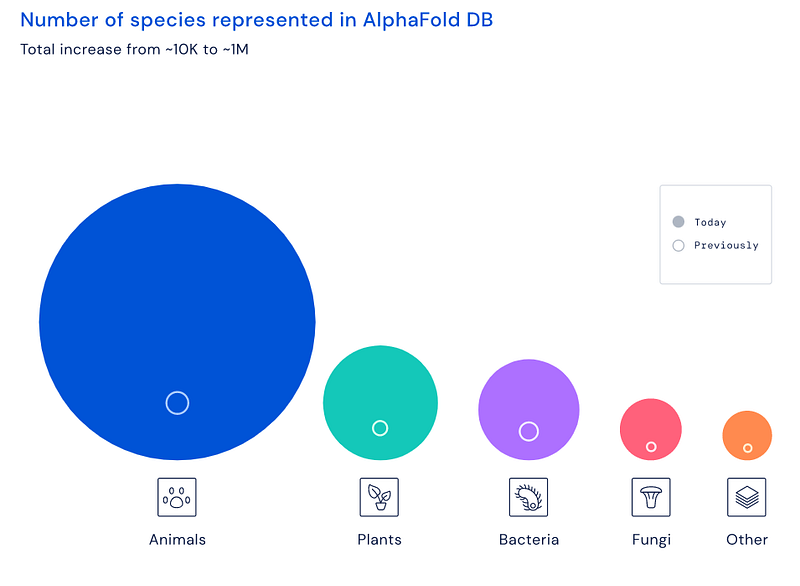
Thus, in just two years, the field has made enormous strides with the help of AlphaFold. Protein folding went from an open challenge before Nov 2020, to a solved problem fueling new, faster and cheaper, drug discovery pipeline!
An this is only the beginning! What a time to be alive!
Oh you’re still here! If you enjoyed this blog post, please consider supporting this effort: 🔔 clap & follow 🔔
Conclusion, this is only the beginning of a new era!
It is incredible to consider the pace of progress in the field of medical research since the breakthrough of AlphaFold in November 2020. Prior to the development of AlphaFold, predicting a protein’s three-dimensional structure from its amino acid sequence remained an open challenge for decades. The traditional experimental methods used to determine protein structures are time-consuming and expensive, limiting the pace of progress in drug discovery.
However, in just two years, the field has made enormous strides with the help of AlphaFold. In July 2022, OpenAI released a database with the predicted 3D structure of 200 million proteins, covering almost every known protein on the planet. This unprecedented access to vast amounts of data enables medical researchers to analyze protein structures in ways that were once impossible.
In January 2023, AlphaFold was successfully applied to identify a hit molecule against a novel target in less than 30 days. This achievement marks a significant milestone in the field of drug discovery, highlighting the potential of AI to accelerate the development of new treatments for diseases.
The pace of progress in medical research since the breakthrough of AlphaFold is truly remarkable. It is a testament to the power of AI and the dedication of researchers in the field. As we continue to push the boundaries of what is possible, it is exciting to consider the potential for future discoveries and the impact they will have on human health and well-being.


