
The Most Effective Way To Learn New Information
Why Active Recall is the Best Technique to Retrieve Information

We all have heard the advice from productivity gurus, that we are all “Lifelong Learners” but how do we learn new information? And how do we recall what we learn?
Whether its a news channel, book, Medium article, new skill or a social media post, we are bombarded with new information on a daily basis. Therefore, we are learning new information constantly. This makes it difficult to remember important information that we need, for example trying to remember facts for an exam.
As a university student, I remember spending late nights trying to cram as much information into my brain as possible by writing notes repeatedly. However, despite my efforts, my grades were average.
It wasn’t until I started using active recall via flashcards on Quizlet that my grades started to increase.
What is Active Recall?
Active recall is the act of retrieving information from your brain.
Using active recall allows the brain to consolidate information into your long term memory by utilising the psychological testing effect.
The psychological testing effect is the finding that long memory retrieval is better when a part of the learning period is used to recall information directly from the brain.
The retrieval of information is a form of practice and the more consistently you recall new information, the stronger the connections are made in the brain. This slows the rate of forgetting the information over time.
Does it Actually Work?
There have been many psychological studies that show the effectiveness of active recall.
Retention Study
A 1939 study by scholar, Herbert F. Spitzer in The Journal of Educational Psychology explored the effect of active recall on the retention of information.
Method
Students were told that they were participating in a learning experiment where they had to remember information in factual articles. In the first group of students, after studying the articles, they had to take a practice test directly after they read the articles. They then took more practice tests within a day and week time delay.
In the second group, students were to continue their normal study routine where they did not do a practice test after reading the factual articles. They were later tested on the information with a day and week time delay from when they first read the articles.
Results
It was found that students in the first group, who had taken a practice test after reading the factual articles performed better than the second group who continued with their normal study routine.
In other words, the first group of students who had actively recalled the information by doing the practice test, retained the information better than the second group who did not.
Practice Retrieval Study
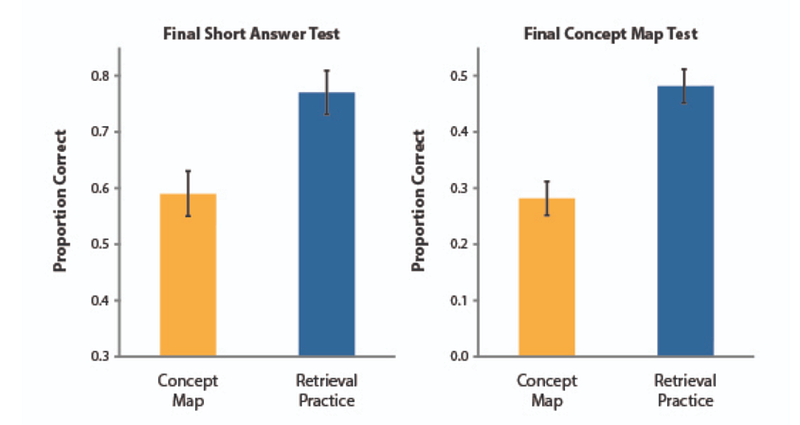
A 2011 study by psychology professor, Jeffery Karpicke in the American Psychological Association investigated the effect of active recall versus concept mapping.
Method
In an experiment, students had to study science topics from a textbook. They were split into two groups. In the first retrieval practice condition, students read the textbook and had to write everything they remembered from the science topics.
In the second condition, students made concept maps while they were reading the textbook. Both groups spent the same amount of time in the two conditions; the retrieval practice condition and the concept map condition.
Results
The students were given two final assessments, either short answer questions which tested their understanding of concepts or the concept map test which tested their integration of concepts. It was found that in both assessments, the students who used retrieval practice outperformed those students who used concepts maps.
How to Use Active Recall
Feynam Technique
“If you can’t explain it to a six year old, you don’t understand it”— Albert Einstein
Take a piece of paper and write about what you have learnt. Try to write in the most cohesive and simple terms as if you were going to explain it to a six year old. This will test your understanding about the topic when you can teach it to someone who has no idea about the information.
Bottom Line: Teach someone else.
Flashcards
There are many digital flashcards that you can use and make online, such as Anki and Quizlet.
Flashcards enable you to actively recall the information so you can check if your answers are correct. It also allows you to identify gaps in your knowledge so you can review those topics again.
Bottom Line: Create and use flashcards online or handwritten.
Practice Testing
Use past exams and quizzes to test your understanding about the information.
This helps you to consolidate the information into memory. This assists the brain in organising the concepts into clusters which makes it easier to recall in the future. It also familiarises you with the information in a testing environment to reduce test anxiety.
Bottom Line: Do practice tests in exam conditions.
Conclusion
There have been many psychological studies that show how effective active recall is to recall new information. This technique has been studied since the start of WW2 with Spitzer’s experiment in 1939 and has consistently been a proven method to learn today.
How to Use Active Recall:
- Feynam Technique
- Flashcards
- Practice Tests


