
The Most Effective Simple Tool for Creating a Daily Writing Habit
Meet FRED.

Everyone has their guilty pleasures. Some people watch bad reality television. Some people read trashy novels. Some people eat expensive chocolate.
Me? I get excited about simple tools.
I’m aware of how boring that makes me seem. But I can’t help it! It all stems from my deeply-rooted right-brainedness. I’m inherently disorganized by nature. And I’m easily distracted by ideas.
AKA I have a massive case of shiny new object syndrome.
If I don’t have tools to help me manage those things, I can’t get anything done. I wind up with a ton of great starts and exactly zero finishes. Or I never get out of the planning phase at all.
So, when I figure out something that’s both elegantly simple and super effective — yeah. That’s big fun.
That’s how FRED came to be my absolute favorite, most effective simple writing tool for creating a daily writing habit.
Meet FRED
FRED stands for the Folder for Reaching the End of my Draft. Clever, right?
He’s like my writing butler and the best non-human accountability partner, ever. FRED keeps me on track for my writing goals. He rewards me when I’m doing a good job. He’s a visual reminder that when I’m writing, I’m doing real work.
That’s a lot, when you consider that all FRED really consists of is a simple monthly calendar, a page for keeping a basic work log, and a manila folder.
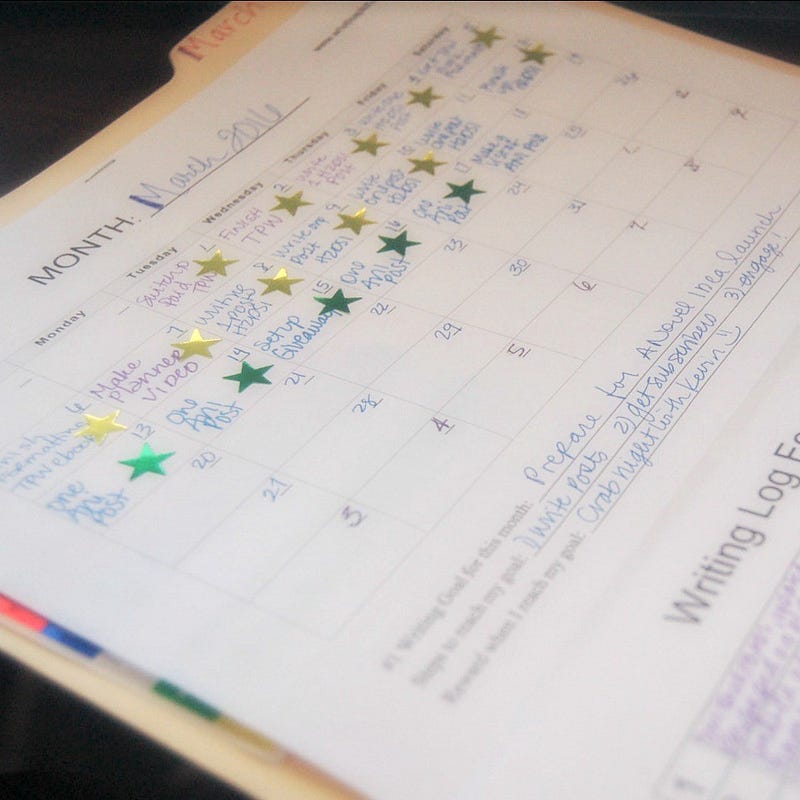
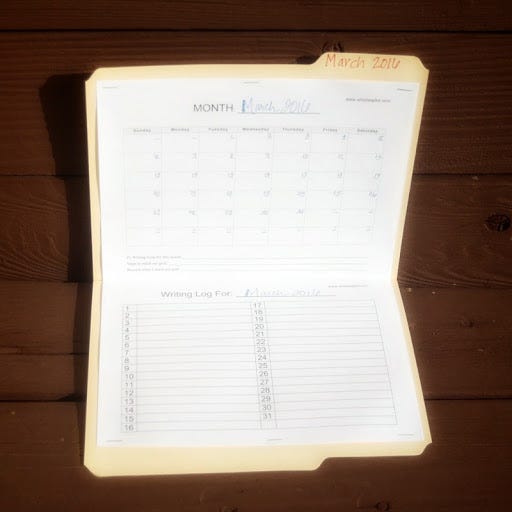
Here’s how FRED works:
- You make a very small goal — my go-to is 10 minutes of writing on project every day.
- Every day that you meet your goal, you give yourself a star sticker on your calendar.
- You can keep your word count on your calendar, too, or make some other small note.
- On the log, just keep a running daily note of your writing work.
- Take notes on the outside of the folder, if you want to.
That’s it. FRED is deceptively powerful, which is what makes him a great simple tool. There’s magic in maintaining a streak and in seeing your work laid out in front of you.
Tiny Goals
Tiny goals are just that — very, very small. I mean, ridiculously small.
Your FRED goal should be so small that it’s easier to just do the damn thing than it is to skip it. For me, that’s been ten minutes of writing a day for years. For you it might be something smaller or maybe slightly larger.
But keep this in mind: If you find yourself skipping your goal at all, then it’s too big.
Beware the Stretch Goal
Here’s something I see people do to themselves sometimes: They make their tiny goal and then they say something to themselves like but really, I’m going to write 1000 words a day.
That’s not how this works.
Stretch goals are fine and all. The magic behind FRED and tiny goals is that you’re unlikely to only ever write for such a small amount of time. It’s the boost that gets you over the hump between not-writing and writing. Once you get started, you’re likely to keep going if you have time and it feels good.
But you get full, 100 percent credit for reaching your tiny goal. I mean that. This is not a preliminary goal. This is not a yeah-but goal.
Your tiny goal is important. Just trust me on this. Use FRED to make sure you’re reaching it every day and see what happens after a month or two.
The Power of Keeping a Log
I love my work log. It’s like my captain’s log — the thing that keeps move moving through the galaxy toward my goals.
This isn’t a diary. I don’t pontificate on my work. I don’t write about it makes me feel. I just log the work I do every day. As a full-time writer, I need more than what I can fit on FRED, so I keep a notebook as well.
I don’t always do a great job of keeping my log every single day. As you can see in the photo below, I skipped almost a week this month. All I can tell you is that I’m happier and more productive when I don’t skip. It’s not a coincidence, I think, that last week was more stressful than is usual for me.
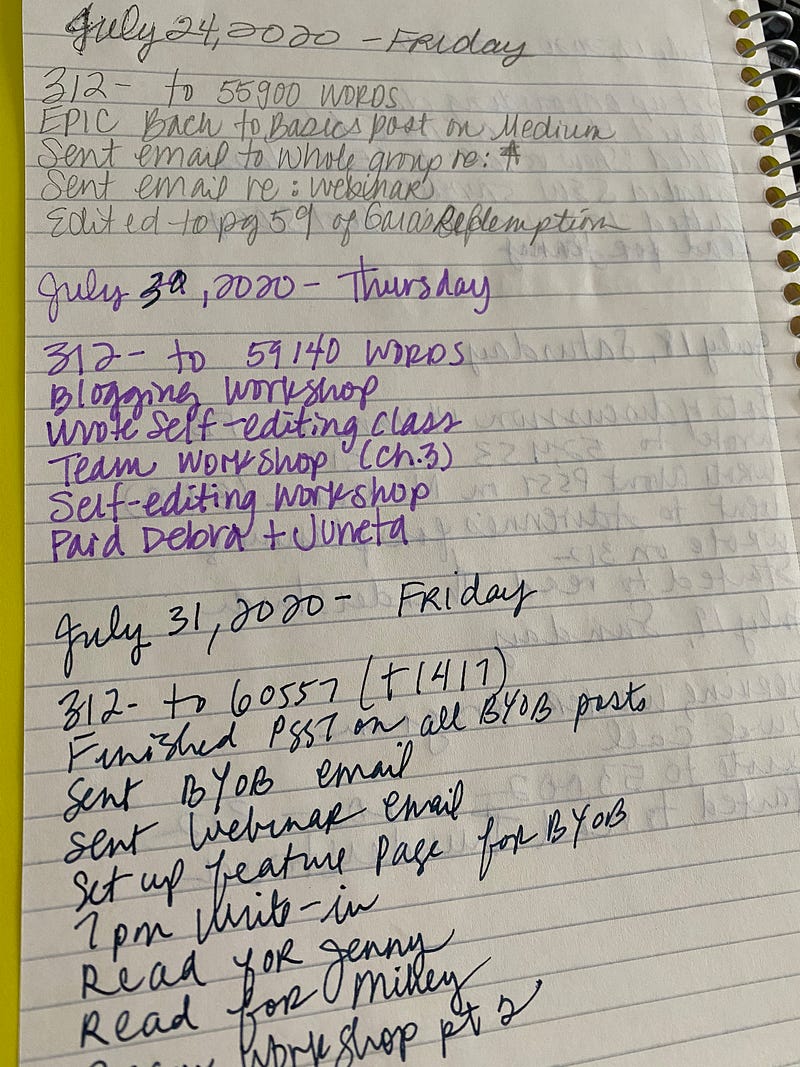
On my FRED, I just keep a log of my actual work-in-progress. My goal is to write on that particular story for 10 minutes a day. I get a star if I do and I log the writing.
If you’re a newer writer or you’re working on fewer projects than I am, you might be able to just use your FRED.
Don’t Undermine Yourself
There a few ways that I’ve seen (in myself and in my students) FRED and tiny goals go a little bit off-kilter. I hope these tips will help you stay on track.
Using Your Log Like a To-Do List
Your log is a list of things done, not things to do. To-do lists are awesome, too. FRED just isn’t one. Don’t log anything you haven’t already done.
Too Many Irons in the Fire
FRED works best if you use him for a single project at a time. That doesn’t mean you don’t have any other goals. It just means that you’re making one goal for the month and sticking with it.
FRED is all about how work toward a goal builds up. That doesn’t happen as well if you’re working ten minutes on 30 different goals every month.
Choose a single goal for the month. Maybe that’s working on a book. Maybe it’s blogging. Maybe it’s finishing some other writing project. Commit your tiny-goal time to it and see what happens.
Put Your FRED Together
Print out the calendar and log sheet. Staple them inside a manilla folder. Get your hands on some star stickers (or use some other method for tracking your streak on your calendar.)
And that’s it.
Just meet your tiny goal. Mark it on your calendar and log it. And witness the magic.
No printer? Just use blank paper. Draw a calendar. Whatever it takes. This really is the simplest of tools. But you’ll be amazed at how well it works if your goal is to create a daily writing habit.
Create your own daily writing habit.
Shaunta Grimes is a writer and teacher. She is an out-of-place Nevadan living in Northwestern PA with her husband, three superstar kids, two dementia patients, a good friend, Alfred the cat, and a yellow rescue dog named Maybelline Scout. She’s on Twitter @shauntagrimes and is the author of Viral Nation, Rebel Nation, The Astonishing Maybe, and Center of Gravity. She is the original Ninja Writer.