
The Most Dangerous Game
You have no choice but to play— scholar of esotericism Richard Smoley suggests how
Asked by the New York Times in 2023 what books he avoids, novelist Aleksandar Hemon replied with lettered-class oblige: “No advice books, least of all self-help manuals…”
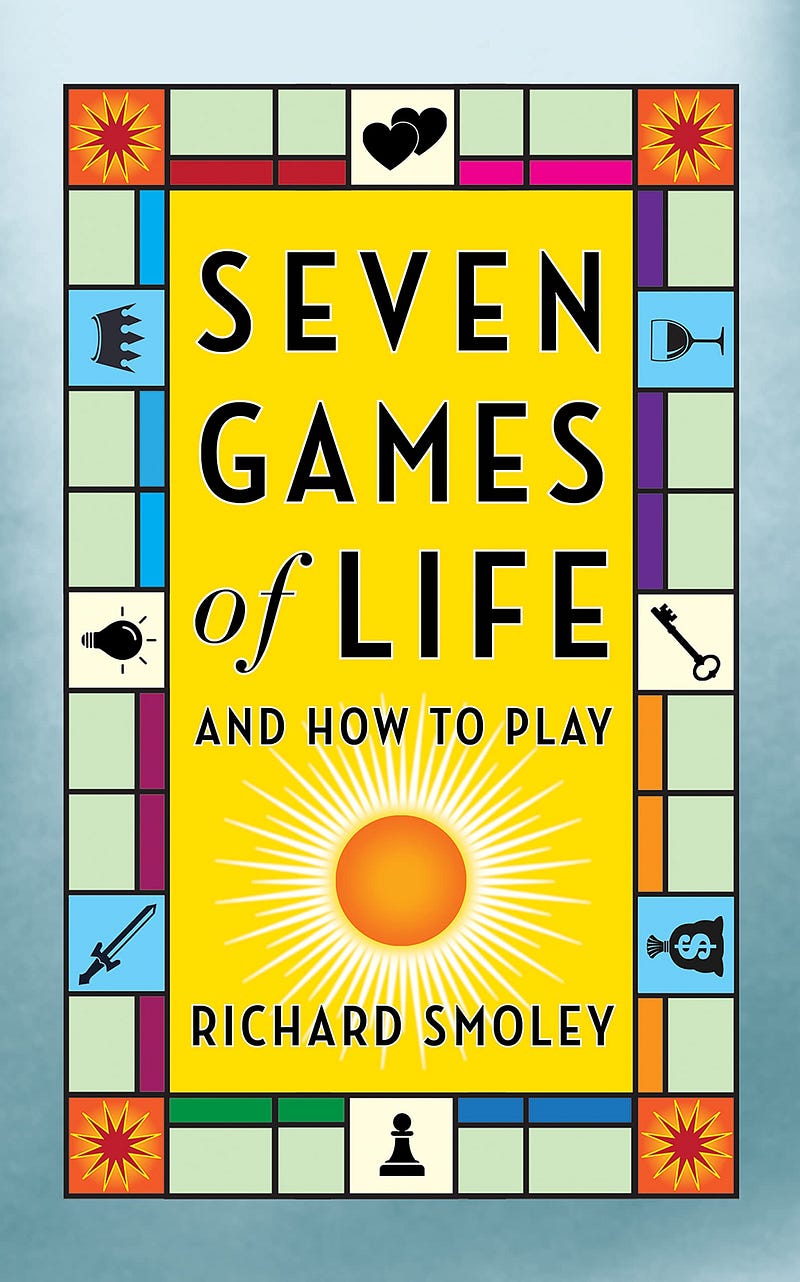
The moment a category is pinned on something — a person, a type of literature, a politics — its relationships and parameters are fixed. In his new book, Seven Games of Life and How to Play, scholar of esotericism Richard Smoley brings a sledgehammer to that party.
At risk of further labeling, I think it is fair to say that Smoley, perhaps today’s most penetrating interpreter of Western esoteric tradition, has produced an anti-self help book. Since the esoteric tradition of which Smoley is a leading scholar posits that life exists on a sliding scale of polarities (“as above, so below”), it is a given that opposition completes.
In 1616, the late-Renaissance alchemist Michael Maier (1568–1622) published an allegorical work called Lusus Serius, Latin for a “serious game.” This is Smoley’s view of life: not as a series of problems to be solved, boxes to be checked, emotions to be resolved, or even a “self” to be actualized; but as a deadly serious drama from which none of us, barring extreme countervailing measures, is free to sit out.
With that fate accepted — or unaccepted, since the player is bound — Smoley, whose observations span a remarkable arc of literary and spiritual thought sharpened by demands of wage-earning and family-raising, explores our seven stages: 1. Survival, 2. Love, 3. Power, 4. Pleasure, 5. Creativity, 6. Courage, and 7. The Master Game.
I must straight up acknowledge a personal debt to Smoley, which suggests why I embrace his counsel. Early in Smoley’s career, before we met (we’re now friends and colleagues), the independent scholar taught me that seriousness derives not from choice of topic but method of treatment, an insight lost on many widely read people who display the type of ersatz seriousness quoted at the start.
In the 1980s and 90s, Smoley and colleagues at the now-defunct Gnosis magazine pioneered writing on occult and metaphysical topics with seriousness, verve, critical sympathy, unsentimental ideals, and impeccable historical tools. Although key modern voices, from William James to Colin Wilson, had already considered esoteric topics with intellectual gravitas, none did so in a manner that proved so relevant. I knew it was the style I wanted.
Indeed, the style with which you approach the “games of life” is perhaps the one thing over which you have nominal control. And Smoley would agree: nominal. His outlooked is influenced by spiritual philosopher G.I. Gurdjieff (1866–1949) and his chief interpreter P.D. Ouspensky (1878–1947), who taught — without metaphor — that man dwells in a state of sleep. Our capacities as players, or our psyches, are riven to pieces and propelled by forces that play on our lives.
Does room exist for personal resolve or ethics? Smoley tells a useful story, one of many in his book:
A number of years ago, an old friend who had made a lot of money threw an enormous birthday party for himself. It was in June, so much of the event was outside, with a large canvas tent under which guests were seated.
At one point during dinner, a sudden storm came up and blew down the tent. Some people dashed out immediately. Others stood around helplessly. Still others tried to hold up the tent poles so that people could get out. It occurred to me that these reflect the three basic types of people in the world.
Of course, nearly every reader thinks that he or she is the “pole holding” guest. To see ourselves otherwise is unbearable — hence, we are built with “buffers,” as Gurdjieff wrote, to prevent us from being driven mad by impressions of our true selves: weak, servile, grasping, and shifty. To quote from another anti-self help book, Money and the Meaning of Life by Jacob Needleman (1934–2022):
A Freudian psychoanalyst once summed up to me his vision of the human condition by saying that man is not as bad as he thinks he is, nor can he become as good as he dreams of becoming. The assumption of this book is precisely the opposite of the psychoanalytic view: man is in far worse condition than he believes, but he can become far greater than he imagines.
This captures the stakes of Smoley’s final chapter: The Master Game. The seventh is the one and only voluntary game on the field. “You started the Master Game,” Smoley writes, “because you were not satisfied with the six familiar games; you sensed that there is something beyond, even if you had no idea of what. You were right.”
Players of the Master Game pursue goals unattainable through the other six, although this makes the preliminaries no less necessary. While Smoley doesn’t say so, I feel near-certain that he would agree that the Master Game cannot be entered until one has entered all other six. The ideal of seeking “greater truth” before reaching terms with the world is a fantasy: you cannot transcend or surpass what you do not relate to. (And even then, chances are slim.)
I am impatient with spiritual teachers habituated to one-upping students or depriving them of questions framed on the student’s own terms. But I will nonetheless quote from a great one: Sufi sage Hazrat Inayat Khan (1882–1927). Asked by a Western student whether a seeker must give up riches, the teacher replied, “Do you possess riches? How can you give up what you do not have?” To which I would add: do not be certain of what you are willing to sacrifice until after attaining it. Make decisions from experience.
The preliminaries leading up to the Master Game prepare us to exchange this for that. This is the known, the given, the familiar. But what is that? Smoley is more disclosing in his book than I am here. But know this: nothing comes without a price.
Before you return to the game, let me whisper a secret based on Smoley’s advice: prioritize treatment over topic.
Now, get back to it. As written in the Talmudic book Pirkei Avot or Ethics of the Fathers: “The work [game] is not yours to complete, but nor may you desist from it.”


