
The Most Credible Theories Regarding The Khamar Daban Incident
Formerly Soviet Russia can be a mysterious place. If you’ve been to the spooky side of YouTube or Reddit you’ve probably heard of the Dyatlov Pass incident where nine experienced hikers died mysteriously in the Russian Ural mountains. This case has been spoken about so many times that it is not worth repeating again, but there is another very similar case that is not so well known. The Dyatlov incident was not the only mysterious hiker death to grace Soviet Siberia. The Khamar Daban (also called Hamar Daban or Chamar Daban) mountain range is in southern Siberia’s Buryatia region, perched below lake Baykal. It’s rugged scenery has made a popular tourist hiking spot, but in 1993, six of those tourists would not make it out of the mountains alive. There are few answers in the case, and the lone survivor has refused to talk about the traumatic event since her first statement to police in 1993. There are so many pieces to the puzzle that is Buryatia’s Dyatlov Pass, many of which may not even be relevant or trustworthy. Here are the tentative facts and theories.
Timeline
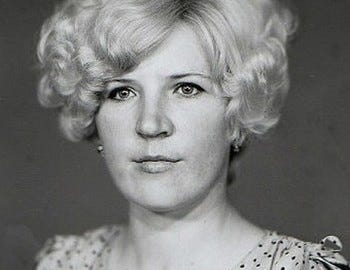
Forty-one year old Lyudmila Korovina was an experienced hiking instructor and survivalist labeled as a ‘master’ by her peers and students. She was known for her tough love on her students, often pushing them very hard. This tough love ultimately paid off however, as her students described her as being a good teacher that taught them confidence and crucial hiking skills. In the summer of 1993, Lyudmila had planned a hike with six of her students to the Khamar Daban mountain range. She was very experienced in the area which was a popular tourist spot and considered a very safe place to hike, especially in the summer. Her students had trained with her for the trip, and she was very close to all of them. The first of the six, and the closest to Lyudmila was twenty-three year old Aleksander (Sacha) Krysin. Lyudmila had known Sacha for most of his life, and considered him to be almost a son to her. The other five students were twenty-four year old Tatyana Filipenko, nineteen year old Denis Shvachkin, seventeen year old Valentina (Valya ) Utochenko, sixteen year old Viktoriya Zalesova, and fifteen year old Timur Bapanov.
On August 2nd, 1993, the group of Seven arrived at the mountain range, in the town of Murino, excited for their journey into the mountains. The weather forecast promised them clear, sunny skies. Lyudmila and her students were one of three hiking groups in the area, one of which was being led by Lyudmila’s daughter, Natalia. Their two groups had plans to meet up on August 5th when their hiking routes would cross paths. All of the six students were ready to begin their hike, as this was their chance to prove themselves experienced hikers. This was a journey they had been planning for and anticipating for months, and as a result, the group had become close.
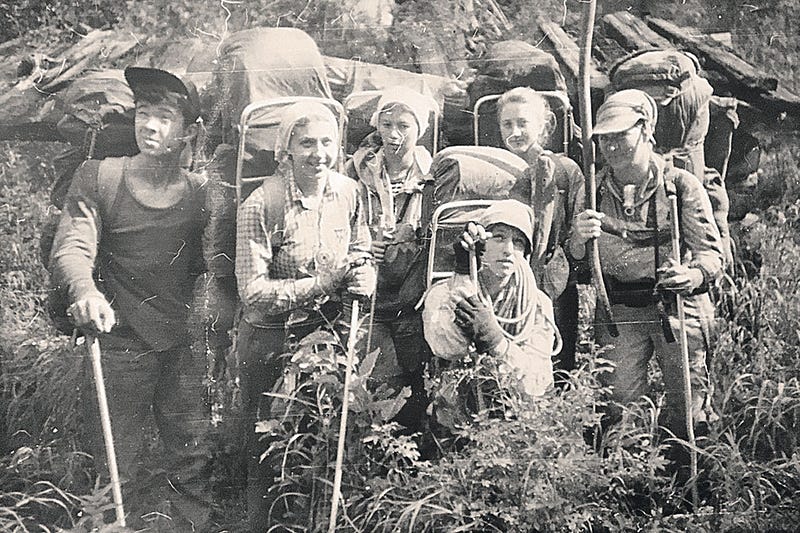
The first two days of the hike went better than planned. The group made extremely good time up Retranslyator peak, pushing themselves hard. By August 4th however, as they were beginning their descent, the weather forecast proved to have been wrong, and they were hit with a rainstorm.
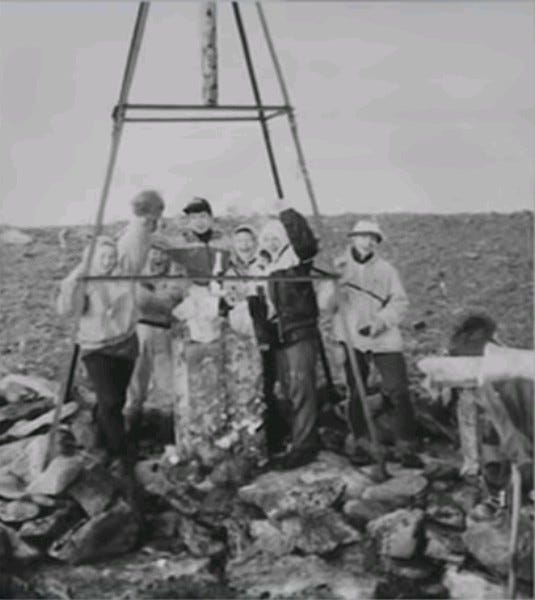
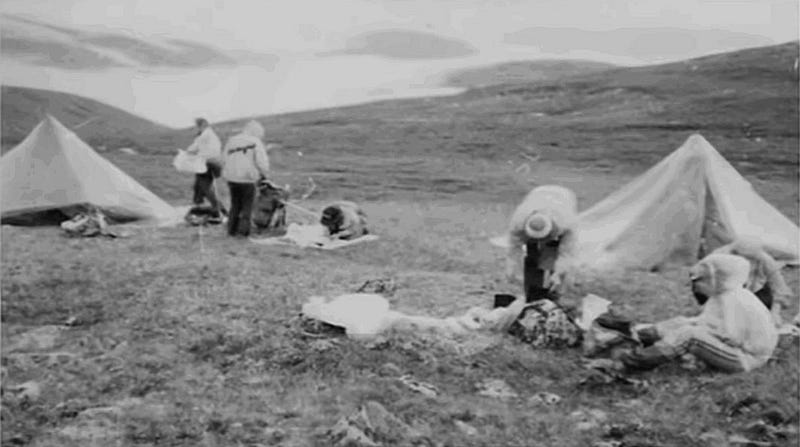
With the hiker’s supplies soaked their journey was slowed down by the added weight. Since the hikers were exhausted, Lyudmila decided to camp out hastily in an exposed location, despite there being tree cover not far away. The group was unable to build a fire that night but were still in good spirits. The next morning an attempt at fire building was successful and they ate breakfast together before heading out for the day. They planned to meet up with Natalia and expected to be able to do so given how quickly they had made their way up the mountain the previous day. Later that day, Natalia and her group made it to the meeting spot, but her mother never showed. The group moved on, and she was not worried about her mother, assuming that the bad weather had put her back. Unfortunately, what had set the group back was much worse than she could ever imagine.
On August 10th, a group of kayakers on the noticed something in the treeline as they were paddling down a river a river at the base of the Khamar Daban mountains. A lone girl was standing and looking at them. The kayakers got out of their boats and when they approached her, some sources claim she was covered in dried blood. The girl became hysterical trying to tell the kayakers her story. Eventually she identified herself as Valentina Utochenko and said that she had been hiking with six others. Horrified, the kayakers took Valya to the nearest police station where a report was filed. However, it wasn’t until years later that she was slowly able to tell the story of what happened to the other six, but it was perplexing and terrifying.

According to Valya, the group set off down the mountain after eating breakfast that morning, but after only a few minutes the first disaster struck. Sacha, who was at the back of the group, began to scream. When everyone turned they saw he was bleeding from his eyes and ears, frothing at the mouth. He fell to the ground convulsing and then went still. Lyudmila ran to him and ordered the rest of the group to continue. She was extremely distraught, trying in vain to get Sacha to gain consciousness. The remaining group did not get far before they heard Lyudmila cry out. As they turned and ran to her they saw she was having the same symptoms as Sacha. Her eyes and nose were pouring blood, and she was frothing at the mouth. She convulsed and then collapsed on top of Sacha. Tatyana who had gotten to Lyudmila first, was the next to collapse, grabbing at her throat as though she couldn’t breath. She slowly crawled over to a nearby rock and bashed her head against it until she went limp. Viktoriya and Timur both ran while Denis hid behind a rock. Valya stood unable to move, having just watched three of her closest friends seemingly die within only a few minutes. Both Viktoriya and Timur collapsed while running, and died in a similar manner, throwing up blood and clawing at their own throats, tearing their clothes off. Realizing they were the only ones left, Valya and Denis ran to each other and hurried away from the site of their friends’ death. It wasn’t long however, before Denis collapsed convulsing. Scared for her life, Valentina ran and left her friends behind. She only had a tent and the clothes on her back for supplies.
Valya ran down the mountain until she was certain she was far away from the tragedy she had just witnessed. Under adequate tree cover she set up the tent for the night and fell asleep.
When she woke up and realized she was still alive, Valya knew immediately that she would need supplies if she was going to survive alone in the wilderness. The problem was that she’d have to return to the site of her friends’ deaths to retrieve them. Knowing she had no other choice, Valya made the trek back up the mountain, retracing her steps. When she reached the site she saw that none of them had moved from the spots where they had fallen. Knowing they were all deceased, Valya quickly took the supplies she needed from their bodies and left, following power lines.
For four days she followed the power lines down the mountain, hoping someone would find her, until she found a river and began to follow it. By the end of her fourth day she was found by the kayakers and brought to safety.
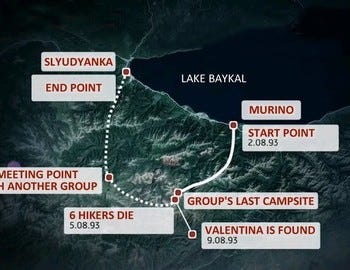
Despite the report to police, no official search was conducted until the 24th of August. Since Valentina had not been able to recount her version of events yet, it took two days to find the bodies using helicopters. An autopsy report concluded that they had all died of hypothermia except for Lyudmila who had suffered a heart attack. They all had signs of bruised lungs, and protein deficiency due to malnutrition was listed as a contributing factor to their deaths. The deaths were ultimately ruled to be accidental. Compared to the testimony of Valya this ruling is strange, and is central to many of the theories in this case.
Theories
The mysterious nature of this incident has rightfully caused many theories to be put forward by those who have researched it. As with any strange event, these theories range from aliens and the supernatural to actual scientifically valid explanations. I have decided to only feature the five theories I have found that make the most sense scientifically and circumstantially. These theories all have strengths and weaknesses, and no one in particular fully explains this incident, but some have the potential to get close or even overlap with each other.
The Hikers Saw Something They Shouldn’t Have
This theory proposes that perhaps the hikers walked in on some sort of Russian military experiment in the mountains and were killed for what they saw. Their deaths were subsequently covered up by the police and medical examiner. It’s true that the group had deviated from the usual route through the region so it’s possible that this change of plans led them to a group of experimenters that weren’t prepared for visitors. Despite this there are two main problems with this theory: the location the hikers died in and Valentina’s survival.
The Khamar Daban mountains are a very public area with multiple groups of tourists traveling through at any given time in the summer. Siberia has many opportunities for secrecy, so it would be strange for a top secret experiment to be taking place in a public location during tourist season. In addition to this, the particular part of the mountain that the hikers died on was an open area visible from the air and from higher ground. It wouldn’t make sense for a top secret mission worth killing people over to be in this section of the Khamar Daban mountains, let alone the Khamar Daban mountains themselves.
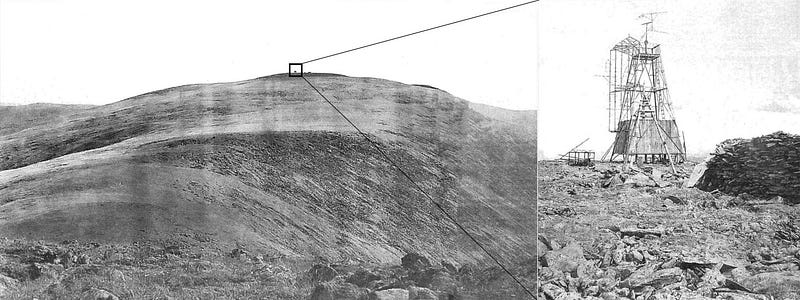
Then there’s Valya. Why did she survive? It doesn’t seem possible for her to have escaped. Take a look again at the geography of the location, there’s nowhere to hide or run to. If we were to put this aside and assume that somehow she did survive than why wasn’t she silenced or killed by the military after? If she was forced to lie about what happened she definitely didn’t help calm suspicions about the incident, and if she hadn’t been forced to keep the secret than why was her story so wild? This is the main problem with the military experiment theory.
A Nerve Agent Killed The Hikers
Many people have pointed out that the symptoms described by Valya are consistent with death by chemical weaponry, specifically nerve agents. The frothing at the mouth and convulsing in particular, match death by a strong nerve agent. This death also matches with the autopsy results. Since contact with nerve agents can cause respiratory distress, the bruising of the lungs can be a sign of death by nerve gas. Cardiac arrest is also caused by nerve agents which matches Lyudmila’s cause of death. The cause of death of the other hikers could very well be hypothermia even if they were exposed to a nerve toxin since they could have been knocked unconscious or fallen into a coma, and then ultimately succumbed to exposure.
Yet another thread of this theory was put forward by YouTuber Cadaber in his video. He proposes that the specific nerve agent that killed the hikers may have been a Novichok gas. Novichok gases are a class of nerve agents created by Soviet Russia up to 1993 which is the year of this incident. They are thought to be the deadliest nerve agents to exist, being ten times more deadly than VX, and twenty times more deadly than Sarin. Novichok agents were reportedly tested in areas near the Khamar Daban region. Exposure to this gas causes rapid death similar to what the hikers reportedly experienced.
Both the above theories have issues. The first and very common one with all of these is Valentina’s survival. She was near most of her friends when they died and even went back to the location without suffering a similar fate. The second is that if no one was there to release the gas, where did it come from?
I did a lot of research on nerve agents for this article, which is honestly not something I expected to be spending my weekend doing, but I found a few interesting things: Nerve agents are soluble in water, they can take four months to evaporate, they are made of heavy particles that often float close to the ground, and the stronger ones can be hazardous in a location where they were used long after they were first released. This may seem completely random, but bear with me. This is my theory:
The rainstorm plays a very key part in this. The rain could have washed a strong nerve agent (likely a Novickok or VX) that had been tested at most four or five months prior in a more discrete site up the mountains, down to the hill. As the morning sun evaporated water from the rainstorm, some of the still hazardous agent went with it, but it did not travel far, staying in sort of epicenters close to the ground. Sacha got unlucky and walked over a highly contaminated spot, causing almost instant symptoms. He may have absorbed the toxin through either his skin or by breathing it in. When Lyudmila ran to him she was exposed to the same toxic location. Tatyana, Viktoriya, and Timur were the first to reach Lyudmila, but quickly ran away. This delayed their deaths slightly. Since Valya did not get close to Lyudmila, only Viktoriya who had removed herself from the epicenter of contamination, Valya was not exposed to high levels of the toxin. However, if Viktoriya had not bit her and Valya had bent down to the ground, she may have. Denis was also not impacted by high levels initially, but his decision to hide and crouch down was his downfall. Small levels of toxin were floating close to the ground and he breathed them in. He was exposed to less than the other five which is why his death was more delayed, but it ultimately caught up to him. Russian police, suspecting that runoff from the test could be the cause of the deaths, waited to start their search in order to ensure that the agent had mostly evaporated before sending a recovery team.
I don’t know how possible this theory would be, and it definitely requires a lot of trust in the solubility and evaporation times of nerve agents to believe. Despite Valya maybe being set apart by not getting too near the “epicenter” of contamination it’s still unlikely that she could have gone without being exposed, but I thought that I couldn’t pass up putting this theory together, no matter how unlikely.
Valentina’s Story Was Inaccurate
When someone undergoes a traumatic experience, they often misremember aspects of the experience, especially when telling it years after like Valya did. Certain parts of the story could have been exaggerated by Valya, by no fault of her own. The research surrounding the inaccurate nature of eyewitness statements is extensive.
It’s possible that the hikers died exactly how the autopsy report concluded they did. The group succumbed to hypothermia after not being properly sheltered that night, and died together on the mountain. Valya could have survived by her decision to go to the forest, a difference in clothing, or as Valya reportedly says herself in regards to her survival, her physical fitness.
It should also be added that people who die from hypothermia often experience “paradoxical undressing” where they strip off their clothes shortly before death. This would be a valid explanation for the hikers being found partially undressed.
This theory can not only stand on its own, but it can also be applied to other theories where there seems to be a missing piece in her testimony that doesn’t match, and could have been exaggerated, but it’s impossible to tell how credible each piece of her story is.
Contaminated Water
This theory also relies on the rainstorm bringing toxins down, but instead it proposes that the hikers drank the toxins in their water. Lake Baykal, which sits above the mountains, is a well known toxic waste dumping ground. If this waste was washed downstream and into the water the hikers could have accidentally drank deadly toxins with their breakfast. The contaminant could have even been one of those water soluble nerve agents I mentioned. Valentina may have survived by drinking less, or getting her water from a different location than the rest of the hikers. Most highly toxic substances take a few minutes to take effect, hence the hikers all dying later.
Similar to the nerve agent theory, this toxin could have incapacitated the hikers causing them to die from hypothermia before they succumbed to the toxin. Depending on the toxin, it may have not been visible in a standard toxicology report.
The problem with this theory is that the deaths were an isolated occurrence. If a water source used by many tourists was so badly contaminated, it doesn’t make sense that only one group would be affected by it.
Mushrooms
This is one of the most interesting theories in my opinion. I found this idea from a YouTube comment and did more research to add to it. This is the only theory I know of where Valya is actually affected by what killed the hikers, eliminating some of the questions around her seemingly being a total outlier compared to the other six.
Lyudmila was a known forager who taught the art to her students. It’s possible that one of the hikers found some mushrooms to add to their breakfast which wasn’t the correct variety. After eating their breakfast, the effects of the mushroom poisoning began to take hold as they were walking, causing them to hallucinate and be sick. Interestingly, a common hallucination caused by psilocybin is to see other people cry blood. Overdoses of psilocybin can cause psychosis, convulsions, cardiac arrest, and even send someone into a coma. Once again, it’s likely that the hikers died as a result of hypothermia due to being in an altered state, whether that was just tripping out or being in a coma.
Valentina could have survived by eating less mushroom, having a tolerance, or even just a genetic disposition to being less affected, wearing warmer clothes, or by running to the forest and sheltering out of paranoia.
This incident may forever remain a mystery, but there are many interesting theories to consider that surround it. Tragically, it’s likely that many of the families of the hikers will never receive closure in this case since there is no clear cut explanation. We can only hope that one day with better technology, answers can be recovered in this case. Until then, we only have the questions.


