
The Monk Who Saved a River
A story about why “changing the world” is wildly overrated
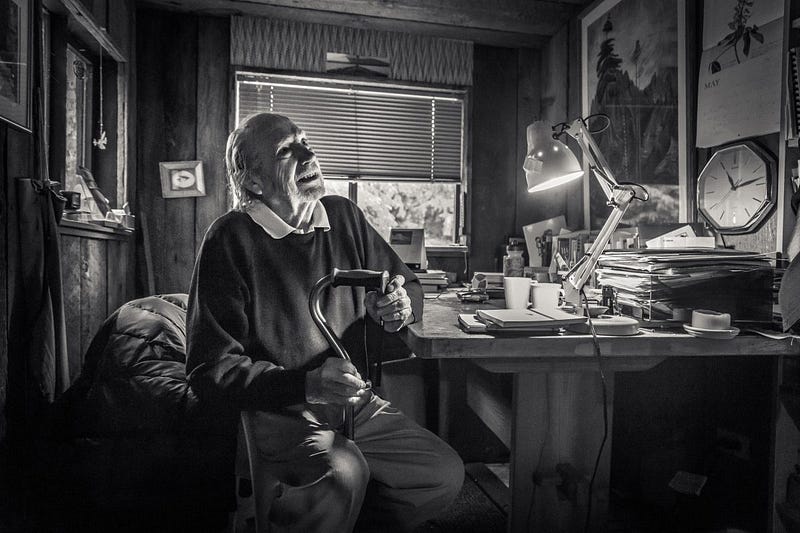
Last month, the world lost an extraordinary man. His name was Charles Alfred Edwin Brandt, age 97. He was an avid fisherman, a noted conservationist, an acclaimed bookbinder, a world-renowned art restorer, and the first person to be ordained as a hermit-priest by the Roman Catholic Church in over two hundred years.
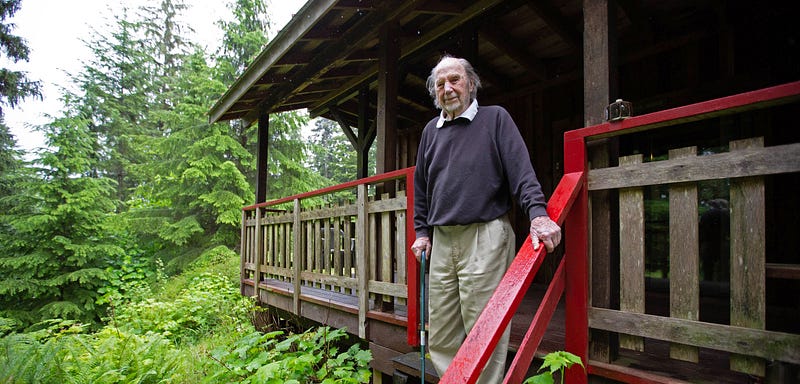
Prior to the priesthood, Brandt had served in the U.S. Air Force in the 1940s before graduating with a Bachelor of Science in ornithology from Cornell University and a Bachelor of Divinity from a theological seminary in Wisconsin. After learning the ancient art of bookbinding at several American monasteries, he built a hermitage on the rainforested banks of the Oyster River in British Columbia and called it home for the next fifty years.
In addition to teaching Christian meditation retreats and occasionally filling pulpits in the Comox Valley and Campbell River, Brandt earned his keep as an art conservationist, gaining world renown for restoring books like The Nuremberg Chronicles (printed in 1493), many ancient Bibles, and an original volume of John James Audubon’s masterpiece, Birds of America (published in 1838, and now worth $12.5 million.)
Despite traveling the world to protect some of our most important historical books, Father Brandt never considered bookbinding and restoration as his sole vocation: “I am interested in conservation on three levels: Restoring and preserving man’s contemplative spirit — mine and other people; restoring what flows from man’s spirit — what he creates from his ink or crafts; and restoring and preserving the earth. If we don’t do this, we have nothing.”
As a monk, Father Brandt’s days started early: at 3:00 AM for prayers, meditation, and reading the Psalms. As dawn rose, he often sauntered through nature, observing wildlife and taking photographs, some of which appeared in books later published. He described his morning meanderings as a transcendent experience: “Every atom of my being is present to every atom in the universe, and they to it.”
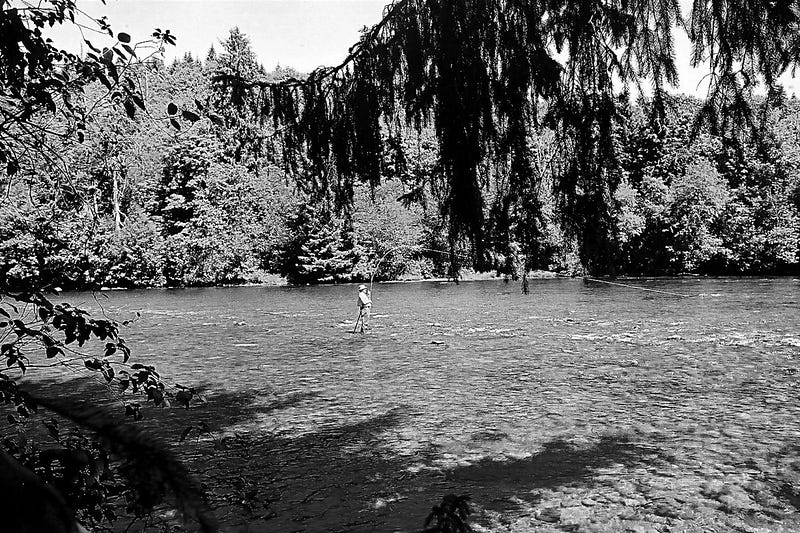
When he wasn’t praying, working, studying, or meditating, Father Brandt was fishing. Dave Muir, a federal fisheries employee, introduced Brandt to Vancouver Island’s cutthroat trout, which proved good practice for winter steelhead fishing. His first steelhead catch, on Christmas Day in 1966, weighed 18 pounds and 6 ounces, remained his largest steelhead catch for the rest of his life.
Saving a River
Father Brandt spent most of the seventies traveling around America and Europe, furthering his studies and working as a paper conservator. When he returned to his riverbank hermitage in 1984, he was shocked by what he found: steelhead and summer chinooks were in serious decline, while autumn-run chinook had been wiped out completely. His two local rivers, the Tsolum and Oyster, were dead from mining pollution and forest clear-cutting.
He couldn’t believe the toll exacted by private interests and corporate greed. The beautiful pools were silted up. The gravel bars were gone. Logging caused uneven water flows; too low in the summer, raging in the winter. Brown slime — an algae called diatom — slicked the river bottom. Copper leachate from the upstream mine had poisoned and annihilated the entire salmonid system.
He made it his mission to save the Tsolum River. He started a committee, did the research, launched a letter-writing campaign (his open letter to the British Columbian minister of the environment started with: “Dear Mr. Pelton: The Tsolum River is dead!”), recruited celebrities, courted journalists, and made his local disaster a national story. The committee fundraised more than $1 million to start river restoration on the Tsolum, and he started a second society to heal the Oyster River.
Through many years of arduous work, frustrating setbacks, and tense battles with resource-devouring companies, his organizations transformed the landscape. Typically there were 25–200 chinooks in the Oyster River in a given year, but by the time he was through, there were nearly 100,000. The change was even more remarkable on the Tsolum River. After raising more than $6 million to reclaim the copper mine, the number of pink salmon rose from just eight in 1983 to more than 130,000 in 2016.
“You know,” Brandt said, “museums like to preserve Indian artifacts — their weaving and sculptures — but what’s really important is to preserve their spirit, the very culture from which these artifacts flow. To do this, we must preserve their environment — their rivers, streams, and mountains. Many Indians still have what I call perennial philosophy — the unity of all beings, living and non-living. We are part of the earth, and it is part of us.”
Stop Trying to Save the World
If there’s a lesson to be learned from the life of the Oracle of Oyster River, it’s this:
Perhaps it’s time to stop trying to save the world, and instead, do something to save our world.
Far too many of us have spent far too much time trying to make world-level changes when maybe we should take the exact opposite approach. We need to surrender the idea that everything depends on us. We need to let go of the delusion that we know best, and that we can and must change the entire planet. It’s too much responsibility for our frail shoulders, too much weight for our human minds and emotions to bear.
There’s a lot of freedom in admitting that you can’t do everything. It helps right-size your dreams and ambitions, and it tempers your desires. It adds a healthy dose of reality to your expectations, which in turn, makes daily life far less frustrating and disappointing.
We then have two paths to choose:
Instead of Doing Good, Be Good.
Father Brandt was thirteen when he discovered another famous naturalist who lived alone in the forest— the nineteenth-century Concordian, Henry David Thoreau. The essayist’s masterwork, Walden, gripped the future monk and inspired him to develop his awareness and empathy for the natural world, and to not simply do good works, but to be a good person.
As Thoreau wrote:
“As for Doing-Good, that is one of the professions which are full. Moreover, I have tried it fairly, and, strange as it may seem, am satisfied that it does not agree with my constitution.
Probably I should not consciously and deliberately forsake my particular calling to do the good which society demands of me, to save the universe from annihilation; [but] what good I do, in the common sense of that word, must be aside from my main path, and for the most part wholly unintended.
If I were to preach at all in this strain, I should say rather, Set about being good… [A person should focus on] steadily increasing his genial heat and beneficence till he is of such brightness that no mortal can look him in the face.”
Instead of Doing Everything, Do Something.
Here’s a concept that is incredibly freeing: We can’t do everything, but we all have our 1/8 billionth part to play. Right?! There are almost eight billion of us on the planet — why should we expect to do a world of work when we have a global family with whom to share the load? If you were in a Shakespeare play, it would be absurd to expect to play all the roles. You can’t be Romeo and Juliet. Play your role, and play it well.
“Purity of heart is to will one thing.” — Soren Kierkegaard
Most of the people who attempted to change the entire world did far more damage than good, and most attempts ended catastrophically: Ghengis Khan, Napoleon Bonaparte, Adolf Hitler.
Conversely, many of the people who actually improved the world did so by focusing on one thing: Mother Teresa focused on orphans in India. Martin Luther King Jr. focused on the African-American right to vote. William Tyndale risked execution to translate the Bible into English. Steve Jobs made elegant devices.
Rather than trying to control everything, try to gently course-correct one thing. Sometimes, it can lead to world-changing outcomes.
Rest in Power
In the pre-dawn hours of Saturday, October 24th, 2020, Charles Brandt’s spirit shook off his 97-year-old body.
But the story isn’t over; Charles Brandt’s legacy will long outlast his name. In 2019, Brandt put a perpetual conservation covenant on his 27-acre rainforest hermitage (which is now covered in 120+ foot trees) and bequeathed the property to the Comox Valley Regional District for use as a public park. He also set aside 5 acres in hopes that another hermit will take his place and continue the good river work he started, which is still nowhere near total restoration and is always under attack from money-hungry corporations.
To be sure, Father Brandt didn’t do all this to simply “leave a legacy”:
“I don’t want it to reflect on me, I just think that everybody should be concerned with the land, with the atmosphere, with the rivers, because we’re really using the earth right now. This [place] is one way of slowing that down.” — Father Brandt
For his part, Father Brandt changed the world by influencing millions of people with profound insights about our role as stewards of the natural world. Brandt didn’t consider himself an ecologist or a theologian, but something of a hybrid of the two: an ecologian, in his words. He was concerned with our growing spiritual disconnect from the nature that supports our entire existence. “I would say, the human community and the natural world has to go into the future as a single sacred community. Not two communities, but a single sacred community.”
Father Brandt was right: We are part of the earth, and it is part of us. Indeed, if everything is connected and everything affects everything else, then the best way to change everything really is to simply change one thing.


