
The Mobicorikon: Chapter Two
Further Dimensions and Noble Shapes. (All photos by Author)
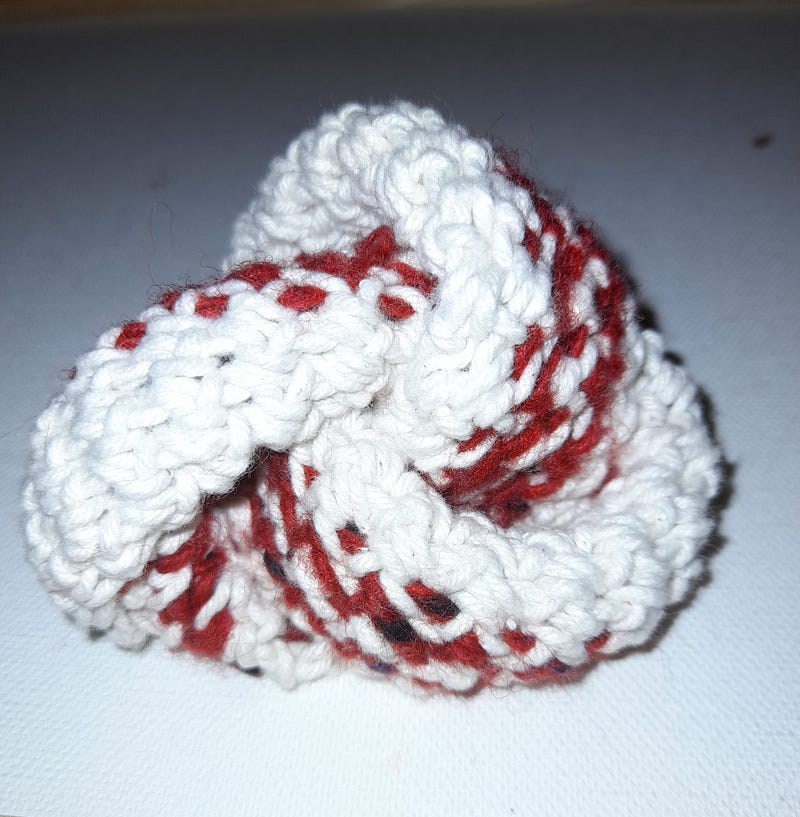
YOU HAVE MADE THE BODY OF WORK IN CHAPTER ONE.
It is a paper Mobius strip grown on to Row 1, complete. The paper strip is equivalent to the crochet Starting Chain; the first layer of safety pins is equivalent to Row 0 (Zero) of Stitch, and the second layer of pins is equivalent to Row 1 (One) of Stitch.
TOPOLOGICAL FIGURES
After the beginners’ How To Crochet chapters Four, Five and Six, the bodies-of-work we make will be crocheted Mobius twists/Mobius Rings, and later on Cook Twists/Cook Rings. They will all be actual manipulable topological symmetrical figures. You can stretch them, push and pull them about, but they will remain essentially the same. As you grow them on Row by Row, they will get bigger and fuller, as well as smaller, because fuller and tighter. As with your paper strip grown-on you will occasionally need to push/pull the working edge up and out of the core gap (the twist) in order to stitch the next gap, and eventually there will be so much growth that the core gap gets full, and it is harder to pull the working edge out in order to add another stitch. Before that event, your Body-of-Work will be arranging and folding itself into beautiful and mysterious shapes, which I call Noble Shapes. I predict you will play with them as they get bigger in order to better understand them, and here might be useful a reminder of the first rule in crochet, which is to Always Keep The String Behind The Work!
WHAT IS TOPOLOGY?
According to the OED, : “Topology is the branch of mathematics concerned with those properties and surfaces which, unlike shape and size, are unchanged by any continuous deformation (i.e. excluding breaking and tearing) and hence with those abstract ‘spaces’ (sets composed of points and subsets of points) which are similarly unchanged by certain kinds of transformation”. Topology is the branch of mathematics, created for Mobius Twists and other similarly one-sided and one-edged figures.
These days, complicated topological figures are still mostly theoretical and mainly exist on a computer screen, with the exception of a Mobius Twist, which is an actual (i.e. not just theoretical) topological figure. A simple Mobius Twist of paper is a model of a topological figure much used and discussed by children, as well as quantum mathematicians, engineers and theorists. As far as I know, however, I am one of very few with an interest in quantum theory who ‘grows Mobius strips on’ and has developed a studied method for how to go about creating different kinds of topological objects/Mobius twists by creating them from a crochet chain, by using and identifying the Gaps, rather than the Stuff. I have also discovered practical uses for some of them on the every day human level. I call the method of growing-on these Mobius twists ‘Cook-Mobius Crochet.’ I call the resulting symmetrical and multi-dimensional topological bodies-of-work ‘Noble Shapes’. I call the written method The Mobicorikon.
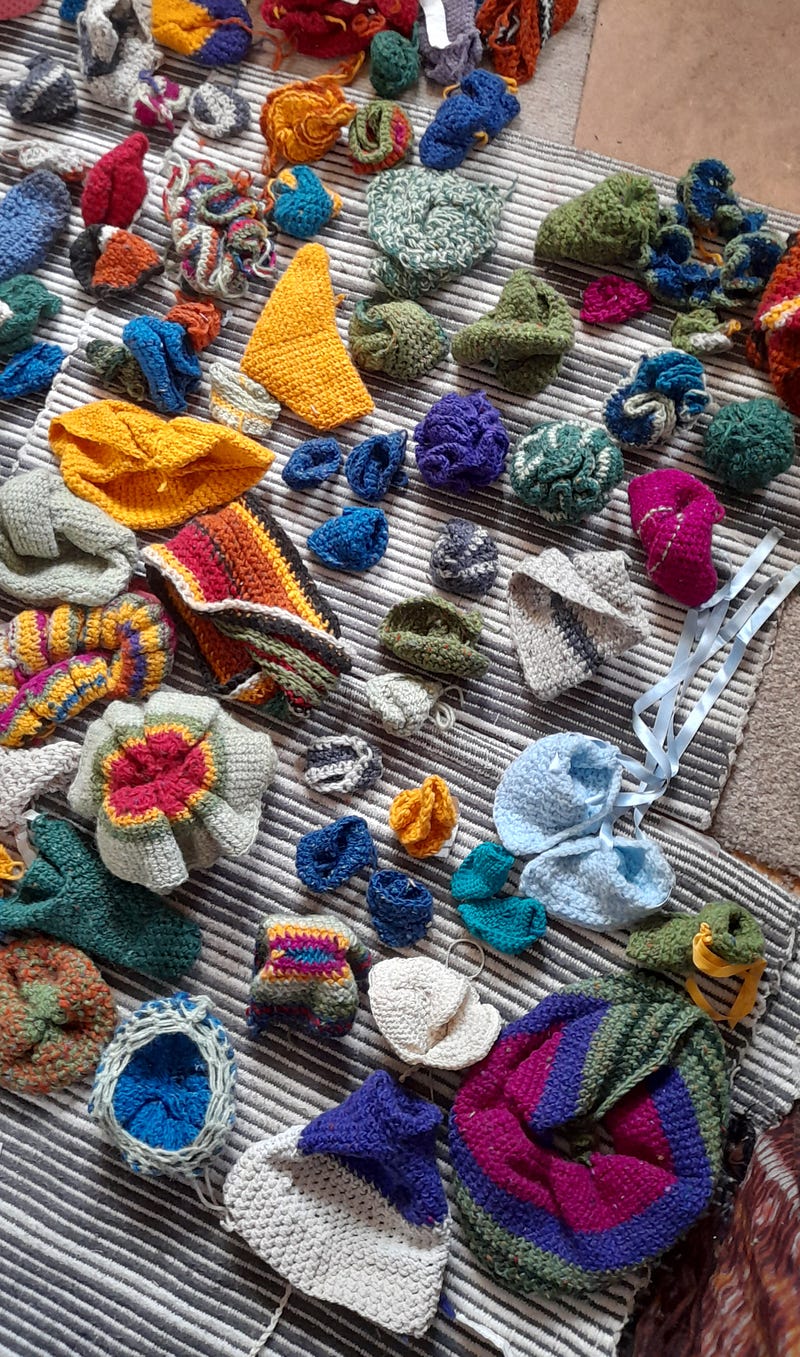
NOBLE SHAPES, NAMED
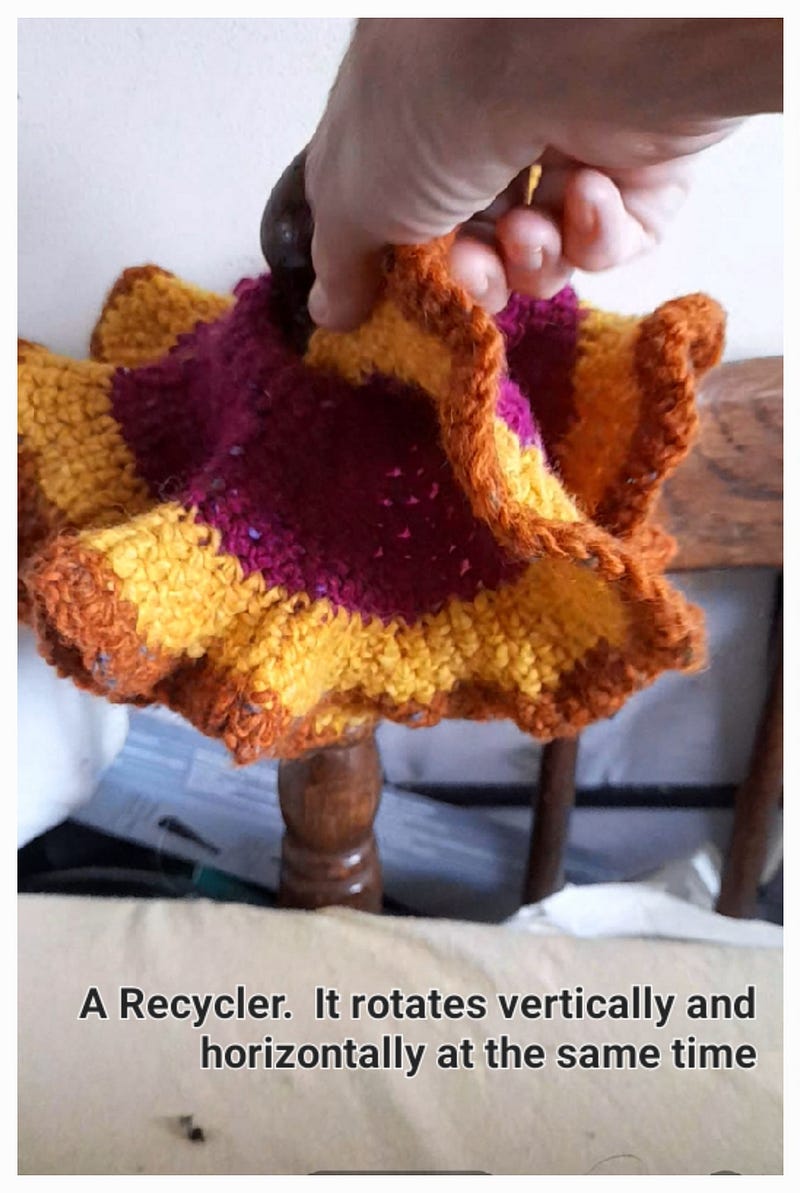
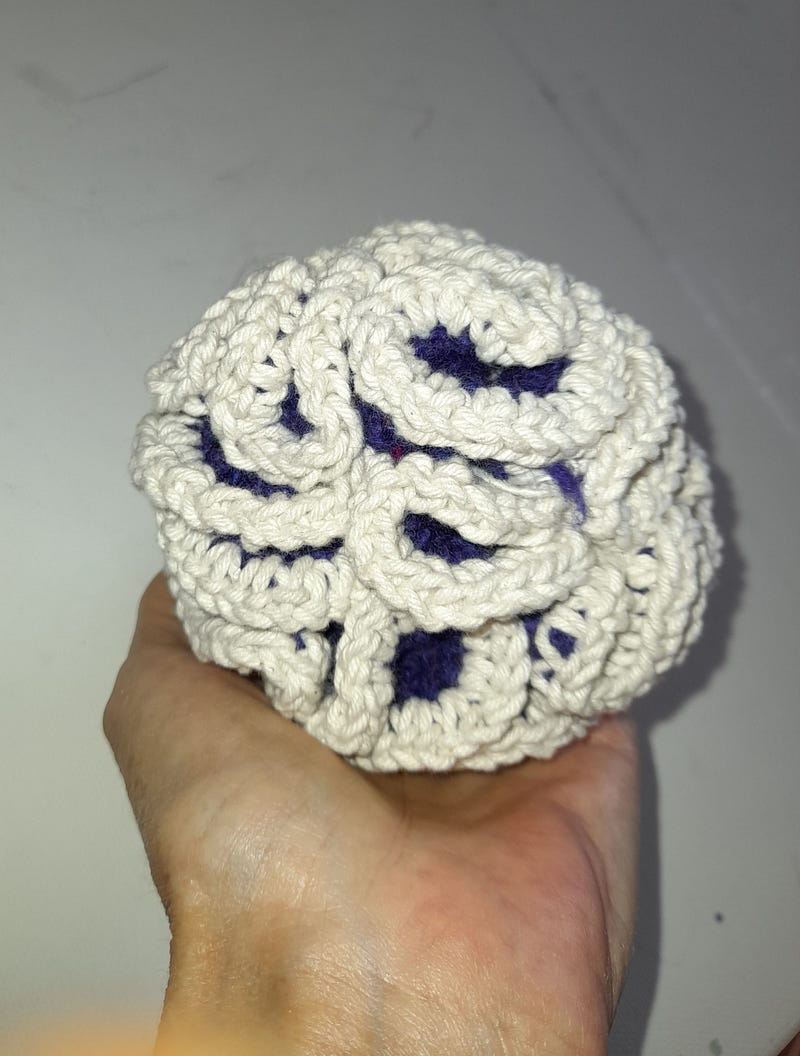
I have names for some Noble Shapes that regularly reoccur in various Twists, at various stages of their growth: a Cornucopia, a Shell, a Tipi Cover, a Slipper, a Mushroom, a Boat, a Spaceship, Ghandi Shorts, a Recycler, a 4-way Pole Connector, Panniers, a Saddle, a Brain, a Sphere, and a Too Tight and an Ugly. In a bigger body-of-work, you would typically see four different and reoccurring shapes as you stitch one round, every quarter bringing forth a different Shape. One out of four is Ugly in certain kinds of twists.
There are different variations of Mobius (and Cook) Twists, depending on what you ‘program’ into the chain at Row Zero of Stitch, and on whether you use two, (and which two) or all three ‘sides’ of the Starting Chain, and how many and what kind of twists you add, and on whether you use a seam. I avoid using a seam in Cook-Mobius Crochet.
You can be creative by using different kinds of crochet stitches, i.e., by consistently adding more gaps at each subset, or by applying a continuous formula before and or after the Chain and its Row Zero is complete, i.e., by consistently adding x number of stitches into every y type gap of the working edge or by similarly skipping stitches or by using a combination of the two.
You can use different colours to enhance not only the visual comprehension but also the stunning artistry of Noble Shapes.
FURTHER DIMENSIONS OF NOBLE SHAPES
As you push and pull the edge in order to add another stitch in, the bodies-of-work automatically fold themselves. These folds are both outside and inside the body-of-work and exist in further-dimensional space. It is impossible to describe it in words, but you will see when you make one. Your manipulations are a kind of dance, mostly push and pull with an indefinable small jiggly turn on occasion. The body-of-work will teach you this dance, I cannot.
Quantum theorists do use (computer-generated!) topological figures to help explain the quantum realm of further dimensions, and they maintain that the further dimensions are to do with folding. They are unsure how many more dimensions there may be, but ten is a popular guess. I believe that the more twists* you add to the chain before connecting as a ring, then the more folds are created and the more dimensions your body-of-work will have to embrace once you grow it on.
* However, there are limits and exceptions. More about that in another chapter of The Mobicorikon.
THREE DIMENSIONS PLUS TIME
We typically perceive three dimensions plus time. Our dimensions are length, width and height: think of how you measure the dimensions of a piece of furniture you are hoping to buy and fit into your home, or think of it as giving the coordinates on a map in order to meet up with someone; you need to describe the length of the table, / or the longitude on a map, also the width of the table, / or the latitude on a map, and thirdly the height — 57 cm? The basement? The International space station? Fourthly, if you are detailing your meeting, you need to describe when in time you will meet. 9.a.m? Next week? In 10 years? Thus, Time is considered a dimension, though of a different kind, and Einstein called it the fourth dimension, but typically people say there are three dimensions, plus Time.
On the human level of perception, if an object has only two measurable dimensions, e.g., a measurable width and length but no height, like a piece of paper, then it is said to be only two-dimensional. A straight line | on the paper is considered to be one dimensional.
That a line on a paper is one-dimensional makes no sense to me, I must confess. Maybe I am too far gone round the twist. The line is on top of the paper, and has a discernible right-hand edge, a left-hand edge, a top edge and a bottom edge in the space around it. So if you focus on the space, (the Gap) and the edges of the line you need more than one dimension to describe it! Go ahead, point to the top edge of the line |, point to the bottom edge of the line |, point to each side edge of the line |.
QUANTUM DIMENSIONS: TWISTS AND TURNS
Quantum scientists use computer-generated topological figures because they help explain the quantum realm of further dimensions, but I have to wonder how much better their understanding might be if they crocheted actual topological figures from scratch? Quantum physics and mechanics use the idea that there are more than three spatial dimensions in order to make fabulous and powerful tools e.g., semi-conductors, solar panels, quantum computers and nano-technology, but these other dimensions are still a mystery and they are unsure how many more of them may exist, nor where they may exist, ha ha, nor whether there are dimensions where time does not exist, or space does not exist. Their best guess is that the extra dimensions are folded into each other. A strange thing about quantum physics is that no one really understands it, yet we can make calculations and machines based on a theory of it.
YOU DO NOT HAVE TO UNDERSTAND IT IN ORDER TO DO IT!
As with quantum physics itself, you do not have to understand Cook-Mobius Crochet in order to do it. Rather, by doing it you gain understanding. You have started from scratch and grown your topological and very weird, but somehow familiar, body-of-work; you have followed it stitch by stitch and row by row, and that is what I mean when I say you will gain an innate sense of the quantum realms through Doing Cook-Mobius Crochet. You know that body-of-work intimately, every single step and stitch and form of it, because you made it with your own two hands.
ANCIENT KNOWLEDGE
Humans have been making and using Mobius twists ever since we started using string to craft things, which I reckon is as long as there have been humans. Twists happen easily and not always intentionally, as anyone who set out to crochet a simple rectangular scarf, only to find that it somehow got itself into a permanent twist can testify to. Or, indeed, anyone sewing or knitting who got their string into a ruinous knot. Knots are Mobius twists, and Nautical Knots and Macrame are an art and a science of their own. Drawing Knots is also an art and science of its own, a kind of Mobicorikon, and kept alive during the dark ages in Ireland. Alice in Wonderland is famously a person who fell asleep while knitting and went down the rabbit hole, where reality and dimensions are changeable and very very strange. People forget that Alice’s Adventures all started with knitting. Perceiving quantum realms of further dimensions is already well-entrenched in the human consciousness.
I believe consciousness itself is a dimension, which claim is supported by the famous Schrodinger’s Cat experiment, and the acceptance by physicists that the very act of observing something changes it, and can influence outcomes. When we dream, we are in a dimension where time and space and causality do not exist, or at least not like they do when we are awake. When we remember and try to describe out dreams, we have to ‘flatten’ them into our 3-D world perception, and the same thing is going on with our understanding of quantum physics — we ‘flatten’ the maths so that it fits our 3-D perception. We spend a third of our lives sleeping, so we are all already intimately acquainted with the quantum world without even trying. Anyone of my generation (1960’s) who watched the original Star Trek television series has witnessed that the fabulous machines and capabilities that were pure imagination in those days, have mostly come into being; the most obvious example being the ubiquitous communicators of the Star Trek crew and our mobile phones. Computers that run the ship and know everything; Beaming things from one place to another ( though not life forms yet) has also come to pass. Quantum-level medicine, tinkered genetics, growing new organs and appendages — these were all imagined from our subconscious, portrayed in the Star Trek series and are now reality. We are working on cloaking and shielding and powerful drives. One thing not overtly imagined in Star Trek was to be able manipulate Gravity (I say overtly because of course, no-one was floating around in Micro-gravity in Star Trek), and I reckon we are still in the technological dark ages because we are nowhere near attempting to do that— Quantum Theory, Mechanics, Mathematics and Chemistry has not advanced enough for that, but it will.
In the meantime, we might not even need those innovations: expert meditation practitioners claim they can travel and communicate without even moving their body, effectively being in two places at once. Meditating opens the gate in your brain between your subconscious and your conscious mind. It connects your everyday awareness directly to your quantum awareness at the same time. Why do you think Buddhas are smiling? It is all quite hilarious. Meditation also heals the body faster than sleep. If you practice meditation, you will reduce your sleeping needs from eight hours down to six or even four hours. We have all come across the phrase “the power of the mind”, well the mind might be the most powerful thing of all.
In The Mobicorikon Chapter Three: The Crochet Starting Chain and Gap Maths:
Everything Is String But Gap Is King; The Starting Chain; Hook, Line and Sinker; Surprise!!!; Gap Maths; Now I Have Something To Go Through!; Three Sides of the Chain; Quantum Symmetry; The Egg; The Knot, Another Egg; Chain One Depicted in All Its Stages; Chain Three.