
The Mind: A Key to Healthy Aging
Mental characteristics that fuel middle age and beyond
Individual differences in people always fascinated me. In particular, how people respond to trauma and bad things as they get older.
Why are some older adults grumpy and sad while others vivacious and happy? How is it that two people with severely dysfunctional childhoods and a history of traumatic events can experience adulthood in such dramatically different ways? Or how is it that some survivors of the Holocaust, for example, lived 100 years while others did not? Why do some combat veterans experience horrific PTSD while others do not? Among sexual assault survivors, what makes one person a warrior for others while another becomes agoraphobic?
Science explains that many factors, biological, environmental, social, and psychological set people on their life paths. However, my clinical experience and informal research into the topic suggest some mental characteristics that increase the likelihood of aging gracefully despite trauma.
Meaning
Viktor Frankl wrote the book on the importance of meaning in life. Required reading in grad school, Frankl’s observations of the people who survived and those who died around him in the Nazi death camps taught us the essential ingredient in any therapy: HOPE.
Frankl witnessed people survive horrendous odds, but he also witnessed what happened when people gave up, when they gave themselves a deadline, or when they had nothing outside the camps to live for. Those people died right next to others who suffered the same maladies.
His conclusion? Without hope, there is nothing. Without something outside of ourselves that brings our lives meaning, there is nothing to keep us moving forward. Thus it is with people everywhere. When I worked with clients suffering from addiction and severe trauma, I witnessed this over and over.
Hope and meaning compel us to live.
Locus of control
This concept fascinated me in grad school. Locus of control defines whether someone believes they have some control over their lives or if their lives are subject to outside forces. People with an external locus of control give up easily, feel like nothing they do will change their situation, and usually give in to depression and hopelessness. Those with an internal locus of control believe that no matter what the world throws at them, they can do something about it — the “can do” people who get the bootstrap metaphor.
People who age gracefully tend to be “internals” or those who get back up when they fall.
Grit
I love this word. Grit. Every time I say it, I feel like it needs the accompaniment of a punch or a foot stomp. While much of the research on grit tends to be with younger people, successful aging requires grit too.
Like locus of control, grit is an intangible characteristic defined by not giving up. Perseverance and grit are best friends. Perseverance keeps the long game in focus while grit kicks her in the pants when barriers, obstacles, pain, and danger threaten the long game.
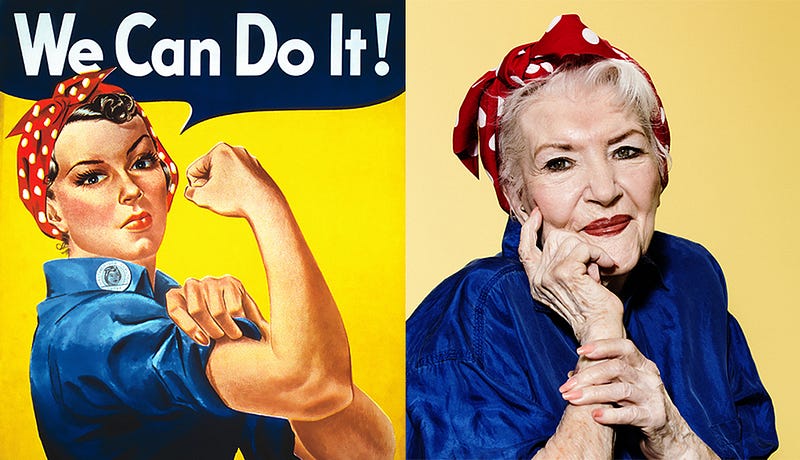
The World War II-era Rosie the Riveter poster and the real-life woman, Naomi Parker-Fraley, who was its inspiration
Resilience
Another popular buzzword in therapeutic circles, resilience is the ability for someone to return to “normal” after experiencing stress or trauma. For example, when a loved one passes away, how quickly does someone get back to functioning in daily life? When a person loses a job, how soon are they pounding the virtual pavement looking for another one?
Resilience and optimism are best friends. Martin Seligman’s extensive research with these topics found that people who have an optimistic worldview exhibit more resilience than those who do not.
Post-traumatic growth
And my favorite, post-traumatic growth. People who are resilient get back to “normal” quickly, but people who experience post-traumatic growth experience a positive change because of the bad thing that happened.
Imagine ourselves as beautiful multi-colored vases. Something bad happens, and that vase shatters into a gazillion pieces. Resilient people work diligently to recreate that original vase, while people who experience post-traumatic growth take those pieces and create something new and exponentially gorgeous. (I did not create that metaphor, but I forget who did.)
The core of almost every superhero story in the comic-verse, post-traumatic growth transforms pain and creates beauty from ashes.
Carol Danvers, aka Captain Marvel, was stolen from her planet and brainwashed to accept another culture’s ideology. Yet, when she discovered the truth, she did not lament her situation and go into hiding. She used what the aliens gave her to help people and save the universe.
Spiderman lost his father-figure to a horrific murder around the time he discovered his spidey-powers. Instead of giving in to despair and sadness, he used his new powers to fulfill a great responsibility.
The young woman who was brutally assaulted by a stranger in her home during college did not give in to fear and disengage from the world. Instead, she founded an organization to help other survivors get back on their feet.
The homeless, unemployed, uneducated man addicted to heroin for years found hope. Instead of accepting what the world told him, that he’d always be an addict no good for anything, he used his experiences to counsel countless others through their recovery.
An aging state of mind
At some point in my training, we talked about the concepts of chronological versus developmental age. I am pretty sure it had to do with evaluating children and adolescents. However, it applies to aging adults.
Chronological age is the number of years our bodies have been alive on this planet, while developmental age is where a person falls on the “normal developmental milestones” continuum. Taking it one step further, developmental age is the age you feel. It’s why someone in their 60’s can feel 30, and someone in their 20’s can feel 80. Thus, age is more of a state of mind than a number.
Because my husband is an Army veteran, I watch a lot of military history documentaries with him. The men and women of previous generations, especially during World War II, exemplify the characteristics of healthy mental aging. I am always moved by their stories and believe young people today need to learn more from them about overcoming hardship.
Not only that, but I love reading stories about older people climbing mountains, fighting off burglars, teaching young kids, and not acting their age. These are the folks who manifest the mental characteristics that defy what the world says aging means.


