
The Milky Way and Beyond: Scientists Publish New Data On Nearly 2 Billion Stars
The Gaia Space Telescope has mapped the precise positions of 1.8 billion stars and has grasped the precise distances of most of them from the earth, as well as their air operations
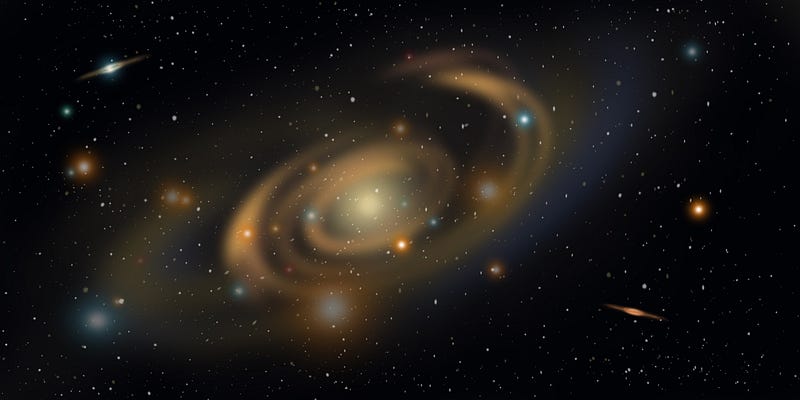
The latest observations by the European Gaia Space Telescope have found that the number of stars in the Milky Way reaches 1.8 billion. This latest star catalog is called the “Ultimate Sky Book”. On December 3, scientists released the latest number of stars currently observed in the Milky Way.
So far, the Gaia Space Telescope has mapped the precise positions of 1.8 billion stars and has grasped the precise distances of most of them from the earth and their movements in the sky.
It is reported that the Gaia Space Telescope was launched in 2013, and it can still serve for 4 years. But now, this “cosmic exploration machine” still brings mankind new insights into the universe at an incredible speed. An average of 3 academic papers is published every day, all based on the observation data of the telescope.
In terms of productivity
No detector can match it, even the powerful Hubble Space Telescope. Martin Barstow of the University of Leicester in the UK said: “Gaia data is like sweeping celestial bodies. A tsunami in the field of physics! The telescope’s observations cover all fields of astrophysics, from stars adjacent to the earth to planets in the solar system, and extending to the edge of the universe.”
The European Space Agency’s Gaia Space Telescope looks like a big spinning hat. It is 1.608 million kilometers away from the Earth. It uses a British-made camera to record all luminous and moving celestial bodies in space with amazing accuracy.
This is particularly important in measuring distances in space. The Gaia Space Telescope measures the distance of a celestial body by tracking how it swings slightly as it rotates around a star.
This is a trigonometric parallax principle
As time goes by, the Gaia Space Telescope will gradually eliminate the uncertainty in the evaluation data. Observing a star of class 15 is blurred far beyond the visible range of the naked eye, but the observation error of the Gaia Space Telescope is 0.027 microarcsec.
Dr. Nicholas Rowell of the University of Edinburgh explained that this is equivalent to staring at a pound coin 200,000 kilometers away.
In 2016, scientists updated the observational data of the Gaia Space Telescope for the first time. At that time, it was observed that the number of stars in the Milky Way was 1.1 billion. But by 2018, the data had risen to 1.6 billion. On December 3, the latest data showed that 1.8 billion stars have been observed in the Milky Way.
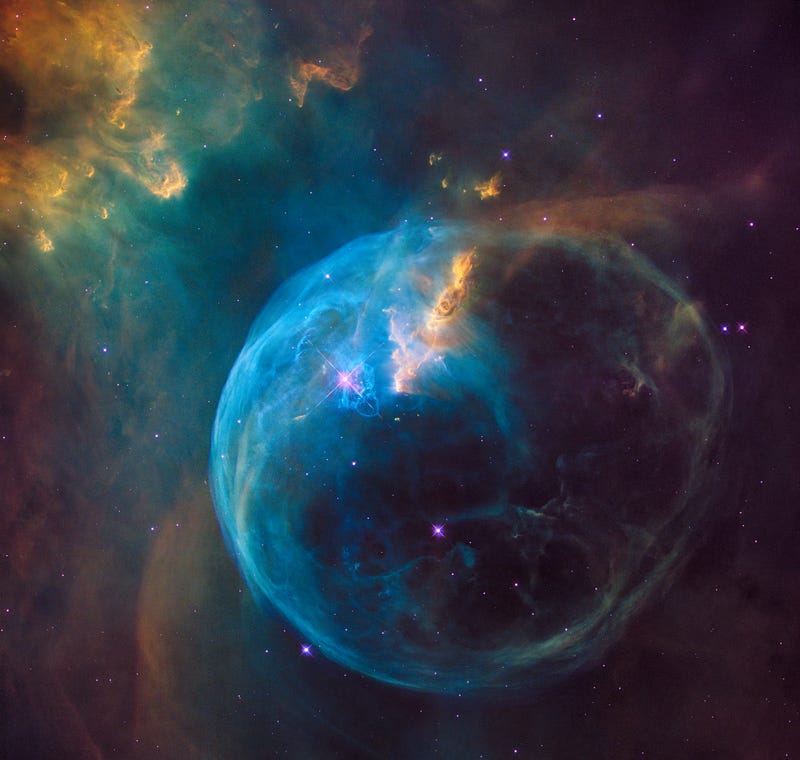
For these 1.8 billion light sources
The Gaia Space Telescope can accurately grasp their position and brightness. Among them, the distance and lateral movement of 1.5 billion stars are recorded. Similar stars are marked with the same color, which is very important for understanding the properties of stars. , Such as temperature, composition, and age of stars.
At present, the Gaia Space Telescope has calculated the radial velocities of 7.2 million stars-their moving speed towards or away from the Earth. Some stars have a very fast radial velocity, reaching more than 500 kilometers per second.
Dr. George Seabroke of the Murad Space Science Laboratory speculates that this speed means that some stars may come from outside the Milky Way. They are usually halo stars. They are far away from the Milky Way disk most of the time, and we may observe it later.
Suddenly passing through the disk of the Milky Way, some of them may be intruders. Through a comprehensive analysis of them, it should be possible to determine their origin.
The focus data published on December 3 is about the gravitational acceleration exerted by the mass of the Milky Way on the sun, which makes the sun and planets of the solar system orbit the center of the Milky Way. The Gaia Space Telescope is based on a “fixed point of light” and uses distant galaxies as a reference coordinate system measuring.
The results show that the sun’s gravitational acceleration is very small, 16 picometers per square second and 1 picometer is one-trillionth of a meter. This will deflect our solar system’s orbit, but will not cause the sun in the universe. “catapult”.

Dr. Floor van Leeuwen from the University of Cambridge in the United Kingdom stated that three years ago
A paper pointed out that the Gaia Space Telescope observation data is of great significance and can observe celestial bodies that are too small to be measured, but in fact, We can measure these distant celestial bodies, and by the end of the Gaia Space Telescope’s service, we should be able to achieve an accuracy of about 1%, which is beyond the imagination of astronomers.
About half of the sun’s gravity comes from the visible matter in the Milky Way, and the other half comes from invisible matter-so-called “dark matter.” Scientists still don’t know what dark matter is, but what is certain is that they have an impact on the normal matter in the universe.
Professor Gerry Gilmore from the University of Cambridge said: “We hope that through follow-up experiments, we can make observational data more accurate and carry out experiments on different scales. Maybe we can observe different types of dark matter. So these pairs of quality The precise measurement of distribution and movement of objects is actually exploring the limits of basic physics.”
The life of the Gaia Space Telescope is affected by the amount of nitrogen stored by the thruster. When the fuel reserve is exhausted, its mission will end. The expected “death time” of the telescope is 2024.