
The Micro-Influencer Revolution: Why Major Brands Prefer Them Over Mega-Followed Influencers
Transforming brand success: Unlocking the power of authenticity and niche connections — a blueprint for every brand, big or small
In the dynamic realm of social media marketing, a remarkable shift has unfolded — the rise of the underdogs, the Micro-Influencers. Trusted by industry giants such as Adidas, Coca-Cola, and Airbnb, these influencers with sub-100k followers are rewriting the rules of brand ambassadorship. The allure of Micro-Influencers lies not in their follower count alone but in the unparalleled authenticity, trust, and niche connection they bring to the table.
Why are these social media underdogs outshining their mega-influencer counterparts with millions of followers?
This trend caught my attention during an international marketing course where I collaborated with 20 seasoned marketers on a research presentation titled ‘The Rise of Micro-Influencers: Niche Marketing in Social Media.’ In the course of our study, we delved into the emergence of this trend, explored its benefits and limitations, and shed light on how brands seek out and collaborate with micro-influencers.
Embark with us on a journey to unveil the intricacies of this marketing phenomenon. Discover why the spotlight is increasingly turning toward Micro-Influencers in today’s ever-evolving social media landscape.
In 2010, Emily Weiss set out to connect with individual makeup consumers while working at Vogue magazine as a stylist. She created a blog reenforcing that everyone is their own beauty expert and four years later created Glossier with her people-powered ecosystem. The brand prides itself on reaching a diverse audience through its micro-influencer social army.
In the landscape of direct-to-consumer (DTC) cosmetics, Glossier has not only carved its path as an industry pioneer but has redefined the paradigm of success. From its inception, Glossier, under the visionary leadership of Emily Weiss, blazed the trail for using micro-influencers as the linchpin in building a thriving cosmetics brand, setting a groundbreaking proof of concept that has since reverberated throughout the industry. Today, Glossier has 2.9 million Instagram followers and works with over 500 brand ambassadors.
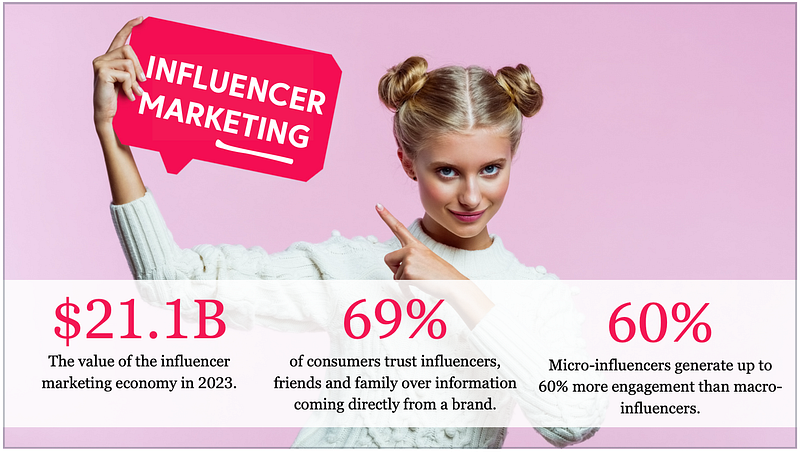
The influencer marketing economy reached $21.1 billion in 2023 and the micro-influencer segment is emerging the fastest.
Why Micro-Influencers?
Brett Owens, Founder and Chief Matchmaker at Afluencer, shares invaluable insights from our recent discussion, emphasizing the significance of micro-influencers in today’s dynamic marketing landscape:
“Why the shift towards micro-influencers? Well, as Brett Owens, aptly puts it, ‘Enter Micros, the ‘Goldilocks’ of the creator economy. They have enough reach to scale a message and potentially achieve the Holy Grail of virality, with follower counts above 10,000 all the way up to 100,000. They are cost-effective, with ‘list prices’ below $500 per post. And in reality, on many platforms, they will ‘Collab’ for $200–300 per post. Which means as marketers, we can build a portfolio of Micro partners with a reasonable up-front investment.’”
‘Enter Micros, the ‘Goldilocks’ of the creator economy. -Brett Owens, Founder of Afluencer
Why are micro-influencers gaining such prominence? Let’s explore the compelling reasons behind their rise:
- Trust Micro-influencers leverage the trust of their audience to execute efficient social advertising campaigns.
- Relevancy 31% of Social Media Users Discover New Products through Influencers. Highly engaged audience through a specific niche.
- Loyalty Since they have a considerably smaller following, their interactions with their audience are often more well-thought-out, personalized, and genuine, building a loyal fan base.
- High in volume On Instagram alone, there are an estimated 500,000 active influencers with micro-influencers making up the largest cohort.
- Credibility An Expercity study showed that 82% of consumers stated that they are likelier to follow a micro-influencer recommendation than more prominent influencers.
Why the Shift from Macro to Micro?
The categories may differ based on the source, but, typically, macro-influencers are characterized by having 100,000 to 1 million followers on a single platform.
- Engagement with platform & content
- In the early days macro influencers helped brands increase visibility and gain followers.
- Macro influencers never ensured engagement, so in response, businesses chose to start scaling with micro-influencers, shifting their strategy from quantity to quality.
- Scaling can be challenging, especially because there’s a need for truly authentic messaging from these micro influencers.
- This lead to businesses working with agencies or establishing in-house teams in order to manage the process. It is still a very manual process in most cases.
Key Benefits of Niche Targeting
Macro-influencers boost brand visibility and follower counts, while micro-influencers offer a targeted and authentic approach.
“Micro-influencers are the ‘sweet spot’ for brands looking for cost-effective social media marketing these days,” says Brett. “Macro-influencers have become quite expensive, charging $1,000 per post. Celebrities can run you $100K+! Very difficult to achieve an acceptable marketing ROI.”
In focusing on niche audiences, micro-influencers bring:
- High Relevance: Messages hold significant relevance for their niche audience.
- Trust & Credibility: Micro-influencers are trusted and carry more credibility than macro or mega (1 million + followers) influencers.
- Cost-effectiveness: Highly cost-effective compared to macro or mega influencers, as previously pointed out by Owens.
- Targeted Marketing: Messaging is precisely tailored to a specific niche.
- Increased Conversion Rates: Demonstrates increased conversion and engagement rates.
- Community Building: Expertise in community building fosters stronger brand loyalty and advocacy.
- Flexibility & Agility: Responsive and agile, adapting to changing trends for brand relevance.
Micro-influencers thrive in niche markets due to their authenticity and deep understanding of their audience.
Its hard to look away from the higher conversion rates. On Instagram alone, the average engagement rate is 3.86% compared to 1.21% for macro-influencers.
Limitations of Working with Micro-Influencers
While micro-influencers offer numerous benefits, like anything valuable, there are limitations. Some caution about potential liability, raising concerns that necessitate the careful management of exposure.
The publication, Insider Intelligence reported, “While the increase has definitely led to more available influencers to work with, brands need to be careful,” said Jessica Dooley, US social practice lead at Mindshare. “The emergence of influencer marketing into a scalable channel has increased a brand’s liability to fraud and potential controversy. Now more than ever, it is paramount that any influencer activation is rooted in a more rigorous evaluation process.”
Limitations to Consider:
- Limited reach, making them less suitable for awareness campaigns.
- Challenges for brands in finding the right fit.
- Potential for decreased content quality.
- Time-consuming processes involved in collaboration.
- Possible conflicts between the brand and the influencer’s content.
- Risk of poor timing in content release by less experienced influencers.
- Complexity in managing campaigns effectively.
Companies Helping Brands
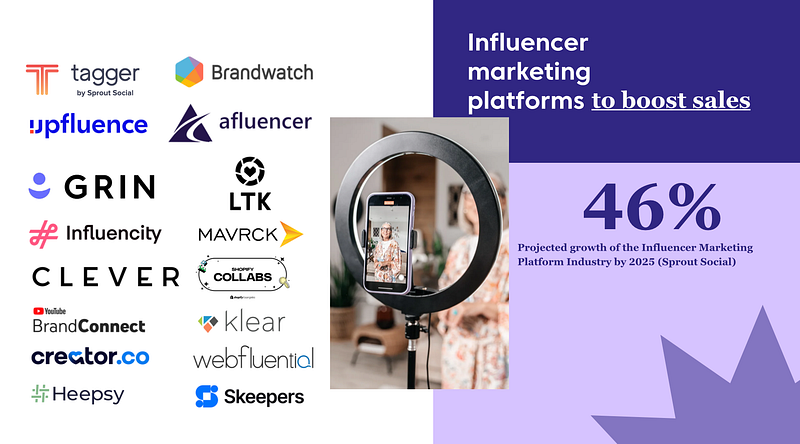
The landscape of companies that help brands connect with influencers is growing day by day. In two years the Influencer Marketing Platforms (which are tools to help brands) are expected to grow by nearly 50%.
In two years the Influencer Marketing Platforms (which are tools to help brands) are expected to grow by nearly 50%
Smaller brands require fewer services, while the needs of larger brands are more complex.
The multifaceted nature of influencer marketing — coupled with its fast growth, has created demands for specialized services which are provided by influencer marketing companies.
How Brands Connect with Micro-Influencers
There are several ways for brands to connect with micro influencers. Looking at it from a high level, we categorized them into 5 groups.
Manual Search- Smaller companies or those with in-house capabilities, may choose to conduct manual searches. The more specialized the industry, the more likely it is that in-house teams can manually identify influencers relevant to their brand.
Database companies- There are database tools that focus on influencer analytics and statistics. Database companies often provide valuable insights into influencers’ performance, audience demographics, and engagement metrics across various social media platforms — but they stop there, and are not involved in matching brands with influencers or managing the influencer collaboration process.
Influencer Marketing Marketplaces- Similar to database companies, marketplaces list stats but maintain a list of brands and influencers who have opted in to collaborating. These platforms focus primarily on connecting brands with influencers, leaving the negotiation, campaign management, and other aspects of collaboration to be handled independently by the involved parties.
Hiring an Influencer Marketing Agency is for those seeking a comprehensive and hands-off approach to influencer marketing. This choice is suitable for businesses that may lack the internal expertise, resources, or time to handle the intricacies of influencer collaborations independently.
Ambassador programs are when a company does it all in-house. These programs aim for long term relationships in hopes to find brand ambassadors. Particularly, micro-influencers with smaller but highly engaged audiences, bring a personal touch and authenticity to ambassador programs and can be very successful.
Micro-Influencer Marketing Trends
In the dynamic landscape of micro-influencer marketing, several notable trends are reshaping the industry.
A fascinating development is the emergence of AI-generated influencers, challenging the traditional role of real influencers in shaping brand narratives.
The rise of Artificial Intelligence (AI) is heralding a new era, influencing how brands engage with influencers.
Simultaneously, regulatory changes are prompting a reevaluation of influencer marketing strategies.
A fascinating development is the emergence of AI-generated influencers, challenging the traditional role of real influencers in shaping brand narratives.
Beyond the influencer realm, micro-influencers are spearheading a paradigm shift in search marketing. Social media platforms are increasingly becoming formidable contenders against search engines, fueled by the growing influence of micro-influencers. This shift is not only altering the dynamics of brand visibility but also signaling a greater budget allocation towards micro-influencer collaborations as brands recognize the profound impact they wield in the evolving marketing landscape.
In Conclusion
The trajectory towards Micro-influencers signifies a departure from traditional models, presenting a dynamic and adaptive avenue for brands to connect meaningfully with their audience. This shift underscores the importance of agility, understanding niche markets, and appreciating the diverse benefits Micro-influencers bring to the forefront of influencer marketing strategies. As brands navigate this evolving landscape, the strategic integration of Micro-influencers is poised to be a key driver of success in the ever-transforming world of digital marketing.
More resources
Want even more guidance on the intricacies of using micro-influencers. Check out Kaleigh Moore’s piece here.