
The Metaverse — A Story of Assumptions
How to Take Humans and Make Them Less

In light of a number of recent events, I’ve had impressed upon me the belief that we really could use a proper philosophy of business, just as we have a philosophy of science, mathematics and medicine. The first item in its canon might be the net benefit schema — the idea of, prior to establishing a company, carefully assessing its likelihood to exert a net positive outcome on society and the individuals who use it. It needn’t be a flippant or rigour-free exercise. Considering the amount of data available to us on the interactions of markets and accompanying social movements (especially monolithic events like elections) following the appearance of market disruptors, and given the increasingly capable beauty of such prediction models as have in recent decades become the preserve of fields like econophysics, making some at least reasonably indicative predictions about a business’ potential social footprint should surely be possible via these means.
Yes, they might be imperfect at first, but they would represent an interesting modelling exercise all the while.
Just imagine:
“What did the big calc predict your personal hurricane app was gonna do, Mustafa?”
“Well, Beth, it told me that my business was likely to topple the British throne, increase the value of synthetic meat companies, and make it 41% more probable that American kids will one day become President of the United States.”
“Wow.”
“And what did it predict your orange-softener business was gonna do, Beth?”
“It told me my business would make teens who favour the colour yellow really happy, make those teens who did not favour the colour yellow really sad, wipe billions off the value of streaming companies, and never be profitable until it was.”
“Fantastic.”
Perhaps this initial version of the model is not quite up to snuff. At any rate, we lack even these rudimental means to take an early stock of the potential footprint a new business idea will leave.
Instead, we must entrust decisions of world-altering importance to the gut feeling of the aspiring entrepreneur and, subsequently, their backers. If it sprung to their minds with sufficient force of inspiration, if it seems to make sense relative to how it disrupts or repairs supply chains or retail conventions, if it’s got a great name, if it just seems cool: all of these things, often alone, are enough to convince us, and them, that this new idea is a good one.
And away they go, and us with them, under the assumptions provided by these intuitions.
The Net Benefit Schema
Subject them to even a basic net benefit schema, one you could pull out around a table in a coffee shop and hash out in an hour, and how many of the companies on which our questionable way of online life relies do you think would survive?
Google? Likely.
Youtube? Probably.
Facebook, Twitter? Definitely not.
Amazon, Robinhood? Questionable.
Coinbase? Roblox? Disney+? It gets more and more difficult to make an appraisal off hand.
Much like actual empires, all of these companies are too big not to have yielded at least incidental benefits, but the arguments that they have satisfied net benefit criteria are, at best, riven with qualifiers. And if you doubt that any of those people responsible for running these companies would agree, study Jack Dorsey’s face in the years since his creation, Twitter, became a dominant social instrument. Observe that look of gaunt, faraway consternation you can see pressed behind those blue eyes in almost every photo in the years leading up to his ouster from Twitter. Note that clearly apparent yearning for a Micronesian retreat. Consider his use of Square as an avoidance mechanism.
You just know he knows it as well as you do, that his creation and legacy has given rise to more harm than good, perhaps not least because when he founded it he lacked the kind of ordering schema that might have allowed him deeper insight into the effect it was likely to have on the collective psychology.
Meta, “Taking Humans and Making Them Less”
You know what other recent development would fail (and spectacularly) a run through the net benefit schema? You guessed it, it’s the flagship innovation of Web 3.0, the metaverse.
People living in digitised societies where visibility is the currency of custom love to get somewhere first, but more important even than that is to be seen getting there first. In the global north in 2022 the performative value of an action has far outstripped the outcome value of that action: this is a statement that should, by now, not be controversial to anyone reading this. It’s why people have begun to presume that abject self-service is the proper corrective to criminal negligence. It’s why consulting has been the fastest growing soft-skill industry in the last ten years. It’s why people give priority to actions that promote visibility over focus on the institutional and bureaucratic issues that prevent us from actually making progress on the manifold challenges we face as a society. It’s why governments think that Twitter game is more important than civil service reform and that the twee deedlings of Lin-Manuel Miranda are an appropriate response to the need to commemorate the first anniversary of an insurrection.
Rarely do I believe that it’s proper journalistic practice to resort to tweets to support a point, but the one below does capture the essence of this new creed of performative narcissism perfectly; and make no mistake, it can and does apply to governments of multiple persuasions and dispositions around the world, so long as those governments are united in this preposterous perceived need to prioritise performativity over effectiveness. In this, these governments mirror an unfortunately large swathe of their electorates.
And it’s because people like to be seen to be trailblazers and explorers that we have the near-at-hand rumblings of Web 3.0. 3.0 is, fundamentally, a reaction against the Second Gilded Age produced by Web 2.0, in which an outsized degree of influence over web economics and user choice is dictated by a relatively small number of companies who, even where they do not fit the typical definition of monopoly, command market power to a degree comparable with an old-fashioned monopoly. As a result, the aim of Web 3.0 is to decentralise the web, a task for which the champions of the movement believe that blockchain technologies are ideally suited. Where many people have awoken in the 20s to the understanding that civil interests on the internet would be best served by more effective regulation, Web 3.0 is a pre-emptive counter-movement. It wants less regulation, decentralised autonomous organisations (DAOs) and decentralised finance (defi), otherwise understood as finance systems that do not rely on a government or bank for oversight, of which cryptocurrency is almost certainly the manifestation you’re most familiar with.
However, what a development fundamentally aims to be will not necessarily bear any intrinsic relation to what that development actually becomes. Remember, if you will, that the fundamental aim of Facebook and Twitter was to connect people and create a deeper ease of communication among the brotherhood of humankind, and we can all recall what soiled fruits those trees bore as though we had only but tasted of them four minutes before finding our way to this article.
Because, even set against Web 2.0, which brought us the birth and rise of social media, Web 3.0 is breathtakingly fixated on ephemera. Many of the movement’s constituent technologies do hold out considerable promise once they can be adequately harnessed for broader societal gain, particularly defi. But considering Web 3.0 as a whole, the main purpose of the enterprise itself is, it seems, to generate attention and interest in the enterprise. When even such pathological narcissists as Elon Musk are suggesting your movement is more buzzword than honey-pit, we are all apt to mark the date and declare it a through-the-looking-glass moment. The thing that seems to be missing from most considerations of Web 3.0 as the next evolution of the internet, whereby the technologies mentioned will be presumably be more embedded into our lives, is something that was in itself in short supply in the manifestos of its predecessor. That something is ‘value’.
Many apostles of decentralised philosophies of the internet — and, as we’ll soon see, particularly the metaverse — are enormously excitable about them, and productively so, as well, soliciting vast amounts of venture capital for new companies and getting it. What none of them seem to be able to articulate is why these new ‘advances’ are necessary, what pressing need of civilisation they address, or how they’ll offer tangible improvement to the material and intellectual circumstances of the wider majority of people.
When large organisations or institutions attempt to grasp and delineate the bounds and nature of a problem at hand, all common schemas for problem-solving among associates call for Class-2 discussions, whereby both sides in a discussion are expected to be able not only to articulate their own argument but their opponent’s argument, to said opponent’s satisfaction. This helps such conversations escape the trap which Class-1 discussions habitually fall into — where people talk past one another, and crucially do not take stock of or analyse the assumptions that underly their own positions or beliefs. It is these assumptions that, left unquestioned, frequently produce, if not waste and confusion throughout execution, then outright disaster.
It is unfortunate, particularly with respect to the metaverse, that many of the acolytes of Web 3.0 are so evangelical on behalf of their assumptions that these are the technologies bounding us for a better future, and may yet not be convinced to question them. Why? Because of the thing that makes the metaverse oddly unique in the annals of technological invention since the beginning of the first industrial revolution.
It, almost alone among innovations, has the dehumanisation of its users as an all-but stated aim.
Non-Value Technology
The metaverse is a non-value technology — that’s what we call one of the companies that moves through our so-far improvisatory net benefit schema and comes out with a benefit curve that skews violently towards the negative. We’ll show our working relative to that judgement shortly. Before we do, consider this:

And then this:

And, of course, this:

Yes, our assessment of the metaverse will take itself down a rigorous path, but this is a technology whose primary use is the vindication of common sense and the imparting upon the public at large with a moment of shared coup d’œil (understanding at a glance). Because a good deal of what is wrong with this idea is evident before any analytic efforts have even begun. Its aim is to take humans and make them less, with progress the avowed aim.
That there is any receipt of the idea of the metaverse that involves anything other than an appalled disgust at the fact that here is a technology that swears unto dehumanisation as a business good[1] shows you how much standardised insanity reigns among many persons speculating on the development of technology.
It’s not just an idle happening; it comes from the fact that the last three decades in the development of consumer technology has studiously excluded information that might suggest the existence of an imperative beyond profitability with respect to a specific product and its impact. For instance, information about the deleterious desensitising effects of internet porn use is now widespread, with datasets and testimony from ten to fifteen years’ worth of addicts ready to collate. The internet porn addiction phenomenon is one of the relatively few means we have to hard-and-fast scale empirical data about the interaction of the human brain with technology aimed at optimising reward response, particularly (but not exclusively) where that human brain matter is the considerably more elastic stuff we find in the minds of teenagers.
If we paid any mind to the porn addiction data (which, even were it not already being collected by more structured means, is thrown up in vast quantities every day on issue-related support groups, demonstrating remarkable homogeneity) and what it told us about the interactions of real people with real impulses in synthesised, highly stimulating surrounds, about what those synthesised interactions do to the brain, and took those conclusions seriously, it would sound an instantaneous death knell for the entire metaverse project.
There is no conception of the metaverse as could be profitable that would not revolve, like internet porn does, around distorting the user’s pleasure response with barrages of high-intensity stimuli. Facebook grew fat off this same imperative and it is not anywhere close to being as engulfing a sensory experience as internet porn use, let alone as all-consuming as an immersive virtual reality environment with novelty experiences tailored to a given user’s every whim. It is only because, in the context of the internet economy’s mania for novelty and inane distraction, the depression of the internet-using world is relativised so neatly against itself — i.e. there are few authoritative voices far away enough from an internet-ised norm to be able to notice, measure and express the decline in critical and creative faculties in the aftermath of widespread internet adoption — that we cannot see how pursuit of stimulation through the internet leads to moribund life outcomes, and that moribund life outcomes are not worth even the most astonishing financial gains, even if those gains are relatively well distributed, which, at any rate, they aren’t. And it would take a spirit of optimism of (or on) strong stuff to believe that the metaversification of the internet aims to change that.
Why the Metaverse is Bad Business

There is no such thing as a mountain that is not cynical — for proof, consider the story of the death of Ali Sadpara. Mountains are constantly in the business of killing those humans brave or foolhardy enough to try and climb them, and K2 has taken more than its fair share of bodies for its baubles. But not all mountains are so classless to do as K2 did and kill a man when he’s on a climb with his son.
Markets, being made of human actors, sometimes like to emulate the cynicism of the mountain, marginalising petty human concerns to the greatest possible degree. For them, perhaps the precedent of shattered life outcomes, depression, physiological dysfunction and the rest provided by social media and porn addiction relative to the metaverse won’t be sufficient to dissuade them from their investments. But perhaps the suggestion that the metaverse is bad business might.
Consider, if you will, the screencap some way above: a metaverse company that specialises in virtual real estate. We live in an economy that’s driven by speculation; and in fact we can cut the crap and take a moment to remind ourselves that this means that we’re living in an economy whose architects are Ponzi artists. Investments are governed more than ever by the presumption of speculated value — leading to meme stocks, the radical over-inflation of Tesla shares etc; yeah, gambling is one of the fastest growing industries in the world but I bet Robinhood is not registered as a contributor to that figure — as opposed to conventional means of assessing the performance of the companies invested in, like recurring revenues or a healthy P/E ratio.
Unlike a sturdy company that pays regular dividends and is valued roughly commensurate with the value it produces, virtual real estate is by nature incapable of producing value. You can’t grow anything on it. It is not scarce. You cannot build anything on it that would in and of itself impart value on the virtual land used. In no state but our state of insanity would any responsible investor put money into virtual real estate.
But, of course, investors are doing just that. And in huge quantities.
The logic behind this is presumably that footfall through the metaverse, once it reaches huge volumes, will result in the limitation of metaverse real estate by environment owners so that, unlike now, it has an artificial scarcity, a little bit like Bitcoin and its limited units. This real estate will subsequently be either traded under speculative auspices (i.e. traded to be traded again), or will be converted into advertising space. If it is advertising space, it will probably be used to hawk wares that have a metaverse-only value (anything else will disincentivise metaverse use). Because you don’t need any human amenities in-verse, that basically limits you to items in a lootbox economy, like new costumes/‘skins’ or in-verse weapons if you’re on a gaming server.
Only problem is that a lootbox economy is infinitely less extensible than an economy that works on real world imperatives — where we actually need things like shelter, clothing, food, shampoo, devices, vehicles, or novelty fake dog crap— drastically reducing the scope advertisers have to make offerings relative to, say, Facebook, which advertises products compatible with real-world needs and which is therefore basically unlimited in its ability to realise transaction fulfilment. So these investors, having paid for this putative advertising space in the metaverse, have done so for the sake of being able to advertise a tiny array of items, with very limited (and entirely value-free) usage, pitched to an audience they don’t know exists yet and may for that matter not ever exist.
And they’ve paid an ungodly premium for it. It costs about $10,000 dollars to get 1,000,000 people (an unspecified percentage of whom will be bots) to see an ad you’ve placed on Facebook. In a metaverse environment that as yet is relatively unpeopled, and may need to be size- and user-volume-limited for reasons of performance, crowd-control, and creating the enforced scarcity we mentioned earlier, these idiots have just dropped millions for a spot that may yet guarantee them not a tenth of the impression potential a simple Facebook ad would.
In other words, think according to the insane man’s reasoning, and the level of investment is still insane. Moreover, however the metaverse project works out relative to levels of adoption by a critical mass of users if/when it gains that mass, the issues of a lootbox economy are more-or-less baked into the model. You will never have as much to sell to an in-verse avatar who has relatively few needs in your environment as you will a human being in the realm of the living. You may well get transaction value volumes on trivial in-verse items that are, in absolute terms, pretty large, but they will never be enough to substantiate scale transitions of capital and ad interest into the metaverse.
Why? Because the value is just not there. Value comes from the satisfaction of need (including needs that the entity satisfying them is responsible for creating). In the metaverse, need is limited. That is the ‘point’ of it, so far it has one. Create need in the metaverse and you disincentivise usage.
So what are the assumptions underpinning the investment of all this money into a metaverse concept that is at such an early stage of development, with so little work having been done to determine how an in-verse economy is going to produce value? The assumptions are that some bright sparks down the line will figure it all out and that an appreciably exploitable in-verse economy capable of incentivising scale advertising interest will emerge, justifying all the early moving.
And the key assumption to it all is that, until the above happens, the cheap capital will never run out, and we can speculate Mansa Musa right into our pockets without fear and, especially, without troubling ourselves to produce value via our investments in the metaverse, or even tie our assets to things that actually do produce value.
Only problem is that, eventually, the cheap capital will run out. When it does, the bubble generated by these metaverse investments — like the bubbles being inflated simultaneously around the world by the Chinese real estate debt crisis, the aforementioned Tesla inflation, and indeed by crypto itself if it doesn’t quit fucking around and tie itself to a reliable value-creation source — will pop. And if they pop in sequence, it will be murder.
Matthew Ball’s Metaverse
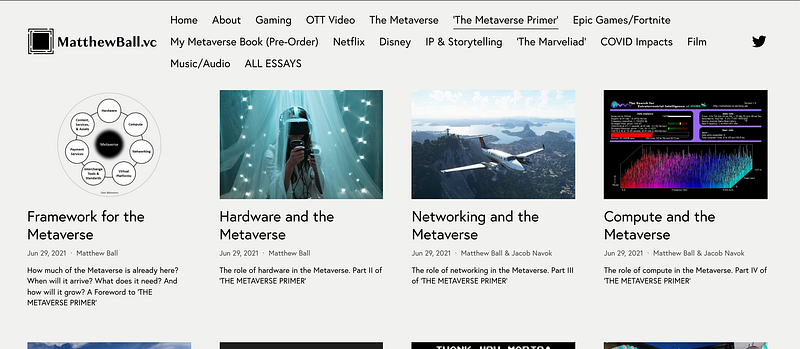
One of the most complete theses on the metaverse to come from a proponent of the technology is the one written by venture capitalist Matthew Ball. ‘The Metaverse Primer’ is segmented into twelve chapters that deal with frameworks, network models, hardware considerations, platforming, tools, financial models, content and more relative to the metaverse. You can find the full thing here. It is, in short, a catalogue of assumptions — no treatise on an untried and untested technology with life-engulfing aims could ever be so feverishly optimistic unless it was high as a kite on the poppy fumes of unexamined belief.
In the first chapter of his analysis, Matthew Ball attempts a sort of framing narrative situating the metaverse alongside revolutionary achievements in technology. It amounts to a potted primer history of what he calls ‘the Electricity Revolution’ (generally referred to as the Second Industrial Revolution). It shares a weakness with most potted histories of anything by being immensely chauvinistic; that is, it operates on the assumption that all of the progress discussed was inevitable, with the implicit value judgement that any historical development that feels inevitable must therefore be ‘good’[2]. Ball then segues into a discussion of the Early Digital era, in which we have been living for twenty-some years, and its advances in mobile technology. By falling into the same pattern of chauvinism along the way, he leaves all the important questions completely untouched, questions like:
- “What have we learned from the past epoch of high-speed technological development?”
- “Why should the metaverse be built? Relative to urbanisation and the invention of the electrical grid, in whose lineage Ball situates metaversification, does it promise to have an equivalently beneficent net-positive effect in creating conditions of life measurably preferable to those that went before?”
- “Is it likely to have a net positive effect on its users individually?”
- “What are the potential risks of creating and operating a metaverse, and what size and of what nature are those risks?”
As he subsequently goes into detail about various components of a metaverse ecosystem, Ball does so with the same sense of Calvinist predestination — not that these things of which he speaks must happen to satisfy a particular need, or that there is a reason for them to happen, but that because they presumably will happen therefore they must happen — that is endemic of almost all thought about technological gains in the Early Digital era. His analysis of metaverse-driven changes to consumer behaviour, to the extent that it is analytical at all, is so limited as to be desultory and is at any rate shunted off at the end of the nine-part series, as though an understanding of the human dimension of this concept really were nowhere near as interesting as pondering hardware and network effects. As though an understanding of what human value this thing will create is, or could be, anything other than the only worthwhile fulcrum from which to discuss it[3].
The actual commercial potential of the metaverse identified by Ball’s analysis is, in a word, embarrassing, completely limited to what we’ve already considered: Fortnite loot-boxes, new outfits and crypto prizes, absolutely none of which are parsed in terms of the value they create or the necessity of such commodities to achieving an improved condition of life to justify all the money being spent to create a system around them. And for the matter of how human behaviour might be warped by metaversification, Ball reserves perhaps the limpest, least convincing and most menacing assumption of them all — that the orientation of childhood in the 10s and 20s, around tablet use and sequestration in virtual worlds, has been a good thing, and furthermore a good thing that the metaverse can, should and will retrench and deepen.
Not only is the jury entirely out on the matter of whether it’s healthy to let an iPad raise your kid, owing to the fact that the generation in question has not yet reached maturity; but from all the projections we can build from the knowledge we have elsewhere, it is highly likely that a more mediated childhood will have negative, perhaps even overbearingly negative effects on life outcomes. There is no sociological consensus anywhere that convincingly argues that the aggressively increased mediation of our lives has made us happier, that it has taught us to develop and use our intellects with more fine precision or that it is has sharpened our instincts towards ethical discernment, and a huge volume of suggestion to the contrary.
Understanding Those Who Prey On Us

One of the things that needs to become an as-expressed article of common understanding in the minds of us all — much like such concepts as “2+2=4”, “Democracy is a political system in which all people are given the vote”, and “Don’t eat the yellow snow”, all expressed and understood in roughly the same way — is that companies like Facebook make their money by making your world worse. The worse your conditions of social life, the more alienated and socially malnourished you feel, the more likely you are to use it, and the more likely Facebook’s advertising partners (perhaps more maligned by their association with the big F than even consumers themselves) are to end up with some of your money in their pocket as a result. After all, sad spends.
And so it will be with metaverse, only on a scale that makes Facebook look as small and seemingly benign as the daddy long legs lurking in the corner of your room. The metaverse creates an enormous rack of incentives to make your real world as bad as possible, so that you’ll spend more of your time and money buying into its promised escapism. The more you use these platforms, the more license (and, crucially, funds) you’re giving them to shape your world in such a way as makes their flat escapism even more appealing.
We have an elemental understanding that tobacco or alcohol abuse are harmful in this way — understanding that was by no means innate, but was rather tailored by careful communication aimed at delivering accurate information regarding the risks of usage to the public.
So remember this: the metaverse can’t make itself profitable by contriving in-verse needs that you have to spend money on, nor can it make itself profitable by incentivising you to spend money on things only useful outside the metaverse. But it can do everything possible to condition you to believe that your need is, in fact, to escape the real world itself, which thanks to Meta’s standard subscription package you can do for as little as $10 per month. It will do that by trying to make your real world worse.
Celebrating the Idea of Value
Our determination relative to the metaverse is that it is a non-value technology, because it shows no sign of the ability to create improved life-outcomes for users — and these are the basics; what about the human development outcomes of these technologies, like the ability to memorise stretches of poetry or exercise metacognition or convincingly plan a strategy to accomplish something you’ve never accomplished before? Who champions these things? — while giving considerable suggestion, relative to other well-established and well-understood technologies, that it will in fact reduce the quality of life-outcomes for said users.
But what of value?
Some people are apt to say of value that, well, “It’s a sticky concept. It’s ambiguous and it’s even a little non-descriptive and we prefer to trade in more concrete terms,” often immediately before sermonising about such concepts as GDP or consumer confidence, what with their texture and consistency and nutritional value so similar to dessert jelly. It’s true that the idea of value thrust at in this essay is not entirely concrete, but concepts like ‘value’, which by nature are abstracted enough to focus our attention on common needs while excluding matters brokering petty difference, are what great undertakings are founded upon. No less an individual than George Mueller, a managerial personality so titanic that he was able to foist on a reeling, inept and politically charged NASA the kinds of relentless systems intelligence that brought the Apollo project to fruition, claimed that the successful mission to the moon was founded, above all else, on ‘faith’.
‘…on the faith that there is a future for mankind and on the belief that the future is one that will be good for all the people of the world both as individuals and as nations. On the faith that elsewhere in the universe life and intelligence exists and on the belief that finding and sharing knowledge and experience will be good for each race. On the faith that learning more about the stars and about the solar system will improve life here on Earth and on the belief that as man learns the secrets of space travel he will use these ships to explore and eventually inhabit other planets [and] tour the stars.’
Of course, it’s not just ‘faith’ that led NASA to the heights and beyond — this is where imprecise language can get us, because metaverse proponents could also allege that their fervour is based on faith, and that it is the animus and aims of individual 3.0 entrepreneurs that will determine whether the outcome of metaversification is positive, not any qualities inherent in the technology itself (and an unhardy interlocutor might subsequently forget to remind them that shifting responsibility to effectors instead of the platform solves precisely none of the problems about which we’ve been speaking).
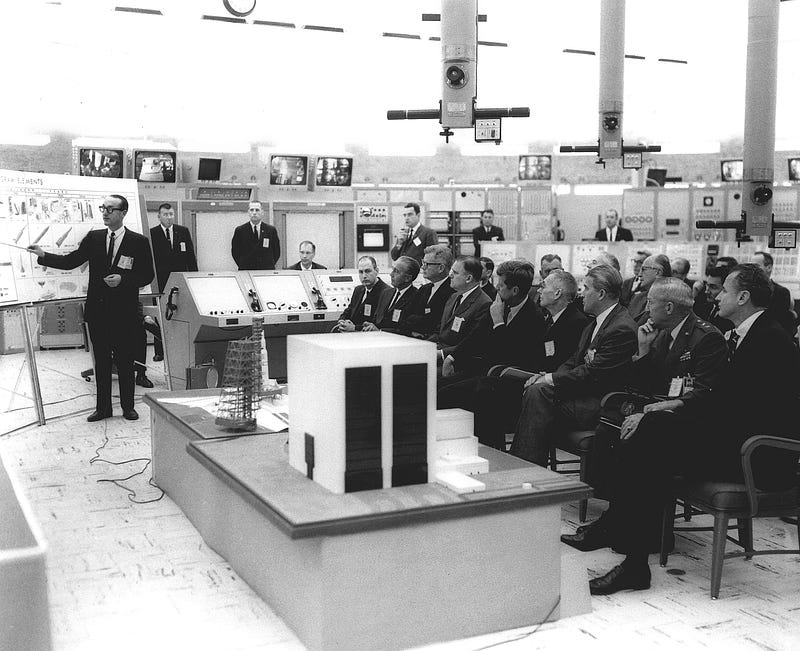
Rather, what led NASA was what we’ll call ‘qualified faith’. The aim of NASA, to venture beyond the Earth, is self-evidently worthwhile: space exploration has scope to pressurise the development of other value-creating technologies, provides a means to unite any number of diverse nations under a common goal, and acts as a safety bulwark against potentially catastrophic, species-threatening events here on Earth. And Mueller’s faith was not merely qualified by the examination and blessing of the aim, but by the construction of a series of systems designed deliberately to maximise the likelihood of its success. Here was a faith qualified by the nobility of its mission, and by the construction of processes and strategies aimed very deliberately and very carefully at achieving it.
And this is where qualified faith gets us — to and beyond the point of first setting foot on a world other than our own. Purposed by the right individuals and entities, qualified faith is the kind of petrol that brings great systems of construction and management alive. If the q-faith is there, an institution or business can attain extraordinary feats well beyond the order of expectation in time-scales as trivial as a decade, spawning entirely new philosophies in how to build and fulfil the objectives of truly momentous undertakings, and yielding enormous incidental follow-on value through means of novel technology, in the process. Take the q-faith away, and you end up with vision that can see no further than the end of a yearly budget, huge unnecessary waste incurred in the explicit mission of trying to minimise waste, and vastly reduced vistas of achievement.
You don’t need to take it as hypothetical; these are all the things that happened to NASA when the powers responsible for it optimised the organisation for yearly budgetary savings and turned away from the scope for continued progression. Boldly imaginative, confluentially experimental, competent, and well-funded, as it was until 1969? NASA makes it to the moon in time to keep Jack’s promise. Non-systematic, parsimonious and under-funded, as it was after? We get the Challenger disaster, decades of diminishing returns on the space frontier[4], and such classics of high-level management as the moment when a $125 million Mars probe crashed because two engineering teams weren’t aware that one of them had been working using imperial units and the other in metric.
There is no qualified faith to be sampled about the metaverse — the fervour surrounding its pursuit is so cynical and thoughtless that it can hardly even be called faith, that much-maligned concept which when it isn’t propelling us to the moon is busy founding the Trinitarians or the Hospitallers or writing the Tao of Pooh (and looking sadly upon its warmongering cousin, dogma, seething in rags in the throne room next door). There is no purpose for the metaverse collectively in mind. There is no great aim for humanity propelling it. There is no plan. There is no heed for the damage that it may wreak. It is about as robust an idea, as understood and pursued, as a cannon which individual people can clamber into, dressed up in their £10 shoes and their Balenciaga sweatshirt (no helmet), and be shot into the sky.
We are jumping into the cannon, or at least hitching a ride on a mismanaged Mars probe, if we charge ahead with projects like the metaverse without a conception of value centring our thinking about why such a thing is necessary, what such an invention should do, and what it could do if left to a whim (including consumer whim). For too long have value and purpose been excluded as orienting principles guiding the decision making of governments and investment institutions.
The second the easy money runs out, we’ll rue the day we allowed this state of affairs to come to pass.
[1] I personally think the metaverse may be the most dehumanising invention (or posited invention) since organised religion, without any of the customary benefits that came with the collective binding and pruning of the human character by religion, which however bleak in their run-on consequences were required at the point in history when they began to develop.
[2] This is why the historian’s skill of being able to place themselves at a disinterested angle from the march of time is so vital: older inventions only feel like inevitabilities because they have already happened, and knowledge of the other branching histories not taken have been subsequently obscured; ascertaining the shape of those unchosen branches is one of the historian’s supreme callings. When dealing with present or near-future developments, we must realise that there are multiple branching histories jostling for prominence on our timeline, and that in most cases there is no candidate whose victory over the other possibilities is inevitable. Belief in branching histories is perhaps the only way to free ourselves from the assumption, which we can take on by accident, that time has only one path, and we are ‘progressing’ along it. As a civilisation sometimes, and then in some ways, we are going ‘forward’ in a worthwhile direction; and sometimes we aren’t.
[3] And in fact the assessment of the ‘human dimension’ is not an assessment of the human dimension but of the ‘user dimension’, which provides valuable short-hand for a key detail in this kind of philosophy: there are no humans, merely users.
[4] These diminishing returns have of course been mixed in with the occasional triumph because, y’know…space. Nevertheless, the actual record of achievement by the global spacefaring community in more than fifty years since Apollo has not seen anything comparable to the execution schedule drawn up by George Mueller for NASA in the aftermath of the successes of 1969, which projected manned lunar bases in the 1970s, a manned Mars mission in the 1980s, and the construction of ‘space railroads’ in the time between. It is impossible to imagine how much these achievements would have vitalised and enlarged humanity’s conception of itself, nor much easier to imagine how much such mission-critical imperatives would have accelerated the evolution of software and computation, with all presumable knock-on effects. Now that’s value.